


Synonym name: Aureine
Catalogue No.: BP1283
Cas No.: 130-01-8
Formula: C18H25NO5
Mol Weight: 335.4
Botanical Source: Alkaloid from many Senecio spp., Brachyglottis repanda, Emilia sonchifolia, Erechtites hieracifolia, Petasites hybridus and other Compositae. Large amts. obtainable from Senecio triangularis; also obt. from Castilleja rhexifolia (Scrophulariaceae)
Purity: 95%~99%
Analysis Method: HPLC-DAD or/and HPLC-ELSD
Identification Method: Mass, NMR
Packing: Brown vial or HDPE plastic bottle
Can be supplied from milligrams to grams.
For Reference Standard and R&D, Not for Human Use Directly.
Inquire for bulk scale.
HPLC of Senecionine
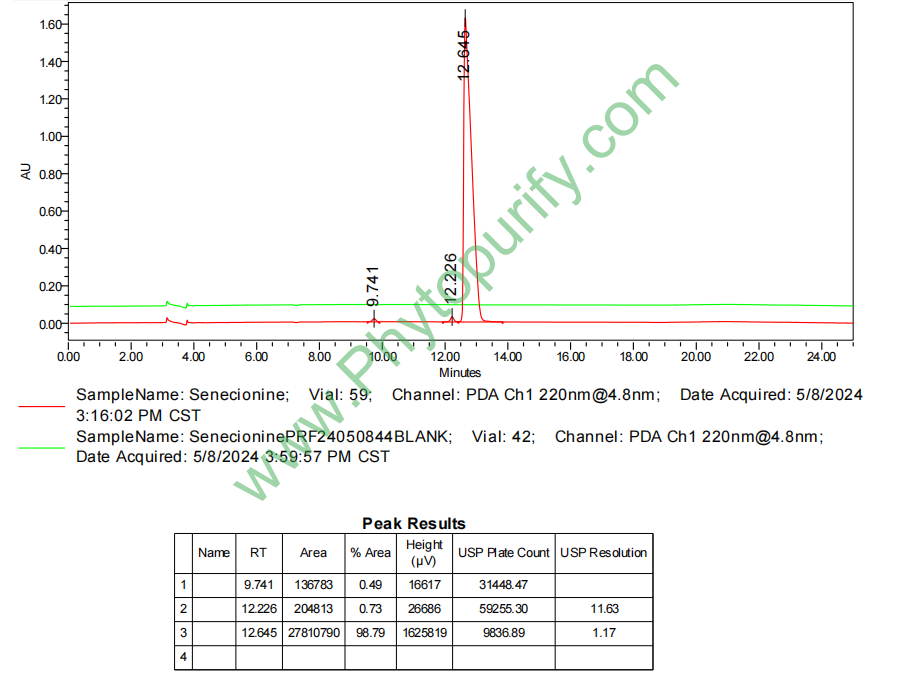
Storage conditions:Short-term storage at 2~8℃, long-term storage at -20 ~ -80℃
76.0700
.7699
.6900
3.3233
2.5934
9.2290
High
29.5651
5.0435
No
No
No
No
Yes
No
0.6
Yes
Yes
Yes
Yes
Pyrrolidine alkaloids are a class of secondary metabolites widely distributed in the plant kingdom, mainly found in plants such as the Asteraceae family, the Fabaceae family, and the Verbenaceae family. These compounds have long been of great interest to researchers in natural product chemistry and pharmacology due to their unique chemical structure and significant biological activity. However, its "double-edged sword" characteristics are also prominent: on the one hand, some PAs exhibit potential medicinal values such as anti-tumor and anti-inflammatory effects; On the other hand, the toxic side effects represented by hepatotoxicity severely limit its clinical application. Senecamine, as a typical 1,2-unsaturated pyrrolizidine alkaloid, is an important model compound for studying the toxicity mechanism and potential activity of PA. Its CAS number is 130-01-8, and its chemical name is Senecionan-11,16-dione, 12 hydroxyl -. This article aims to provide a systematic review of the chemical properties, plant sources, pharmacological and toxicological activities, molecular mechanisms of action, and medicinal properties of camptothecin, in order to provide a comprehensive scientific perspective for a deeper understanding of the biological effects of this type of compound and its possible rational development and utilization in the future.
The molecular formula of camptothecin is C18H25NO5, with a molecular weight of 335.40 g/mol. Its core structure is a kilolane skeleton with a double ring, containing a 5-membered pyrrole ring fused with a nitrogen atom and an 8-membered nitrogen heterocycle, and forming an unsaturated double bond (1,2-unsaturated) between the C1 and C2 positions, which is the key structural feature for its toxicity. Its specific structure consists of a hydroxyl group attached at the C12 position and two ketone carbonyl groups formed at the C11 and C16 positions.
In terms of physical and chemical properties, the calculated value of the lipid water partition coefficient (LogP) of camptothecin is about 0.77, indicating that it has a certain lipophilicity, but not highly hydrophobic. Its topological polar surface area (TPSA) is 76.07 Å ², reflecting the presence of polar groups (hydroxyl, ketone) in the molecule. The predicted value of water solubility is about 3.32 mg/mL, which belongs to the range of slightly soluble to soluble. These properties collectively affect its absorption, distribution, and metabolic behavior within living organisms. It is worth noting that its predicted blood-brain barrier permeability is high, suggesting that it may enter the central nervous system, which is consistent with its potential neurotoxicity reports.
Seneca alkaloids mainly come from plants in the Asteraceae family, including common Seneca(Senecio vulgaris)It is one of its classic sources. In addition, this alkaloid is also widely present in various other plants of the same genus, such as the European Senecio(S. jacobaea)Wait. These plants are distributed in many regions around the world and are often considered weeds. However, due to their presence of PAs, they often lead to poisoning incidents when ingested by livestock, making them of great significance in animal husbandry.
The extraction of matrine from plant materials usually follows the conventional process of natural product separation. Firstly, the dried and crushed plant materials are extracted or refluxed using polar organic solvents such as methanol, ethanol, or chloroform methanol mixtures. Subsequently, crude extract was obtained by vacuum concentration. The crude extract is dissolved in acidic water (such as dilute hydrochloric acid or dilute sulfuric acid), alkalized (such as ammonia water), and then extracted with organic solvents (such as chloroform or dichloromethane) to enrich the alkaloid fraction. Further purification often uses column chromatography technology, with silica gel or alumina as the stationary phase, and gradient elution with different ratios of organic solvents (such as chloroform methanol). By combining thin-layer chromatography monitoring and collecting fractions containing camptothecin, high-purity compounds can be obtained through methods such as recrystallization or preparative high-performance liquid chromatography. Modern analysis and identification mainly rely on nuclear magnetic resonance, mass spectrometry, and comparison with standard samples.
The pharmacological activity research of scopolamine mainly focuses on its toxic effects, especially liver toxicity, and also involves its impact on certain enzyme activities.
1. Hepatotoxicity: This is the most significant and extensively studied pharmacological (toxicological) activity of scopolamine. Acute and chronic exposure to camptothecin can lead to liver damage, characterized by hepatocyte necrosis, bleeding, sinusoidal obstruction syndrome, and even the development of liver fibrosis, cirrhosis, and liver cancer. Its toxicity varies among species and is dose-dependent.
2. Enzyme activity regulation: As shown in the compound description, scopolamine can significantly reduce the activity of various liver metabolic enzymes and detoxifying enzymes. This includes:
* Glutathione-S-transferase: This enzyme is a key enzyme in the II phase binding reaction, responsible for catalyzing the binding of glutathione with electrophilic substances (such as metabolic activation products of camptothecin) and promoting their excretion. Reduced GST activity can weaken the body's detoxification ability and exacerbate toxicity.
* Cytochrome P450 enzyme system: Choline can inhibit the activity of aminopyrine-N-demethylase (mainly catalyzed by CYP2C and CYP3A) and aromatic hydroxylase. It is worth noting that CYP3A4 and CYP2E1 are key enzymes that activate the production of toxic pyrrole metabolites from scopolamine, and this inhibition may be a complex feedback regulation or competitive inhibition.
* Other oxidative stress-related enzymes: Research has shown that exposure to scopolamine can affect the activity and expression of antioxidant enzymes such as superoxide dismutase, catalase, and glutathione peroxidase, which are closely related to their mechanism of inducing oxidative stress.
3. Other potential activities: There are sporadic studies reporting that certain PAs have anti-tumor or anti-inflammatory activity, but there is relatively little research on scopolamine in this area, and its strong hepatotoxicity masks any potential benefits, making it difficult to use as a direct therapeutic agent.
The toxic effects of scopolamine, especially liver toxicity, are a multi-step and multi-target process, with the core mechanism being metabolic activation induced cell stress and death.
1. Metabolic activation and direct damage: Choline itself is a prodrug. In the liver, it is mainly oxidized and dehydrogenated by cytochrome P450 enzymes (especially CYP3A4 and CYP2E1), producing highly active dehydropyrrolizidine alkaloids. These electrophilic pyrrole metabolites can form covalent adducts with intracellular nucleophilic substances such as proteins, DNA, and glutathione, leading to the loss of macromolecular function. The addition of DNA may cause genetic mutations, with potential genotoxicity and carcinogenicity (Ames test result is 0.6, indicating potential mutagenicity, but needs to be interpreted in conjunction with specific experimental systems). The addition of key proteins directly disrupts the normal physiological functions of cells.
2. Oxidative stress: The generation and metabolism of DHPAs are accompanied by a large amount of reactive oxygen species. Meanwhile, matrine and its metabolites can interfere with the antioxidant defense system of cells. Its targets include:
* Antioxidant enzymes: Downregulate or inhibit the activity or expression of SOD1 (superoxide dismutase 1), CAT (catalase), and GPX1 (glutathione peroxidase 1), leading to a decrease in the cell's ability to clear ROS.
* Transcription factor NFE2L2 (Nrf2): Nrf2 is a key factor regulating gene expression driven by antioxidant response elements. The toxicity of scopolamine may interfere with the Nrf2 signaling pathway by consuming its key cofactors or directly damaging them, thereby inhibiting the transcription of various phase II detoxifying enzymes and antioxidant enzymes, including GST, GPX, quinone oxidoreductase, etc., forming a vicious cycle.
* Mitochondrial targets: Oxidative stress and toxic metabolites attack mitochondria, leading to a decrease in membrane potential, opening of permeability transition pores, release of cytochrome c, and activation of the apoptotic pathway. The anti apoptotic protein BCL2 is a key protein that maintains mitochondrial outer membrane integrity. The toxicity induced by scopolamine may promote apoptosis by affecting the expression or function of BCL2.
* Microsomal glutathione transferase (MGST1): MGST1 is a membrane-bound GST located on the endoplasmic reticulum, which plays an important role in detoxification of hydrophobic electrophilic substances. Choline may reduce the activity of MGST1 and weaken the ability to resist endoplasmic reticulum stress by consuming glutathione or directly inhibiting it.
3. Secondary inflammation and fibrosis: Liver cell injury releases damage related molecular patterns, activates immune cells such as Kupffer cells, releases a large amount of inflammatory factors, and triggers an inflammatory cascade reaction. Continuous inflammation and damage activate hepatic stellate cells, leading to excessive deposition of extracellular matrix and ultimately developing into liver fibrosis.
Based on its clear toxicity characteristics, the prospects of using scopolamine as a potential drug candidate are extremely bleak. The evaluation of its pharmacological parameters clearly reflects this point.
Absorption, distribution, metabolism, excretion: After oral administration, scopolamine can be absorbed through the gastrointestinal tract. Its moderate LogP value and certain water solubility are beneficial for absorption. In terms of distribution, its predicted high blood-brain barrier permeability implies that it may be distributed to the central system, posing potential risks. Metabolism is the core link of its pharmacokinetics, as mentioned earlier, mainly activated by the CYP450 enzyme system in the liver to generate toxic DHPAs. The prototype drug and its metabolites are mainly excreted through bile and urine. Its metabolic activation characteristics lead to significant liver first pass effects and target organ toxicity.
Analysis of pharmacological parameters:
* Molecular weight (335.4): Meets the typical range of small molecule drugs (<500).
* LogP(0.77): Being at the lower limit of the ideal range (usually considered 1-3 to be optimal) suggests that the distribution characteristics may be acceptable, but not optimal.
* TPSA(76.07): The value is moderate and has a certain impact on membrane permeability.
* Water solubility (3.32 mg/mL): Can meet the basic requirements for oral administration.
* HERG inhibition (No): This is a positive signal indicating that it may not directly cause the serious side effect of prolonged QT interval in the heart.
* Ames test (0.6): This value usually needs to be determined based on specific experimental concentrations and bacterial strains. If the result shows a positive trend, it strongly suggests that its metabolites have genetic toxicity and are a "fatal flaw" in drug development.
* Key defects: The core negative factor is its Clear and mechanistic hepatotoxicity, as well as potential genetic toxicity (Ames test suggests). This completely violates the primary principle of drug safety. High blood-brain barrier permeability is an advantage in certain situations, but for a compound with systemic toxicity, this may increase the risk of neurotoxicity.
Therefore, the pharmacological evaluation of scopolamine is extremely low. The current research value lies not in developing it into a drug, but in using it as a tool molecule to deeply explore the toxicological mechanism of PA, construct liver injury models, and search for possible detoxification strategies.
The possibility of direct application of scopolamine itself in clinical treatment is almost zero. However, research surrounding it still holds significant value and prospects in the following directions:
1. As a tool compound for toxicology research: Choline is a classic tool drug for studying scientific issues such as liver toxicity (especially hepatic sinus obstruction syndrome), drug-induced liver injury, oxidative stress mechanisms, metabolic activation induced toxicity, etc. It can be used to establish stable animal or cell models for screening hepatoprotective drugs and studying the process of liver fibrosis.
2. Warning and public health significance: In depth research on the toxicity and distribution of PAs such as scopolamine in plants is of great public health significance for preventing the misuse of herbs, contamination of food (such as honey and pollen mixed with PA plants), and livestock poisoning. It is crucial to establish limit standards for PAs in related plant medicinal materials and food.
3. Exploration of structural modification and optimization (high-risk areas): From an extremely cautious and fundamental research perspective, scientists have attempted to structurally modify PAs with the aim of eliminating or reducing their toxicity while retaining or enhancing their potential beneficial activities (such as anti-tumor). For example, saturating 1,2-double bonds (generating saturated PAs with significantly reduced toxicity), or modifying ester bond sites. However, these attempts have not been successfully translated into clinical practice, highlighting the enormous challenge of completely eliminating its inherent toxicity.
4. Research on detoxification strategies: Studying how to intervene in the metabolic activation process of scopolamine (such as using CYP450 inhibitors), enhance detoxification ability (such as supplementing glutathione precursor N-acetylcysteine), or counteract its induced oxidative stress and cell apoptosis, these studies not only contribute to the treatment of PA poisoning cases, but their principles may also benefit other types of liver toxicity.
5. Targeted delivery system (highly theoretical): Under extreme assumptions, if a prodrug can be designed that is only activated and releases toxic metabolites of scopolamine at the lesion site with high expression of specific enzymes (such as certain CYPs highly expressed in tumor cells), or if it can be specifically delivered to tumor tissue using nanocarriers, theoretically it may "turn toxicity into medicine". But this faces enormous technological challenges and security risks, and is currently only at the conceptual stage.
As a typical 1,2-unsaturated pyrrolizidine alkaloid, the research history of camptothecin clearly demonstrates the profound connotation of the dual nature of "efficacy toxicity" of natural products. It has a unique chemical structure and is a product of plant defense mechanisms; In pharmacology, it is a "classic toxin" that triggers strong oxidative stress, covalent binding, and multi-target interference through metabolic activation, ultimately leading to severe liver damage. Although its pharmacological parameters may seem acceptable on some indicators, the inherent and strong hepatotoxicity and potential genetic toxicity fundamentally negate its potential as a therapeutic drug. The current and future research value of scopolamine should be placed more on the exploration of toxicological mechanisms, public safety warnings, and as a negative example to promote the safe and rational use of natural medicines. It reminds us that in the process of searching for drug treasures from nature, we must remain highly vigilant about potential toxicity and use modern scientific technology to conduct rigorous risk benefit assessments. The in-depth study of matrine will continue to provide an indispensable scientific basis for understanding the complex network of chemical liver injury, developing liver protection strategies, and ensuring the safe use of traditional Chinese medicine and food.
