


Synonym name: Apigenin 4'-methyl ether; Linarigenin; Buddleoflavonol
Catalogue No.: BP0114
Cas No.: 480-44-4
Formula: C16H12O5
Mol Weight: 284.267
Botanical Source: Robinia pseudacacia (common acacia) and Ammi visnaga. Also many other plants incl. Asteraceae, Cistaceae, Clusiaceae, Fabaceae, Liliaceae etc.
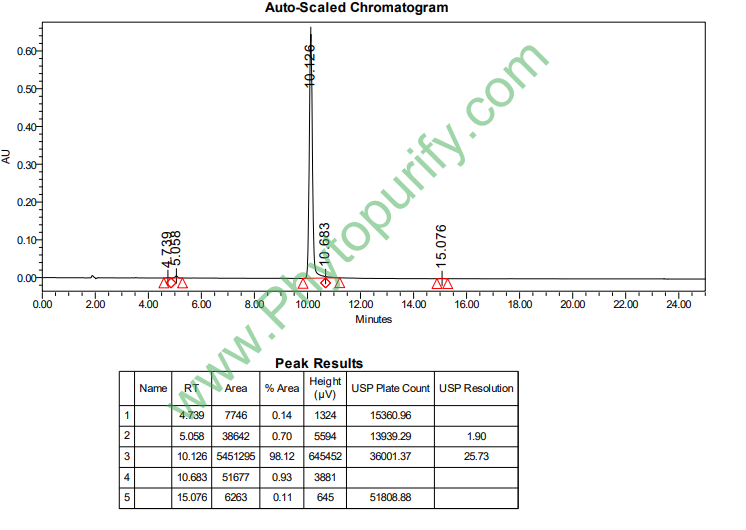
Purity: 95%~99%
Analysis Method: HPLC-DAD or/and HPLC-ELSD
Identification Method: Mass, NMR
Packing: Brown vial or HDPE plastic bottle
Can be supplied from milligrams to grams.
For Reference Standard and R&D, Not for Human Use Directly.
Inquire for bulk scale.
HPLC of Acacetin
Storage conditions:Short-term storage at 2~8℃, long-term storage at -20 ~ -80℃
86.9900
2.2000
2.2000
Moderate
No
No
No
No
No
Negative
Acacetin (CAS number: 480-44-4) is a natural monomethoxyflavone, chemically a 4 '- methyl ether derivative of apigenin. As a functional plant metabolite, acacetin has shown a wide range of biological activities in both traditional Chinese medicine and modern pharmacological research, covering multiple fields such as anticonvulsant, anticancer, anti-inflammatory, antioxidant, and cardiovascular protection. In recent years, with the deepening development of natural product pharmacology, acacetin has become one of the hot molecules in the research of atrial fibrillation, cancer, and inflammation related diseases due to its unique molecular mechanism of action and good drug properties.
This review aims to systematically summarize the chemical structure and physicochemical properties, plant sources, and extraction processes of acacetin, with a focus on its pharmacological activity and mechanism of action, exploring its pharmacological properties and pharmacokinetic characteristics, and looking forward to its clinical application potential, providing theoretical basis and reference for subsequent basic and translational research.
The chemical name of acacetin is 5-hydroxy-2- (4-methoxyphenyl) -4-oxo-4H-1-benzopyran-7-phenolic acid conjugate acid, with a molecular formula of C16H12O5 and a molecular weight of 284.26. Its structural core is a typical flavonoid skeleton, with a single 4 '- methoxy substituent, which is different from the hydroxyl group of apigenin, endowing it with unique physicochemical properties and biological activity.
In terms of physical and chemical properties, the LogP value of acacetin is about 2.2, indicating moderate lipid solubility, which is beneficial for cell membrane penetration and bioavailability. The topological polar surface area (TPSA) is 86.99 Å ², indicating that it has a certain polarity that facilitates hydrogen bonding with biological targets. The number of hydrogen bond receptors is 5, supporting their multi-point binding with protein targets. The permeability of the blood-brain barrier is moderate, indicating its potential application value in central nervous system diseases. Low risk of hepatotoxicity, negative for cardiac toxicity and hERG channel inhibition, demonstrating good safety.
Acacetin is mainly found in plants of the Asteraceae family, especially in chrysanthemums (Dendranthema morifolium) where it is abundant. This plant is widely used in traditional Chinese medicine for clearing heat, detoxifying, calming the liver, and improving vision. Acacia extract, as one of its important active ingredients, has multiple pharmacological effects.
In terms of extraction methods, commonly used solvents include ethanol, water, and their mixtures. The conventional extraction steps are as follows: after crushing the dried plant materials, reflux extraction or ultrasound assisted extraction is used, followed by liquid-liquid distribution, column chromatography and other methods for separation and purification. High performance liquid chromatography (HPLC) and mass spectrometry (LC-MS) are widely used for qualitative and quantitative analysis of acacetin. In recent years, green technologies such as supercritical fluid extraction and microwave-assisted extraction have gradually been applied to the efficient extraction of acacetin, improving extraction efficiency and purity.
Acacetin, as an atrial selective drug, can significantly prolong the effective refractory period (AERP) of the atrium without affecting the corrected QT interval, demonstrating good antiarrhythmic potential. In animal experiments, acacetin was found to effectively prevent atrial fibrillation (AF) in anesthetized dogs through intraglandular administration, indicating its potential application in the prevention and treatment of clinical arrhythmias, especially atrial fibrillation.
Acacetin exhibits significant anti proliferative effects in various cancer cell lines. Its mechanism includes inducing cell cycle arrest, promoting cell apoptosis, and autophagy. At the molecular level, acacetin inhibits the ATP binding pocket of PI3K γ, interferes with the PI3K/AKT signaling pathway, and blocks the growth and survival signals of cancer cells. In addition, acacetin also has inhibitory effects on the migration and invasion of tumor cells, demonstrating multi-target anti-tumor potential.
Acacetin can significantly inhibit the release of inflammatory mediators and activation of inflammatory signaling pathways, such as NF - κ B and MAPK pathways, and alleviate tissue inflammatory responses. Its antioxidant activity is manifested by clearing free radicals, reducing the generation of lipid peroxides, and protecting cells from oxidative stress damage. These effects make acacetin have therapeutic potential in inflammatory and oxidative stress-related diseases.
As a natural anticonvulsant, acacetin can regulate neurotransmitter balance, inhibit neuronal overexcitation, and alleviate epileptic seizures. Its blood-brain barrier permeability is moderate, supporting its application in central nervous system diseases. Related studies have also shown that acacetin has a protective effect on neuroinflammation and neurodegenerative diseases.
Acacetin also exhibits multiple biological activities such as anti mutation, antiepileptic, and pain relief, demonstrating its broad potential for application in various disease models.
The multi-target mechanism of action of acacetin is the basis of its multiple pharmacological effects. Through molecular docking and biochemical experiments, it has been found that acacetin can bind to and regulate multiple key protein targets:
The diversity of these targets reflects the multiple regulatory roles of acacetin in cardiovascular disease, cancer, neurological disorders, and inflammation.
The pharmacological parameters of acacetin indicate its good potential for drug development. The molecular weight is moderate (284.26), which conforms to Lipinski's rule. The LogP value of 2.2 indicates moderate lipid solubility, which is beneficial for oral absorption. TPSA is approximately 87 Å ², supporting its excellent membrane permeability and target binding ability.
In terms of safety, acacetin has a low risk of hepatotoxicity, no cardiac toxicity or hERG channel inhibition, and a negative Ames test, indicating a low risk of genotoxicity and good safety.
Pharmacokinetic studies have shown that acacetin has good oral bioavailability and moderate blood-brain barrier permeability, making it suitable for the treatment of central nervous system diseases. Its metabolism is mainly through the liver enzyme system, with stable metabolites and diverse excretion pathways, supporting its good pharmacological maintenance in the body.
Acacetin, with its multi-target and multi mechanism pharmacological effects, has shown a wide range of clinical application potential:
Future research should focus on preclinical pharmacokinetic optimization, formulation development, and safety evaluation of acacetin, while combining modern molecular biology and medicinal chemistry techniques to deeply analyze its mechanism of action and promote its clinical translation.
Acacia extract, as a natural plant derived monomethoxyflavonoid, has become an important object of pharmacological research in natural products due to its unique chemical structure and diverse biological activities. Its significant effects in cardiovascular protection, anti-cancer, anti-inflammatory, and neuroprotection, combined with good drug properties and safety, have laid a solid foundation for it as a potential drug molecule. In the future, through systematic pharmacological mechanism research and clinical translational development, acacetin is expected to become a new natural medicine for the treatment of various diseases, contributing new strength to human health.
