


Name: Diosmetin-7-glucoside
Synonym name: Diosmetin-7-O-beta-D-glucopyranoside
Catalogue No.: BP0507
Cas No.: 20126-59-4
Formula: C22H22O11
Mol Weight: 462.407
Botanical Source: Galium spp., Chrysanthemum sp. and Cassia sp.
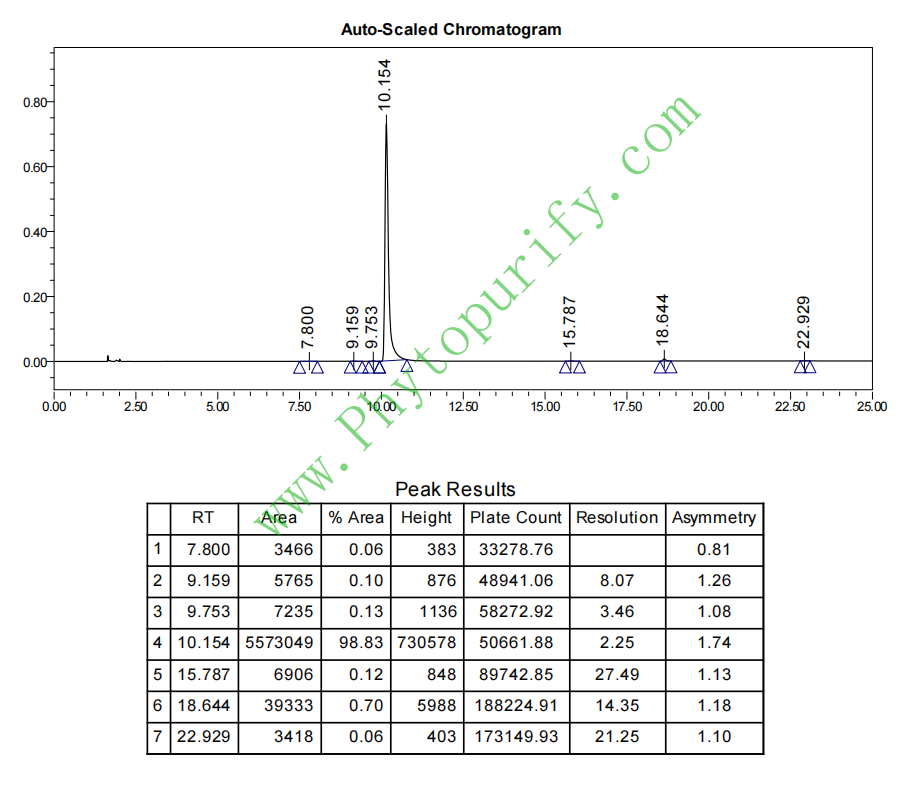
Purity: 95%~99%
Analysis Method: HPLC-DAD or/and HPLC-ELSD
Identification Method: Mass, NMR
Packing: Brown vial or HDPE plastic bottle
Can be supplied from milligrams to grams.
For Reference Standard and R&D, Not for Human Use Directly.
Inquire for bulk scale.
HPLC of Diosmetin-7-glucoside
Storage conditions:Short-term storage at 2~8℃, long-term storage at -20 ~ -80℃
179.2800
.1409
.1279
1.5075
.5914
.1952
Low
82.3007
3.8836
Yes
No
No
No
Yes
No
0.6
Yes
No
Yes
No
Flavonoids, as one of the most widely distributed plant secondary metabolites in nature, have always been a hot topic in natural product pharmacology research due to their diverse chemical structures and extensive biological activities. Diosmetin-7-glucoside (CAS number: 20126-59-4) is a 7-hydroxy-glucoside product of the flavonoid compound Diosmetin, belonging to the flavonoid glycoside class. Compared to its aglycone, the introduction of glycosides typically significantly improves its water solubility and bioavailability, potentially enhancing its biological activity or altering its spectrum of action. In recent years, with the in-depth study of the anti-tumor activity of natural products, the potential of geranium lignin 7-O-glucoside in the prevention and treatment of breast cancer has gradually become prominent. Breast cancer is the malignant tumor with the highest incidence rate among women in the world. Its occurrence and development involve complex signal pathway networks and molecular targets, such as cell apoptosis disorder, hormone receptor signal abnormality, formation of multidrug resistance (MDR), and enhancement of invasion and metastasis. Although existing treatment methods are constantly improving, they still face challenges such as drug resistance, recurrence, and side effects. Therefore, it is of great strategic significance to search for new candidate drugs or adjuvant therapies with high efficiency and low toxicity from natural products. The purpose of this paper is to systematically review the chemical properties, plant sources, and extraction methods of geranium-7-O-glucoside, and focus on its pharmacological activity, mechanism of action, and medicinal properties in the prevention and treatment of breast cancer, in order to provide a comprehensive scientific reference for the further research and development of this compound.
The chemical name of fragrant leaf lignin-7-O-glucoside is 5,7-dihydroxy-2- (3-hydroxy-4-methoxyphenyl) -4H-phenylpyran-4-one-7-O - β - D-glucopyranoside. Its parent nucleus is a flavonoid (2-phenylchromenone) structure, with hydroxyl groups at positions 5 and 7 of the A ring, hydroxyl groups at position 3 'of the B ring, and methoxy groups at position 4'. Its characteristic is that the hydroxyl group at position 7 is connected to a molecule of β - D-glucose through a glycosidic bond. This glycosidic structure is the key difference between it and the lignin of the aromatic leaves, and deeply affects its physicochemical properties.
According to the analysis of drug parameters, its molecular weight is 462.4070, which belongs to the category of medium-sized molecules. The calculated lipid water partition coefficient (LogP) value is 0.1409, indicating that the compound has good hydrophilicity, mainly due to the introduction of glucose groups. The topologically polar surface area (TPSA) is as high as 179.28 Å ², further confirming its strong molecular polarity and containing multiple hydrogen bond donor and acceptor sites (from hydroxyl and sugar groups). The predicted water solubility value is 1.5075 (usually measured in mg/mL or log mol/L, indicating good solubility), which is consistent with high TPSA and low LogP values. These properties indicate that it has good solubility in aqueous media, which is beneficial for the development of oral formulations. However, high polarity also brings challenges in crossing lipid biofilms, with a predicted "low" blood-brain barrier (BBB) permeability, meaning it is less likely to enter the central nervous system. This may actually reduce the potential risk of neurotoxicity for the treatment of peripheral tumors. In the early toxicity warning indicators, hERG inhibitory prediction is "no", indicating a low risk of causing QT interval prolongation in the heart; The simulated value of Ames test is 0.6 (usually interpreted as negative or weakly positive, subject to experimental confirmation), which suggests that its mutagenic risk may be low. Overall, the lignin 7-O-glucoside from Fragrant Leaf has shown an ideal preliminary physicochemical and safety profile as a drug lead compound.
Fragrant leaf lignin-7-O-glucoside is widely distributed in the plant kingdom and mainly exists in various medicinal and edible plants. Common plant sources include the peels and leaves of citrus plants such as Rosmarinus officinalis and Perilla frutescens in the family Lamiaceae, Citrus limon in the family Rutaceae, as well as some plants in the legume family. These plants are often used in traditional medicine for anti-inflammatory, antioxidant, and health purposes, and some of their effects may be related to this ingredient.
The classic solvent extraction method is often used to extract lignin 7-O-glucoside from plant materials. Due to the properties of its flavonoid glycosides, medium polarity solvents such as methanol, ethanol, or ethanol water mixtures are commonly used as extraction solvents. In order to improve extraction efficiency, modern extraction techniques such as ultrasound assisted extraction (UAE), microwave-assisted extraction (MAE), and pressurized liquid extraction (PLE) have been widely used. These methods destroy plant cell walls through physical means, accelerate solvent penetration and component dissolution, and can achieve higher extraction rates in a shorter time and with less solvent. For example, using a 60% -80% ethanol aqueous solution for ultrasonic extraction has been proven to be an effective method for efficiently obtaining the flavonoid glycoside.
The crude extract after extraction has complex components and requires further separation and purification to obtain high-purity cinnamoyl-7-O-glucoside. The conventional purification process includes: first, using macroporous adsorption resins (such as AB-8, D101) for preliminary enrichment, and removing impurities such as sugars and proteins based on polarity differences; Subsequently, silica gel column chromatography, polyamide column chromatography or Sephadex LH-20 column chromatography were used for subdivision; The final high-purity preparation often relies on high-performance liquid chromatography (HPLC) or high-speed counter current chromatography (HSCCC) and other high-performance preparation chromatography techniques. Among them, HSCCC, as a liquid-liquid distribution chromatography, does not require a solid carrier, avoiding irreversible adsorption, and is particularly suitable for the separation of flavonoid glycosides, which are heat sensitive and volatile natural products, and can maintain their biological activity well.
At present, the pharmacological activities of vanillin-7-O-glucoside are mainly concentrated in the field of anti-tumor, especially for breast cancer, and also involve other potential biological activities.
1. Anti breast cancer activity
A large number of in vitro studies have shown that vanillin-7-O-glucoside has significant proliferation inhibitory activity on a variety of human breast cancer cell lines (such as MCF-7, MDA-MB-231, T47D, etc.). Its effect is concentration and time-dependent. Studies have shown that this compound can effectively induce cell cycle arrest of breast cancer cells, such as blocking cells in G2/M or S phase, thus preventing cell division. More importantly, it can significantly induce tumor cell apoptosis, manifested as nuclear condensation, DNA fragmentation, phosphatidylserine eversion, and activation of apoptosis related proteins such as Caspase-3. Compared to certain chemotherapy drugs, it has lower toxicity to normal breast epithelial cells and exhibits certain selectivity, providing preliminary evidence for its safety as an anti-cancer candidate drug.
2. Anti inflammatory and antioxidant activity
As a flavonoid glycoside, it usually has inherent antioxidant capacity, which can scavenge free radicals (such as DPPH free radicals, ABTS free radical cations), inhibit lipid peroxidation, and enhance the activity of intracellular antioxidant enzymes (such as superoxide dismutase SOD, glutathione peroxidase GSH Px). Oxidative stress and chronic inflammation are important promoting factors for the occurrence and development of cancer. The anti-inflammatory effect of this compound is reflected in its ability to inhibit the excessive production of nitric oxide (NO), prostaglandin E2 (PGE2), and pro-inflammatory cytokines (such as TNF - α, IL-6, IL-1 β) in inflammatory cell models induced by lipopolysaccharides (LPS), etc. Its mechanism may be related to the inhibition of nuclear factor kappa B (NF - κ B) and mitogen activated protein kinase (MAPK) signaling pathways.
3. Other potential activities
In addition, preliminary studies suggest that lignin-7-O-glucoside may have the potential to protect nerves and improve metabolic disorders, but further research is needed to confirm these activities.
The anti breast cancer effect of vanillin-7-O-glucoside is the result of multi target and multi pathway synergy, and its mechanism network is complex and fine, mainly involving the following key targets and pathways:
1. Regulating energy metabolism and cell growth: AMPK (PRKAA1) pathway
AMP activated protein kinase (AMPK) is an energy receptor in cells, whose activation can inhibit synthetic metabolism, promote catabolism, and regulate cell growth. Research has shown that lignin-7-O-glucoside from fragrant leaves can activate the AMPK signaling pathway. The activation of AMPK directly inhibits the mammalian target protein (mTOR) complex of rapamycin, thereby suppressing protein synthesis and cell proliferation; On the other hand, it can also upregulate tumor suppressor factors such as p53, jointly exerting a role in inhibiting tumor growth.
2. Inducing cell apoptosis: regulating BCL2 family and STAT3 signaling
Apoptosis escape is one of the signs of cancer. This compound can downregulate the expression of anti apoptotic protein Bcl-2, while possibly upregulating the expression of pro apoptotic proteins such as Bax, leading to a decrease in mitochondrial membrane potential, release of cytochrome C, and activation of Caspase cascade reaction, triggering cell apoptosis. In addition, signal transducer and activator of transcription 3 (STAT3) is an important oncogenic transcription factor, which is continuously activated in a variety of breast cancer to promote cell survival, proliferation and immune escape. Fragrant leaf lignin-7-O-glucoside has been shown to inhibit the phosphorylation (activation) of STAT3 and the expression of downstream target genes (such as Cyclin D1, Survivin), thereby weakening its pro cancer function.
3. Intervention hormone signaling: acting on estrogen receptor beta (ESR2)
The occurrence of breast cancer is closely related to estrogen signal. Fragrant leaf lignin-7-O-glucoside exhibits regulatory effects on estrogen receptor beta (ER β/ESR2). ER β is generally believed to have functions that are different from or even antagonistic to the classical pro proliferative ER α, and may mediate anti proliferative and pro differentiation effects. This compound may act as a regulator of ER β, inhibit the proliferation promoting signal of ER α by activating ER β pathway, and thus play an inhibitory role in hormone receptor positive breast cancer.
4. Reversing multidrug resistance (MDR): Inhibiting ABC transporter protein
MDR is the main cause of chemotherapy failure, which is often mediated by the overexpression of ATP binding cassette (ABC) transporters such as P-glycoprotein (ABCB1/MDR1) and breast cancer drug resistance protein (ABCG2/BCRP). Fragrant leaf lignin-7-O-glucoside has been proven to be an effective inhibitor of these efflux pumps. It can combine with ABCB1 and ABCG2 in a competitive or noncompetitive manner to inhibit their efflux function, thus increasing the accumulation of chemotherapy drugs (such as doxorubicin and paclitaxel) in drug-resistant breast cancer cells and restoring cell sensitivity to chemotherapy.
5. Inhibiting invasion and metastasis: intervening in MMP2 and related signals
Tumor metastasis is the main cause of death. The compound can inhibit the migration and invasion of breast cancer cells. The mechanism includes: downregulating the expression and activity of matrix metalloproteinase-2 (MMP2), which is a key enzyme for degrading extracellular matrix (ECM) and promoting invasion; Inhibiting signaling molecules such as protein kinase C alpha (PRKCA), which are involved in regulating cytoskeleton rearrangement and movement; In addition, its potential impact on microtubule associated protein tau (MAPT) suggests that it may interfere with intracellular transport and movement mechanisms.
6. Other targets
The research also involves the inhibitory activity of tyrosinase (TYR). Although this is more related to melanin synthesis, it has reference value in certain breast cancer subtypes or as the evaluation of the miss target effect.
In summary, the lignin-7-O-glucoside from Fragrant Leaves synergistically acts on multiple key targets such as AMPK, STAT3, BCL2, ER β, ABC transporter, MMP2, forming a three-dimensional anti-tumor network that inhibits proliferation, induces apoptosis, reverses drug resistance, and prevents invasion and metastasis.
Although lignin 7-O-glucoside has shown excellent biological activity in vitro, its potential as a drug still requires systematic pharmacological evaluation and pharmacokinetic studies.
1. Absorption, distribution, metabolism, and excretion (ADME)
* absorb As a flavonoid glycoside, it has strong hydrophilicity and may be partially absorbed in the small intestine through the sodium dependent glucose transporter (SGLT1) after oral administration. But more commonly, β - glucosidase in the gut microbiota hydrolyzes it into aglycone lignin and glucose, which have higher lipid solubility and may be absorbed through passive diffusion. Therefore, its oral bioavailability is the comprehensive result of the combined effects of glycoside absorption, intestinal hydrolysis, and liver first pass metabolism (on aglycones). Currently, there is a lack of complete human data, and animal model research is the next key step.
* distribution The predicted blood-brain barrier permeability is low, indicating that it is mainly distributed in peripheral tissues and organs. Experimental research is needed to determine its accumulation ability in breast tumor tissues.
* Metabolism Flavonoid glycosides and their aglycones mainly undergo phase II metabolic reactions in the body, such as glucuronidation, sulfation, and methylation. The liver and intestines are the main metabolic sites. The activity of metabolites may change, and it is necessary to clarify their main metabolites and their pharmacology/toxicity.
* excretion Metabolites are mainly excreted through the kidneys with urine, and some may also be excreted through bile and feces.
2. Challenges and strategies for optimizing drug properties
The main challenges facing drug development currently include: ① low oral bioavailability; ② Easy to be rapidly metabolized and cleared in the body, resulting in a short half-life; ③ As a natural product, the space for structural modification is relatively limited, but it is not impossible.
Future optimization strategies may include:
* Prodrug design Modification of glycosides or sugar groups to prepare precursor drugs with higher lipid solubility, in order to improve membrane permeability and bioavailability, and then convert them into active forms in vivo.
* New drug delivery system The use of nanotechnology, such as liposomes, polymer nanoparticles, solid lipid nanoparticles, etc., to encapsulate drugs can significantly improve their stability, prolong circulation time, enhance tumor targeting (using EPR effect or active targeting modification), and may bypass ABC transporter mediated efflux, thereby simultaneously improving efficacy and reducing systemic toxicity.
* Structural similarity screening Based on its pharmacophore, a series of structurally similar compounds were synthesized to screen for candidate molecules with higher activity and more stable metabolism.
3. Preliminary safety assessment
Based on computational predictions, its hERG inhibition and mutagenic (Ames) risk are low, which is a positive signal. However, a comprehensive preclinical safety evaluation is still needed, including acute toxicity, subchronic toxicity, genetic toxicity, reproductive toxicity, etc., to confirm its safety window.
Vanillin-7-O-glucoside has shown many potential applications in the prevention and treatment of breast cancer:
1. As a chemotherapy sensitizer: Its strong ability to inhibit ABC transporter makes it possible to combine it with conventional chemotherapy drugs (such as anthracyclines and taxanes) to reverse clinical multidrug resistance and improve chemotherapy efficacy, especially for patients with refractory/recurrent breast cancer.
2. As an adjunct or alternative to hormone therapy The regulation of ER β provides a new idea for the development of new selective estrogen receptor modulator (SERM) or down-regulation (SERD), which may be used for long-term maintenance treatment or prevention of ER positive breast cancer.
3. As a preventive healthcare product or adjuvant therapy: With its antioxidant, anti-inflammatory properties and relatively low cytotoxicity, it can be explored and developed as a dietary supplement for high-risk groups of breast cancer or an auxiliary drug to help improve the quality of life of patients and reduce the side effects of radiotherapy and chemotherapy.
4. Multi target combination therapy components Its characteristic of acting on multiple key oncogenic pathways is in line with modern "multi-target" drug therapy strategies, which may reduce the problem of resistance to single target drugs.
However, pushing it from the laboratory to clinical practice still faces many challenges: ① a large amount of in-depth in vivo pharmacological validation is needed, especially to confirm its efficacy in more clinical models such as human tumor xenografts (PDX); ② Strict preclinical pharmacokinetic and toxicological studies must be conducted to clarify the safe dosage range; ③ Need to address industrialization issues such as low natural product content, high extraction costs, and difficulty in chemical synthesis; ④ Explore the optimal clinical dosing regimen (monotherapy or combination? Dose and duration?).
Future research should focus on using computational chemistry and structural biology methods to elucidate the precise binding patterns with key targets such as ABCB1 and STAT3; Reasonably modify its ADME properties through medicinal chemical methods; Actively conducting research on delivery systems based on nanotechnology; And ultimately promote preclinical and clinical research that complies with Good Laboratory Practice (GLP) and Good Manufacturing Practice (GMP).
As a natural flavonoid glycoside, vanillin-7-O-glucoside, with its unique chemical structure and multi-target mechanism of action, has shown remarkable potential in the field of anti breast cancer. It can not only directly inhibit tumor cell proliferation and induce apoptosis, but also effectively reverse multidrug resistance, inhibit invasion and metastasis, forming a relatively complete anti-tumor effect system. Although it faces common challenges such as bioavailability and metabolic stability in drug development, it is expected to be overcome through modern medicinal chemistry and pharmaceutical strategies such as prodrug design and nano delivery. The current research is still in the preclinical stage, and there is an urgent need for more in-depth in vivo mechanism verification, systematic pharmacokinetics, and safety evaluation. With the continuous advancement of research, vanillin-7-O-glucoside is expected to develop into a new type of breast cancer treatment or adjuvant treatment drugs, or provide valuable natural lead compounds to overcome clinical drug resistance problems. Its research and development process will also provide useful reference for the modernization of research on other natural active ingredients.
