


Product name: Usnic acid
Synonym name: Usninic acid; Carbonusninic acid
Catalogue No.: BP1427
Cas No.: 125-46-2
Formula: C18H16O7
Mol Weight: 344.319
Botanical Source: Usnea diffracta Vain.
Physical Description:
Type of Compound: Miscellaneous
Purity: 95%~99%
Analysis Method: HPLC-DAD or/and HPLC-ELSD
Identification Method: Mass, NMR
Packing: Brown vial or HDPE plastic bottle
Storage: Store in a well closed container, protected from air and light. Put into refrigerate or freeze for long term storage.
Whenever possible, you should prepare and use solutions on the same day. However, if you need to make up stock solutions in advance, we recommend that you store the solution as aliquots in tightly sealed vials at -20℃. Generally, these will be useable for up to two weeks.
The product could be supplied from milligrams to grams
Inquire for bulk scale.
Chengdu Biopurify Phytochemicals Ltd. is a leading company in the research, development, manufacture and marketing of High Quality Phytochemicals and Extracts(especially Active Ingredients from Traditional Chinese Medicine,TCM), Natural Active Pharmaceutical Ingredients worldwide.
The main services:
A. Supply active ingredients and reference standards of TCM, from mgs to kgs scale
B. Custom extraction and purification, target Herb Active Ingredients
C. Custom synthesis and semi-synthesis for Natural Active Ingredients
D. CR(contract research), CM(contract manufacture) and PD(process development) services from lab scale, pilot scale to commercial scale(GMP is also available)
E. TCM compounds library for drug screen,more than 3000 compounds available, many of them are rare and unique.
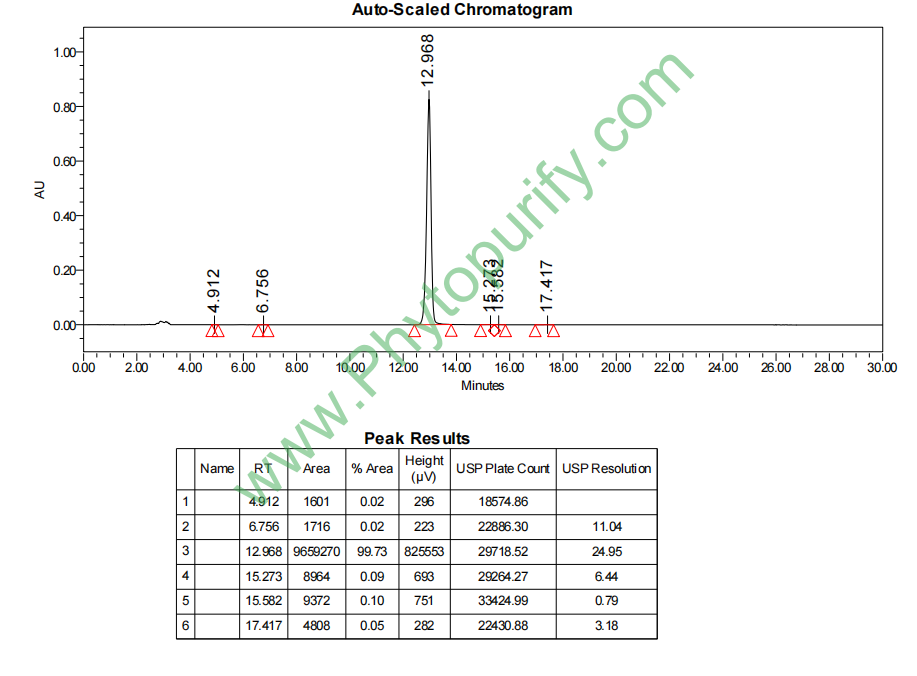
HPLC of Usnic acid
Storage conditions:Short-term storage at 2~8℃, long-term storage at -20 ~ -80℃
Usnic acid (CAS number: 125-46-2) is a natural diterpenoid compound mainly found in lichens, especially abundant in Usnea spp. plants. As one of the metabolites of lichens, jasmonic acid has attracted widespread attention in pharmacology and natural product drug development in recent years due to its diverse biological activities and unique molecular structure. Research has shown that jasmonic acid not only has significant antibacterial, anti-inflammatory, and anti-tumor activities, but also exerts multiple pharmacological effects by regulating intracellular signaling pathways, especially exhibiting unique advantages in inhibiting the mammalian rapamycin target protein complex (mTOR) signaling pathway.
The mTOR signaling pathway, as a key regulatory hub for cell growth, proliferation, and metabolism, plays an important role in tumorigenesis, inflammatory response, and various metabolic diseases. Songluo acid effectively inhibits the activity of mTORC1 and mTORC2 complexes by binding to the ATP binding pocket of mTOR, thereby regulating the phosphorylation levels of downstream effector proteins Akt, 4EBP1, and S6K, inducing cellular autophagy, and demonstrating good anti-tumor potential. In addition, malic acid exhibits significant antibacterial activity against various Gram positive bacteria such as Staphylococcus aureus and Enterococcus faecalis, demonstrating its potential as an anti infective drug.
This article provides a systematic review of the chemical structure and physicochemical properties, plant sources, and extraction methods of malic acid. It delves into its pharmacological activity and mechanism of action, evaluates its pharmacological properties and pharmacokinetic characteristics, and looks forward to its clinical application prospects. The aim is to provide scientific basis and theoretical support for further research and development of malic acid.
Songluo acid is a diterpenoid compound with a complex bicyclic structure, with a molecular formula of C18H16O7 and a molecular weight of 344.3190. Its structure consists of two benzene rings connected by a dioxy bridge, forming a unique diterpenoid phenolic skeleton with multiple hydroxyl and ketone functional groups. The LogP value of malic acid is 1.7765, indicating that it has moderate lipid solubility and is conducive to cell membrane penetration; The TPSA (Topological Polarity Surface Area) is 117.9700, reflecting its moderate polarity, which is conducive to binding with biomolecules. Low water solubility (0.4778 mg/mL) suggests limited solubility in aqueous phase, which may affect its bioavailability.
The stereochemical form of malic acid is (+) - malic acid, which has specific optical activity and is of great significance for its binding to biological targets. Multiple phenolic hydroxyl groups in its structure endow it with antioxidant capacity and also affect its chemical stability. Songluo acid does not inhibit hERG channels, indicating a low risk of cardiac toxicity; The Ames test result is 0.6, indicating a low risk of genotoxicity and meeting drug safety requirements.
Pinellia acid mainly comes from lichen plants, especially Usnea spp. The lichen of the genus Malus is widely distributed in temperate and cold regions around the world, attached to the surface of tree bark, rocks, and other materials. Its biosynthetic pathway involves multiple enzymatic reactions, ultimately forming bioactive jasmonic acid.
The traditional extraction method mainly uses organic solvent extraction, such as ethanol, acetone or methanol extraction, combined with ultrasound assisted extraction technology to improve extraction efficiency. The extraction process usually includes the following steps:
In recent years, supercritical CO2 extraction and microwave-assisted extraction techniques have also been applied to the extraction of malic acid, significantly improving extraction efficiency and purity, and reducing the use of organic solvents, in line with the concept of green chemistry.
Pinellia acid exhibits significant inhibitory effects on various Gram positive bacteria, especially against clinically common pathogens such as Staphylococcus aureus and Enterococcus faecalis, demonstrating strong antibacterial activity. Its mechanism of action involves interfering with multiple targets such as bacterial DNA replication, protein synthesis, and cell wall synthesis, including inhibition of key enzymes such as DNA gyrase (GYRA), fatty acid synthase (FABI), and dihydrofolate reductase (DHFR).
In addition, jasmonic acid has shown a certain inhibitory effect on drug-resistant strains such as methicillin-resistant Staphylococcus aureus (MRSA), indicating its potential application value in combating drug-resistant bacterial infections. Its antibacterial spectrum is relatively narrow, mainly targeting Gram positive bacteria, with weak activity against Gram negative bacteria.
Songluo acid significantly reduces the phosphorylation levels of Akt (Ser473), 4EBP1, and S6K in tumor cells by inhibiting the mTOR signaling pathway, blocking cell proliferation signals, inducing cell cycle arrest and autophagy, and promoting tumor cell apoptosis. Several in vitro cell experiments and in vivo tumor models have verified its anti-tumor potential, covering lung cancer, breast cancer, liver cancer and other solid tumor types.
The autophagy induced by malic acid not only promotes tumor cell death, but also may enhance the sensitivity of chemotherapy drugs, demonstrating its potential as an adjuvant anticancer drug. In addition, malic acid has a regulatory effect on the inflammatory response in the tumor microenvironment, further inhibiting tumor progression.
Songluo acid can significantly inhibit the release of inflammatory mediators, such as tumor necrosis factor alpha (TNF - α), interleukin-6 (IL-6), and nitric oxide (NO), and alleviate the inflammatory response. Its anti-inflammatory mechanism partially relies on the regulation of the mTOR signaling pathway, reducing the transmission of pro-inflammatory signals and protecting tissues from inflammatory damage.
Both in vitro and animal model studies have shown that malic acid has good therapeutic effects in various inflammatory diseases such as arthritis, skin inflammation, and lung inflammation, indicating its potential as a natural anti-inflammatory drug.
The main pharmacological mechanism of action of malic acid is focused on regulating the mTOR signaling pathway. MTOR, as a core regulatory factor for cell growth and metabolism, exists in two different complexes, mTORC1 and mTORC2. Songluo acid inhibits mTORC1/2 signaling by binding to the ATP binding pocket of mTOR protein, suppressing its kinase activity.
The specific mechanism includes:
In addition, the effect of malic acid on bacteria involves multi-target synergistic inhibition, including:
These multi-target mechanisms endow malic acid with broad-spectrum antibacterial activity and lower resistance risk.
The pharmacological parameters of malic acid show that it has good potential for drug development. The molecular weight is 344.3190, which conforms to the Lipinski rule for drug molecular weight range; The LogP is 1.7765, indicating moderate lipid solubility, which is beneficial for oral absorption and cell membrane penetration; The TPSA is 117.9700, which is within the range suitable for oral bioavailability.
Low water solubility (0.4778 mg/mL) may limit its oral bioavailability and in vivo distribution, and requires formulation improvement or optimization of drug delivery systems. The low blood-brain barrier penetration ability of succinic acid suggests its limited application in central nervous system diseases, but it also reduces the risk of central neurotoxicity.
In terms of safety, malic acid does not inhibit hERG channels and reduces the risk of cardiac toxicity; The Ames test result is 0.6, indicating a low risk of genotoxicity and meeting the safety requirements for clinical development.
Pharmacokinetic studies have shown that malic acid is metabolically stable in vivo, mainly processed by the liver metabolic enzyme system, and excreted mainly through bile and feces. Its half-life is moderate and suitable for daily administration. In the future, further research is needed on the activity and toxicity of its metabolites to improve safety evaluation.
Due to its multiple pharmacological activities, especially its potential in anti-tumor, antibacterial, and anti-inflammatory fields, malic acid has become a hot topic in the development of natural medicines. The unique mechanism of inhibiting the mTOR signaling pathway provides new ideas for tumor treatment, which may serve as adjuvant drugs for monotherapy or combination chemotherapy, improving tumor treatment efficacy and reducing drug resistance.
In terms of antibacterial activity, the activity of malic acid against various Gram positive pathogenic bacteria and its inhibitory effect on drug-resistant strains suggest its potential application in the development of anti infective drugs. In the future, its antibacterial spectrum and water solubility can be improved through structural modification, expanding its clinical indications.
The anti-inflammatory activity of sophocarpus acid makes it widely applicable in chronic inflammatory diseases such as arthritis, skin diseases, and respiratory inflammation. Combined with its low toxicity risk, it is expected to be developed into a safe and effective natural anti-inflammatory drug.
However, the water solubility and bioavailability of malic acid limit its clinical application, and its pharmacokinetic performance needs to be improved through drug delivery systems (such as nanocarriers, liposomes) or chemical modifications. At the same time, there is still a lack of preclinical and clinical trial data for the system. In the future, efforts should be made to strengthen pharmacological, safety, and clinical research to promote its clinical translation.
As a widely sourced natural product of lichens, malic acid has shown broad application prospects in anti-tumor, antibacterial, and anti-inflammatory fields due to its unique chemical structure and multi-target pharmacological activity. It regulates cell growth and metabolism, induces autophagy, and exerts anti-tumor effects by inhibiting the mTOR signaling pathway; At the same time, it has significant inhibitory effects on multiple Gram positive bacteria and has the potential to develop new anti infective drugs.
Despite having a good medicinal basis and safety characteristics, the problems of poor water solubility and low bioavailability of malic acid still need to be overcome. Future research should focus on structural optimization, innovation in drug delivery technology, and systematic clinical evaluation to promote the transition of malic acid from laboratory to clinical application, benefiting patients.
In summary, as an important object of pharmacological research on natural products, malic acid has significant scientific value and application potential, and is a star compound that cannot be ignored in the future field of natural medicine research and development.
