


Product name: Vaccarin
Synonym name:
Catalogue No.: BP1428
Cas No.: 53452-16-7
Formula: C32H38O19
Mol Weight: 726.637
Botanical Source: Vaccaria segetalis(Neck.)Garcke
Physical Description:
Type of Compound: Flavonoids
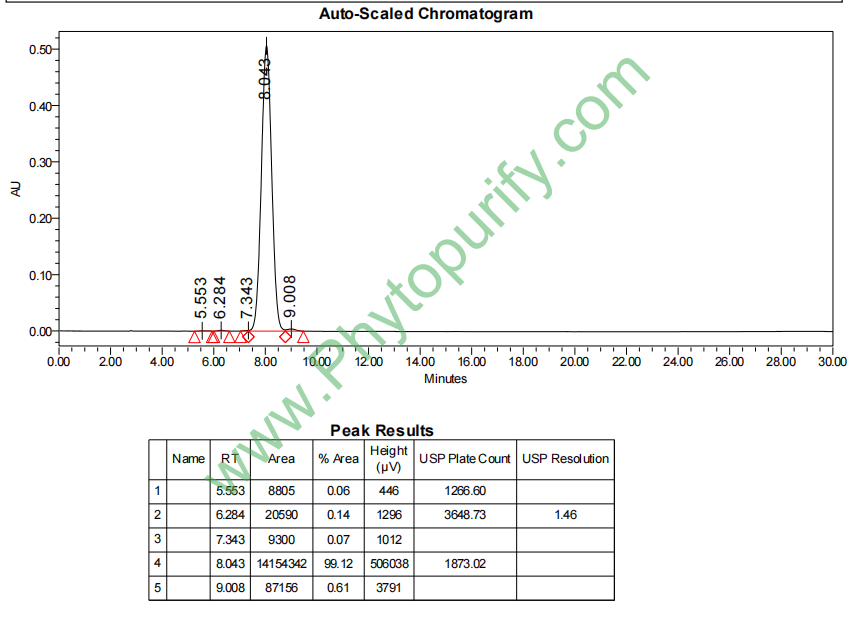
Purity: 95%~99%
Analysis Method: HPLC-DAD or/and HPLC-ELSD
Identification Method: Mass, NMR
Packing: Brown vial or HDPE plastic bottle
Storage: Store in a well closed container, protected from air and light. Put into refrigerate or freeze for long term storage.
Whenever possible, you should prepare and use solutions on the same day. However, if you need to make up stock solutions in advance, we recommend that you store the solution as aliquots in tightly sealed vials at -20℃. Generally, these will be useable for up to two weeks.
The product could be supplied from milligrams to grams
Inquire for bulk scale.
Description:
Vaccarin exhibits extensive biological activities including vascular endothelial cell protective effects, it can significantly promote neovascularization by enhancing protein expression of p-Akt , p‑Erk, and CD31, and selectively protect vascular endothelium from dysfunction induced by H2O2.
References:
Mol Med Rep. 2015 Jul;12(1):1131-6.
Vaccarin promotes endothelial cell proliferation in association with neovascularization in vitro and in vivo.
Angiogenesis is a major pathological component of several diseases, including traumatic vascular disease and coronary heart disease. The purpose of the present study was to determine the effects of Vaccarin on endothelial cell migration and neovascularization, which are important and necessary components of wound healing.
METHODS AND RESULTS:
The present study investigated and confirmed neovascularization induced by Vaccarin in vitro and in vivo. In vitro, the effects of Vaccarin (1.08 and 2.15 µM) on proliferation, migration and tube formation of human microvascular endothelial cells (HMEC)-1 were evaluated via sulforhodamine B assay and migration and tube formation assay, respectively. Furthermore, a mouse Matrigel plus model was used to detect capillary-like tube structures in vivo. Immunohistochemistry was used to detect the protein expression of cluster of differentiation 31 (CD31), p-AKT and p-extracellular-signal-regulated kinases (Erk). Vaccarin significantly promoted HMEC-1 proliferation and migration and tube formation of HMEC-1 at a dose of 2.15 µM. In vivo, Vaccarin delivered by daily oral administration significantly improved epidermal growth factor-induced angiogenesis in an intradermal inoculation mouse model.
CONCLUSIONS:
The mouse Matrigel model study also revealed that Vaccarin significantly promoted neovascularization via detection of CD31 levels and enhanced protein expression of p-Akt and p‑Erk. In addition, Vaccarin also promoted expression of CD31.
Int J Mol Med. 2015 Jan;35(1):135-42.
Vaccarin attenuates the human EA.hy926 endothelial cell oxidative stress injury through inhibition of Notch signaling.
Endothelial cell injury is an essential component of atherosclerosis and hypertension. Atherosclerosis and other macrovascular diseases are the most common complications of diabetes. Vaccarinis a major flavonoid glycoside in Vaccariae semen, and is expected to be useful in the treatment of vascular diseases. The aim of the present study was to evaluate the possible effects of Vaccarinin human umbilical vein endothelial cells (EA.hy926) induced by hydrogen peroxide (H2O2) and its underlying mechanism in the prevention and treatment of H2O2 injury.
METHODS AND RESULTS:
In this study, the EA.hy926 cells were exposed to 250, 500 and 1000 µM H2O2 for 2 and 4 h in the absence or presence of Vaccarin, and the cell injury induced by H2O2 was examined via SRB. Cell migratory ability, lactate dehydrogenase (LDH) leakage, malondialdehyde (MDA) levels and decreasing superoxide dismutase (SOD) activity were evaluated by the wound healing assay and corresponding assay kits. Cell apoptosis was detected by flow cytometry with Annexin V-fluorescein isothiocyanate/propidium iodide Apoptosis Detection kit and Hoechst staining. Furthermore, western blot detected the protein expressions of Notch1, Hes1 and caspase-3. Following treatment with H2O2, it was found that H2O2 stimulated cell injury in a dose-dependent manner, including reducing cell viability and cell migratory ability, increasing LDH leakage and MDA levels, and decreasing SOD activity. H2O2 further accelerated cell apoptosis via activation of Notch1 and the downstream molecule Hes1. Preincubation with Vaccarin was found to protect EA.hy926 cells from H2O2-induced cell oxidative stress injury, which promoted cell viability and cell migratory ability, inhibited the level of LDH and MDA, but enhanced the activity of SOD. In particular, in addition to downregulation Notch signaling, Vaccarin treatments also downregulated caspase-3, a cell apoptotic pathway-related protein.
CONCLUSIONS:
These findings indicated that Vaccarin may be able to selectively protect vascular endothelium from dysfunction induced by H2O2.
HPLC of Vaccarin
Storage conditions:Short-term storage at 2~8℃, long-term storage at -20 ~ -80℃
319.1200
-1.1154
-1.1698
4.9319
.4767
.0709
Low
75.7329
5.2798
Yes
No
No
No
Yes
No
0.6
Yes
No
Yes
Yes
Natural products have always been an important source of innovative drug discovery, among which flavonoid compounds have attracted much attention due to their broad biological activity and relatively low toxicity. Vaccarin, CAS number 53452-16-7, is a flavonoid carbon glycoside isolated from the seeds of traditional Chinese medicine Vaccaria segatalis. In recent years, with the deepening of modern pharmacological research, Vaccarin has demonstrated remarkable multi-target and multi-channel pharmacological activities beyond its traditional use of "promoting blood circulation and meridian circulation, reducing swelling in the lower breast". Research has shown that Vaccarin is a naturally occurring compound with oral activity that exhibits significant potential in promoting angiogenesis, improving metabolic disorders, inhibiting excessive bone resorption, and protecting the cardiovascular system. Its mechanism of action involves precise regulation of multiple key signaling pathways such as AKT/ERK, AMPK, MAPK, NF - κ B, and NFAT, revealing its enormous value as a lead compound for pleiotropic drugs. This article aims to systematically review the chemical properties, plant sources, pharmacological activities, molecular mechanisms of action, pharmacological characteristics, and clinical application prospects of Vaccarin, in order to provide comprehensive scientific references for the in-depth development and transformation research of this natural product.
The chemical name of Vaccarin is kaempferol-3-O - β - D-glucopyranosyl - (1 → 2) - β - D-galactopyranoside, which is a flavonol carbon glycoside. Its molecular formula is C34H42O19 and its molecular weight is 726.6370. Unlike common flavonol glycosides, the sugar group (glucose galactose disaccharide chain) in Vaccarin is directly connected to the A ring of kaempferol (usually at positions C-6 or C-8) through carbon carbon bonds. This carbon glycoside structure gives it stronger stability against acid hydrolysis and enzymatic hydrolysis, which may be an important structural basis for its activity in vivo.
From the analysis of physical and chemical properties, the lipid water partition coefficient (LogP) of Vaccarin is -1.1154, indicating its high hydrophilicity. Its topological polar surface area (TPSA) is as high as 319.1200 Å ², mainly attributed to the presence of multiple hydroxyl and sugar groups in the molecule. High hydrophilicity and large polar surface area also indicate poor lipid solubility. The water solubility data (4.9319) further confirms its easy solubility in water. These properties collectively determine the distribution characteristics of Vaccarin in organisms: it is difficult to penetrate the blood-brain barrier (predicted as low permeability), but may have good gastrointestinal absorption potential (oral activity has been confirmed). In addition, preliminary drug safety screening showed that Vaccarin had a result of 0.6 in the Ames test (generally considered to have a potential mutagenic risk of>1.0, indicating a low risk in this testing system), and did not inhibit hERG potassium channels (hERG inhibition: no), which means its risk of inducing QT interval prolongation in the heart is low, providing important safety evidence for its cardiovascular application.
Vaccarin mainly comes from the dried and mature seeds of the Caryophyllaceae plant Vaccaria segatalis (Neck.) Garcke, which is known as "Wang Buliuxing" in traditional Chinese medicine. Wang Buliuxing is widely distributed in China and has a long history of medicinal use. It was first recorded in the "Shennong Bencao Jing" and its characteristic of "walking without stopping" is used to promote milk circulation, blood circulation, and reduce swelling.
The extraction and separation of Vaccarin usually use organic solvent extraction combined with modern chromatographic techniques. The classic process is as follows: first, the seeds of Wang Buliuxing are crushed and degreased with petroleum ether or ether. The defatted medicinal powder is often subjected to heating reflux or ultrasound assisted extraction using alcohol solvents (such as 70-95% ethanol or methanol) to fully extract flavonoid glycosides. Combine the extracts and concentrate them under reduced pressure to obtain a paste. Subsequently, the extract was suspended in water and extracted sequentially with ethyl acetate and n-butanol. Vaccarin was mainly enriched in the n-butanol fraction. Further purification depends on column chromatography technology. Macroporous adsorption resins (such as D101, AB-8), silica gel, polyamide or sephadex gel (Sephadex LH-20) and other fillers are often used for gradient elution in chloroform methanol or water ethanol systems of different proportions. High performance liquid chromatography (HPLC), especially preparative HPLC, is the ultimate key step in obtaining high-purity Vaccarin monomers. In recent years, green and efficient technologies such as supercritical fluid extraction and high-speed countercurrent chromatography have also been applied to optimize their extraction and separation processes.
A large number of in vitro and in vivo studies have revealed the extensive and significant pharmacological activities of Vaccarin, mainly focusing on the following aspects:
Promoting angiogenesis and wound healing activity Vaccarin has been proven to be an effective pro angiogenic agent. Vaccarin significantly increased the number of microvessels in chicken embryo chorioallantoic membrane models and Matrigel plug models implanted subcutaneously in mice. In the model of full-thickness skin resection wound and diabetes chronic wound, local or systemic administration of Vaccarin can accelerate wound healing, and its mechanism is closely related to promoting endothelial cell proliferation, migration and tubular structure formation, and increasing granulation tissue growth and collagen deposition. This activity provides a core pharmacological basis for its treatment of ischemic diseases (such as myocardial ischemia, lower limb ischemia) and refractory injuries.
Cardiovascular protective activity Vaccarin exhibits multiple protective effects on the cardiovascular system. In animal models of myocardial ischemia/reperfusion injury, Vaccarin pretreatment can reduce myocardial infarction area, improve heart function, alleviate myocardial cell apoptosis and oxidative stress. Its protective effect is related to activating survival signaling pathways (such as AKT), upregulating endothelial nitric oxide synthase (NOS3) expression, and inhibiting the expression of inflammatory factors and adhesion molecules (such as ICAM1, VCAM1). In addition, its potential ACE inhibition and calcium regulating effects (involving SLC8A1/NCX1) also suggest its potential in regulating blood pressure and cardiac contraction.
Improving insulin resistance and hepatic steatosis In the field of metabolic diseases, Vaccarin has shown potential to improve glucose and lipid metabolism disorders. In the high-fat diet induced obesity or diabetes mouse model, Vaccarin intervention can reduce fasting blood glucose, improve insulin sensitivity, reduce weight gain and significantly alleviate liver steatosis (fatty liver). These effects are mainly attributed to their activation of the AMP activated protein kinase (AMPK) signaling pathway in the liver and skeletal muscle, thereby promoting fatty acid oxidation, inhibiting fat synthesis, and enhancing glucose uptake.
Inhibition of osteoclastogenesis and bone protective effects Vaccarin is a potent inhibitor of RANKL induced osteoclast differentiation and bone resorption function. In vitro, it can dose dependently inhibit the differentiation of osteoclast precursor cells into mature osteoclasts and weaken the ability of mature osteoclasts to form bone resorption cavities. In mouse models of ovariectomy (simulating postmenopausal osteoporosis) and inflammatory arthritis, Vaccarin treatment effectively prevents bone loss and reduces damage to trabecular bone structure. This activity makes it a potential candidate drug for treating diseases such as osteoporosis and rheumatoid arthritis with bone destruction.
Anti inflammatory and antioxidant activity As a flavonoid compound, Vaccarin also possesses basic anti-inflammatory and antioxidant properties. It can inhibit the excessive production of pro-inflammatory mediators (such as TNF - α, IL-6, NO) in macrophages stimulated by lipopolysaccharides, and clear free radicals, reducing oxidative damage. These effects serve as auxiliary mechanisms for its benefits in cardiovascular, metabolic, and skeletal protection.
The pleiotropic pharmacological effects of Vaccarin stem from its cross regulation of multiple key signaling pathways within cells. The known core mechanism of action and molecular target network are as follows:
AKT/ERK pathway promoting angiogenesis and cell survival Vaccarin promotes endothelial cell proliferation, migration, and survival by activating protein kinase B (AKT1) downstream of phosphatidylinositol 3-kinase (PI3K) and extracellular signal regulated kinase (ERK1/2) pathways. The activation of AKT further phosphorylates and activates endothelial nitric oxide synthase (NOS3), increasing the production of NO with vasodilatory and protective effects. This is the core mechanism of its promotion of angiogenesis and myocardial protection.
AMPK pathway regulating energy metabolism Vaccarin is a conformational activator of AMPK. It activates AMPK phosphorylation by increasing the intracellular AMP/ATP ratio or directly acting on AMPK. Activated AMPK not only inhibits key lipid synthesis enzymes such as acetyl CoA carboxylase and fatty acid synthase, but also activates peroxisome proliferator activated receptor gamma co activator 1 alpha (PGC-1 alpha) and carnitine palmitoyltransferase 1 (CPT1), promoting mitochondrial biogenesis and fatty acid beta oxidation, thereby comprehensively improving insulin resistance and liver steatosis. This pathway also interacts with the regulation of PPARG (peroxisome proliferator activated receptor gamma).
MAPK/NF - κ B/NFAT pathway for anti-inflammatory and anti osteoclastogenesis The anti-inflammatory and bone protective effects of Vaccarin are mainly achieved through the inhibition of pro-inflammatory signaling pathways. It can effectively inhibit the overactivation of mitogen activated protein kinases (MAPK, including p38, JNK, ERK) and nuclear factor kappa B (NF - κ B) pathways triggered by RANKL or inflammatory factors. More importantly, Vaccarin can directly inhibit the activation and nuclear translocation of activated T cell nuclear factor (NFATc1), which is the main regulatory transcription factor for osteoclast differentiation. By blocking this critical axis, Vaccarin inhibits the generation and function of osteoclasts from the source.
Multi target regulation of cardiovascular system In addition to the aforementioned pathways, Vaccarin also involves other cardiovascular related targets. It may inhibit the adhesion of white blood cells to endothelial cells and alleviate inflammatory reactions by affecting the expression of Selectin P (SELP) and adhesion molecules (ICAM1, VCAM1). Its potential inhibitory effect on angiotensin converting enzyme (ACE) may contribute to the hypotensive effect. In addition, its effects on β 2-adrenergic receptors (ADRB2) and potassium ion channels (KCNH2/hERG without inhibition) suggest that it may have complex and delicate roles in regulating heart rate and rhythm, and further research is needed.
Based on its physicochemical parameters and preliminary research, the pharmacological characteristics of Vaccarin have begun to take shape.
Absorption, distribution, metabolism, excretion (ADME):
* absorb Vaccarin has oral activity, and multiple animal experiments have confirmed its effectiveness when administered orally. But it is a highly polar macromolecular glycoside, and intestinal absorption may depend on the transporters of intestinal epithelial cells (such as glucose transporters), and its absolute bioavailability needs to be accurately determined.
* distribution Due to its high hydrophilicity and large TPSA, Vaccarin is difficult to penetrate the blood-brain barrier and is mainly distributed in the blood and peripheral tissues of the body. This is a disadvantage for treating central nervous system diseases, but it can reduce the risk of central side effects and is acceptable for peripheral targets such as blood vessels, metabolism, and bones that it focuses on.
* Metabolism As a carbon glycoside, Vaccarin is more tolerant to hydrolysis by gut microbiota and liver metabolic enzymes than oxyglycosides, and may exist in the form of prototype or partially deglycosylated metabolites. The liver's II binding reactions (such as glucuronidation and sulfation) may be its main metabolic pathway.
* excretion Expected to be mainly excreted through the kidneys and bile. The detailed data on its pharmacokinetic characteristics, such as half-life and clearance rate, are currently incomplete and are key information that needs to be filled in future translational research.
Preliminary evaluation of safety:
The existing data suggests that Vaccarin has a good security foundation. The negative result of Ames test preliminarily ruled out its strong mutagenicity. Not inhibiting hERG channels is a very advantageous characteristic of it as a cardiovascular drug. However, comprehensive preclinical safety evaluations, including long-term toxicity, reproductive toxicity, genotoxicity complete trials, etc., have not yet been systematically reported, which is a necessary step for its development into drugs.
Pharmaceutical considerations:
Vaccarin has good water solubility and is beneficial for making oral solutions, tablets, or injections. But if you want to improve its bioavailability or achieve targeted delivery, you may need to use formulation technology, such as making phospholipid complexes, nanoparticles, or liposomes, to improve its membrane permeability or enrich at specific sites.
The multi-target pharmacological activity of Vaccarin depicts broad prospects for its application in multiple disease fields:
However, there are still many challenges in pushing Vaccarin from a lead compound to clinical drugs: firstly, systematic preclinical pharmacokinetic and toxicological studies need to be conducted to clarify its safety window. Secondly, it is necessary to clarify in depth the specific weights and potential off target effects of its "multi-target" effect in the in vivo network. Furthermore, it is necessary to optimize its delivery system and dosage form to improve efficacy and targeting. Finally, and most importantly, it is necessary to design and implement rigorous clinical trials to validate their effectiveness and safety in humans.
Future research directions can focus on: ① using chemical biology methods to search for its direct target proteins; ② Carry out structure based derivative design to optimize their drug properties while retaining their activity; ③ Explore its combination therapy strategy with other drugs such as conventional hypoglycemic agents and anti osteoporosis drugs; ④ Utilize modern biotechnology, such as synthetic biology, to address the issue of limited plant sources.
Vaccarin, a natural flavonoid carbon glycoside derived from traditional Chinese medicine, has shown new vitality in modern pharmacological research due to its unique chemical structure and ability to regulate multiple pathways. Its significant activities in promoting angiogenesis, cardiovascular protection, metabolic regulation, and bone protection reveal its enormous potential as a multi indication therapeutic drug. Although there are still challenges in pharmacokinetics, toxicology, and formulation on the road to clinical application, existing research has laid a solid scientific foundation for it. With the continuous deepening of research and the advancement of translational medicine, Vaccarin is expected to develop from an excellent natural product lead compound into an innovative drug for treating ischemic, metabolic, and skeletal system diseases, achieving a leap from traditional wisdom to modern medicine and contributing new strength to human health.
