


Product name: Alpha Cyperone
Synonym name: (+)-Alpha Cyperone; 4,11-Selinadien-3-one; (-)-Alpha Cyperone, 23665-61-4
Catalogue No.: BP0152
Cas No.: 473-08-5
Formula: C15H22O
Mol Weight: 218.34
Botanical Source: Cyperus rotundus L.
Physical Description:
Type of Compound: Sesquiterpenoids
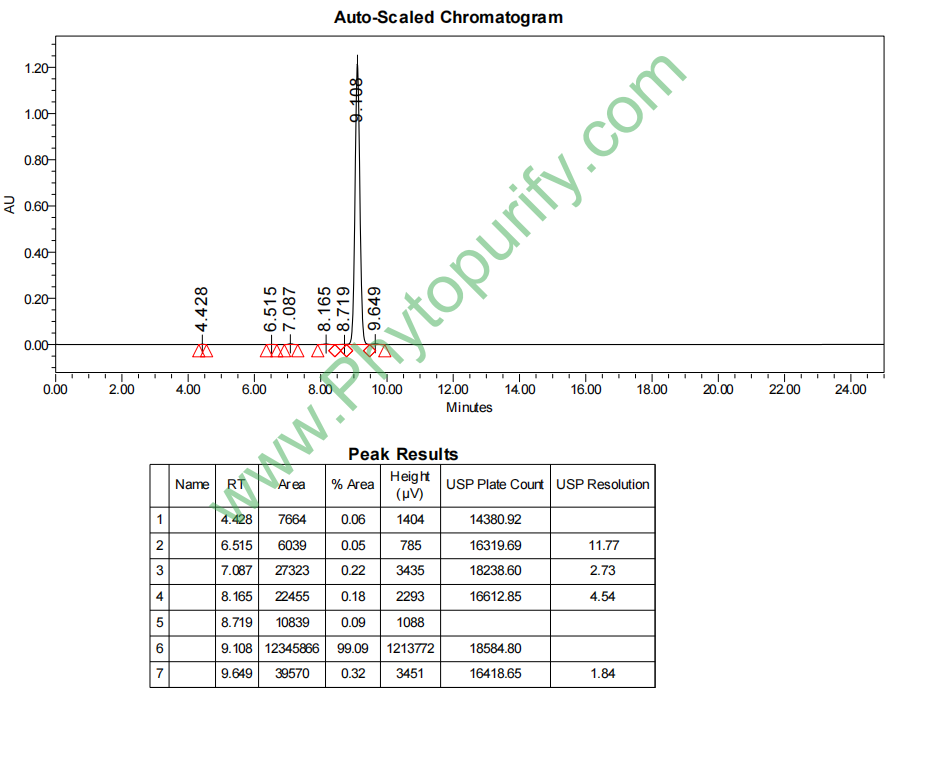
Purity: 95%~99%
Analysis Method: HPLC-DAD or/and HPLC-ELSD
Identification Method: Mass, NMR
Packing: Brown vial or HDPE plastic bottle
Storage: Store in a well closed container, protected from air and light. Put into refrigerate or freeze for long term storage.
Whenever possible, you should prepare and use solutions on the same day. However, if you need to make up stock solutions in advance, we recommend that you store the solution as aliquots in tightly sealed vials at -20℃. Generally, these will be useable for up to two weeks.
The product could be supplied from milligrams to grams
Inquire for bulk scale.
Chengdu Biopurify Phytochemicals Ltd. is a leading company in the research, development, manufacture and marketing of High Quality Phytochemicals and Extracts(especially Active Ingredients from Traditional Chinese Medicine,TCM), Natural Active Pharmaceutical Ingredients worldwide.
The main services:
A. Supply active ingredients and reference standards of TCM, from mgs to kgs scale
B. Custom extraction and purification, target Herb Active Ingredients
C. Custom synthesis and semi-synthesis for Natural Active Ingredients
D. CR(contract research), CM(contract manufacture) and PD(process development) services from lab scale, pilot scale to commercial scale(GMP is also available)
E. TCM compounds library for drug screen,more than 3000 compounds available, many of them are rare and unique.
HPLCof Alpha Cyperone
Storage conditions:Short-term storage at 2~8℃, long-term storage at -20 ~ -80℃
Alpha Cyperone (CAS number: 473-08-5) is a natural sesquiterpene compound isolated from the traditional Chinese medicine Cyperus Rotundus L. As one of the main active ingredients of Xiangfu, α - Xiangfu ketone has attracted much attention due to its significant pharmacological activity, especially in the fields of anti-inflammatory, antioxidant, and metabolic regulation, showing potential therapeutic value. In recent years, with the in-depth study of the mechanisms of chronic inflammation related diseases, α - coumarin has shown good anti-inflammatory effects by regulating the expression of inflammation related molecules such as Cox-2, IL-6, and cytoskeletal regulatory proteins Nck-2, Cdc42, and Rac1. In addition, alpha vanillin has shown certain potential in the treatment of metabolic diseases such as hyperglycemia, involving multiple key targets such as EHMT2, AMPK, and SGLT2.
This article provides a systematic review of the chemical structure and physicochemical properties, plant sources, and extraction methods of α - coumarin, with a focus on its pharmacological activity and molecular mechanism of action. Combined with pharmacological evaluation and pharmacokinetic data, it explores its clinical application prospects and development directions, aiming to provide comprehensive and in-depth reference materials for researchers in the field of natural product pharmacology.
Alpha benzophenone is a sesquiterpene ketone compound with a molecular formula of C15H22O and a molecular weight of 218.34. Its structural features include a sesquiterpene skeleton containing a cyclic skeleton and a ketone group, endowing it with certain polarity and reactivity. In terms of physical and chemical properties, the LogP value of α - coumarin is 3.5, indicating that it has moderate lipid solubility and is conducive to penetrating cell membranes and the blood-brain barrier (BBB penetration is high). Its topological polar surface area (TPSA) is 17.07 Å ², and the number of hydrogen bond acceptors is only 1, indicating low molecular polarity, which is beneficial for improving in vivo bioavailability.
In addition, α - Xiangfu ketone has no hepatotoxicity or cardiotoxicity, and does not inhibit hERG channels. The Ames mutagenicity test result is negative, indicating its high safety and good pharmacological basis. These physicochemical and toxicological characteristics lay a solid foundation for its potential as a drug molecule.
Alpha coumarin is mainly present in the volatile oil of Cyperus Rotundus L., a plant of the Cyperus family widely distributed in parts of Asia, Africa, and Europe. It is an important traditional Chinese medicine herb used for regulating qi and blood, relieving pain, and anti-inflammatory effects. The volatile oil of Aconitum carmichaelii is rich in sesquiterpenes, among which α - coumarin has a high content and is one of its main active ingredients.
The common methods for extracting α - coumarin include steam distillation and solvent extraction. The steam distillation method is suitable for extracting the volatile oil of Aconitum carmichaelii, and then purifying it through chromatographic separation techniques such as column chromatography and preparative high-performance liquid chromatography to obtain α - Aconitum carmichaelii ketone. Solvent extraction usually uses ethanol or ethyl acetate as extraction agents, combined with ultrasound assisted extraction or reflux extraction to improve extraction efficiency. During the purification process, high-purity α - coumarin can be obtained using techniques such as silica gel column chromatography and reverse phase HPLC, which facilitates subsequent pharmacological research.
In recent years, with the development of extraction technology, supercritical CO2 extraction technology has also been applied to the extraction of volatile oil from Aconitum carmichaelii, which has the advantages of environmental friendliness and high extraction efficiency, providing new ideas for the industrial production of α - coumarin.
The pharmacological activity research of α - coumarin mainly focuses on its anti-inflammatory, antioxidant, and metabolic regulatory effects.
A large number of in vitro and in vivo experiments have shown that alpha vanillin can significantly inhibit inflammatory reactions. The mechanism involves downregulating the expression of inflammation related enzymes and cytokines, such as cyclooxygenase-2 (Cox-2) and interleukin-6 (IL-6). Cox-2, as a key enzyme involved in the synthesis of inflammatory mediators, reduces its expression and directly decreases the production of prostaglandins, thereby alleviating the inflammatory response. IL-6, as a multifunctional pro-inflammatory cytokine, plays a key role in various inflammatory diseases. Alpha benzophenone inhibits IL-6 expression, regulates immune response, and alleviates inflammatory symptoms.
In addition, α - coumarin also affects the expression of cytoskeleton related proteins Nck-2, Cdc42, and Rac1, which are involved in cell migration, morphological changes, and signal transduction, regulating the activation and chemotaxis of inflammatory cells, and further exerting anti-inflammatory effects.
Oxidative stress is an important mechanism for the occurrence and development of various chronic diseases. Alpha vanillin has the ability to scavenge free radicals, reduce oxidative damage, enhance intracellular antioxidant enzyme activity, alleviate cellular damage caused by oxidative stress, and protect tissue function.
In the study of hyperglycemia and related metabolic disorders, alpha vanillin has shown potential in regulating blood sugar and improving metabolic disorders. Although its direct target is not fully understood, relevant studies suggest that it may participate in glucose metabolism, insulin signaling, and energy homeostasis regulation by regulating the expression and function of key proteins such as EHMT2, UBP2, PAI1, AMPK, SGLT2, GCK, APP, BACE1, CES1, and PTPN1.
Among them, AMPK serves as a central regulatory factor in energy metabolism, and activation of the AMPK pathway by α - coumarin can help improve insulin resistance and promote glucose uptake. Inhibition of SGLT2 helps to reduce renal glucose reabsorption and alleviate hyperglycemia.
The mechanism of action of α - coumarin is complex and diverse, covering multiple signaling pathways and molecular targets, mainly manifested in the following aspects:
In addition, the regulation of APP and BACE1 by α - coumarin suggests that it may have potential protective effects in neurodegenerative diseases and deserves further research.
The pharmacological evaluation of alpha benzophenone shows that it has good potential for drug development:
In terms of pharmacokinetics, although there are few existing literature reports, based on its physicochemical properties, it is speculated that α - coumarin has good oral absorption, wide distribution, and may be enriched in the central nervous system. Its metabolic pathway may involve the liver enzyme system, and excretion is mainly through the kidneys. In the future, systematic ADME (absorption, distribution, metabolism, excretion) research is needed to clarify its in vivo behavior.
Based on the multi-target regulatory ability and good safety of α - coumarin, its clinical application prospects are broad in various diseases:
Future research should focus on the preclinical pharmacokinetic and toxicological evaluation of alpha benzophenone, conduct systematic in vivo disease model validation, and optimize dosage forms and administration regimens. In addition, based on its multi-target mechanism of action and combined with modern drug design techniques, the development of α - benzophenone derivatives or combination therapy strategies will help enhance its clinical translational value.
As a natural sesquiterpene ketone derived from traditional Chinese medicine Xiangfu, α - Xiangfu ketone has become an important research object in the field of natural product pharmacology due to its significant anti-inflammatory and metabolic regulatory activities, as well as good medicinal properties. It exhibits broad pharmacological potential and clinical application prospects by regulating inflammation and metabolism related molecules through multiple targets and pathways. In the future, by combining modern pharmacology and medicinal chemistry techniques, the mechanism of action and in vivo behavior of α - coumarin will be further elucidated, providing a solid foundation for its development into a new natural medicine and promoting its application in the treatment of chronic inflammation and metabolic diseases.
