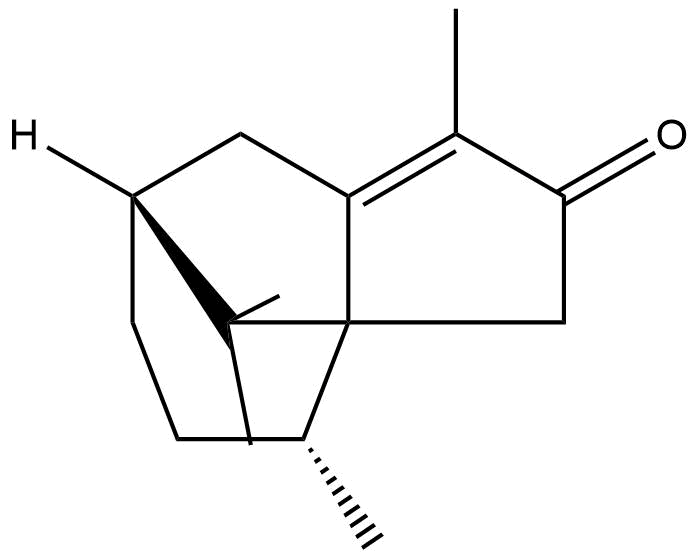


Product name: Cyperenone
Synonym name: Cyperotundone;(+)-Cyperotundone;Isopatchoulenone
Catalogue No.: BP4184
Cas No.: 3466-15-7
Formula: C15H22O
Mol Weight: 218.34
Botanical Source: Cyperus rotundus L.
Physical Description:
Type of Compound: Sesquiterpenoids
Purity: 95%~99%
Analysis Method: HPLC-DAD or/and HPLC-ELSD
Identification Method: Mass, NMR
Packing: Brown vial or HDPE plastic bottle
Storage: Store in a well closed container, protected from air and light. Put into refrigerate or freeze for long term storage.
Whenever possible, you should prepare and use solutions on the same day. However, if you need to make up stock solutions in advance, we recommend that you store the solution as aliquots in tightly sealed vials at -20℃. Generally, these will be useable for up to two weeks.
The product could be supplied from milligrams to grams
Inquire for bulk scale.
For Reference Standard and R&D, Not for Human Use Directly.
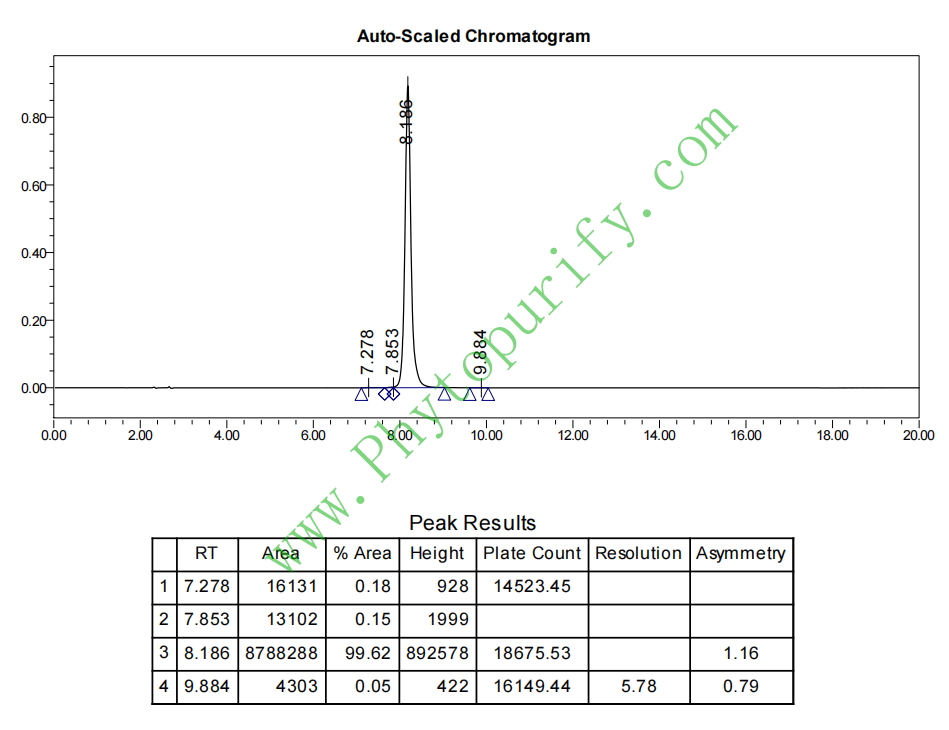
HPLC of Cyperenone
Storage conditions:Short-term storage at 2~8℃, long-term storage at -20 ~ -80℃
17.0700
3.8872
3.8872
.0231
10.0624
37.6745
High
74.9449
5.3362
No
Yes
No
No
No
No
0.0
Yes
No
Yes
Yes
Cyperenone (CAS number: 3466-15-7) is a natural product belonging to the sesquiterpene class. It was first isolated from Cyperus rotandus and other plants in the Cyperus family. As one of the main active ingredients of traditional Chinese medicinal herb Xiangfu, Xiangfu enone has attracted widespread attention due to its diverse biological activities, especially its potential role in anti-inflammatory fields. In recent years, with the deepening development of pharmacology of natural products, the chemical structure, pharmacological activity, mechanism of action, and evaluation of drug properties of vanillin have gradually been systematically elucidated, providing a theoretical basis for its clinical development.
This article aims to provide a systematic review of the chemical structure and physicochemical properties, plant sources and extraction methods, pharmacological activity research, mechanism of action and molecular targets, pharmacological evaluation and pharmacokinetic characteristics of vanillin, as well as its clinical application prospects and development trends. It is expected to provide comprehensive reference materials for researchers in related fields.
The molecular formula of Xiangfu ketone is C15H26O, with a molecular weight of 218.34. Its structure belongs to sesquiterpene ketone compounds, with a typical terpene skeleton and a ketone functional group. According to the existing structural analysis, vanillin exhibits high hydrophobicity with a LogP value of 3.8872, indicating its strong lipid solubility and favorable penetration of lipid bilayer membranes.
Its topological polar surface area (TPSA) is 17.07 Å ², indicating low molecular polarity and poor water solubility (0.0231 mg/mL), which is consistent with its hydrophobicity. Xiangfu ketone can effectively cross the blood-brain barrier, indicating its potential application value in central nervous system diseases. The negative result of hERG channel inhibition experiment indicates a low risk of cardiac toxicity; The Ames test result is 0.0, indicating no significant mutagenicity and good safety.
In summary, the physicochemical properties of Xiangfu enone are suitable for further pharmacokinetic optimization and clinical development as a drug molecule.
Cyperus rotandus L., a perennial herbaceous plant in the Cyperus family, is mainly found in the volatile oil of Cyperus rotandus L. It is widely distributed in parts of Asia, Africa, and Europe. Xiangfu is widely used in traditional Chinese medicine to regulate qi and blood, soothe the liver and relieve depression, and relieve pain.
The common methods for extracting vanillin include steam distillation and organic solvent extraction. The steam distillation method is mainly used to extract plant volatile oils, and vanillin, as one of the main components of volatile oils, has a high content. To improve purity, separation and purification techniques such as liquid-liquid extraction and column chromatography (such as silica gel column chromatography and reverse phase high-performance liquid chromatography) are usually combined.
In recent years, supercritical CO2 extraction technology has also been applied to the extraction of volatile oil from Aconitum carmichaelii, with advantages such as high extraction efficiency, good selectivity, and no solvent residue, which helps to obtain high-purity Aconitum carmichaelii ketone. In addition, modern separation techniques such as preparative HPLC and medium pressure liquid chromatography have also been used for the purification of vanillin.
The pharmacological activity research of vanillin mainly focuses on its anti-inflammatory effects and related disease models. In vitro experiments have shown that vanillin can significantly inhibit the release of various inflammatory mediators, such as tumor necrosis factor alpha (TNF - α), interleukin-6 (IL-6), etc., exhibiting good anti-inflammatory effects.
In vivo experiments, Xiangfu ketone has shown significant anti-inflammatory activity in various inflammatory models, such as mouse plantar edema model and arthritis model, which can alleviate tissue inflammatory response and reduce the expression level of inflammatory factors. In addition, Xiangfu enone also exhibits auxiliary pharmacological effects such as analgesia and antioxidation, further enhancing its therapeutic potential.
In recent years, studies have also found that vanillin has inhibitory effects on neuroinflammation, possibly by regulating neuroinflammation related signaling pathways and reducing inflammatory damage in neurological diseases. This provides a theoretical basis for its application in the treatment of neurodegenerative diseases and chronic pain.
The anti-inflammatory mechanism of vanillin involves multiple molecular targets and signaling pathways. Research has shown that its main targets include:
Through multi-target synergistic effects, Xiangfu ketone can effectively regulate multiple stages of inflammatory response, exhibiting broad-spectrum anti-inflammatory effects. In addition, its regulatory effect on TRPV1 and TRPA1 also makes it potentially valuable in pain management.
The pharmacological evaluation of Xiangfu enone shows that it has good potential for drug development. Its molecular weight is moderate (218.34 Da), which conforms to Lipinski's rule. The LogP value of 3.8872 suggests that it has good membrane permeability and can effectively cross cell membranes and the blood-brain barrier (BBB permeability is high), making it suitable for drug development in central nervous system diseases.
The low water solubility (0.0231 mg/mL) may limit its oral bioavailability, but pharmaceutical improvements (such as nanocarriers, solid dispersions, etc.) are expected to improve its solubility and absorption performance. The hERG channel inhibition experiment was negative, indicating low risk of cardiac toxicity and good safety. The Ames test result is 0, indicating no mutagenicity and meeting safety requirements.
At present, there is limited research on the pharmacokinetics of vanillin. Preliminary data suggests that it is rapidly absorbed orally, has a moderate plasma half-life, and is widely distributed in the body, especially at high concentrations in brain tissue. The metabolic pathway may involve the liver CYP450 enzyme system, and further research is needed on the metabolites and their activities.
Xiangfu enone, as a natural product with significant anti-inflammatory activity, has broad clinical application potential. Its therapeutic value in inflammatory diseases such as rheumatoid arthritis, inflammatory bowel disease, neuropathy, etc. is worth further exploration. Due to its excellent blood-brain barrier penetration, carvoxetine has broad prospects for application in central nervous system diseases such as Alzheimer's disease, multiple sclerosis, and chronic pain syndrome.
Future research should focus on the preclinical pharmacokinetics and toxicology evaluation of carvone, optimize its drug formulation, and enhance its oral bioavailability and targeting. At the same time, combining modern molecular biology techniques, further elucidating its multi-target mechanism of action provides theoretical support for precision therapy.
In addition, the structural modification and derivative development of vanillin are also important directions for expanding its drug applications. By optimizing its structure, improving its water solubility, stability, and targeting selectivity, it is expected to develop new anti-inflammatory drugs with greater clinical value.
Xiangfu enone, as a natural sesquiterpene ketone derived from traditional Chinese medicine Xiangfu, has become a research hotspot in the field of natural product pharmacology due to its significant anti-inflammatory activity and good medicinal properties. Its multi-target and multi pathway mechanism of action provides new ideas and strategies for anti-inflammatory treatment. Although the research on its pharmacokinetics and clinical application is still in its infancy, with the deepening of research, Xiangfu enone is expected to become an important candidate drug for anti-inflammatory and related disease treatment.
In the future, by combining modern medicinal chemistry, pharmacology, and pharmaceutical technology, systematic preclinical research and clinical trials of carvoxetine will be carried out, which will promote its transition from laboratory to clinical use and benefit a large number of patients. The unique advantages of natural products and the potential of vanillin give it an irreplaceable and important position in the field of natural medicine development.
