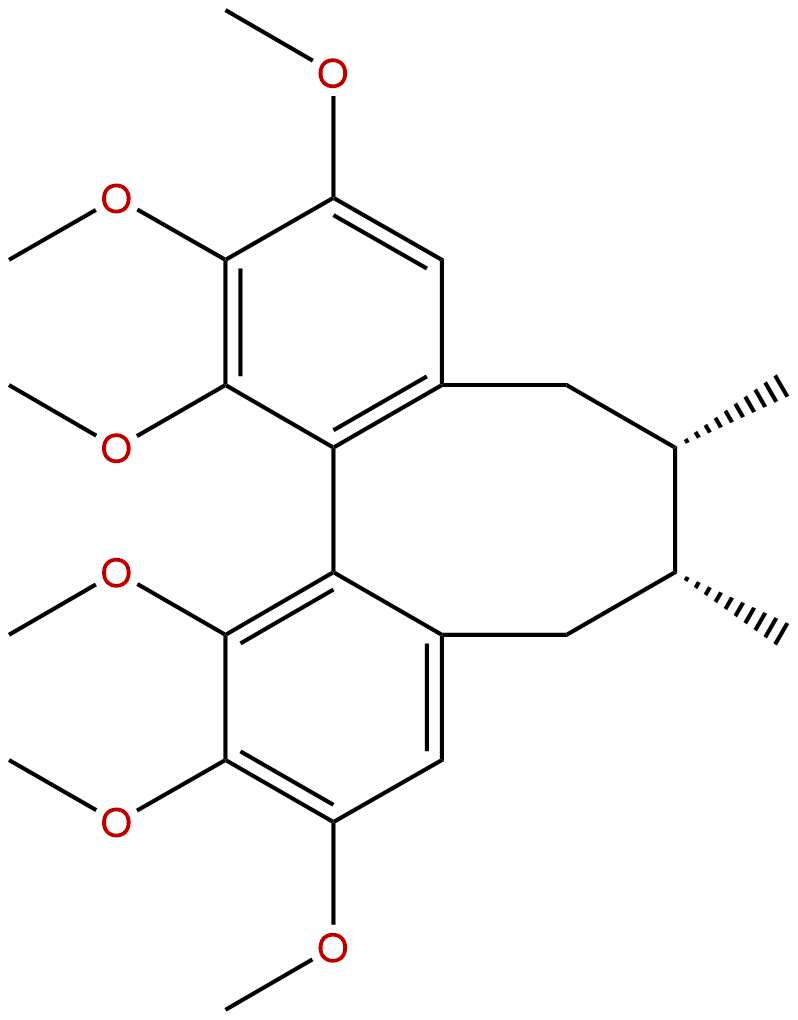


Product name: Schisandrin A
Synonym name: Deoxyschizandrin; Schizandrin A; Wuweizisu A; Dimethylgomisin J; Deoxyschisandrin
Catalogue No.: BP1261
Cas No.: 61281-38-7
Formula: C24H32O6
Mol Weight: 416.514
Botanical Source: Schisandra chinensis(Turcz.)Baill.
Physical Description:
Type of Compound: Lignans
Purity: 95%~99%
Analysis Method: HPLC-DAD or/and HPLC-ELSD
Identification Method: Mass, NMR
Packing: Brown vial or HDPE plastic bottle
Storage: Store in a well closed container, protected from air and light. Put into refrigerate or freeze for long term storage.
Whenever possible, you should prepare and use solutions on the same day. However, if you need to make up stock solutions in advance, we recommend that you store the solution as aliquots in tightly sealed vials at -20℃. Generally, these will be useable for up to two weeks.
The product could be supplied from milligrams to grams
Inquire for bulk scale.
Chengdu Biopurify Phytochemicals Ltd. is a leading company in the research, development, manufacture and marketing of High Quality Phytochemicals and Extracts(especially Active Ingredients from Traditional Chinese Medicine,TCM), Natural Active Pharmaceutical Ingredients worldwide.
The main services:
A. Supply active ingredients and reference standards of TCM, from mgs to kgs scale
B. Custom extraction and purification, target Herb Active Ingredients
C. Custom synthesis and semi-synthesis for Natural Active Ingredients
D. CR(contract research), CM(contract manufacture) and PD(process development) services from lab scale, pilot scale to commercial scale(GMP is also available)
E. TCM compounds library for drug screen,more than 3000 compounds available, many of them are rare and unique.
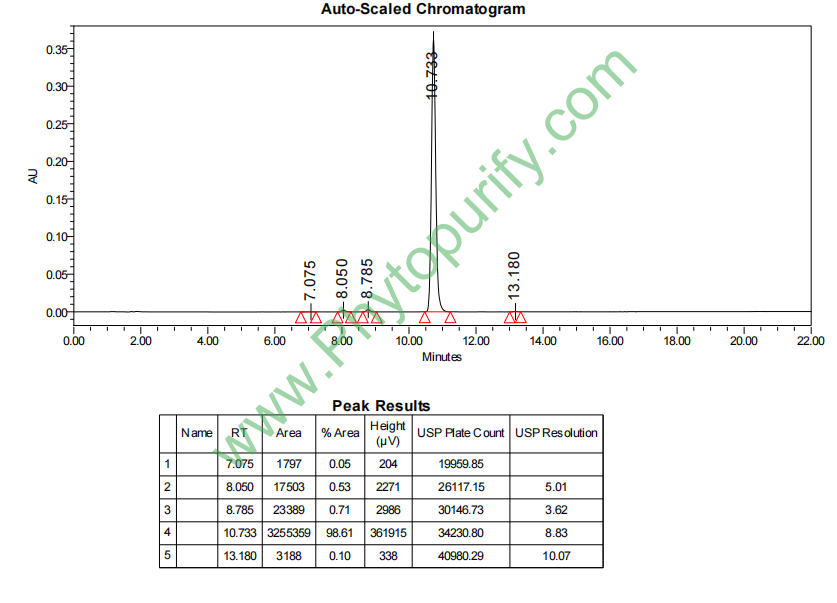
HPLC of Schisandrin A
Storage conditions:Short-term storage at 2~8℃, long-term storage at -20 ~ -80℃
Schisandrin A (CAS number: 61281-38-7) is an important diphenylcyclohexane lignan compound isolated from the traditional Chinese medicine Schisandra chinensis. As one of the most biologically active components in Schisandra chinensis, Schisandrin A has attracted widespread attention in the field of natural product pharmacology. Its unique chemical structure endows it with various biological activities, especially showing significant efficacy in liver protection, antioxidant, anti-inflammatory, and regulation of drug metabolism enzymes. In recent years, with the in-depth study of the pathogenesis of liver diseases, Schisandrin A has gradually become a research hotspot as a potential liver protectant.
This review aims to systematically summarize the chemical structure and physicochemical properties, plant sources, and extraction methods of Schisandrin A, with a focus on its pharmacological activity and mechanism of action, exploring its pharmacological properties and pharmacokinetic characteristics, and looking forward to its potential and challenges in clinical applications. It is expected to provide theoretical support and practical guidance for related research.
The chemical name of Schisandrin A is (±) -3,4,5,6,7,8-hexahydro-1,1-dimethyl-6,7-dimethyl-2H-benzo [c] chromen-2-one, with a molecular formula of C24H32O7 and a molecular weight of 416.5140. The core of its structure is a diphenylcyclohexane lignin skeleton, which contains multiple methoxy substituents and gives it strong lipid solubility.
In terms of physical and chemical properties, the LogP value of Schisandrin A is 4.9614, indicating high lipid solubility, which is beneficial for penetrating cell membranes and the blood-brain barrier (BBB permeability is high). Its polar surface area (TPSA) is 55.38 Å ², and its water solubility is extremely low (0.0013 mg/mL), indicating limited solubility in aqueous phase, which may have some impact on oral absorption and bioavailability. In terms of safety, Wuweizi Jia Su did not exhibit hERG channel inhibitory activity, and the Ames mutagenicity test was negative, demonstrating good safety characteristics.
Schisandrin A also exhibits inhibitory effects on the CYP3A subtype in the cytochrome P450 enzyme system, with an IC50 of 6.60 μ M and a Ki of 5.83 μ M, suggesting that it may affect the metabolic processes of multiple drugs and requires attention in clinical applications.
Schisandra chinensis, a traditional Chinese medicinal herb, is mainly derived from Schisandra chinensis, which is widely distributed in Northeast China, North China, and the Korean Peninsula. The fruit of Schisandra chinensis is rich in various lignans, among which Schisandrin A has a higher content and is often used as one of the quality control indicators.
The extraction process usually uses organic solvent extraction combined with column chromatography separation technology. The commonly used extraction solvents include ethanol, methanol, and their aqueous solutions. By utilizing their lipophilicity characteristics, crude extraction is performed first, and then purified and separated by silica gel column chromatography, reverse phase high performance liquid chromatography (RP-HPLC), and other methods. In recent years, green extraction techniques such as ultrasound assisted extraction and microwave-assisted extraction have also been applied to improve extraction efficiency and purity.
The optimization of extraction process not only improves the yield of schisandrin, but also provides stable and reliable raw material guarantee for subsequent pharmacological activity research and drug development.
Schisandrin A has been extensively studied in the field of liver protection. Multiple in vitro and in vivo experiments have shown that Schisandrin A can significantly alleviate pathological conditions such as drug-induced liver injury, alcoholic liver injury, and liver fibrosis. Its liver protective effects mainly manifest as antioxidant, anti-inflammatory, and regulation of liver cell apoptosis.
In the drug-induced liver injury model, schisandrin activates the nuclear factor erythroid 2-related factor 2 (NRF2) signaling pathway, promoting the expression of downstream antioxidant enzymes such as superoxide dismutase (SOD1, SOD2), catalase (CAT), glutathione peroxidase (GPX1), and NAD (P) H quinone oxidoreductase 1 (NQO1), significantly enhancing cellular antioxidant defense ability, reducing the accumulation of reactive oxygen species (ROS), and alleviating oxidative stress damage.
In addition, Schisandrin A can downregulate the expression of transforming growth factor beta 1 (TGFB1) and alpha smooth muscle actin (ACTA2), inhibit the activation of hepatic stellate cells, and slow down the process of liver fibrosis. Its regulatory effect on matrix metalloproteinase 9 (MMP9) also helps maintain liver matrix homeostasis and prevent excessive fibrosis.
Schisandrin A regulates the NRF2/ARE signaling pathway, induces the expression of various antioxidant enzymes, and significantly enhances cell resistance to oxidative damage. Its anti-inflammatory effect is related to the inhibition of nuclear factor kappa B (NF - κ B) activation and downstream pro-inflammatory cytokine expression, effectively reducing the inflammatory response.
Schisandrin A has a significant inhibitory effect on liver drug metabolizing enzyme CYP3A, with IC50 and Ki values of 6.60 μ M and 5.83 μ M, respectively. CYP3A, as one of the most important drug metabolizing enzymes in the human body, participates in the metabolic conversion of various drugs. The inhibitory effect of schisandrin suggests that it may cause drug interactions, affecting the pharmacokinetics and efficacy of co administered drugs.
The biological effects of Schisandrin A are mainly achieved through multiple signaling pathways and molecular targets:
NRF2/ARE signaling pathway Schisandrin A activates NRF2, promotes its nuclear translocation, enhances the expression of antioxidant enzyme genes, improves cellular antioxidant capacity, and reduces oxidative stress.
Anti-inflammatory signal regulation By inhibiting the NF - κ B pathway and reducing the release of pro-inflammatory cytokines such as TNF - α and IL-6, the inflammatory response is alleviated.
Liver fibrosis related targets Downregulate the expression of TGFB1 and ACTA2, inhibit the activation of hepatic stellate cells, reduce collagen deposition, and alleviate liver fibrosis.
Matrix metalloproteinases regulation Regulating MMP9 expression, maintaining dynamic balance of liver matrix, and preventing excessive fibrosis.
Drug metabolizing enzyme inhibition Directly inhibiting CYP3A enzyme activity, affecting drug metabolism, suggests potential risks in combination therapy.
These multi-target and multi pathway mechanisms of action together form the basis for the multiple pharmacological effects of Schisandrin A.
The pharmacological evaluation of Schisandrin A shows that it has certain advantages and challenges:
Fat solubility and bioavailability A high LogP value (4.96) and low water solubility (0.0013 mg/mL) indicate strong lipid solubility, but poor water solubility, which may limit oral absorption efficiency. It is necessary to improve its solubility and bioavailability through formulation technology.
Blood-brain barrier permeability High blood-brain barrier permeability suggests that it may play a role in the central nervous system and broaden its indications.
safety No hERG inhibition and no mutagenicity (Ames test negative), with good safety.
Pharmacokinetic characteristics Existing studies have shown that Schisandrin A is absorbed quickly after oral administration, widely distributed in the body, and significantly enriched in the liver, which meets the targeted requirements for its liver protective effect. Its inhibitory effect on CYP3A suggests the possibility of drug interaction risks, and further research is needed on its metabolic pathways and clearance mechanisms.
Overall, Schisandrin A has good safety and biological activity, but its pharmacokinetic properties need to be optimized to enhance its clinical application potential.
Schisandrin A, as a natural product, has broad clinical application prospects due to its significant liver protective effect and good safety. Its potential therapeutic value in various liver diseases such as drug-induced liver injury, alcoholic liver disease, non-alcoholic fatty liver disease, and liver fibrosis has been confirmed by a large amount of basic research.
Future clinical translation should focus on the following aspects:
Formulation development and optimization of administration routes To address its poor water solubility, new dosage forms such as nano formulations, liposomes, and solid dispersions have been developed to improve oral bioavailability.
Drug interaction research Thoroughly evaluate its impact on CYP3A and other drug metabolizing enzymes, guide rational combination therapy, and avoid adverse reactions.
Clinical trial design Conduct systematic clinical safety and efficacy evaluations, clarify the scope of indications and dosage of medication.
Research on multi-target mechanism Combining modern molecular biology techniques to further elucidate its mechanism of action and explore new indications.
Combination therapy strategy Explore the synergistic effects with other liver protective drugs or antioxidants to enhance treatment efficacy.
In summary, Schisandrin A, as a natural product with multiple pharmacological activities, has the potential to become a new drug for the treatment of liver diseases. However, its clinical application still needs to overcome challenges in pharmacokinetics and drug interactions.
Schisandrin A, as the main active ingredient in Schisandra chinensis, exhibits significant pharmacological activity in liver protection and antioxidant fields due to its unique chemical structure and multi-target mechanism of action. It achieves multi-level protection of the liver by activating the NRF2 signaling pathway, regulating antioxidant enzyme expression, inhibiting inflammatory response, and regulating liver fibrosis related molecules. Meanwhile, the inhibitory effect of Schisandrin A on CYP3A suggests that drug interactions should be taken into account in its clinical application.
In the future, combining modern pharmaceutical formulation technology and systematic pharmacokinetic research to optimize the pharmacological properties of Schisandrin A will provide a solid foundation for its clinical translation. With the in-depth analysis of its mechanism of action and the advancement of clinical research, Schisandrin A is expected to become an effective natural medicine for the treatment of liver diseases, contributing new strength to natural product pharmacology research and liver disease treatment.
