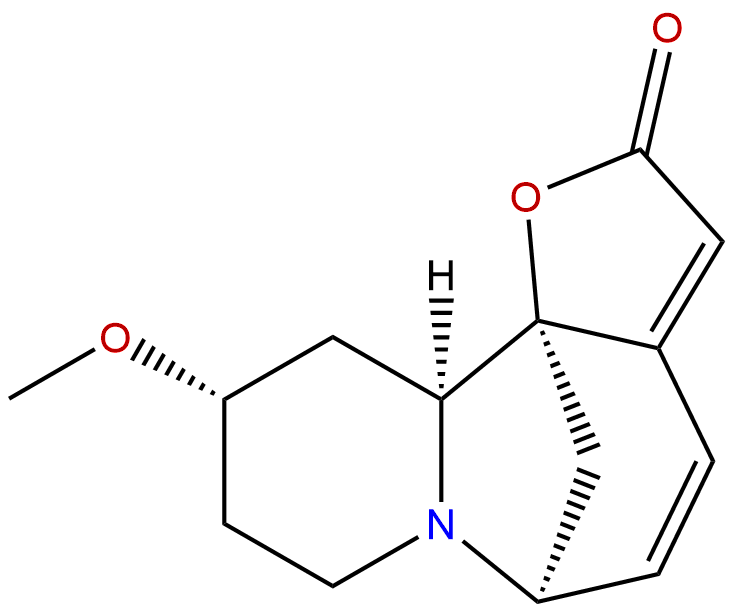


Product name: Securitinine
Synonym name:
Catalogue No.: SBP03634
Cas No.: 13861-71-7
Formula: C14H17NO3
Mol Weight: 247.294
Botanical Source:
Physical Description:
Type of Compound: Alkaloids
Purity: 95%~99%
Analysis Method: HPLC-DAD or/and HPLC-ELSD
Identification Method: Mass, NMR
Packing: Brown vial or HDPE plastic bottle
The product could be supplied from milligrams to grams. Inquire for bulk scale.
We provide solution to improve the water-solubility of compounds, thereby facilitating the variety of activity tests and clinic uses.
For Reference Standard and R&D, Not for Human Use Directly.
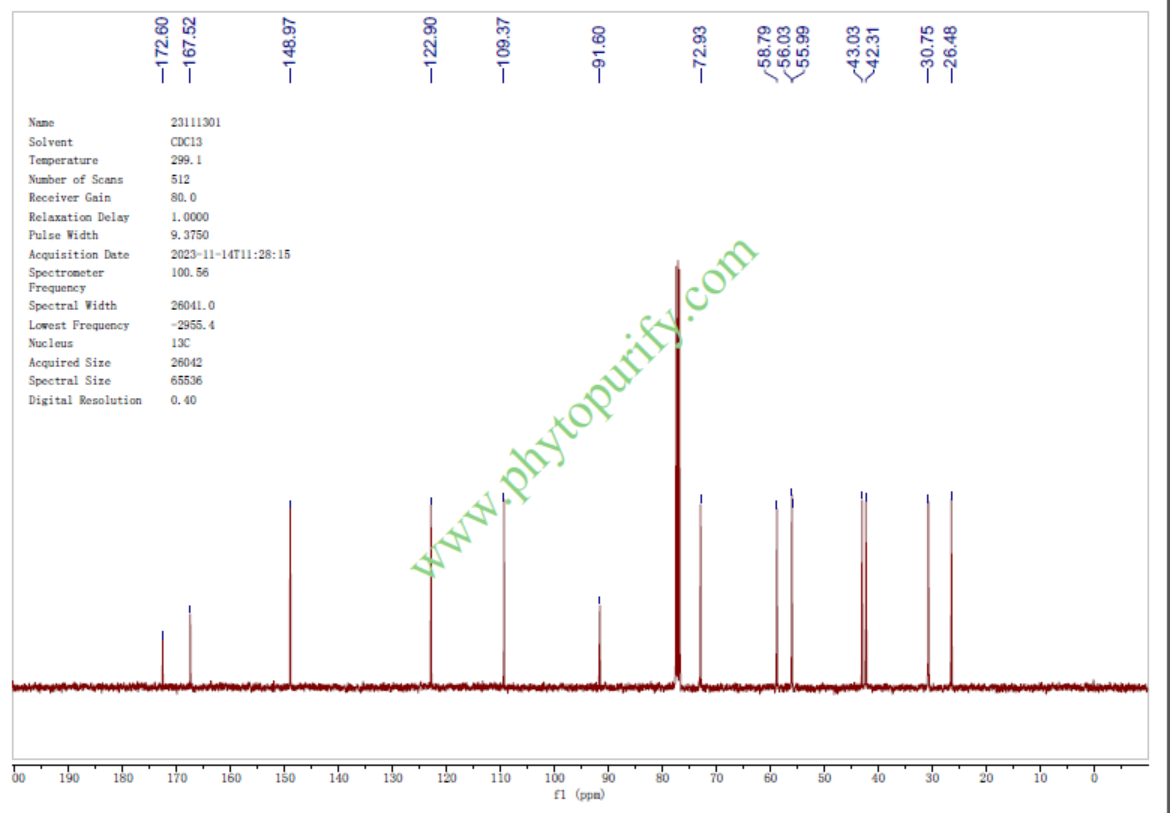
NMR of Securitinine
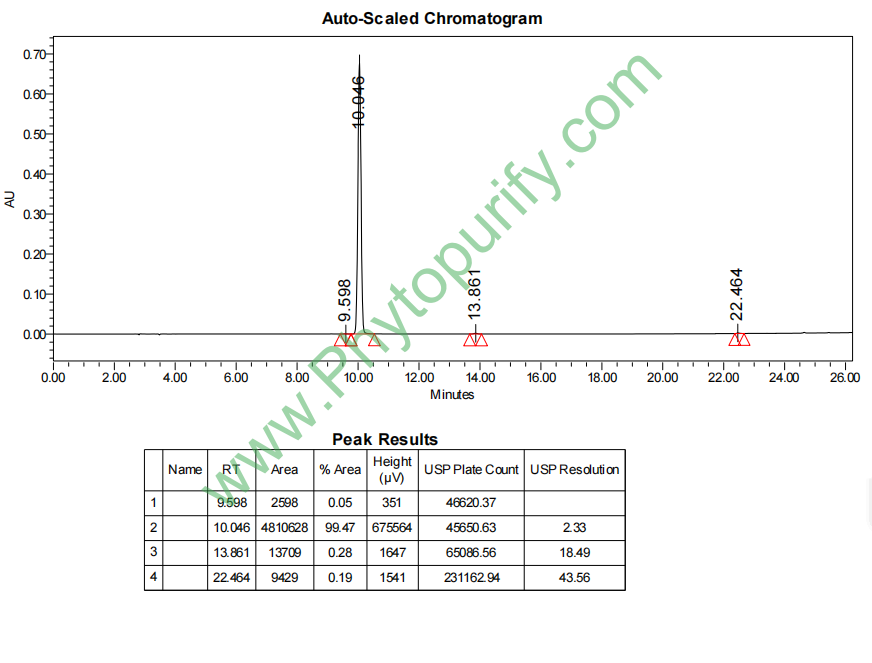
HPLC of Securitinine
Storage conditions:Short-term storage at 2~8℃, long-term storage at -20 ~ -80℃
38.7700
.9579
.9011
4.3445
4.6342
12.3913
High
34.3101
5.8691
No
Yes
Yes
No
Yes
No
1.2
No
Yes
Yes
Yes
Securitine (CAS number: 13861-71-7) is a traditional medicinal plant Yiye Hagi(Securinega suffruticosa)The natural alkaloids isolated from the leaves belong to the alkaloid class compounds at the bottom of the leaves. Its molecular formula is C14H17NO3 and its molecular weight is 247.2940 g/mol. As a research object in the fields of natural product chemistry and medicinal chemistry, Yiyeqixin alkaloid has attracted attention due to its unique chemical structure and potential biological activity. Existing research data shows that this compound interacts with multiple neural related targets such as CREB1, BDNF, NGF, etc., and exhibits neuroprotection This aspect demonstrates potential application value. This makes it one of the candidate molecules for developing drugs to treat neurodegenerative diseases (such as Alzheimer's disease, Parkinson's disease) or repair nerve damage. This article will systematically introduce this natural product from its chemical structure, plant origin, pharmacological mechanism, medicinal evaluation, and research prospects.
The chemical structure of Yiyeqixin alkaloid has typical alkaloid characteristics, and its SMILES is expressed as:CO[C@H]1CCN2[C@@H]3C=CC4=CC(=O)O[C@]4(C3)[C@@H]2C1From this representation, it can be seen that the molecule contains multiple chiral centers (represented by@and@@The symbol indicates that its stereochemical structure is complex and may have significant impacts on biological activity and selectivity. The structure contains heterocyclic systems such as tetrahydropyrrole ring and furanone ring, which are commonly found in biologically active natural products.
From the analysis of the provided pharmacological parameters:
- Molecular weight (MW)It is 247.29 g/mol, which is within the typical range of small molecule drugs (<500 Da).
- Lipid water partition coefficient (LogP)Is 0.96,LogD A value of 0.90 indicates that the compound has moderate lipophilicity, neither too hydrophobic (LogP>5 may lead to solubility and absorption issues) nor too hydrophilic (LogP<0 may lead to poor membrane permeability), which facilitates its penetration through biological membranes.
- Topological Polarity Surface Area (TPSA)The value of 38.77 Å ² is relatively low and is usually associated with good membrane permeability, especially for neuroactive substances that need to penetrate the blood-brain barrier (BBB), which is a favorable feature.
- Water solubility At 4.34 mg/mL (estimated unit), it indicates that it has a certain solubility in water, which is beneficial for formulation development and in vivo distribution.
- Caco-2 cell permeability The value of 12.39 (× 10 ⁻⁶ cm/s) is relatively high, indicating that it may have good intestinal absorption characteristics.
- Blood-brain barrier permeability (BBB permeability)Marked as' high ', this is consistent with its lower TPSA and moderate LogP values, providing a key pharmacokinetic basis for its pharmacological effects in the central nervous system.
These physical and chemical parameters collectively depict a small molecule profile with a good drug like starting point.
Yiyeqixin alkaloid comes from plants Yiye Hagi(Securinega suffruticosa)This plant belongs to the Phyllanthaceae family. Yiye Hagi is mainly distributed in East Asia, including China, Japan, and Korea. In traditional medicine, especially in folk medicine in China and Japan, the roots, stems, leaves, and other parts of Hagia multiflora are often used to treat various diseases. The literature records its uses, including Dispelling wind and dampness, relaxing tendons and activating collaterals, reducing swelling and relieving pain Commonly used for conditions such as rheumatism, numbness in limbs, and injuries from falls. Modern plant chemistry research has isolated various structurally unique alkaloids from this genus of plants, and one of them is the alkaloid Yiyeqixin. These alkaloids are considered as important material basis for the pharmacological activity of this plant. There seems to be a certain correlation between the traditional use of "unblocking collaterals" and the discovery of its neuroprotective activity in modern research, reflecting the enlightening role of traditional medicinal experience in modern drug discovery.
According to the provided target information, the action of Yiyeqixin alkaloid is related to multiple key factors related to nerve growth, survival, and plasticity, mainly targeting neuroprotection This core pharmacological activity. Below are interpretations of each target and its possible mechanisms:
CREB1 (cAMP response element binding protein 1)CREB1 is an important transcription regulator in cells, activated by various signaling pathways such as cAMP/PKA, MAPK/ERK, CaMKIV. Activated CREB1 can promote the expression of a series of genes related to neuronal survival, synaptic plasticity, and memory formation, such as BDNF and Bcl-2. If Yiyeqixin alkaloid can activate or enhance the activity of CREB1, it may resist neurotoxic damage and promote neuronal survival by upregulating these protective genes.
BDNF (brain-derived neurotrophic factor)BDNF is a core member of the neurotrophic factor family and is crucial for the survival, differentiation, growth, synaptic function, and plasticity of neurons. BDNF signaling pathway disorders are associated with various neurodegenerative diseases and depression. Yiyeqixin alkaloid may upregulate the expression of BDNF or enhance its signal transduction directly or indirectly (such as through CREB1), thereby exerting neurotrophic and protective effects.
NGF (nerve growth factor) and GDNF (glial cell derived neurotrophic factor)Both are important neurotrophic factors. NGF mainly acts on sensory neurons and cholinergic neurons, while GDNF has a strong protective effect on dopaminergic neurons, motor neurons, etc. If Yiyeqixin alkaloid can produce a synergistic effect with these neurotrophic factor systems, it may provide more precise protection against specific types of neuronal damage, such as dopaminergic neurons in Parkinson's disease.
SYP (synaptophysin)SYP is a marker protein on the presynaptic vesicle membrane, involved in the release of neurotransmitters, and its expression level is often used as an indicator of synaptic density and function. In neurodegenerative diseases, synaptic loss and decreased expression of SYP are often observed. If Yiyeqixin alkaloid can enhance the expression of SYP, it suggests that it may have Protect or promote synaptic structural integrity and improve synaptic function The role is crucial for maintaining cognitive function.
Mechanism of Action Integration Hypothesis Based on the above targets, the neuroprotective mechanism of Yiyeqixin alkaloid may be a synergistic process involving multiple targets and pathways. It may activate intracellular signal transduction (such as PKA, MAPK pathways) through some initial signal (such as affecting the neurotransmitter system or directly acting on specific receptors), thereby phosphorylating and activating transcription factor CREB1. Activated CREB1 enters the nucleus and initiates transcription of neurotrophic factor genes such as BDNF. The increased BDNF binds to its receptor TrkB through autocrine or paracrine pathways, further enhancing survival signaling pathways (such as PI3K/Akt, Ras/MAPK), inhibiting apoptosis, promoting neuronal survival, and synthesizing synaptic proteins (such as SYP). At the same time, it may also have cross dialogue with other neurotrophic factors such as NGF and GDNF, forming a broad neuroprotective network. This multi-target mode of action, although increasing the complexity of mechanism research, may also bring more comprehensive and robust therapeutic effects, which is a characteristic of many natural products.
Based on the provided pharmacological parameters and combined with classical methods Lipinski's Five Rules Preliminary evaluation based on Rule of Five (Ro5):
1. Molecular weight (MW):247.29 (<500),Comply with。
2. Lipid water partition coefficient (LogP):0.96 (<5),Comply with。
3. Number of hydrogen bond donors (HBDs)From the structural formula, it can be inferred that there may be 0 or 1 (- NH - or - OH),Comply with(<5)。
4. Number of hydrogen bond acceptors (HBA)The molecular formula contains 3 O's and 1 N, totaling 4,Comply with(<10)。
5. Number of rotatable keys Inferring from the structure, the quantity is relatively small,Comply with(Usually<10).
Therefore, Yiyeqixin alkaloid fully complies with Lipinski's five rules, indicating its good oral absorption potential.
Further analysis of other key parameters:
- Absorption and distribution High Caco-2 permeability and high BBB permeability are its most prominent advantages, which means it is likely to have good oral bioavailability and can effectively enter the central nervous system, which is crucial for its neuroprotective effects.
- Protein binding rate (PPB)34.31%, belonging to the moderate to low level, means that the proportion of free (active) drugs in the blood is relatively high, which is conducive to the efficacy of the drug.
- Metabolism and toxicity This is an aspect that requires focused attention and careful evaluation.
- Genotoxicity The Ames test value is 1.2 (usually>1.1 is considered a potential positive), and the detection of "chromosomal aberration" is "present", indicating the possible presence of Ichthyosamine Genetic toxicity risk It is a "red flag" signal that needs to be strictly screened and evaluated in drug development.
- cardiotoxicity HERG inhibition as' no 'is a positive signal that reduces the likelihood of causing QT interval prolongation in the heart.
- Hepatotoxicity The serum markers GGT, AST, and ALT are all "yes", indicating that they may have Potential risk of liver injury Detailed validation is required through liver cell toxicity experiments and in vivo liver enzyme indicators in preclinical studies.
- Other toxicities Skin sensitization and respiratory sensitization are "yes", indicating that it may be a allergen and should be protected during preparation and production processes.
- Phototoxicity and Serum alkaline phosphatase (ALK) Raising risk to 'none' or 'no' is a neutral or positive signal.
Comprehensive evaluation of drug properties One Leaf Hagiuxin Alkali Excellent performance in pharmacokinetic (ADME) properties Especially its excellent BBB penetration has laid a solid foundation for its use as a neuroprotective agent. However, it There are obvious safety (toxicity) hazards The potential genetic toxicity and liver toxicity, in particular, are the main obstacles hindering its direct path towards drug development. Future research needs to first confirm and quantify these risks through more comprehensive in vitro and in vivo toxicology experiments, and explore the use of Structural modification To eliminate toxicity, preserve or enhance the possibility of activity.
At present, research on Yiyeqixin alkaloid is still in progress Early detection and preliminary activity verification stage The existing data mainly focuses on the identification of its plant origin, analysis of its chemical structure, and neuroprotective activity based on target prediction or preliminary cell models. Its specific target proteins (whether they bind directly or indirectly), detailed signaling pathways, and effectiveness and safety in animal disease models (such as Alzheimer's disease, cerebral ischemia, and spinal cord injury models) still require in-depth and systematic research.
Application prospects and future directions:
1. Deepening mechanism research The primary task is to use techniques such as molecular docking, surface plasmon resonance (SPR), and cell thermal shift analysis (CETSA) to verify its direct interaction with predicted targets such as CREB1 and BDNF. And through methods such as gene knockout/knockout, reporter gene experiments, and pathway inhibitors, the signaling network is elaborated in detail at the cellular level.
2. lead optimization Systematically address its toxicity issues Structure Activity Relationship (SAR) Study and Structural modification For example, by synthesizing its derivatives or analogues, search for optimized molecules that retain or even enhance activity but significantly reduce genotoxicity and hepatotoxicity. Its relatively simple molecular skeleton provides a good foundation for chemical modification.
3. Preclinical development After obtaining candidate compounds with improved safety, standardized preclinical pharmacological, pharmacokinetic, and toxicological studies need to be conducted to validate their efficacy in reliable animal disease models, and GLP standard safety evaluation experiments need to be completed to provide data support for possible clinical trial applications.
4. Potential application areas If its neuroprotective activity is confirmed and safety issues are resolved, its potential applications can cover Acute nerve injury(such as adjuvant therapy for stroke and traumatic brain injury)Chronic neurodegenerative diseases Disease course modification therapy for conditions such as Alzheimer's disease, Parkinson's disease, and amyotrophic lateral sclerosis, and may even be used for depression or Cognitive impairment Improvement.
In summary, as a natural small molecule with a unique structure and good brain permeability, Yiyeqixin alkaloid provides a valuable starting point for the development of neuroprotective drugs. However, the road from natural products to safe and effective drugs is long and challenging, especially in overcoming their toxicity barriers, which will be the key to determining their future fate. It will continue to attract the joint attention of medicinal chemists, pharmacologists, and neuroscientists, exploring its true translational medical value through interdisciplinary research.
