


Synonym name: Irinotecan Related Compound E
Catalogue No.: BP0100
Cas No.: 78287-27-1
Formula: C22H20N2O4
Mol Weight: 376.412
Botanical Source:
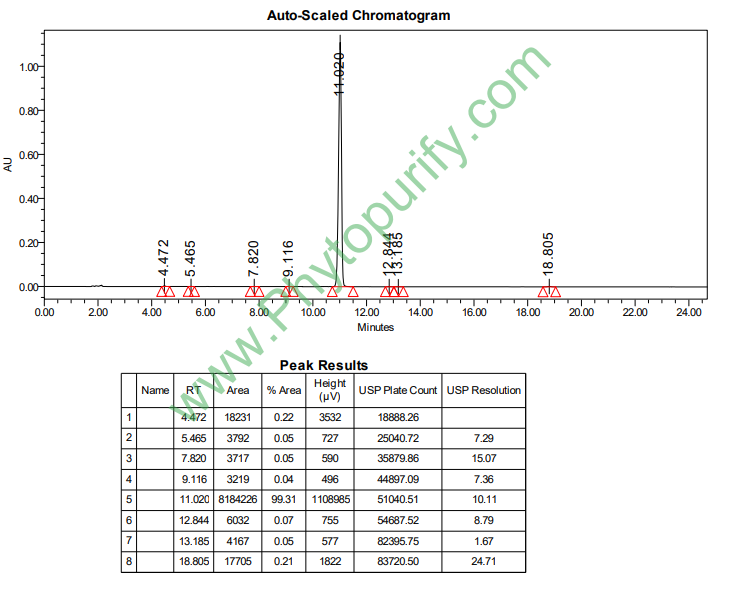
Purity: 95%~99%
Analysis Method: HPLC-DAD or/and HPLC-ELSD
Identification Method: Mass, NMR
Packing: Brown vial or HDPE plastic bottle
Can be supplied from milligrams to grams.
For Reference Standard and R&D, Not for Human Use Directly.
Inquire for bulk scale.
HPLC of 7-Ethylcamptothecin
Storage conditions:Short-term storage at 2~8℃, long-term storage at -20 ~ -80℃
86.1300
2.2500
1.7800
High
No
No
No
No
No
Negative
7-Ethylcamptothecin (CAS number: 78287-27-1) is a natural product derivative with significant anti-tumor activity, belonging to the pyrano indazino quinoline class of compounds. As a structurally modified product of camptothecin (CPT), 7-ethylcamptothecin has attracted much attention in the field of anti-cancer drug development. It exhibits superior pharmacological properties in vivo compared to camptothecin, especially in terms of stronger activity in inhibiting tumor cell growth, and has a longer residence time and higher bioavailability in the intestine. In addition, 7-ethylcamptothecin is also a key intermediate for the synthesis of 7-ethyl-10-hydroxycamptothecin (SN-38), which is the active metabolite of the widely used anticancer drug Irinotecan in clinical practice.
In recent years, in addition to its potential in cancer treatment, 7-ethylcamptothecin has also shown new application prospects in related research on diseases such as pulmonary hypertension (PH). By regulating multiple molecular targets, including DNA topoisomerase I (TOP1), hypoxia inducible factor 1 alpha (HIF1A), histone deacetylase 6 (HDAC6), endothelin receptor B (EDNRB), and prolyl hydroxylase (EGLN1), 7-ethylcamptothecin is expected to exert multi-target synergistic regulation and expand its clinical indications.
This article provides a systematic review of the chemical structure and physicochemical properties, plant sources and extraction methods, pharmacological activity and mechanism of action, pharmacological evaluation and pharmacokinetic characteristics of 7-ethylcamptothecin, and explores its clinical application prospects and future development directions. The aim is to provide theoretical basis and research references for the pharmacology of natural products and the development of anti-tumor drugs.
7-Ethylcamptothecin is a complex pyranosindolequinone alkaloid with the molecular formula C20H21N2O4 and a molecular weight of 376.41. Structurally, 7-ethylcamptothecin introduces an ethyl substituent at the 7th position on the basis of camptothecin, which significantly affects its pharmacological activity and pharmacokinetic properties. Its core structure includes a polycyclic system of fused pyran ring and indazole ring, with a typical indoline alkaloid skeleton and polar functional groups such as hydroxyl and carboxyl groups.
In terms of physicochemical properties, the LogP of 7-ethylcamptothecin is 2.25, indicating its moderate lipid solubility, which is beneficial for membrane penetration and in vivo distribution. Its topological polar surface area (TPSA) is 86.13 Å ², and the number of hydrogen bond acceptors is 6, all of which comply with the drug similarity rules for oral small molecule drugs (such as Lipinski rule), indicating its good oral bioavailability potential. The high permeability of the blood-brain barrier suggests that it may affect the central nervous system and requires attention to its safety in clinical applications.
Toxicological evaluation shows that 7-ethylcamptothecin has low risk of hepatotoxicity, no cardiac toxicity, no hERG channel inhibition effect, negative Ames mutagenicity test, and overall ideal safety, which meets the requirements for further development as a clinical drug.
7-Ethylcamptothecin was originally derived from the structural modification of camptothecin, a natural product of the Chinese medicinal herb Camptotheca acuminata. Camptotheca acuminata is a plant of the Wisteriaceae family, mainly distributed in southern China and Southeast Asia. Its dry bark and root bark are rich in camptothecin and its derivatives. The extraction of camptothecin is usually carried out using organic solvent extraction combined with liquid chromatography separation and purification technology. The extraction process is mature and the yield is stable.
7-Ethylcamptothecin, as a semi synthetic derivative of camptothecin, is usually obtained through chemical synthesis routes. The synthesis process uses camptothecin as the starting material and undergoes a 7-position ethylation reaction to achieve structural modification. The key steps in the synthesis process include selective protection and deprotection, nucleophilic substitution reactions, and purification and separation to ensure the high purity and structural integrity of the product.
In recent years, with the development of synthetic biology and enzyme catalysis technology, some studies have attempted to use microbial fermentation and enzyme catalyzed synthesis strategies to improve the yield and environmental friendliness of 7-ethylcamptothecin. In addition, the construction of a derivative library based on camptothecin also provides the possibility to search for more active and pharmacokinetic analogs.
The pharmacological activity of 7-ethylcamptothecin is mainly reflected in its anti-tumor effect. Compared with the parent compound camptothecin, 7-ethylcamptothecin exhibits stronger growth inhibition ability in various tumor cell lines. Its anti-tumor activity covers lung cancer, colorectal cancer, breast cancer, ovarian cancer and other solid tumors, and shows good anti-tumor effect in vivo animal models.
In vivo pharmacological studies have shown that the retention time of 7-ethylcamptothecin in the intestine is prolonged, the blood concentration is maintained for a longer period of time, the bioavailability is significantly improved, and the frequency of administration and dose-dependent toxic side effects are reduced. Its distribution advantage in the tumor microenvironment enhances the selective killing of tumor cells.
In addition to anti-tumor effects, 7-ethylcamptothecin has also shown potential therapeutic value in the study of non tumor diseases such as pulmonary hypertension. Pulmonary hypertension is a lethal disease characterized by elevated pulmonary artery pressure. 7-ethylcamptothecin has shown the potential to alleviate symptoms of pulmonary hypertension by regulating key molecular targets, inhibiting vascular remodeling and inflammatory responses.
The main mechanism of action of 7-ethylcamptothecin is to inhibit the activity of DNA topoisomerase I (TOP1), block DNA replication and transcription processes, and induce tumor cell apoptosis. TOP1 is a key enzyme that maintains the supercoiled state of DNA. 7-ethylcamptothecin binds to the TOP1-DNA complex, stabilizing the complex and leading to the accumulation of DNA strand breaks, ultimately triggering cell death.
In addition, the therapeutic potential of 7-ethylcamptothecin in pulmonary hypertension involves multi-target regulation:
HIF1A (hypoxia inducible factor 1 alpha)7-Ethylcamptothecin can inhibit the expression and activity of HIF1A, alleviate vascular dysplasia and metabolic reprogramming under hypoxic conditions.
HDAC6 (histone deacetylase 6)By regulating HDAC6 activity, 7-ethylcamptothecin affects cytoskeleton remodeling and inflammatory response, helping to alleviate abnormal proliferation of pulmonary vascular smooth muscle cells.
EDNRB (endothelin receptor B)Regulating vascular constriction and dilation, 7-ethylcamptothecin improves pulmonary artery pressure by affecting the EDNRB signaling pathway.
EGLN1 (prolyl hydroxylase)As a regulatory factor of HIF1A, EGLN1 activity is indirectly regulated by 7-ethylcamptothecin, further affecting hypoxia response.
These multi-target mechanisms not only enhance the therapeutic effect of 7-ethylcamptothecin, but also provide a theoretical basis for its application in various diseases.
The pharmacological parameters of 7-ethylcamptothecin show that it has good potential for drug development. The molecular weight of 376.41, LogP 2.25, and TPSA 86.13 meet the ideal range in drug design, indicating good membrane permeability and oral absorption capacity. The number of hydrogen bond acceptors is 6, which is conducive to stable binding with biomolecules.
The high permeability of the blood-brain barrier suggests that it may penetrate the central nervous system, and attention should be paid to potential central nervous system toxicity and side effects. Toxicological assessment shows low risk of hepatotoxicity, no cardiac toxicity or hERG channel inhibition, negative Ames test, and overall good safety.
Pharmacokinetic studies have shown that 7-ethylcamptothecin has a long half-life and high bioavailability in vivo, with prolonged intestinal retention time, which is beneficial for oral administration. Its metabolic pathway is mainly transformed through the liver enzyme system, and the activity and toxicity of metabolites need further in-depth research.
7-Ethylcamptothecin, as an important derivative of camptothecin based anti-tumor drugs, has broad clinical application prospects due to its excellent anti-tumor activity and good safety. It has shown potential advantages in the treatment of various solid tumors such as lung cancer and colorectal cancer, and is particularly suitable for development as an oral anti-cancer drug to improve patient compliance.
In addition, the multi-target mechanism of 7-ethylcamptothecin in non tumor diseases such as pulmonary hypertension provides new possibilities for expanding its indications. In the future, precision medicine strategies can be combined to design personalized treatments targeting specific molecular targets.
Future research directions include:
Optimize the synthesis process, improve yield and purity, and reduce production costs.
Thoroughly analyze its pharmacokinetics and metabolic mechanisms, clarify active metabolites and toxicity risks.
Combining nanotechnology and drug delivery systems to improve targeting and therapeutic efficacy.
Conduct preclinical and clinical trials to verify its safety and efficacy.
Explore combination therapy strategies to enhance anti-tumor efficacy and overcome drug resistance.
7-Ethylcamptothecin, as a structurally modified product of camptothecin, has become an important research object in the field of natural product pharmacology due to its excellent anti-tumor activity and good pharmacokinetic properties. Its multi-target mechanism of action not only broadens the therapeutic scope of anticancer drugs, but also provides new ideas for the treatment of diseases such as pulmonary hypertension. With the continuous advancement of synthesis technology and drug delivery systems, 7-ethylcamptothecin is expected to play a greater role in clinical practice and become a new generation of efficient and safe anti-tumor and pulmonary hypertension treatment drugs. In the future, systematic pharmacological research and clinical validation will be the key to promoting its translational applications.
