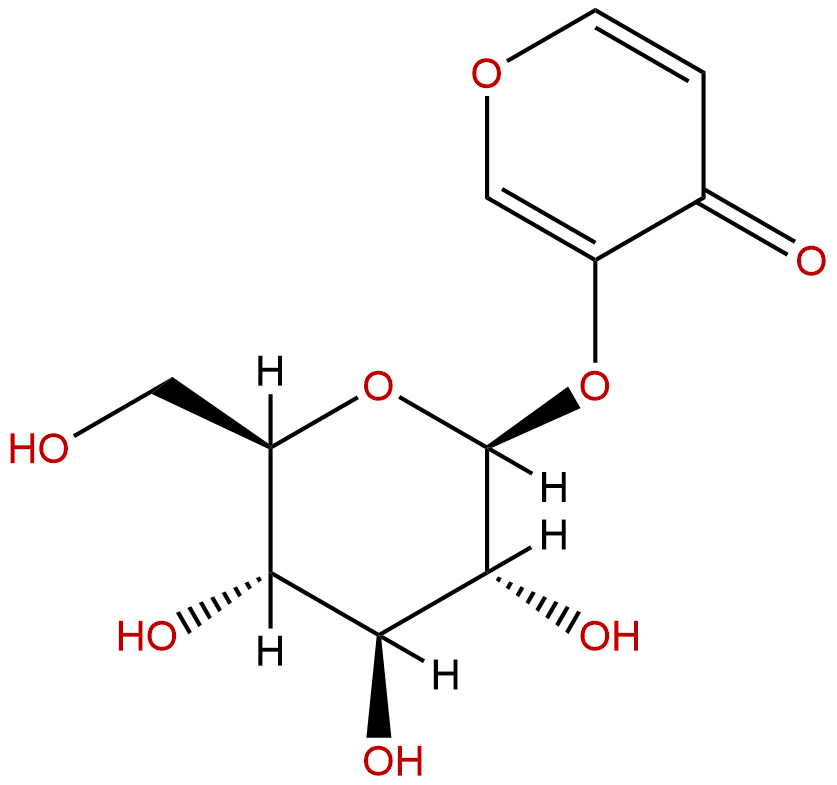
| Catalog No | Package | Original Price | Price | Inventory | Quantity | Operating |
|---|---|---|---|---|---|---|
| BP0551-5mg | 5mg | $360.00 | Sign in |
|


Synonym name: 4-Pyrone-3-beta-D-glucopyranoside
Catalogue No.: BP0551
Cas No.: 59219-76-0
Formula: C11H14O8
Mol Weight: 274.225
Botanical Source: Erigeron sp.
Purity: 95%~99%
Analysis Method: HPLC-DAD or/and HPLC-ELSD
Identification Method: Mass, NMR
Packing: Brown vial or HDPE plastic bottle
Can be supplied from milligrams to grams.
For Reference Standard and R&D, Not for Human Use Directly.
Inquire for bulk scale.
Storage conditions:Short-term storage at 2~8℃, long-term storage at -20 ~ -80℃
Erigeroside (CAS number: 59219-76-0) is a natural product isolated from the plant Satureja khuzistanica Jamzad and belongs to the class of glucose derivatives. In recent years, with the increasing importance of natural products in the field of drug development, Feipeng glycoside has gradually become a hot topic in pharmacological research due to its significant antioxidant properties and potential anti-tumor activity. Oxidative stress is closely related to the occurrence and development of various diseases, especially in the tumor microenvironment, where the ability to clear oxidative free radicals directly affects cell survival and apoptosis. Feipeng glycoside exhibits excellent ability to scavenge oxidative free radicals, indicating its broad application prospects in anti-tumor, anti-inflammatory, and neuroprotective fields.
This article aims to systematically review the chemical structure and physicochemical properties, plant sources and extraction methods, pharmacological activity and mechanism of action of Feipenoside, with a focus on exploring its anti-tumor related molecular targets and drug efficacy evaluation. Combined with existing pharmacokinetic data, the clinical application potential of Feipenoside is discussed, providing theoretical basis and reference for subsequent drug development and clinical research.
The molecular formula of Feipeng glycoside is C12H18O7, with a molecular weight of 274.2250, and it belongs to glucose derivatives. Its structure contains multiple hydroxyl groups, endowing it with strong hydrophilicity and antioxidant activity. The LogP value is -1.4310, indicating strong hydrophilicity and a water solubility of 61.7935 mg/mL, indicating good solubility of paeoniflorin in aqueous phase. The topological polar surface area (TPSA) of polarity is 129.59 Å ², indicating that it has strong polar groups, which have a certain impact on its biofilm penetration ability.
From a pharmacokinetic perspective, the blood-brain barrier permeability of Feipeng glycoside is relatively low, which may limit its effects in the central nervous system, but is beneficial for reducing central nervous system related side effects. The negative result of hERG inhibition experiment indicates a low risk of cardiac toxicity. The Ames test score is 0.6, indicating a low risk of genetic toxicity and high safety.
The multi hydroxyl nature of its chemical structure endows Feipeng glycoside with strong free radical scavenging ability, enabling it to exert antioxidant effects by directly capturing reactive oxygen species (ROS) and reactive nitrogen species (RNS). In addition, the sugar moiety in the structure may affect its bioavailability and targeting, which is an important structural basis for its pharmacological activity.
Feipeng glycoside is mainly isolated from Satureja khuzistanica Jamzad, a plant in the family Lamiaceae. This plant is widely distributed in Iran and neighboring areas, traditionally used to treat various inflammatory diseases and infections. Satureja khuzistanica contains abundant volatile oils, polyphenols, and flavonoids, among which paeoniflorin, as one of the important active ingredients, plays a biological role in antioxidant and anti-inflammatory functions.
The common methods for extracting paeoniflorin include solvent extraction, column chromatography separation, and high-performance liquid chromatography (HPLC) purification. Generally, ethanol or methanol is used as the extraction solvent, and ultrasonic assisted extraction is used to improve the extraction efficiency. Subsequently, separation and purification were performed using silica gel column chromatography or reverse phase C18 column, followed by structural identification using mass spectrometry and nuclear magnetic resonance (NMR) techniques. In recent years, the application of supercritical fluid extraction and membrane separation technology is expected to further improve the extraction purity and yield of paeoniflorin.
The optimization of extraction process not only affects the yield of paeoniflorin, but also directly relates to the maintenance of its biological activity and the feasibility of drug development. Future research should focus on the development of green extraction technology to achieve efficient, environmentally friendly, and economical preparation of paeoniflorin.
Feipeng glycoside, as a natural antioxidant, exhibits excellent free radical scavenging ability. In vitro experiments have shown that Feipeng glycoside can effectively scavenge hydroxyl radicals, superoxide anions, and hydrogen peroxide, significantly reducing oxidative stress levels. Its antioxidant mechanism mainly includes directly capturing reactive oxygen species, enhancing the activity of intracellular antioxidant enzymes such as superoxide dismutase (SOD) and glutathione peroxidase (GPx), and inhibiting the process of lipid peroxidation.
The antioxidant effect not only protects cells from oxidative damage, but also indirectly regulates multiple signaling pathways, affecting cell proliferation, apoptosis, and immune response, laying the foundation for its anti-tumor and anti-inflammatory activities.
Feipeng glycoside exhibits inhibitory activity on proliferation and induces apoptosis in various tumor cell lines. Cell experiments have shown that paeoniflorin can inhibit the migration and invasion of tumor cells, reduce the expression of tumor associated matrix metalloproteinases (MMP2), and block the remodeling of the tumor microenvironment. Animal model studies further confirm its inhibitory effect on tumor growth, demonstrating good safety and tolerability.
In addition, Feipeng glycoside has regulatory effects on various tumor related signaling pathways, by regulating apoptosis related proteins (such as MCL1, BCL2), inhibiting the activity of tumor transcription factor STAT3, and interfering with the proliferation and survival of tumor cells. Its inhibitory effect on tumor hypoxia factor HIF1A helps to slow down tumor angiogenesis and drug resistance development.
In addition to its antioxidant and anti-tumor effects, Feipeng glycoside also exhibits certain anti-inflammatory, immune regulatory, and neuroprotective activities. By regulating signaling pathways such as MAPK1 and estrogen receptor ESR1, fisetin may be involved in regulating inflammatory responses and cellular metabolism, and has potential multi-target therapeutic value.
The pharmacological effects of Feipeng glycoside involve multiple signaling pathways and molecular targets, especially in the field of anti-tumor effects. The main targets include:
MCL1 and BCL2 These two anti apoptotic proteins play a crucial role in the survival of tumor cells. Feipeng glycoside promotes programmed cell death of tumor cells and enhances sensitivity to chemotherapy drugs by downregulating the expression of MCL1 and BCL2.
STAT3 As a tumor promoting transcription factor, STAT3 regulates various genes related to cell proliferation and immune escape. Feipeng glycoside inhibits the phosphorylation and nuclear translocation of STAT3, blocks its transcriptional activity, inhibits tumor cell proliferation, and suppresses the formation of an immunosuppressive microenvironment.
MMP2 Matrix metalloproteinase-2 is involved in the degradation and metastasis of tumor cell matrix. Feipeng glycoside inhibits MMP2 expression, reduces the invasive ability of tumor cells, and blocks tumor metastasis.
TOP1 and TOP2A Topoisomerase I and II are important enzymes involved in DNA replication and transcription. Pegasus glycosides may interfere with DNA metabolism in tumor cells and induce cell cycle arrest by regulating the activity of these two enzymes.
HIF1A Tumor hypoxia inducible factor 1 alpha promotes tumor adaptation to hypoxic environments, while fisetin inhibits HIF1A expression, blocks tumor angiogenesis, and metabolic reprogramming.
MAPK1 As a key regulatory factor of cell proliferation and stress response, Feipeng glycoside regulates the MAPK1 signaling pathway, affecting the balance between cell growth and apoptosis.
ESR1 and CYP19A1 Estrogen receptors and aromatase play important roles in hormone dependent tumors. Feipeng glycoside may exert its potential in anti hormone dependent tumors by regulating the expression of both.
In summary, Feipeng glycoside achieves its comprehensive anti-tumor and antioxidant effects through multi-target and multi pathway synergistic effects. This multi-target characteristic provides a theoretical basis for it as a candidate molecule for novel natural medicines.
The pharmacological parameters of Feipeng glycoside show that it has good potential for drug development. The molecular weight of 274.2250 conforms to Lipinski's rule, with a LogP of -1.4310, indicating good water solubility but low lipid solubility, which may affect oral absorption and cell membrane penetration. The high TPSA (129.59 Å ²) further indicates its strong polarity and low blood-brain barrier permeability, making it suitable for treating peripheral diseases and reducing the risk of central nervous system side effects.
The negative hERG channel inhibition experiment indicates that the risk of cardiac toxicity of Feipenoside is low, which is beneficial for clinical safety. The Ames test results indicate that it has low genetic toxicity and good safety.
At present, there is limited pharmacokinetic research on Feipeng glycoside, and preliminary data indicates that its oral bioavailability is limited. It may be necessary to improve its in vivo absorption and distribution through drug formulation technologies such as nanocarriers and liposomes. The metabolic pathway has not been fully elucidated, and it is speculated that it is mainly metabolized through the liver enzyme system. Future research needs to focus on its metabolic stability and potential drug interactions.
Feipeng glycoside, as a natural glucose derivative, has shown broad clinical application prospects due to its significant antioxidant and anti-tumor activities. Its multi-target regulatory mechanism provides new ideas for the treatment of complex diseases such as tumors, inflammation, and metabolic syndrome.
In the field of tumor treatment, fisetin can be used as an adjuvant drug to enhance the efficacy of existing chemotherapy drugs, reduce side effects, and delay the development of drug resistance. Its regulatory effect on the tumor microenvironment helps improve the efficacy of immunotherapy. In the future, targeted drugs and immune checkpoint inhibitors can be combined to explore combination therapy strategies.
In addition, the antioxidant properties of Feipeng glycoside make it potentially valuable for the treatment of neurodegenerative diseases, cardiovascular diseases, and chronic inflammatory diseases. Given its low blood-brain barrier permeability, drug delivery to the central nervous system can be improved through structural modifications or carrier systems.
During the clinical translation process, further systematic pharmacokinetic, toxicological, and preclinical studies are needed to clarify its safety and effective dosage range. The innovation of drug formulation technology will be the key to improving the bioavailability and therapeutic effect of Feipeng glycoside.
Feipeng glycoside, as a natural glucose derivative derived from Satureja khuzistanica, has become an important object of natural product pharmacology research due to its excellent antioxidant and anti-tumor activities. Its multi-target and multi pathway mechanism of action provides new strategies for the treatment of complex diseases. The pharmacological evaluation shows that Feipeng glycoside has good safety and development potential, but its pharmacokinetic properties need further optimization.
Future research should focus on the structural modification, pharmacokinetic optimization, and preclinical safety evaluation of paeoniflorin, in order to promote its translation into clinical applications. With the advancement of natural product drug research and development technology, Feipeng glycoside is expected to become an important candidate drug in the field of anti-tumor and antioxidant therapy, contributing new strength to human health.
