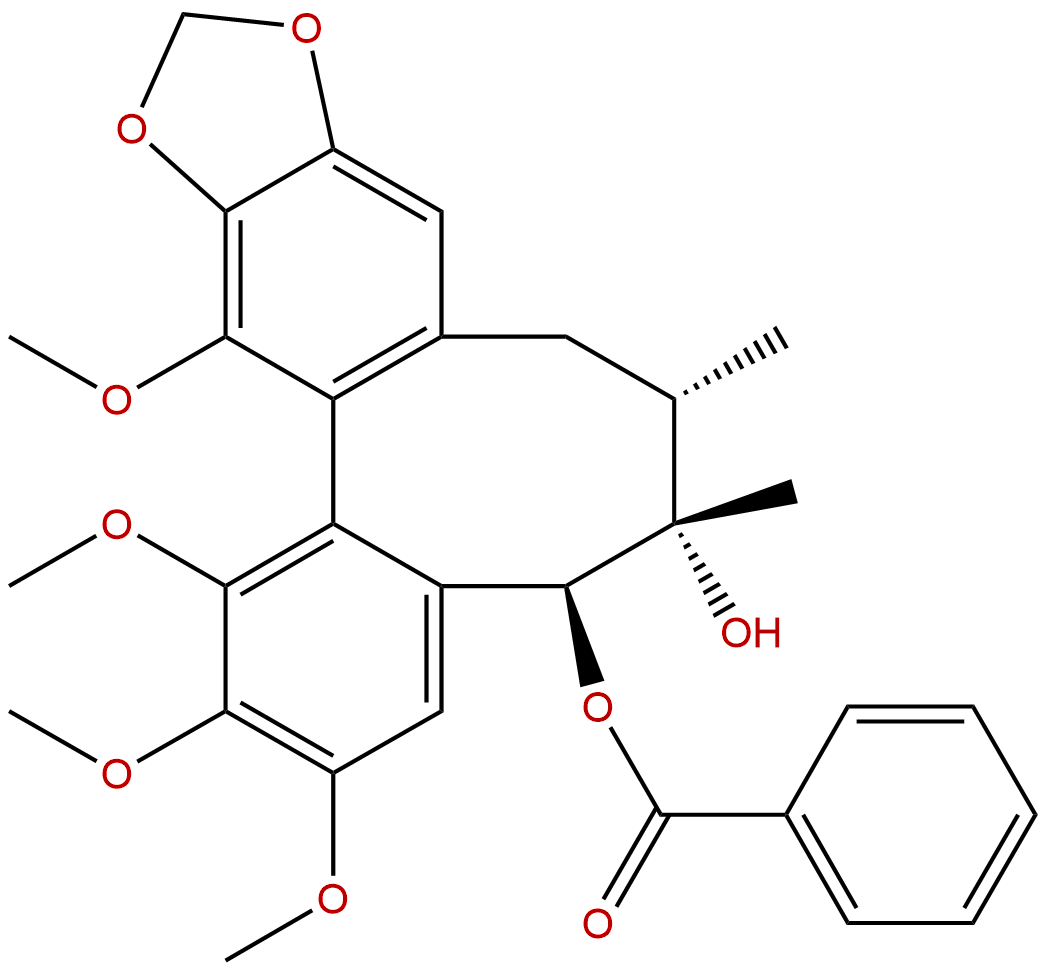


Product name: Schizantherin A
Synonym name: Gomisin C; Schisantherin A; Wuweizi ester A
Catalogue No.: BP1267
Cas No.: 58546-56-8
Formula: C30H32O9
Mol Weight: 536.577
Botanical Source: Schisandra chinensis(Turcz.)Baill.
Physical Description:
Type of Compound: Lignans
Purity: 95%~99%
Analysis Method: HPLC-DAD or/and HPLC-ELSD
Identification Method: Mass, NMR
Packing: Brown vial or HDPE plastic bottle
Storage: Store in a well closed container, protected from air and light. Put into refrigerate or freeze for long term storage.
Whenever possible, you should prepare and use solutions on the same day. However, if you need to make up stock solutions in advance, we recommend that you store the solution as aliquots in tightly sealed vials at -20℃. Generally, these will be useable for up to two weeks.
The product could be supplied from milligrams to grams
Inquire for bulk scale.
Description:
Schisantherin A exhibits anti-tussive, sedative, anti-inflammatory, antioxidant, anti-osteoporotic, neuroprotective, cognition enhancing, and cardioprotective activities. Schisantherin A can significantly attenuate Aβ1-42-induced learning and memory impairment and noticeably improve the histopathological changes in the hippocampus. Schisantherin A exhibits neuroprotection against 1-methyl-4-phenylpyridinium ion (MPP(+)) through the regulation of two distinct pathways including increasing CREB-mediated Bcl-2 expression and activating PI3K/Akt survival signaling.
References:
PLoS One. 2013 Apr 19;8(4):e61590.
Protective role of deoxyschizandrin and schisantherin A against myocardial ischemia-reperfusion injury in rats.
METHODS AND RESULTS:
Anesthetized male rats were treated once with deoxyschizandrin(DSD) and Schisantherin A(STA) (each 40 μmol/kg) through the tail vein after 45 min of ischemia, followed by 2-h reperfusion. Cardiac function, infarct size, biochemical markers, histopathology and apoptosis were measured and mRNA expression of gp91 (phox) in myocardial tissue assessed by RT-PCR. Neonatal rat cardiomyocytes were pretreated with DSD and STA and then damaged by H2O2. Cell apoptosis was tested by a flow cytometric assay. Compared with the I/R group: (i) DSD and STA could significantly reduce the abnormalities of LVSP, LVEDP, ±dp/dtmax and arrhythmias, thereby showing their protective roles in cardiac function; (ii) DSD and STA could significantly attenuate the infarct size and MDA release while increasing SOD activity, suggesting a role in reducing myocardial injury; (iii) tissue morphology and myocardial textual analysis revealed that DSD and STA mitigated changes in myocardial histopathology; (iv) DSD and STA decreased apoptosis (33.56±2.58% to 10.28±2.80% and 10.98±1.99%, respectively) and caspase-3 activity in the myocardium (0.62±0.02 OD/mg to 0.38±0.02 OD/mg and 0.32±0.02 OD/mg, respectively), showing their protective effects upon cardiomyocytes; and (v) DSD and STA had similar protective effects on I/R injury as those seen with the positive control metoprolol. In vitro, DSD and STA could significantly decrease the apoptosis of neonatal cardiomyocytes.
CONCLUSIONS:
These data suggest that DSD and STA can protect against myocardial I/R injury. The underlining mechanism may be related to their role in inhibiting cardiomyocyte apoptosis.
Biochem Biophys Res Commun. 2014 Jul 4;449(3):344-50.
Schisantherin A suppresses osteoclast formation and wear particle-induced osteolysis via modulating RANKL signaling pathways.
Receptor activator of NF-κB ligand (RANKL) plays critical role in osteoclastogenesis. Targeting RANKL signaling pathways has been a promising strategy for treating osteoclast related bone diseases such as osteoporosis and aseptic prosthetic loosening. Schisantherin A (SA), a dibenzocyclooctadiene lignan isolated from the fruit of Schisandra sphenanthera, has been used as an antitussive, tonic, and sedative agent, but its effect on osteoclasts has been hitherto unknown.
METHODS AND RESULTS:
In the present study, SA was found to inhibit RANKL-induced osteoclast formation and bone resorption. The osteoclastic specific marker genes induced by RANKL including c-Src, SA inhibited OSCAR, cathepsin K and TRAP in a dose dependent manner. Further signal transduction studies revealed that SA down-regulate RANKL-induced nuclear factor-kappaB (NF-κB) signaling activation by suppressing the phosphorylation and degradation of IκBα, and subsequently preventing the NF-κB transcriptional activity. Moreover, SA also decreased the RANKL-induced MAPKs signaling pathway, including JNK and ERK1/2 posphorylation while had no obvious effects on p38 activation. Finally, SA suppressed the NF-κB and MAPKs subsequent gene expression of NFATc1 and c-Fos. In vivo studies, SA inhibited osteoclast function and exhibited bone protection effect in wear-particle-induced bone erosion model. Taken together, SA could attenuate osteoclast formation and wear particle-induced osteolysis by mediating RANKL signaling pathways.
CONCLUSIONS:
These data indicated that SA is a promising therapeutic natural compound for the treatment of osteoclast-related prosthesis loosening.
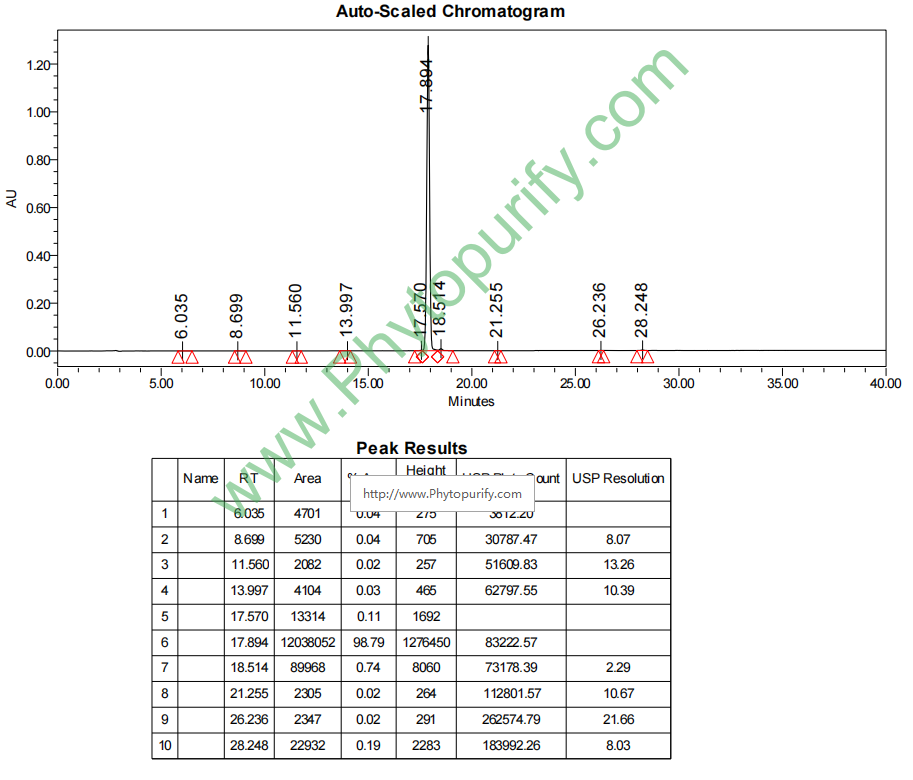
HPLC of Schizantherin A
Storage conditions:Short-term storage at 2~8℃, long-term storage at -20 ~ -80℃
Schizantherin A is a natural tannic acid compound derived from Schisandra chinensis, which exhibits significant biological activity and broad pharmacological potential in the field of liver protection. Schisandra chinensis, as a traditional Chinese medicinal herb, has always been used to treat liver disease, enhance physical strength, and regulate immune function. Its active ingredient, schisandrin methyl, has become a hot topic in natural product pharmacology research in recent years due to its unique chemical structure and biological effects. This article will provide a systematic review of the chemical properties, plant sources, pharmacological activities, mechanisms of action, pharmacological evaluation, and clinical application prospects of Schisandra esters, aiming to provide theoretical basis and research direction for subsequent drug development and clinical translation.
The molecular formula of Schisandra ester A is C29H-36O10, with a molecular weight of 536.5770 and a CAS number of 58546-56-8. Its chemical structure belongs to tannic acid, with multiple phenolic hydroxyl and ester groups, endowing it with strong antioxidant capacity. The LogP value of this compound is 3.9499, indicating that it has moderate lipid solubility, which is beneficial for cell membrane penetration and in vivo distribution. The TPSA (topological polar surface area) is 101.9100, indicating that it has a certain balance between polar and non-polar environments, which is helpful for binding to various biological targets.
The low water solubility of Schisandrin methyl ester (0.0016 mg/mL) may limit its oral bioavailability, but its high blood-brain barrier permeability suggests that the compound can enter the central nervous system and has potential neuroprotective effects. The negative result of hERG channel inhibition experiment indicates a low risk of cardiac toxicity. The Ames test result is 0.0, indicating no significant genotoxicity and high safety.
Schisandra esters are mainly found in the fruit of Schisandra chinensis, which belongs to the Magnoliaceae family and is widely distributed in Northeast China, North China, and the Korean Peninsula. Traditionally, Schisandra fruit has been used clinically through methods such as water decoction and wine soaking, but modern research often uses organic solvent extraction to enrich active ingredients.
Common extraction methods include:
In recent years, with the promotion of green chemistry concepts, new technologies such as supercritical CO2 extraction and microwave-assisted extraction have gradually been applied to the extraction of active ingredients from Schisandra chinensis, improving extraction efficiency and environmental friendliness.
The pharmacological activity of Schisandrin methyl mainly focuses on liver protection, and its multiple mechanisms of action such as antioxidant, anti-inflammatory, and anti fibrotic provide scientific basis for the prevention and treatment of liver diseases.
In addition to liver protection, Schisandrin A may have the potential for neuroprotection and anti neurodegenerative diseases due to its good blood-brain barrier permeability, and related research is still in the preliminary stage.
The liver protective effect of Schisandra ester A is mainly achieved through multi-target synergistic regulation:
In summary, Schisandrin A forms a complex and effective liver protection network through multi-target and multi pathway synergistic effects.
The pharmacological parameters of Schisandra ester A indicate that it has certain potential for drug development:
Pharmacokinetic studies have shown that Schisandrin methyl has a long half-life in vivo, is widely distributed, and is particularly enriched in the liver, meeting its targeted requirements for liver protection. The metabolic pathways mainly involve the oxidation and ester hydrolysis of liver enzymes, and the safety of metabolites needs further evaluation.
Schisandra ester A, as a natural tannic acid compound, has shown great potential in the treatment of liver diseases due to its significant antioxidant, anti-inflammatory, and anti fibrotic effects. Especially in the adjuvant treatment of chronic hepatitis, liver fibrosis, and cirrhosis, Schisandrin methyl is expected to become an effective natural drug candidate.
Future research directions include:
In addition, given its excellent blood-brain barrier permeability, the potential application of Schisandrin A in neurological diseases is also worth paying attention to.
Schisandra ester A, as an important active ingredient in Schisandra chinensis, has become a research hotspot in the field of natural product pharmacology due to its unique chemical structure and multi-target liver protection mechanism. Its excellent safety and pharmacological parameters have laid a solid foundation for its clinical translation. In the future, through interdisciplinary collaboration and the combination of modern medicinal chemistry, molecular biology, and clinical medicine research methods, Schisandrin methyl ester is expected to develop into an innovative natural medicine for the treatment of liver diseases, contributing new strength to human health.
