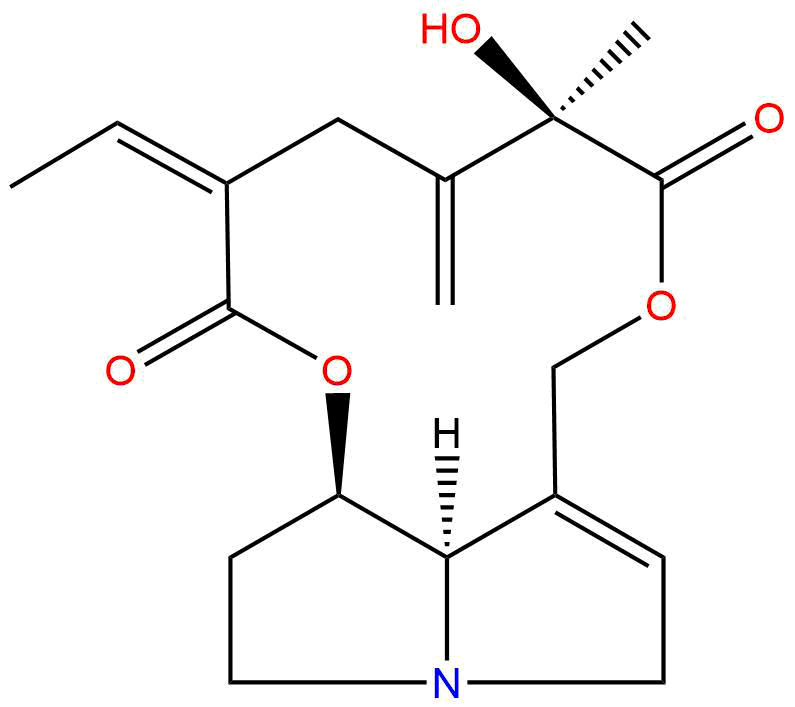


Product name: Seneciphylline
Synonym name:
Catalogue No.: BP2025
Cas No.: 480-81-9
Formula: C18H23NO5
Mol Weight: 333.384
Botanical Source:
Physical Description:
Type of Compound: Alkaloids
Purity: 95%~99%
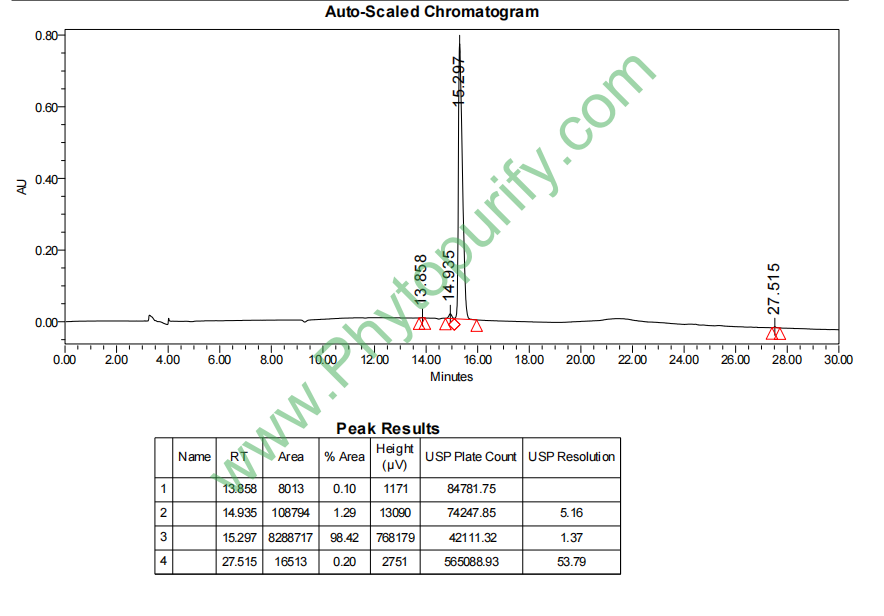
Analysis Method: HPLC-DAD or/and HPLC-ELSD
Identification Method: Mass, NMR
Packing: Brown vial or HDPE plastic bottle
Storage: Store in a well closed container, protected from air and light. Put into refrigerate or freeze for long term storage.
The product could be supplied from milligrams to grams
Inquire for bulk scale.
For Reference Standard and R&D, Not for Human Use Directly.
Description:
Seneciphylline, one of the hepatotoxic pyrolizidine alkaloids, has mutagenic activity in Drosophila and their transfer into rat milk.Seneciphylline can significantly increased the activities of epoxide hydrase and glutathione-S-transferase but cause reduction of cytochrome P-450 and related monooxygenase activities.
References:
J Ethnopharmacol. 1984 Dec;12(3):271-8.
Effect of seneciphylline and senecionine on hepatic drug metabolizing enzymes in rats.
METHODS AND RESULTS:
The effect of oral administration of the pyrrolizidine alkaloids, Seneciphylline and senecionine, from Senecio vulgaris (Compositae) on activities of hepatic epoxide hydrase, glutathione-S-transferase, aminopyrine-N-demethylase and arylhydrocarbon hydroxylase (AHH) was investigated in microsomes of young male albino rats. Seneciphylline significantly increased the activities of epoxide hydrase and glutathione-S-transferase but caused reduction of cytochrome P-450 and related monooxygenase activities. Senecionine failed to stimulate epoxide hydrase while it diminished the activities of glutathione-S-transferase, aminopyrine demethylase and AHH.
CONCLUSIONS:
Seneciphylline and senecionine could not produce any prominent in vitro effect on the hepatic drug metabolizing enzymes under study, except slight stimulation of epoxide hydrase activity by both the alkaloids and slight reduction of aminopyrine demethylase activity by senecionine.
Experientia, 1977, 33(4):498-9.
Hypertrophy of pulmonary arteries and arterioles with cor pulmonale in rats induced by seneciphylline, a pyrrolizidine alkaloid.
METHODS AND RESULTS:
Seneciphylline, one of the hepatotoxic pyrolizidine alkaloids, induced, as do also monoclotaline, etc., a marked arterial and arteriolar hypertrophy of the lung of young Wistar rats a month after a single s. c. injection of 50–80 mg/kg. Cor pulmonale with leftward shift of the ventricular septum was also noted.
HPLC of Seneciphylline
Storage conditions:Short-term storage at 2~8℃, long-term storage at -20 ~ -80℃
76.0700
.5157
.4412
4.1618
2.9115
7.6057
High
32.5507
5.1306
No
Yes
No
No
Yes
No
0.6
Yes
Yes
Yes
Yes
Seneciphylline (CAS: 480-81-9) is a pyrrolizidine alkaloid with significant biological activity. As an important molecule in the study of natural product chemistry and toxicology, it mainly comes from plants in the Asteraceae family, such as the common Chinese herbal medicine Senecio(Senecio scandens). This compound has attracted much attention due to its strong hepatotoxicity and has been clearly classified as an orally effective hepatotoxicity inducer. Its molecular formula is C18H23NO5 and its molecular weight is 333.3840 g/mol.
The research background of Qianli Guangfeiling alkaloid is of great warning significance. In history, plants containing such alkaloids have caused poisoning in humans and animals due to ingestion or improper use, prompting scientists to conduct in-depth research on their toxicity mechanisms. Modern pharmacology reveals that camptothecin itself is not a directly toxic substance. It needs to be metabolized and activated by liver cytochrome P450 enzymes to convert into highly active pyrrole derivatives. These active intermediates can irreversibly covalently bind with key biomolecules within the cell, such as proteins and DNA, forming adducts that trigger a series of cascading toxic reactions, including inducing cell apoptosis, disrupting mitochondrial function, and leading to liver cell necrosis.
However, the charm of scientific exploration lies in transforming perspectives. In recent years, with a deeper understanding of cancer biology, the toxicity mechanism of camptothecin, particularly its ability to interfere with specific cellular signaling pathways, has begun to be re examined. According to database information, it is associated with multiple key tumor suppressor genes and oncogenes such as TP53, CDKN2A, PTEN, RB1, MYC, and is also linked to the malignant disease of osteosarcoma. This suggests that under strict control and safety research frameworks, this' toxin 'may provide a unique entry point for understanding the pathological mechanisms of certain cancers or developing new research tools. This article will start from its chemical essence, systematically sort out its sources, toxicity mechanisms, and associations with diseases, and evaluate its potential application value based on pharmacological parameters.
The chemical structure of camptothecin is the material basis for its biological activity. The SMILES string (C=C1C/C (=C/C) C (=O) O [C @ @ H] 2CCN3CC=C (COC (=O) [C @] 1 (C) O) [C @ H] 23) depicts a complex cyclic system, with the core being a pyrrolizidine base (nitrogen-containing bicyclic ring) connected to a diester structure. The double bond (C=C) and multiple chiral centers (represented by the @ symbol) in the structure are crucial for its spatial conformation and biological activity. The structure of pyrrolizidine is the key site for its activation by CYP450 enzymes and the generation of electrophilic pyrrole rings.
Analyzing its physicochemical properties from the parameters of drug formation can provide a deeper understanding of its in vivo behavior:
- Molecular weight and lipid water partition coefficient The molecular weight of 333.38 g/mol falls within the common range of small molecule drugs (usually<500 Da). The calculated LogP value is 0.5157 and LogD is 0.4412, indicating that the molecule is neutral at physiological pH and has moderate lipophilicity, neither highly hydrophilic nor highly lipophilic. This is beneficial for its penetration through the cell membrane, but it may also affect its distribution in aqueous body fluids.
- Polarity surface area and solubility The topological polar surface area (TPSA) is 76.07 Å ², which is relatively moderate and usually associated with good membrane permeability. Its water solubility is 4.16 mg/mL (estimated unit), indicating that it has a certain degree of water solubility, which is related to the polarity brought by the ester bonds and hydroxyl groups in its structure.
- Permeability and Distribution The permeability data of Caco-2 cells is 7.61 (× 10 ⁻⁶ cm/s), combined with its moderate LogP and TPSA, indicating that it has good intestinal absorption potential. It is worth noting that its blood-brain barrier (BBB) penetrability is marked as "high", which means it can enter the central nervous system, which may bring additional neurotoxic risks and is also an aspect that needs to be guarded against as a potential toxin.
- protein binding The plasma protein binding rate (PPB) is 32.55%, which is a relatively low level, indicating that most drugs in the blood exist in free form and may be more easily distributed to tissues and produce effects.
These physicochemical properties collectively determine that camptothecin can be effectively absorbed and widely distributed in the body (including entering the brain), and is easily metabolized and activated inside cells, thus paving the way for its subsequent toxic effects.
The natural sources of camptothecin are mainly concentrated in plants of the Asteraceae genus. The database clearly indicates that it originates from Groundsel (scientific name) Senecio scandens). The Senecio genus is a vast family with over 1000 species worldwide, many of which contain pyrrolizidine alkaloids. In traditional Chinese medicine, a thousand miles of light(Senecio scandens Buch. - Ham. is often used as medicine with whole grass, which is cold in nature and bitter in taste. It has the effects of clearing heat and detoxifying, improving vision, and relieving itching. In history, it has been used to treat diseases such as dysentery, enteritis, hepatitis, redness and swelling of the eyes, and skin eczema.
However, there is a huge gap between traditional applications and modern toxicology knowledge. Many plants containing pyrrolizidine alkaloids have a medicinal history accompanied by risks. Due to the latent and cumulative hepatotoxicity of ingredients such as camptothecin, short-term or low-dose use may not cause obvious symptoms, but long-term or excessive use can lead to irreversible liver damage, such as hepatic vein occlusion disease, and in severe cases, liver failure or even death. In history, there have been incidents of poisoning in populations around the world due to consuming grains contaminated with plants of the Senecio genus or long-term consumption of related herbal teas.
Therefore, modern traditional Chinese medicine has strict regulations and controls on the use of medicinal herbs such as Qianli Guang, emphasizing the reduction of toxicity, control of dosage and treatment course, and clearly indicating its contraindications (such as prohibition for pregnant women and caution for those with liver dysfunction). The in-depth study of Qianli Guangfeiling alkaloid is aimed at clarifying the boundary between its "therapeutic effect" and "toxic effect" from a scientific perspective, ensuring medication safety. This also warns us that the development and utilization of natural products must be based on a comprehensive understanding of their chemical composition and toxicological mechanisms.
The core pharmacological activity of Qianli Guangfeiling alkaloid is its strong hepatotoxicity, but its mechanism of action goes far beyond simple cell killing. It is a classic 'pre toxin' whose toxic journey begins with the metabolic activation of the liver.
Metabolic activation and direct toxicity mechanism:
After oral administration, quinquefoline is absorbed into the portal vein and first reaches the liver. The cytochrome P450 enzymes (especially CYP3A4 and CYP2B6 isoenzymes) in liver cells oxidize specific positions on their pyrrolizidine ring, producing unstable dehydropyrrolizidine Alkaloids (DHPAs). These DHPAs are highly electrophilic active intermediates that, like "molecular missiles," can irreversibly covalently bind with biomolecules rich in nucleophilic groups (such as thiol and amino groups) within cells, forming adducts.
1. Binding with proteins Binding with functional proteins (such as enzymes and structural proteins) can lead to protein inactivation, functional disorders, and disruption of normal cellular metabolism and signal transduction.
2. Binding with DNA Forming adducts with DNA bases (especially guanine) can interfere with DNA replication and transcription, leading to gene mutations and chromosomal rearrangements. The database shows that the Ames test result is 0.6 (usually<1 indicates a risk of mutagenicity), and there is a clear chromosomal aberration effect, which confirms its genetic toxicity.
3. Downstream cellular events The above-mentioned molecular damage can trigger a series of downstream events: a decrease in mitochondrial membrane potential, a large production of reactive oxygen species, an imbalance in intracellular calcium ion homeostasis, ultimately activating apoptotic pathways (such as caspase cascade reactions) or leading to cell necrosis. The "Ser_LK, Ser_GGT, Ser_ST, Ser_LT" in the database are all "yes". These are enzyme markers released into the bloodstream after liver cell injury and are key indicators for diagnosing liver toxicity in clinical practice.
Potential association with tumor targets and osteosarcoma:
The target information provided by the database (TP53, CDKN2A, PTEN, RB1, MYC) is highly informative. These are not protein targets directly affected by camptothecin, but rather key cellular signaling pathway nodes that may be affected by its toxic effects, suggesting the underlying mechanisms and potential research directions of its toxic effects.
- TP53 and CDKN2A TP53 is a well-known tumor suppressor gene responsible for DNA damage repair, cell cycle arrest, and apoptosis induction. CDKN2A encodes the p16 protein and is an important negative regulator of the G1 phase checkpoint in the cell cycle. The DNA damage caused by camptothecin can strongly activate the p53 pathway, attempting to repair or clear damaged cells. But if the damage is too severe or persists, it may lead to p53 dysfunction or mutation, which is associated with the occurrence of many cancers, including osteosarcoma.
- PTEN and RB1 PTEN is the main negative regulator of the PI3K/AKT/mTOR growth signaling pathway; RB1 is the 'brake' for the transition of the cell cycle from G1 phase to S phase. Both of these are important tumor suppressor genes. Their inactivation can lead to uncontrolled cell proliferation.
- MYC MYC is a proto oncogene that promotes cell proliferation, metabolism, and growth. Under stress conditions such as DNA damage, the expression and activity of MYC may undergo abnormal changes.
The connection with osteosarcoma Osteosarcoma is a malignant bone tumor that is more common in adolescents, and its occurrence and development are closely related to abnormalities in multiple genes mentioned above. For example, TP53 mutations are very common in osteosarcoma; The inactivation of RB1 gene is a classic molecular feature of osteosarcoma; The absence of PTEN is associated with the progression and poor prognosis of osteosarcoma; MYC amplification or overexpression is also seen in some osteosarcoma cases. As an environmental toxin that can cause DNA damage and may interfere with these critical pathways, the research value of Qianli Guangfeiling alkaloid lies in:Can it serve as a tool molecule to simulate or exacerbate the pathological processes caused by these gene abnormalities in experimental models? For example, in cell or animal models with existing p53 or Rb functional defects, does exposure to camptothecin accelerate or promote the occurrence of osteosarcoma like lesions? This provides a unique approach for studying the etiology of osteosarcoma, especially the interaction between environmental factors and genetic susceptibility, and searching for new therapeutic targets.
Based on the provided pharmacological parameters, we can use standards such as Lipinski's Rule of Five to objectively evaluate the development potential of Qianfengfeiling alkaloid as a traditional "therapeutic drug".
Lipinski's Five Rules Analysis:
1. Molecular weight<500 Da: 333.38,Comply with。
2. LogP < 5:0.5157,Comply with。
3. The number of hydrogen bond donors (inferred from structure, - OH, - NH -) is approximately ≤ 5: From the molecular formula C18H23NO5, there are many H, but the actual functional groups that can form hydrogen bonds (such as hydroxyl and secondary amines) are limited, estimated to be 2-3,Comply with。
4. Number of hydrogen bond acceptors (N, O) ≤ 10: There are a total of 6 O and 1 N in the molecule,Comply with。
From these four points, it can be seen that Qianfengfeiling alkaloid fully complies with Lipinski's rule, indicating that it has good potential for oral absorption and bioavailability. Its high Caco-2 permeability (7.61) and effective Peff value (2.91) also support this judgment.
Key Defects and Risk Assessment:
Although it conforms to the basic physical and chemical rules of drug like properties, there are fatal flaws in safety and toxicity that prevent it from being developed as a conventional drug:
1. Serious toxicity Its core function is to induce liver toxicity, and Ames test and chromosomal aberration data have confirmed its genetic toxicity (mutagenicity and teratogenic risk). This is absolutely unacceptable in drug development.
2. Poor specificity Its toxicity originates from the non-specific covalent binding of active intermediates produced by metabolism with various biomolecules, lacking selective action on a single disease target.
3. Other toxicity indicators The database shows that it has skin sensitization (Skid_Sens: Yes), which increases its application risk.
4. The treatment window is extremely narrow There may be no safe window between its toxic dose and any potential therapeutic dose.
Potential assessment for repositioning:
Although the prospects as a direct therapeutic drug are bleak, there is still value in evaluating it from other perspectives:
- research tool Its clear toxicity mechanism and association with key cancer pathways make it an excellent chemical tool for studying liver toxicity, DNA damage response, interaction between environmental carcinogens and genetic factors, as well as pathological models of specific cancers such as osteosarcoma.
- Reference for prodrug design The "pre toxin" characteristic (activated by CYP450 metabolism) itself is a design strategy. In the design of anti-tumor prodrugs, enzymes highly expressed in tumor tissue are often used to specifically activate the prodrug. The structure of camptothecin provides a chemical template for designing tumor specific activated cytotoxic drugs, although its parent nucleus structure itself is too toxic and requires thorough modification.
- ADME properties Its good oral absorption and moderate distribution characteristics (low protein binding, high BBB penetration) demonstrate certain advantages of pyrrolizidine structures in in vivo delivery, which can be used to guide the design of other structurally similar but safer molecules.
Currently, research on camptothecin mainly focuses on two fields:
1. Toxicology and Safety Science As a representative of pyrrolizidine alkaloids, study their metabolic fate in different species, specific sites of adduct formation, dose-response relationships, and detoxification strategies (such as using protective agents such as N-acetylcysteine). These studies are crucial for developing food safety standards, regulating the use of Chinese herbal medicine, diagnosing and treating related poisoning cases.
2. Tool applications in cancer research With the understanding of its mechanism of action and its association with cancer-related genes, more and more research is beginning to explore its instrumental value in cancer biology. For example, by utilizing its ability to induce DNA damage and cellular stress, the role of pathways such as p53 and RB in maintaining genomic stability can be studied; Or explore its potential as an environmental cancer promoting factor in animal models with specific genetic backgrounds, especially for cancers such as osteosarcoma that are associated with DNA damage repair defects.
Future Prospects:
The future application prospects of Qianli Guangfeiling alkaloid do not lie in its becoming a drug itself, but in the scientific value it brings as a "probe" and "warning".
- Mechanism probe Develop derivatives (such as fluorescently labeled analogues) based on the structure of camptothecin, but with controllable or traceable toxicity, for real-time visualization of the formation and repair processes of DNA adducts.
- Disease model construction In the study of osteosarcoma, it is possible to explore the combination of low-dose camptothecin with specific genetically engineered mouse models (such as p53+/- or Rb+/-) to construct animal models that are more closely related to human disease occurrence (gene environment interaction), for the screening of preventive or therapeutic drugs.
- Structural Inspiration and New Drug Discovery In depth analysis of the precise structural basis of its metabolic enzyme (CYP450) activation, as well as the three-dimensional structure of its active intermediates and biomacromolecule adducts, can provide inspiration for designing novel and more targeted DNA alkylating agents or protein inhibitors. Meanwhile, a profound understanding of its toxic structure can also guide drug developers to actively avoid similar toxic structural fragments in the design of new compounds.
In short, Qianli Guangfeiling alkaloid is a double-edged sword bestowed by nature. It is not only a natural toxin that requires vigilance and prevention, but also a key to opening the door to liver toxicity mechanisms, DNA damage reactions, and even partial cancer etiology research. The comprehensive and in-depth research on it perfectly interprets the core spirit of modern natural product pharmacy: reverence for nature, analysis of essence, seeking benefits and avoiding harm, and transformation and application. Under strict scientific norms and ethical frameworks, even the most toxic molecules may bring unique insights to human health.
