


Synonym name:
Catalogue No.: BP0994
Cas No.: 17676-33-4
Formula: C27H40O4
Mol Weight: 428.613
Botanical Source: Ruscus aculeatus, Ruscus hypoglossum and Sansevieria trifasciata
Purity: 95%~99%
Analysis Method: HPLC-DAD or/and HPLC-ELSD
Identification Method: Mass, NMR
Packing: Brown vial or HDPE plastic bottle
Can be supplied from milligrams to grams.
For Reference Standard and R&D, Not for Human Use Directly.
Inquire for bulk scale.
Description:
Neoruscogenin represents a universal pharmacological tool for RORα research due to its specific selectivity profile versus other nuclear receptors.
References:
J Biomol Screen. 2014 Mar;19(3):399-406.
The identification of naturally occurring neoruscogenin as a bioavailable, potent, and high-affinity agonist of the nuclear receptor RORα (NR1F1).
Plants represent a tremendous structural diversity of natural compounds that bind to many different human disease targets and are potentially useful as starting points for medicinal chemistry programs. This resource is, however, still underexploited due to technical difficulties with the identification of minute quantities of active ingredients in complex mixtures of structurally diverse compounds upon raw phytomass extraction.
METHODS AND RESULTS:
In this work, we describe the successful identification of a novel class of potent RAR-related orphan receptor alpha (RORα or nuclear receptor NR1F1) agonists from a library of 12,000 plant extract fractions by using an optimized, robust high-throughput cell-free screening method, as well as an innovative hit compound identification procedure through further extract deconvolution and subsequent structural elucidation of the active natural compound(s). In particular, we demonstrate that Neoruscogenin, a member of the steroidal sapogenin family, is a potent and high-affinity RORα agonist, as shown by its activity in RORα reporter assays and from its effect on RORα target gene expression in vitro and in vivo.
CONCLUSIONS:
Neoruscogenin represents a universal pharmacological tool for RORα research due to its specific selectivity profile versus other nuclear receptors, its excellent microsomal stability, good bioavailability, and significant peripheral exposure in mouse.
Phytochemistry. 2013 Jun;90:106-13.
Spirostanol saponins and esculin from Rusci rhizoma reduce the thrombin-induced hyperpermeability of endothelial cells.
Rusci rhizoma extracts are traditionally used against chronic venous disorders (CVD).
METHODS AND RESULTS:
To determine the effect of its secondary plant metabolites on the endothelium, phenolic compounds and saponins from Butcher's broom were isolated from a methanolic extract, and their activity on the thrombin-induced hyperpermeability of human microvascular endothelial cells (HMEC-1) was investigated in vitro. In addition to the six known spirostanol saponins deglucoruscin (5), 22-O-methyl-deglucoruscoside (6), deglucoruscoside (7), ruscin (8), ruscogenin-1-O-(α-l-rhamnopyranosyl-(1→2)-β-d-galactopyranoside (9) and 1-O-sulpho-ruscogenin (10), three new spirostanol derivatives were isolated and identified: 3'-O-acetyl-4'-O-sulphodeglucoruscin (1), 4'-O-(2-hydroxy-3-methylpentanoyl)-deglucoruscin (2) and 4'-O-acetyl-deglucoruscin (3). Furthermore, the coumarin esculin (4), which is also prominently present in other medicinal plants used in the treatment of CVD, was isolated for the first time from Rusci rhizoma. Five of the isolated steroid derivatives (2, 5, 8, 9 and 10) and esculin (4) were tested for their ability to reduce the thrombin-induced hyperpermeability of endothelial cells in vitro, and the results were compared to those of the aglycone Neoruscogenin (11). The latter compound showed a slight but concentration-dependent reduction in hyperpermeability to 71.8% at 100μM. The highest activities were observed for the spirostanol saponins 5 and 8 and for esculin (4) at 10μM, and these compounds resulted in a reduction of the thrombin-induced hyperpermeability to 41.9%, 42.6% and 53.3%, respectively. For 2, 5 and 8, the highest concentration tested (100μM) resulted in a drastic increase of the thrombin effect. The effect of esculin observed at a concentration of 10μM was diminished at 100μM.
CONCLUSIONS:
These in vitro data provide insight into the pharmacological mechanism by which the genuine spirostanol saponins and esculin can contribute to the efficacy of Butcher's broom against chronic venous disorders.
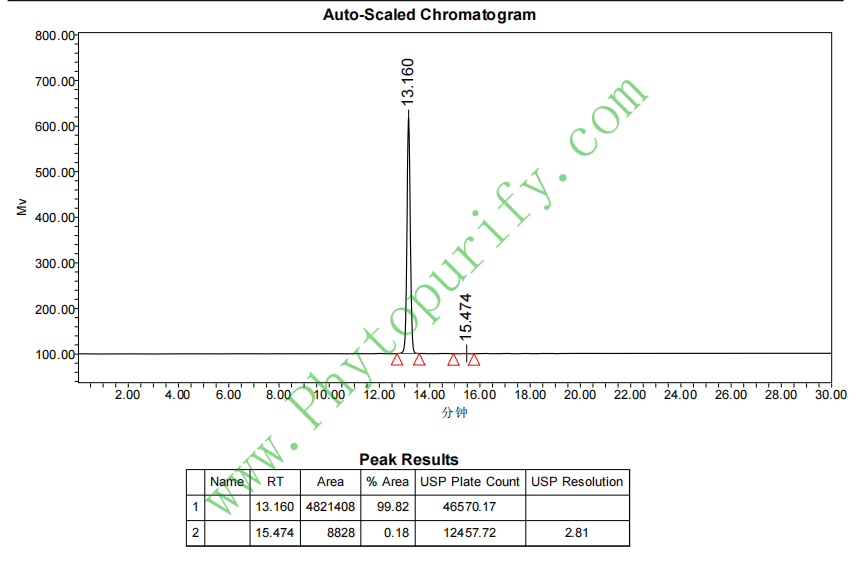
HPLC of Neoruscogenin
Storage conditions:Short-term storage at 2~8℃, long-term storage at -20 ~ -80℃
Neoruscogenin is a type of steroidal sapogenin belonging to the steroidal sapogenin family. Due to its unique molecular structure and significant biological activity, it has attracted widespread attention in the field of natural product pharmacology in recent years. As a high affinity nuclear receptor ROR α (NR1F1) agonist (EC50=0.11 µ M), the potential role of neonicotinoid saponins in regulating various physiological and pathological processes is gradually being revealed, especially in the field of anti-tumor applications, showing promising prospects. As an important member of the nuclear receptor superfamily, ROR α participates in regulating key biological processes such as cell metabolism, inflammatory response, immune regulation, and cell cycle. Its agonist, neonicotinoid saponin, is therefore considered a powerful candidate molecule for developing novel anti-tumor drugs.
This article provides a systematic review of the chemical structure and physicochemical properties, plant sources and extraction methods, pharmacological activity and mechanism of action, pharmacological evaluation and pharmacokinetic characteristics of neonicotinoid saponins, combined with their potential clinical applications in anti-tumor and related diseases. The aim is to provide a theoretical basis and reference for the in-depth research and drug development of this compound.
The molecular formula of Xinluosu saponin is C27H42O5, with a molecular weight of 428.6130, belonging to the steroid sapogenin class compounds. Its core structure is a typical four ring steroid skeleton, containing multiple hydroxyl and oxygen bridge structures in the molecule, which endow it with unique biological activity. The LogP value of Xin Lu Si Ke saponin is 3.8172, indicating moderate lipid solubility, which is beneficial for cell membrane penetration and in vivo distribution. Its topological polar surface area (TPSA) is 58.92 Å ², indicating that it has good membrane permeability, especially high blood-brain barrier penetration ability, which is consistent with its potential application in the central nervous system.
The low water solubility (0.0022 mg/mL) to some extent limits its oral bioavailability, but also provides direction for drug formulation design, such as nanocarrier or liposome encapsulation strategies. Xinluosu saponin does not show hERG channel inhibitory activity, indicating a low risk of cardiac toxicity, and the Ames test result is negative, indicating a low risk of genotoxicity and a good safety basis.
New Ruscus saponins are mainly found in plants of the Araceae family, such as Ruscus spp. and related species. In traditional Chinese medicine, Lusco plants are commonly used to treat diseases such as varicose veins and blood circulation disorders. Xinrusco saponin, as one of its main active ingredients, has multiple pharmacological effects.
The common methods for extracting neonicotinoid saponins include organic solvent extraction, column chromatography separation, and high-performance liquid chromatography (HPLC) purification. Ethanol or methanol are usually used as extraction solvents to obtain crude extracts through reflux extraction, followed by separation and purification using silica gel columns or C18 reverse phase columns. In recent years, supercritical CO2 extraction technology and microwave-assisted extraction technology have also been applied to improve extraction efficiency and purity, reduce solvent residue, and enhance the environmental and economic benefits of extraction.
During the extraction process, temperature, solvent polarity, and pH value all have a significant impact on the yield of neonicotinoid saponins. Optimizing process parameters not only helps to obtain high-purity target compounds, but also lays the foundation for subsequent pharmacological research and drug development.
Xin Lu Si Ke saponin has shown significant anti proliferative and pro apoptotic effects in various tumor models. Its target involves multiple tumor related signaling pathways, including downregulation of anti apoptotic proteins MCL1 and BCL2, which promote tumor cells to enter the apoptotic program; Inhibition of STAT3 signaling pathway, blocking tumor cell proliferation and immune escape; And the inhibition of MMP2 reduces the invasion and metastasis ability of tumor cells.
In addition, neonicotinoid saponins also have a regulatory effect on the activity of DNA topoisomerases (TOP1, TOP2A) in tumor cells, affecting DNA replication and repair processes, and enhancing cell sensitivity to chemotherapy drugs. It has an inhibitory effect on the expression of HIF1A in the tumor microenvironment, reduces the tumor's ability to adapt to hypoxia, and inhibits angiogenesis.
In addition to its anti-tumor activity, neonicotinoid saponins also exhibit the potential to regulate the endocrine system. By affecting the expression of estrogen receptor (ESR1) and aromatase (CYP19A1), it may be involved in the regulation of hormone related diseases. In addition, its regulation of the MAPK1 signaling pathway suggests its potential role in inflammation and cellular stress response.
As a high affinity agonist of the ROR α nuclear receptor, neonicotinoid saponins can regulate the transcriptional activity mediated by this receptor. ROR α plays an important role in cell metabolism, immune regulation, and cell cycle control. Its activation helps restore cellular homeostasis and inhibit abnormal proliferation of tumor cells.
The specific mechanism includes:
Regulating the expression of anti apoptotic proteins Xinluosu saponins activate ROR α, negatively regulate the expression of MCL1 and BCL2, and promote tumor cell apoptosis.
Inhibition of STAT3 signaling pathway STAT3, as a key factor in tumor cell proliferation and immune escape, is significantly inhibited by neonicotinoid saponins, weakening the survival ability of tumor cells.
Inhibition of Matrix Metalloproteinase MMP2 By reducing MMP2 activity, decreasing the matrix degradation ability of tumor cells, and inhibiting tumor invasion and metastasis.
Regulating DNA Topoisomerase Activity: Affects the functions of TOP1 and TOP2A, blocks DNA replication and repair, and enhances drug sensitivity of tumor cells.
Inhibit tumor hypoxia response By downregulating HIF1A, we can block tumor adaptation to hypoxic environments and inhibit angiogenesis.
Regulating hormone receptor signaling: Affects the expression of ESR1 and CYP19A1, which may be involved in the regulation of hormone dependent tumors.
These multi-target and multi pathway mechanisms of action give neonicotinoid saponins unique advantages in anti-tumor therapy, overcoming the resistance and side effects of single target drugs.
Xin Lu Si Ke saponin has ideal pharmacological parameters. Its molecular weight of 428.6 conforms to Lipinski's rule, with a moderate LogP value of 3.8, which is beneficial for the membrane permeability and in vivo distribution of the drug. The TPSA value of 58.9 indicates that it has good cell membrane penetration ability, especially high blood-brain barrier permeability, which expands its potential application in central nervous system diseases.
Low water solubility is currently the main challenge it faces, limiting oral absorption and bioavailability. In response to this issue, improvements in pharmaceutical formulation, such as nanocarriers, liposome encapsulation, solid dispersions, and other technologies, are expected to significantly enhance their in vivo utilization efficiency.
In terms of safety, neonicotinoid saponins do not inhibit hERG channels, reducing the risk of cardiac toxicity; A negative Ames test indicates low genotoxicity and a good safety basis. Preliminary pharmacokinetic studies have shown that neonicotinoid saponins are widely distributed in the body, with stable metabolism and mainly excreted through liver metabolism and bile excretion.
Further systematic pharmacokinetic and toxicological studies are needed in the future to clarify its in vivo metabolic pathways, half-life, and potential drug interactions, providing scientific basis for clinical development.
As a natural steroid sapogenin, neonicotinoid saponins have shown broad clinical application prospects due to their highly efficient ROR α agonist activity and multi-target anti-tumor effects. Its potential in the field of anti-tumor is particularly outstanding, especially suitable for adjuvant therapy of various solid tumors and hematological tumors.
In addition, its ability to regulate hormone receptors and inflammatory signaling pathways makes it potentially applicable in hormone dependent tumors, inflammatory diseases, and metabolic syndrome. The high blood-brain barrier penetration also provides possibilities for its treatment in neurotumors and neurodegenerative diseases.
Future research should focus on the following aspects:
Preclinical efficacy and safety evaluation Systematic evaluation of the efficacy and toxicological characteristics of neonicotinoid saponins in different tumor models.
Optimization of drug formulations Overcoming the limitations of poor water solubility, improving oral bioavailability and in vivo stability.
In depth analysis of the mechanism of action Combining multiple omics techniques to reveal its regulatory network and potential synergistic targets.
Clinical trial design Conduct a phase one clinical trial to evaluate its safety, tolerability, and preliminary efficacy.
Combination therapy strategy Explore the combination application with existing chemotherapy drugs and immunotherapy drugs to improve treatment efficacy and reduce the risk of drug resistance.
In summary, as a natural product with a unique mechanism of action, neonicotinoid saponins have significant potential to become a new type of anti-tumor drug and are worthy of further development and clinical translation.
As an important member of the steroidal sapogenin family, neonicotinoid saponins have become a research hotspot in the field of natural product pharmacology due to their high affinity ROR α agonist activity and multi-target anti-tumor effects. Its unique chemical structure and physicochemical properties endow it with excellent biological activity and safety, and its wide-ranging pharmacological effects cover multiple aspects such as anti-tumor, endocrine regulation, and immune regulation.
Although its low water solubility limits its drug development, it is expected to overcome this bottleneck through the optimization of modern drug formulation technology. In depth pharmacokinetic, toxicological, and preclinical studies in the future will lay a solid foundation for its clinical application. By combining multi-target and multi pathway mechanisms of action, neonicotinoid saponins have the potential to become a novel drug for anti-tumor and related disease treatment, contributing significantly to the development of natural product pharmacology.
Continuous basic and applied research will drive the development of neonicotinoid saponins from the laboratory to clinical practice, opening up a new chapter in the research and development of natural anti-tumor drugs.
