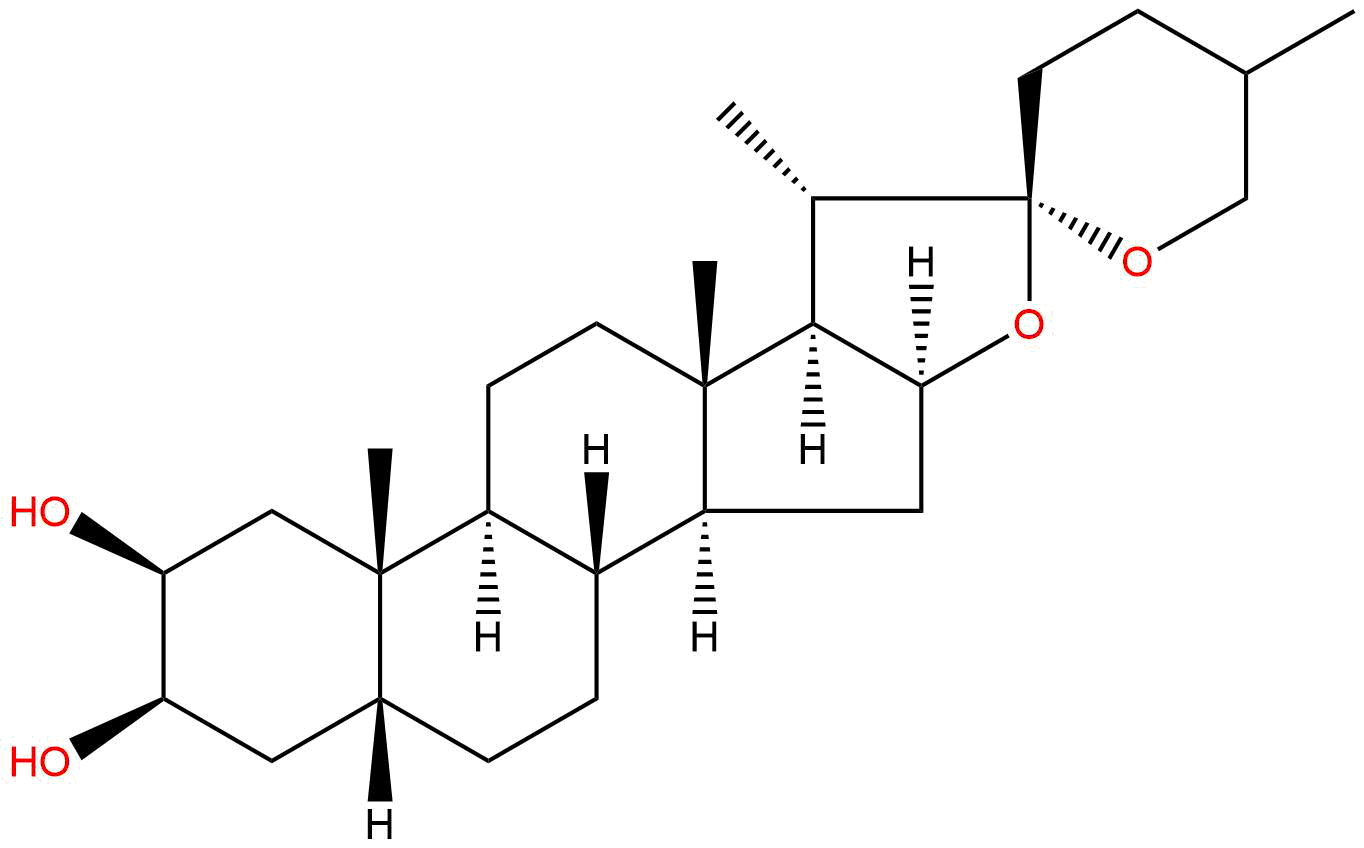


Product name: Markogenin
Synonym name:
Catalogue No.: BP2197
Cas No.: 562-35-6
Formula: C27H44O4
Mol Weight: 432.645
Botanical Source:
Type of Compound: Steroids
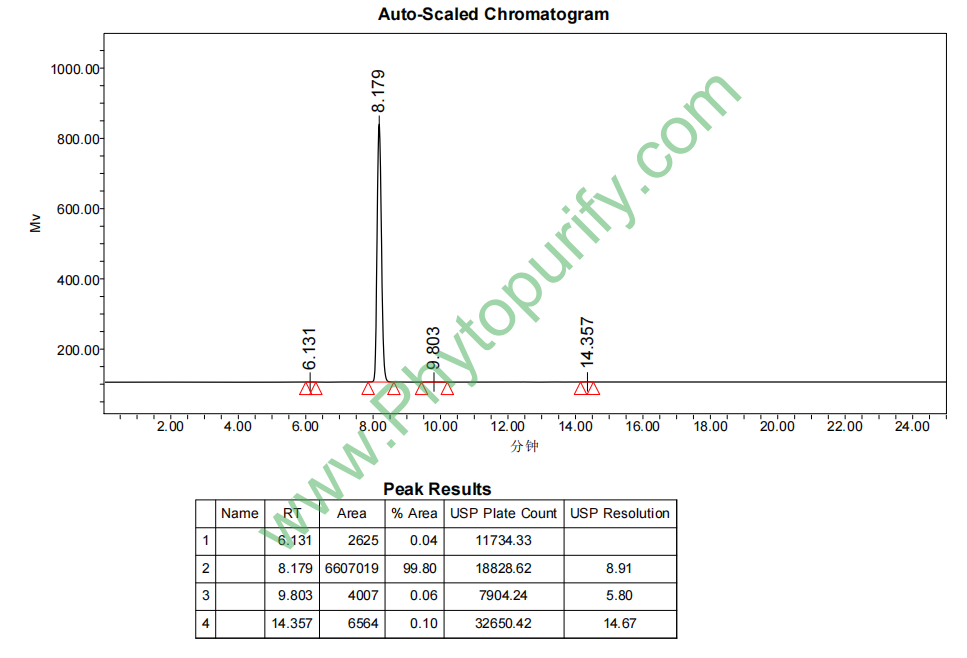
Purity: 95%~99%
Analysis Method: HPLC-DAD or/and HPLC-ELSD
Identification Method: Mass, NMR
Packing: Brown vial or HDPE plastic bottle
Storage: Store in a well closed container, protected from air and light. Put into refrigerate or freeze for long term storage.
Whenever possible, you should prepare and use solutions on the same day. However, if you need to make up stock solutions in advance, we recommend that you store the solution as aliquots in tightly sealed vials at -20℃. Generally, these will be useable for up to two weeks.
The product could be supplied from milligrams to grams
Inquire for bulk scale.
For Reference Standard and R&D, Not for Human Use Directly.
HPLC of Markogenin
Storage conditions:Short-term storage at 2~8℃, long-term storage at -20 ~ -80℃
58.9200
4.3497
4.3497
.0006
3.6991
6.9453
High
88.0521
5.3839
No
No
No
No
No
No
0.0
No
No
No
No
Markogenin (CAS number: 562-35-6) is a natural steroid product mainly isolated from the Yucca shidgera plant, which is endemic to the Americas. As a typical steroidal sapogenin, it has attracted widespread attention in the field of natural product pharmacology. In recent years, with the continuous deepening of research on natural products in the field of anti-tumor, Marko saponin has become one of the hotspots in the treatment of malignant tumors such as lymphoma due to its unique chemical structure and multi-target biological activity.
Lymphoma, as a type of malignant tumor originating from the lymphatic system, has high heterogeneity and complex pathogenic mechanisms. Traditional treatment methods such as chemotherapy, radiotherapy, and targeted therapy have improved patient prognosis to a certain extent, but there are still issues such as drug resistance and toxic side effects. Therefore, developing new safe and effective anti lymphoma drugs has become an urgent medical challenge to be solved. Malkosaponin has shown promising pharmacological potential and potential as a drug due to its regulatory effects on various lymphoma related molecular targets.
This article will provide a systematic review of the chemical structure and physicochemical properties, plant sources and extraction methods, pharmacological activity and mechanism of action, pharmacological evaluation and pharmacokinetic characteristics of Marko saponin, with a focus on exploring its molecular targets and mechanisms in the treatment of lymphoma. The aim is to provide theoretical basis and research direction for the further development and clinical application of this natural product.
Malkosaponin belongs to the class of steroidal saponins, with a molecular formula of C30H48O4 and a molecular weight of 432.6450. Its structural core is a typical four ring steroid skeleton with multiple hydroxyl substituents, endowing it with certain polarity and biological activity. The LogP value of Markosapogenin is 4.3497, indicating its good lipid solubility, which has a positive impact on its cell membrane penetration and in vivo distribution. Its topological polar surface area (TPSA) is 58.92 Å ², indicating moderate solubility in polar environments.
The extremely low water solubility (0.0006 mg/mL) suggests that the solubility of Markosapogenin in aqueous phase is limited, which may affect its oral absorption and bioavailability. It is worth noting that the compound has a high blood-brain barrier penetration ability, indicating its potential application value in the treatment of central nervous system diseases.
In terms of safety, Marko saponin did not exhibit hERG channel inhibition, reducing the risk of cardiac toxicity; The Ames mutagenicity test result is 0.0, indicating a low risk of genotoxicity and meeting drug safety requirements.
The main source of Markosaponin is Yucca shidgera, which belongs to the Agavaceae family and is widely distributed in arid and semi-arid regions of southwestern North America. Yucca shidgera is traditionally used in folk therapies such as anti-inflammatory, antibacterial, and immune regulation due to its rich content of steroidal saponins.
The extraction of Markosaponin is usually carried out using organic solvent extraction combined with column chromatography separation technology. The specific steps include:
In addition, with the advancement of technology, new green extraction methods such as ultrasound assisted extraction and microwave-assisted extraction are gradually being applied to the acquisition of Markovnikov saponins, improving extraction efficiency and purity, reducing the use of organic solvents, and in line with the environmental trend of modern natural product extraction.
The pharmacological activity research of Marko saponin mainly focuses on its anti-tumor, anti-inflammatory, and immunomodulatory effects. Especially in the field of lymphoma, relevant in vitro and in vivo experiments have shown significant regulatory effects on tumor cell proliferation, apoptosis, and signaling pathways.
Multiple studies have shown that Markosaponin can inhibit the proliferation of lymphoma cell lines, induce cell cycle arrest and apoptosis. Its mechanism of action involves the regulation of multiple signaling pathways, including changes in the expression of anti apoptotic protein families, cell cycle regulatory factors, and transcription factors.
In the in vivo model, Markosapogenin significantly prolongs the survival of experimental animals by inhibiting tumor growth and promoting tumor cell apoptosis, with minimal toxic side effects, demonstrating good therapeutic potential.
Malkosaponin can regulate immune cell function, inhibit the release of pro-inflammatory cytokines, and alleviate inflammatory reactions. This effect is particularly important for regulating the microenvironment of lymphoma, helping to restore immune surveillance function and inhibit tumor progression.
In addition, Markosapogenin also exhibits a positive effect in regulating macrophage and T cell activity, which may enhance the body's anti-tumor immune response by regulating the cytokine network.
The mechanism of action of Markosapogenin in the treatment of lymphoma is complex, involving multiple key molecular targets and signaling pathways. Based on systems biology and molecular pharmacology research, the following main targets have been identified:
Overall, Markosapogenin regulates tumor cell proliferation, apoptosis, immune escape, and microenvironment through multi-target and multi pathway synergistic effects, demonstrating multidimensional anti-tumor mechanisms.
The LogP of Markosapogenin is 4.3497, indicating that it has good lipid solubility, which is beneficial for cell membrane permeability and in vivo distribution. However, excessive lipid solubility may affect water solubility and oral absorption. Its TPSA is 58.92 Å ², which is in a moderate range and beneficial for penetrating cell membranes and the blood-brain barrier.
The extremely low water solubility (0.0006 mg/mL) is a major challenge for its drug development, limiting its oral bioavailability and formulation development. To solve this problem, techniques such as nanocarriers, liposome encapsulation, or preparation of solid dispersions can be used to improve its solubility and stability.
In terms of safety, Marko saponin does not inhibit hERG channels, reducing the risk of cardiac toxicity, and the Ames test is negative with low genotoxicity risk, which meets the clinical safety requirements for medication.
At present, there is limited systematic pharmacokinetic research on Marko saponins. Preliminary data suggests that Markosapogenin has good blood-brain barrier penetration ability in vivo, suggesting its widespread distribution and potential action on the central nervous system.
Its metabolic pathway has not been fully elucidated, and it is speculated that it is mainly metabolized by the liver cytochrome P450 enzyme system, producing various metabolites. Further research is needed on the half-life and clearance rate in the body to guide dosage design.
In the future, systematic pharmacokinetic and toxicological studies need to be conducted to evaluate their absorption, distribution, metabolism, and excretion (ADME) characteristics, optimize dosing regimens, and ensure clinical safety and effectiveness.
Malkosaponin, as a natural steroidal saponin with multi-target anti lymphoma activity, has shown broad clinical application prospects. Its ability to regulate tumor cell survival and immune microenvironment in multiple dimensions provides a new therapeutic strategy for lymphoma and related malignant tumors.
Future clinical development should focus on the following directions:
In addition, the blood-brain barrier penetrability of Markosapogenin suggests its potential application value in central nervous system tumors and neurodegenerative diseases, which is worthy of further research.
As an important steroidal saponin in Yucca shidgera, Marko saponin has demonstrated significant pharmacological activity and good safety in the field of anti lymphoma due to its unique chemical structure and multi-target regulatory ability. Its multidimensional mechanism of action covers anti apoptosis, cell cycle regulation, immune regulation, and signal transduction pathway intervention, providing new ideas and drug candidates for lymphoma treatment.
Although its poor water solubility and insufficient pharmacokinetic research are the main bottlenecks restricting its clinical application, with the continuous progress of formulation technology and pharmacological research, Marko saponin is expected to become an important breakthrough in the development of natural product anti-tumor drugs. In the future, through systematic pharmacokinetic studies, dosage form optimization, and clinical validation, it is expected that marquisogenin will move from the laboratory to clinical practice, benefiting a large number of lymphoma patients.
In summary, Markosapogenin not only enriches the pharmacological connotation of steroid saponin natural products, but also provides valuable examples and inspirations for the development of natural product drugs, which is worthy of continuous attention and in-depth exploration by scientific research and the pharmaceutical industry.
