Introduction/Overview
Diabetes, as a global chronic metabolic disease, its incidence rate continues to rise and has become a major public health problem threatening human health. Although current first-line hypoglycemic drugs can effectively control blood sugar, long-term use often accompanies side effects such as weight gain, low blood sugar risk, and cardiovascular events, prompting researchers to continuously explore safer and multi-target new treatment strategies from natural products. Traditional Chinese Medicine Zhimu(Anemarrhena asphodeloides Bunge), Liliaceae plants, whose dry roots are used as medicine, have the effects of clearing away heat, purging fire, nourishing yin and moistening dryness, and have a long history of application in the treatment of diabetes (diabetes) in traditional Chinese medicine. Modern pharmacological research has confirmed that the steroidal saponins rich in Anemarrhena asphodeloides are the material basis for its various biological activities.
Anemarrhenasaponin III (CAS: 163047-23-2) is an important steroid saponin monomer isolated from Anemarrhena. In recent years, with the progress of separation and identification technology and the deepening of molecular pharmacology research, the outstanding activity of Anemarrhena asphodeloides saponin III in anti diabetes and its unique multi target mechanism of action have attracted increasing attention. It not only exhibits significant effects in improving insulin resistance, promoting glucose uptake, and regulating glucose and lipid metabolism, but is also considered a highly promising natural lead compound due to its targets involving key signaling pathways and proteins such as AMPK, PPAR γ, PI3K/Akt, SGLT2, etc. This article aims to provide a systematic review of the chemical properties, plant sources, pharmacological activities, molecular mechanisms of action, pharmacological evaluation, and clinical application prospects of saponins III from Anemarrhena, in order to provide comprehensive scientific references for the in-depth research and future drug development of this compound.
Chemical structure and physicochemical properties
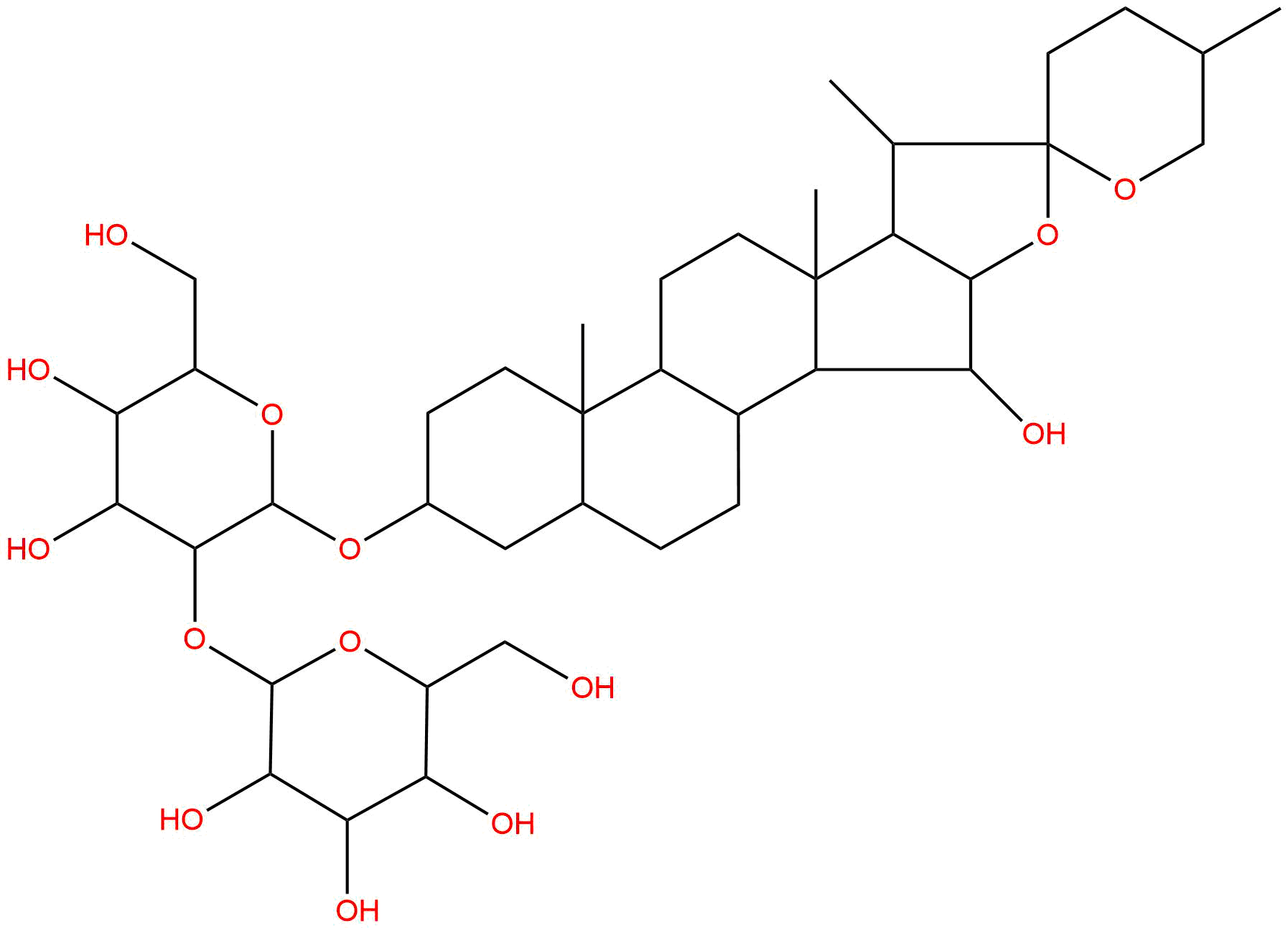
Zhimu saponin III is a spirostanol type steroid saponin. Its basic skeleton is composed of hydrophobic steroid mother nucleus (spirostane) and hydrophilic oligosaccharide chains connected by glycosidic bonds, and this amphiphilic structure is an important basis for its biological activity.
Chemical structural characteristics The steroid mother nucleus is a typical spirostane structure, with a disaccharide chain composed of glucose and galactose connected to the C-3 hydroxyl group. The sugar moiety is crucial for its water solubility, recognition and binding ability to target proteins. The molecular formula is C ∝₉ H ₆₄ O ₁∝, and the molecular weight is 756.9270 g/mol.
Physicochemical properties According to the provided pharmacological parameters, the logarithm of the lipid water partition coefficient (LogP) of Zhimu saponin III is 1.6950, indicating that it has a certain lipophilicity but is not highly lipophilic. Its topological polar surface area (TPSA) is as high as 217.2200 Å ², which is mainly attributed to the multiple hydroxyl groups and oxygen atoms on the sugar ring in the molecule, indicating its strong molecular polarity and ability to form hydrogen bonds. The water solubility value is 0.0891 (usually measured in mg/mL or mol/L, indicating that it is slightly soluble or poorly soluble in water), which is consistent with the properties of large molecule saponin compounds. The higher TPSA and lower LogP values jointly determine its limited ability to cross biological membranes (such as intestinal epithelial cell membranes and blood-brain barriers), with blood-brain barrier permeability assessed as "low", indicating a lower risk of central nervous system related side effects. In addition, hERG inhibition is' no ', indicating a low risk of cardiac toxicity; The Ames test result is 0.3 (usually referring to the ratio of the number of revertant mutant colonies to the control), indicating that no significant mutagenicity was observed in this testing system, and the preliminary safety assessment is good.
Plant sources and extraction methods
Zhimu Saponin III is specifically derived from the Liliaceae plant Zhimu(Anemarrhena asphodeloides Bunge's dried rhizomes. Zhimu is mainly distributed in northern China, such as Hebei and Shanxi, and its rhizomes are rich in various steroidal saponins, flavonoids, and polysaccharides.
extraction process Obtaining saponins III from the rhizomes of Anemarrhena asphodeloides usually involves a multi-step separation and purification process. Firstly, the dried rhizomes of Anemarrhena chinensis are crushed and subjected to reflux extraction or ultrasound assisted extraction using alcohol solvents (such as methanol, ethanol) or alcohol water mixed solvents to maximize the extraction of saponin components. After vacuum concentration, the crude extract is preliminarily enriched and purified using macroporous adsorption resins (such as D101, AB-8). Different concentrations of ethanol aqueous solutions are commonly used for gradient elution, and saponin components are usually eluted in the medium to high concentration ethanol range (such as 50% -70%).
Separation and Purification After obtaining the crude saponin, it is necessary to further use modern chromatographic techniques for fine separation. Positive or reverse phase silica gel column chromatography is a commonly used method to separate saponins of different polarities by adjusting the ratio of eluent (such as chloroform methanol water system). High performance liquid chromatography (HPLC), especially preparative HPLC, is a key technology for obtaining high-purity monomers of paeoniflorin III. Usually, a C18 reverse phase chromatography column is used, with acetonitrile water or methanol water as the mobile phase for isocratic or gradient elution, and monitored and collected by UV detector (saponins have terminal absorption at 200-210 nm) or evaporative light scattering detector (ELSD). The final obtained compound needs to undergo structural confirmation using spectroscopic techniques such as nuclear magnetic resonance (NMR, including ¹ H-NMR, ¹ ³ C-NMR, 2D-NMR) and mass spectrometry (MS).
Pharmacological activity research
A large number of pharmacological experiments in vivo and in vitro have confirmed that Anemarrhena saponin III has extensive and significant anti diabetes and related metabolic disorders.
Improving insulin resistance and lowering blood sugar levels: In a variety of diabetes animal models (such as streptozotocin induced diabetes rats, high-fat diet combined with low-dose streptozotocin induced type 2 diabetes rats, db/db spontaneous diabetes mice), long-term intragastric administration of anemarroside III can reduce the levels of fasting blood glucose, postprandial blood glucose and glycosylated hemoglobin in a dose-dependent manner. Oral glucose tolerance test and insulin tolerance test show that it can significantly improve the body's ability to handle glucose and sensitivity to insulin, and improve insulin resistance status.
Promote peripheral tissue glucose uptake and utilization At the cellular level, Zhimu saponin III can significantly promote glucose uptake in insulin resistant adipocytes (such as 3T3-L1) and skeletal muscle cells (such as C2C12). This promoting effect is not entirely dependent on insulin, suggesting that it may exert its effect through pathways other than the insulin signaling pathway.
Regulating lipid metabolism Diabetes is often accompanied by abnormal lipid metabolism. Research shows that Anemarrhena asphodeloides saponin III can reduce the levels of total cholesterol, triglycerides and low-density lipoprotein cholesterol in the serum of diabetes model animals, increase high-density lipoprotein cholesterol, improve lipid mass spectrometry, and reduce liver steatosis.
Protecting pancreatic beta cell function In addition to improving peripheral tissue insulin sensitivity, Zhimu saponin III also showed a protective effect on pancreatic beta cells. It can alleviate beta cell apoptosis induced by high glucose or inflammatory factors, promote insulin secretion, and maintain the integrity of pancreatic islet structure.
Anti inflammatory and antioxidant properties Chronic low-grade inflammation and oxidative stress are the core links in the occurrence and development of insulin resistance and diabetes complications. Zhimu Saponin III can inhibit the expression of pro-inflammatory factors (such as TNF - α, IL-6) in adipose tissue, liver, and muscle, while enhancing the activity of antioxidant enzymes (such as SOD, GSH Px), reducing reactive oxygen species levels, and fundamentally alleviating metabolic inflammation and oxidative damage.
Mechanism of action and molecular targets
The anti diabetes effect of saponin III of Anemarrhena asphodeloides is not achieved through a single target, but through a complex multi target network. Its mechanism of action involves multiple key signal pathways and molecular targets.
Activate AMPK signaling pathway Adenosine activated protein kinase (AMPK) is the master switch of cellular energy metabolism. Zhimu saponin III has been proven to be an effective activator of AMPK. It activates the catalytic subunit of AMPK (PRKAA1) directly or indirectly, thereby phosphorylating downstream targets such as acetyl CoA carboxylase (ACC). The activation of AMPK leads to: 1) promoting the translocation of glucose transporter 4 (GLUT4, encoded by the SLC2A4 gene) from skeletal muscle and adipocyte membranes to the cell membrane, increasing glucose uptake; 2) Inhibit the expression of key enzymes involved in hepatic gluconeogenesis and reduce hepatic glucose output; 3) Promote fatty acid oxidation and inhibit fat synthesis. This is one of the core mechanisms by which it improves insulin resistance and regulates energy metabolism.
Regulating the PI3K/Akt signaling pathway The phosphatidylinositol 3-kinase (PI3K)/protein kinase B (Akt) pathway is a classic insulin signaling pathway. Zhimu saponin III can enhance tyrosine phosphorylation of insulin receptor substrate 1 (IRS1), promote the activation of PI3K regulatory subunit (PIK3R1) and catalytic subunit, and thereby activate Akt (AKT1). Activated Akt synergistically promotes glucose uptake, utilization, and storage by promoting GLUT4 translocation, activating glycogen synthase, and inhibiting glycogen synthase kinase 3.
Regulating PPAR γ activity Peroxisome proliferator activated receptor gamma (PPARG) is a key nuclear receptor that regulates adipocyte differentiation, lipid metabolism, and insulin sensitivity. Zhimu saponin III may act as a partial agonist or regulator of PPAR γ, enhancing its transcriptional activity, promoting normal differentiation of adipocytes, increasing the secretion of beneficial adipokines such as adiponectin, and thus systematically improving insulin sensitivity.
Inhibit SGLT2 and DPP4 Sodium glucose cotransporter 2 (SGLT2) is a key protein responsible for glucose reabsorption in the proximal tubules of the kidney. Research has shown that saponins III from Anemarrhena chinensis may have certain SGLT2 inhibitory activity, reducing renal reabsorption of glucose, increasing urinary glucose excretion, and thereby lowering blood sugar. This mechanism is similar to clinical SGLT2 inhibitor drugs. In addition, it can inhibit the activity of dipeptidyl peptidase-4 (DPP4), reduce the degradation of glucagon like peptide-1 (GLP-1), prolong its effect of promoting insulin secretion and inhibiting glucagon release.
Affects glucokinase (GCK) and other targets Glucokinase (GCK) is a glucose sensor in the liver and pancreatic beta cells. Zhimu saponin III may affect liver glucose metabolism and insulin secretion by regulating the activity or expression of GCK. Its synergistic effect on multiple targets forms a three-dimensional anti diabetes effect network, avoiding the limitations of single target drugs.
Evaluation of drug properties and pharmacokinetics
Although the pharmacological activity of Zhimu saponin III is clear, its development as a drug candidate molecule still requires comprehensive pharmacological evaluation.
Absorption, distribution, metabolism, excretion (ADME)As a large molecule polar saponin, the oral bioavailability of Zhimu saponin III may face challenges. Its high molecular weight and TPSA, as well as low blood-brain barrier permeability, indicate that its oral absorption may be poor, mainly distributed in the blood and peripheral tissues, making it difficult to enter the central nervous system. Saponin compounds are easily hydrolyzed by acid or metabolized by gut microbiota in the gastrointestinal tract. The glycosyl portion may be hydrolyzed to produce secondary glycosides or aglycones, and the activity of these metabolites may be different from that of the original compound. Preliminary in vitro studies on the metabolic stability of liver microsomes and in vivo pharmacokinetic studies (usually conducted in rats or mice) are necessary steps to evaluate their metabolic rate, major metabolites, and half-life. Its excretion pathway may mainly be through bile and feces.
Formulation and administration strategy To improve its oral bioavailability, advanced drug delivery technologies such as nanocrystals, liposomes, solid dispersions, phospholipid complexes, or in combination with absorption enhancers may be required. These technologies can increase its solubility, improve membrane permeability, and protect it from gastrointestinal degradation. In addition, considering the development of non oral routes of administration (such as injections, but with the need to address potential safety issues such as hemolysis of saponins) is also an option.
Preliminary Safety Assessment The preliminary data provided (hERG inhibition negative, Ames test negative) is a good start, but a complete preclinical safety evaluation is still needed. This includes a complete set of tests for acute toxicity, long-term repeated administration toxicity (28 day, 90 day toxicity tests), reproductive toxicity, genetic toxicity, as well as special safety tests for potential irritation and hemolysis caused by saponin components. The therapeutic index (the ratio of effective dose to toxic dose) needs to be determined in animal models.
Clinical application prospects and prospects
As a multi target anti diabetes natural lead compound, Anemarrhena asphodeloides saponin III has broad clinical application prospects, but also faces many challenges.
tap potential:
1. New multi target anti diabetes drugs: It simultaneously acts on multiple key pathways, such as AMPK, PI3K/Akt, PPAR γ, and may produce synergistic effects. It has comprehensive advantages in improving insulin resistance, protecting β cells, and regulating glucose and lipid metabolism, especially for complex type 2 diabetes.
2. Combination medication components Can be used in combination with existing single target drugs (such as metformin, SGLT2 inhibitors, DPP4 inhibitors), which may produce complementary or enhancing effects, reducing their respective dosages and side effects.
3. Dietary supplements or functional foods Under the premise of ensuring safety, it can be developed as a health product to assist in blood glucose management.
4. Chemical modification and structural optimization By using it as the parent nucleus for structural modification (such as modifying the sugar moiety or modifying the steroid nucleus), it is expected to obtain derivatives with stronger activity, higher oral bioavailability, and better selectivity.
challenges faced:
1. Drug bottleneck Poor oral absorption and unstable metabolism are the main physical, chemical, and pharmacokinetic barriers that restrict its development.
2. Depth of mechanism of action At present, there is a lack of precise molecular level research (such as eutectic structure, enzyme kinetics data) on its binding mode, affinity, and selectivity with some targets (such as SGLT2, DPP4).
3. System security A comprehensive and standardized preclinical safety evaluation of Good Laboratory Practice (GLP) standards is required.
4. Intellectual Property and Industrialization How to efficiently, cost effectively, and sustainably prepare high-purity saponins III from natural products on a large scale, and form patent protection, is a problem that must be solved for industrialization.
Future research directions:
Future research should focus on: 1) using computer-aided drug design combined with synthetic chemistry to systematically optimize its structure; 2) Conduct in-depth molecular docking and molecular dynamics simulations based on target structures to elucidate their precise modes of action; 3) Using genetically modified animals, gene knockout techniques, etc., to validate their key targets at the overall animal level; 4) Actively exploring new drug delivery systems and breaking through their delivery bottlenecks; 5) Conduct standardized preclinical pharmacodynamic and toxicological studies to accumulate data for applying for clinical research approval (IND).
Conclusion
Anemarrhena asphodeloides saponin III is a steroid saponin monomer with clear and multiple anti diabetes pharmacological activities, which was excavated from the traditional Chinese medicine Anemarrhena asphodeloides. It demonstrates comprehensive therapeutic advantages in improving insulin resistance, promoting glucose utilization, regulating lipid metabolism, and protecting pancreatic islet function by synergistically activating AMPK, regulating PI3K/Akt, and influencing PPAR γ signaling pathways. Despite its challenges in oral bioavailability and other aspects of drug formation, its unique multi target mechanism of action provides a valuable natural lead compound template for the development of a new generation of anti diabetes drugs. With the cross integration of modern pharmaceutical chemistry, pharmacy and molecular pharmacology, through in-depth structural optimization, mechanism interpretation and delivery strategy innovation of Anemarrhena saponin III, it is expected to transform it into an innovative drug with clinical application value, providing new options for the prevention and treatment of diabetes and its complications, and also providing a model for the modernization of traditional Chinese medicine and the development of new natural products.