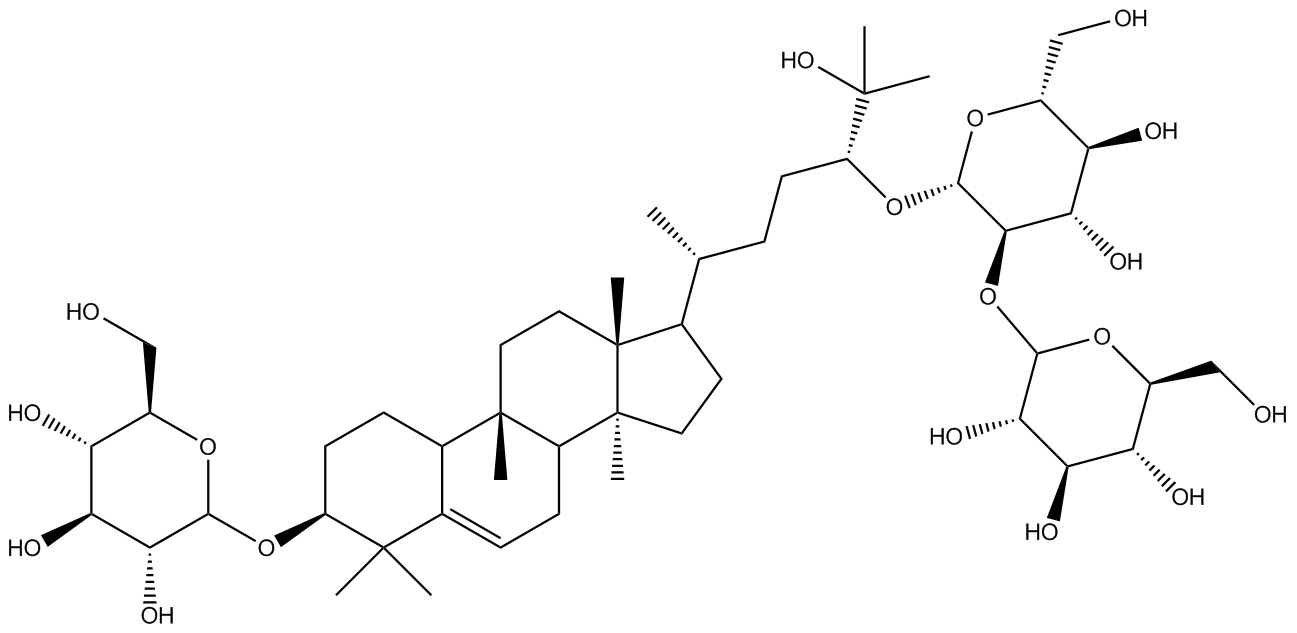


Product name: 11-Deoxymogroside IIIE
Synonym name:
Catalogue No.: BP2040
Cas No.: 1793003-47-0
Formula: C48H82O18
Mol Weight: 947.166
Botanical Source: Siraitiae fructus
Physical Description:
Type of Compound: Triterpenoids
Purity: 95%~99%
Analysis Method: HPLC-DAD or/and HPLC-ELSD
Identification Method: Mass, NMR
Packing: Brown vial or HDPE plastic bottle
Storage: Store in a well closed container, protected from air and light. Put into refrigerate or freeze for long term storage.
Whenever possible, you should prepare and use solutions on the same day. However, if you need to make up stock solutions in advance, we recommend that you store the solution as aliquots in tightly sealed vials at -20℃. Generally, these will be useable for up to two weeks.
The product could be supplied from milligrams to grams
Inquire for bulk scale.
For Reference Standard and R&D, Not for Human Use Directly.
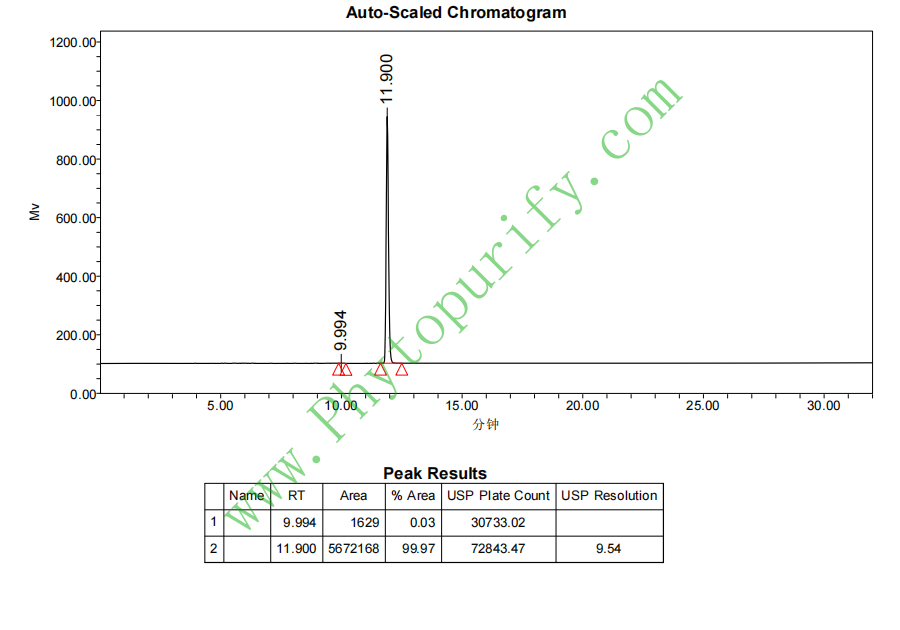
HPLC of 11-Deoxymogroside IIIE
Storage conditions:Short-term storage at 2~8℃, long-term storage at -20 ~ -80℃
With the global prevalence of metabolic diseases, especially the high incidence of diabetes, the development of safe and effective anti diabetes natural products has become an important direction of drug research and development. Siraitia grosvenorii, as the representative of traditional Chinese medicine and natural sweeteners, its main active ingredients Arhat fruit glycosides have attracted much attention due to their low calorie, high sweetness and multiple biological activities. 11 deoxymogroside IIIE (11 deoxymogroside IIIE) is an important triterpene glycoside in Arhat grosvenorii, which has shown significant pharmacological potential in the field of anti diabetes in recent years. In this paper, the chemical structure, extraction method, pharmacological activity, mechanism of action, and evaluation of drug performance of 11 deoxygenated Arhat fruit glycoside IIIE are systematically reviewed, in order to provide scientific basis for its clinical transformation and new drug development.
11 deoxygenated Arhat fruit glycoside IIIE is a high molecular weight triterpene sweet glycoside with a molecular weight of 947.1660, a complex molecular formula, and a steroid skeleton connected by multiple glycosides. Its LogP value is 2.5042, indicating moderate hydrophobicity that facilitates cell membrane penetration but is not prone to excessive accumulation. The TPSA (topological polar surface area) is 298.14, indicating its high polarity and number of hydrogen bond donors/acceptors, which may affect its oral absorption and bioavailability. Low water solubility (0.0952) suggests limited solubility in aqueous media and may require appropriate formulation techniques to improve its bioavailability. Low blood-brain barrier penetration ability reduces the risk of central nervous system side effects. The negative result of hERG inhibition experiment indicates a low risk of cardiac toxicity. The Ames test was 0.0, indicating no significant genotoxicity.
The chemical structure core of 11 deoxygenated Arhat fruit glycoside IIIE is a pentacyclic triterpene skeleton, and the characteristics of 11 anoxic groups make it distinct from other Arhat fruit glycosides. Its polysaccharide glycosylation modification endows it with strong water solubility and biological activity, and the type and connection mode of sugar chains have a significant impact on its pharmacological effects.
11 deoxygenated Arhat IIIE is mainly obtained from siraitia grosvenorii fruit. Momordica grosvenorii is a cucurbitaceae plant native to southern China, and its fruit contains rich sweet glycosides. Traditional extraction processes often use water extraction combined with alcohol precipitation. In recent years, the application of ultrasound assisted extraction, microwave-assisted extraction, and membrane separation technology has significantly improved extraction efficiency and purity.
The specific extraction process generally includes: fresh or dried siraitia grosvenorii fruit is crushed, and then extracted with hot water or 70% ethanol. After the extraction solution is filtered and concentrated, the impurities are separated with organic solvents, and then purified by column chromatography (such as silica gel column, reverse phase C18 column). Finally, 11 deoxygenated Arhat glycoside IIIE is identified and separated by high performance liquid chromatography (HPLC). In recent years, the introduction of supercritical CO2 extraction and membrane separation technology has further optimized the extraction process, ensuring the stability and biological activity of active ingredients.
11 deoxygenated Arhat fruit glycoside IIIE has shown significant anti diabetes activity in many in vitro and in vivo experiments. Its main manifestations include improving insulin sensitivity, promoting glucose uptake, inhibiting gluconeogenesis, and regulating lipid metabolism.
Cell model study showed that 11 deoxygenated Arhat fruit glycoside IIIE could activate AMPK pathway and enhance glucose uptake by skeletal muscle cells and adipocytes. It has a significant protective effect on pancreatic beta cells and can alleviate high glucose induced oxidative stress and cell apoptosis. In addition, 11 deoxygenated Arhat fruit glycoside IIIE can inhibit the activity of DPP4 enzyme, thus prolonging the half-life of GLP-1 and promoting insulin secretion.
In the diabetes rat model, oral administration of 11 deoxygenated Arhat fruit glycoside IIIE significantly reduced fasting blood glucose and glucose tolerance, and improved insulin resistance. It can also regulate lipid metabolism, reduce serum triglycerides and cholesterol levels, and alleviate liver steatosis. Long term administration shows that it has protective effect on diabetes complications such as kidney and retina.
Toxicological studies showed that 11 deoxygenated Arhat fruit glycoside IIIE had no obvious acute toxicity and genetic toxicity, and the hERG channel inhibition test was negative, indicating that the heart was safe. The Ames test result is negative, supporting its safety.
The anti diabetes effect of 11 deoxygenated Arhat fruit glycoside IIIE involves multiple signal pathways and key molecular targets, mainly including:
AMP activated protein kinase (AMPK) is a core regulatory factor in cellular energy metabolism. 11 deoxygenated Arhat fruit glycoside IIIE promotes glucose uptake and fatty acid oxidation by activating AMPK (PRKAA1 subunit), inhibits gluconeogenesis and improves metabolic homeostasis.
Sodium glucose cotransporter 2 (SGLT2) is a key target for renal glucose reabsorption. 11 deoxygenated Arhat fruit glycoside IIIE has a certain inhibitory effect on SGLT2, promotes urine glucose excretion, and reduces blood sugar level.
Glucokinase (GCK) is the key enzyme of glucose metabolism. 11 deoxygenated Arhat glycoside IIIE can enhance its activity and promote glucose metabolism. Peroxisome proliferator activated receptor γ (PPARG) regulates lipid metabolism and insulin sensitivity, and 11 deoxygenated Arhat fruit glycoside IIIE improves lipid metabolism abnormalities by regulating PPARG expression.
11 deoxygenated Arhat fruit glycoside IIIE promotes the activation of AKT1 and PIK3R1 in insulin signaling pathway, enhances insulin mediated glucose transport, and improves insulin resistance.
Dipeptidyl peptidase 4 (DPP4) degrades GLP-1 and affects insulin secretion. 11 deoxygenated Arhat fruit glycoside IIIE inhibits DPP4 activity, increases GLP-1 level, and promotes islet β cell function.
Insulin receptor substrate 1 (IRS1) and glucose transporter 4 (SLC2A4) are key molecules involved in insulin signaling transduction and glucose uptake. 11 deoxygenated Arhat fruit glycoside IIIE enhances IRS1 phosphorylation, promotes SLC2A4 transport to cell membrane, and improves glucose uptake efficiency.
To sum up, 11 deoxygenated Arhat fruit glycoside IIIE achieves comprehensive regulation of sugar metabolism through multi target and multi pathway synergy.
The pharmaceutical evaluation of 11 deoxygenated Arhat IIIE shows that it has good safety and potential efficacy advantages. The high molecular weight and polarity may limit its oral bioavailability, but its moderate LogP value and low blood-brain barrier permeability provide safety assurance.
Pharmacokinetic study showed that 11 deoxygenated Arhat fruit glycoside IIIE was absorbed slowly in vivo, and was mainly transformed into active metabolites through intestinal metabolic enzymes and intestinal flora metabolism. Its half-life is moderate, mainly metabolized by the liver, and excreted mainly through bile. Due to low water solubility, formulation design requires the use of techniques such as nanoparticles, liposomes, or inclusion complexes to improve solubility and bioavailability.
In addition, 11 deoxygenated Arhat fruit glycoside IIIE has no significant hERG channel inhibition and genotoxicity, showing a good safety pedigree, which is suitable for subsequent clinical development.
As a natural product derived from traditional Chinese medicine Momordica grosvenorii, 11 deoxygenated Arhat fruit glycoside IIIE shows a broad application prospect in the field of anti diabetes. Its multi target mechanism of action meets the needs of modern multi factor diabetes treatment, especially suitable for combined drug strategy.
Future research should focus on the following aspects:
In conclusion, 11 deoxygenated Arhat fruit glycoside IIIE, as a safe and effective natural anti diabetes candidate compound, has strong clinical transformation potential.
As an important triterpene glycoside in Arhat grosvenorii, 11 deoxygenated siraitin IIIE, with its unique chemical structure and multi-target anti diabetes mechanism, has become a hot spot in natural product pharmacology. Its good safety and multiple pharmacological activities provide new ideas and candidate molecules for the treatment of diabetes. In the future, through in-depth pharmacological mechanism research, pharmaceutical optimization and clinical verification, it is expected to promote the clinical application of 11 deoxygenated Arhat fruit glycoside IIIE and benefit the majority of diabetes patients.
