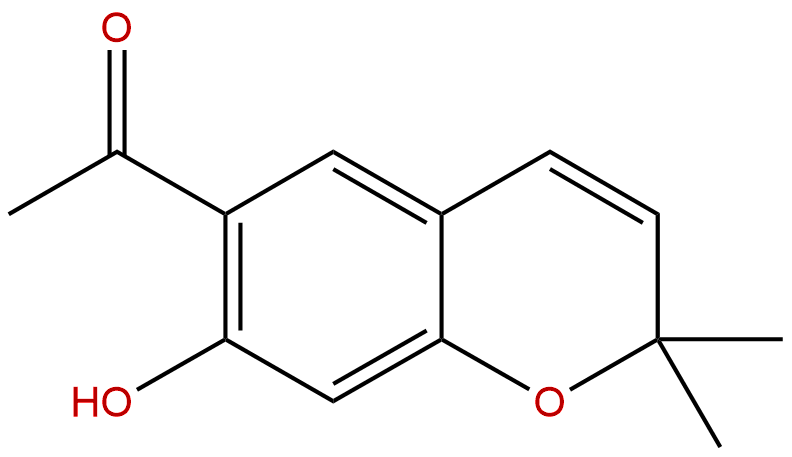


Product name: Eupatoriochromene
Synonym name: De-O-methylencecalin; Demethylencecalin
Catalogue No.: SBP00156
Cas No.: 19013-03-7
Formula: C13H14O3
Mol Weight: 218.252
Botanical Source:
Physical Description: Cryst.
Type of Compound: Phenols
Purity: 95%~99%
Analysis Method: HPLC-DAD or/and HPLC-ELSD
Identification Method: Mass, NMR
Packing: Brown vial or HDPE plastic bottle
The product could be supplied from milligrams to grams. Inquire for bulk scale.
We provide solution to improve the water-solubility of compounds, thereby facilitating the variety of activity tests and clinic uses.
For Reference Standard and R&D, Not for Human Use Directly.
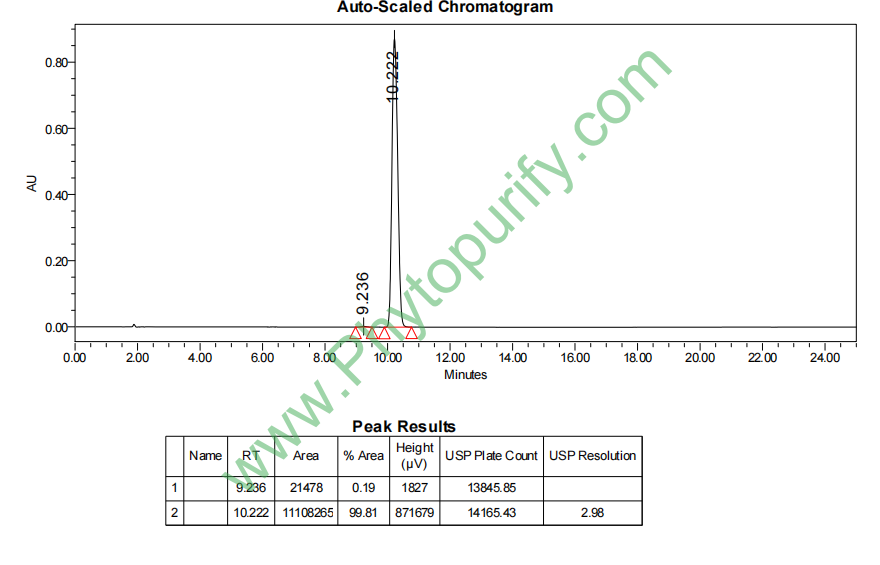
HPLC of Eupatoriochromene
Storage conditions:Short-term storage at 2~8℃, long-term storage at -20 ~ -80℃
46.5300
3.0322
2.9646
.1478
5.7787
13.0241
High
84.1668
2.7667
Yes
Yes
No
No
Yes
Yes
0.0
Yes
Yes
Yes
Yes
Eupatoriochromone (CAS number: 19013-03-7) is a natural product of the benzopyran class derived from plants. Due to its unique chemical structure and significant biological activity, it has attracted widespread attention in the field of natural product pharmacology in recent years. As a compound with inhibitory activity against xanthine oxidase (XO), Zeeland has shown potential application value in anti-inflammatory, antioxidant, and related disease treatment. As a key enzyme in purine metabolism, xanthine oxidase is involved in the production of uric acid, and its abnormal activity is closely related to gout, hyperuricemia, and various inflammatory diseases. Zeelan chromogens may provide new ideas for the treatment of these diseases by regulating XO activity.
In addition, Zeranserine exhibits multi-target regulatory ability in the anti-inflammatory field, involving important inflammatory signaling pathways and molecular targets such as IL-6, STAT3, CASP1, TRPV1, PTGS1, TNF, TRPA1, NOS2, PTGS2, and NFKB1, demonstrating its complex mechanism of action in regulating immune responses and inflammatory processes. This article provides a systematic review of the chemical structure and physicochemical properties, plant sources and extraction methods, pharmacological activity and mechanism of action, pharmacological evaluation and pharmacokinetic characteristics of Zeelan Xanthan, combined with its clinical application potential, aiming to provide scientific basis and theoretical support for the in-depth research and development of this natural product.
Zeelan chromene belongs to the class of benzopyran compounds, and its basic skeleton is a fusion structure of a benzene ring and a pyran ring, which has strong chemical stability and biological activity. Its molecular formula is C14H14O3, with a molecular weight of 218.2520. The structure contains functional groups such as hydroxyl and methoxy, which endow it with certain polarity and the ability to bind to biological targets.
In terms of physical and chemical properties, the LogP value of Zeelan Xanthan is 3.0322, indicating its moderate lipid solubility, which is beneficial for membrane penetration and in vivo distribution. Its topological polar surface area (TPSA) is 46.53 Å ², indicating moderate polarity that may affect its oral absorption and blood-brain barrier permeability. The low water solubility (0.1478 mg/mL) to some extent limits its bioavailability, but also provides directions for improvement in drug formulation design.
It is worth noting that Zeranserine has a high blood-brain barrier permeability, which means it may play a role in the treatment of central nervous system diseases. In addition, the hERG channel inhibition test result was negative, indicating a low risk of cardiac toxicity, and the Ames test result was 0.0, indicating no significant genotoxicity risk. These pharmacological parameters provide preliminary guarantees for its safety.
Zeeland chromogens are mainly found in plants of the Zeeland genus, especially in the traditional Chinese medicine Eupatorium fortunei Turcz., which has a relatively abundant content. Zelan is a plant in the Asteraceae family, widely distributed in southern China and Southeast Asia. It has always been used as a traditional Chinese medicine and has the effects of clearing heat and detoxifying, promoting blood circulation and removing blood stasis.
The common methods for extracting Zeelan chromogens include solvent extraction, column chromatography separation, and high-performance liquid chromatography (HPLC) purification. Generally, ethanol or methanol is used as the extraction solvent, and crude extract is obtained by reflux extraction. Then, silica gel column chromatography is used for separation, combined with thin layer chromatography (TLC) to monitor the presence of target components. The purified Zeelan chromophore can be structurally identified by techniques such as nuclear magnetic resonance (NMR), mass spectrometry (MS), and infrared spectroscopy (IR).
In recent years, emerging technologies such as ultrasound assisted extraction and microwave-assisted extraction have also been applied to the extraction of Zeeland chromogens, significantly improving extraction efficiency and purity, laying the foundation for their large-scale preparation.
The pharmacological activity research of Zeelan Xanthan mainly focuses on its anti-inflammatory and antioxidant effects. As an inhibitor of xanthine oxidase, Zeeland can effectively reduce XO mediated reactive oxygen species (ROS) production, alleviate oxidative stress damage, and thereby alleviate inflammatory reactions.
Multiple in vitro experiments have shown that Zeeland can significantly inhibit the expression of inflammatory factors IL-6 and TNF - α, reduce the release of inflammatory mediators, and exert anti-inflammatory effects. In cell models, Zeelan Xanthan regulates the activation status of immune cells and reduces the inflammatory cascade by inhibiting the STAT3 and NF - κ B signaling pathways. In addition, its regulatory effect on CASP1 (caspase-1) suggests that it may be involved in the regulation of inflammasome activity.
Animal experiments further confirmed that Zeelan Xanthan can alleviate tissue damage and improve pathological conditions in inflammatory disease models. For example, in arthritis and enteritis models, Zeeland significantly reduces inflammatory markers, improves tissue inflammation and edema, and demonstrates good anti-inflammatory effects.
In addition to anti-inflammatory effects, Zeelan Xanthan has a regulatory effect on pain related receptors such as TRPV1 and TRPA1, indicating its potential value in pain management. Its inhibition of NOS2 (inducible nitric oxide synthase) may further alleviate inflammation related oxidative damage.
The mechanism of action of Zeelan Xanthan involves the regulation of multiple inflammatory signaling pathways and molecular targets. As an inhibitor of xanthine oxidase, it directly blocks the production of reactive oxygen species in purine metabolism, reduces oxidative stress, and alleviates the inflammatory microenvironment.
At the cellular signaling level, Zeelan Xanthan inhibits NF - κ B (NFKB1) activation, blocks the transcriptional expression of pro-inflammatory genes, and reduces the release of key inflammatory factors such as IL-6, TNF - α, and PTGS2 (COX-2). In addition, Zeeland can regulate the STAT3 signaling pathway, inhibit the proliferation and activation of inflammatory cells, and alleviate chronic inflammation.
CASP1, as the core enzyme of inflammasomes, participates in the maturation and secretion of pro-inflammatory cytokine IL-1 β. The inhibitory effect of Zeelan Xanthan on CASP1 suggests that it may regulate the activity of inflammasomes and control the initiation and diffusion of inflammatory responses.
TRPV1 and TRPA1 are important ion channels for sensing pain and inflammatory signals. The regulatory effect of Zeelan Xanthan on them may alleviate inflammation related pain symptoms and improve patients' quality of life.
In addition, the dual regulation of Zelanserine on PTGS1 (COX-1) and PTGS2 (COX-2) may reduce the common gastrointestinal side effects of traditional nonsteroidal anti-inflammatory drugs (NSAIDs) while inhibiting inflammation. This characteristic provides a theoretical basis for it to become a safer anti-inflammatory drug.
The pharmacological evaluation of Zelanserine shows that it has good potential for drug development. Its molecular weight is moderate (218.25 Da), which conforms to Lipinski's rules and is beneficial for oral absorption. The LogP value is 3.03, indicating moderate lipid solubility, which ensures in vivo distribution and avoids the decrease in bioavailability caused by excessive lipid solubility.
The TPSA value of 46.53 Å ² suggests that it has good cell membrane penetration ability. Combined with its high blood-brain barrier permeability, Zeelan Xanthan is expected to be used for the treatment of central nervous system related diseases.
In terms of safety, the hERG channel inhibition experiment results were negative, reducing the potential risk of cardiac toxicity. The Ames test showed no mutagenicity, indicating a low risk of genetic toxicity and meeting drug safety requirements.
At present, there is limited pharmacokinetic (PK) data on Zeelan Xanthan, and preliminary in vivo studies suggest that its oral bioavailability is limited, possibly due to its low water solubility. The metabolic pathway has not been fully elucidated, and it is speculated that it is mainly metabolized through the liver enzyme system. In the future, further in vivo pharmacokinetic and metabolic studies are needed to optimize dosage forms and administration regimens.
Zelanserine has shown broad clinical application prospects due to its multi-target anti-inflammatory effects and good safety. As a xanthine oxidase inhibitor, it is suitable for adjuvant therapy of metabolic diseases such as gout and hyperuricemia, and may reduce the side effects of traditional XO inhibitors such as allopurinol.
In the field of chronic inflammatory diseases such as rheumatoid arthritis and inflammatory bowel disease, Zeelan Xanthan is expected to become a novel anti-inflammatory drug by regulating multiple inflammatory signaling pathways, improving patient symptoms, and delaying disease progression.
In addition, its ability to regulate central nervous system inflammation and pain related targets suggests its potential application value in the management of neuroinflammation, neurodegenerative diseases, and chronic pain.
In the future, the clinical translation of Zeelan Xanthan will focus on addressing its water solubility and bioavailability issues, developing efficient drug formulations, and conducting systematic toxicology and pharmacokinetic studies to ensure its safety and efficacy. Combining modern drug design techniques such as structural optimization and nanocarrier delivery is expected to enhance its clinical application potential.
Zeelan chromene, as a natural product of the benzopyran class with significant xanthine oxidase inhibitory activity, has become a hot topic in natural product pharmacology research due to its multi-target anti-inflammatory mechanism and good pharmacological properties. Its potential in anti-inflammatory, antioxidant, and related disease treatment provides valuable resources for the development of new natural medicines.
Although some progress has been made in the research of Zeelan Xanthan, its pharmacokinetic characteristics and clinical applications still need to be further explored. In the future, through interdisciplinary collaborative innovation and the combination of modern medicinal chemistry and pharmacology techniques, Zeelan Xanthan is expected to achieve successful transformation from laboratory to clinical use, becoming an important candidate drug for the treatment of inflammation and metabolic diseases.
