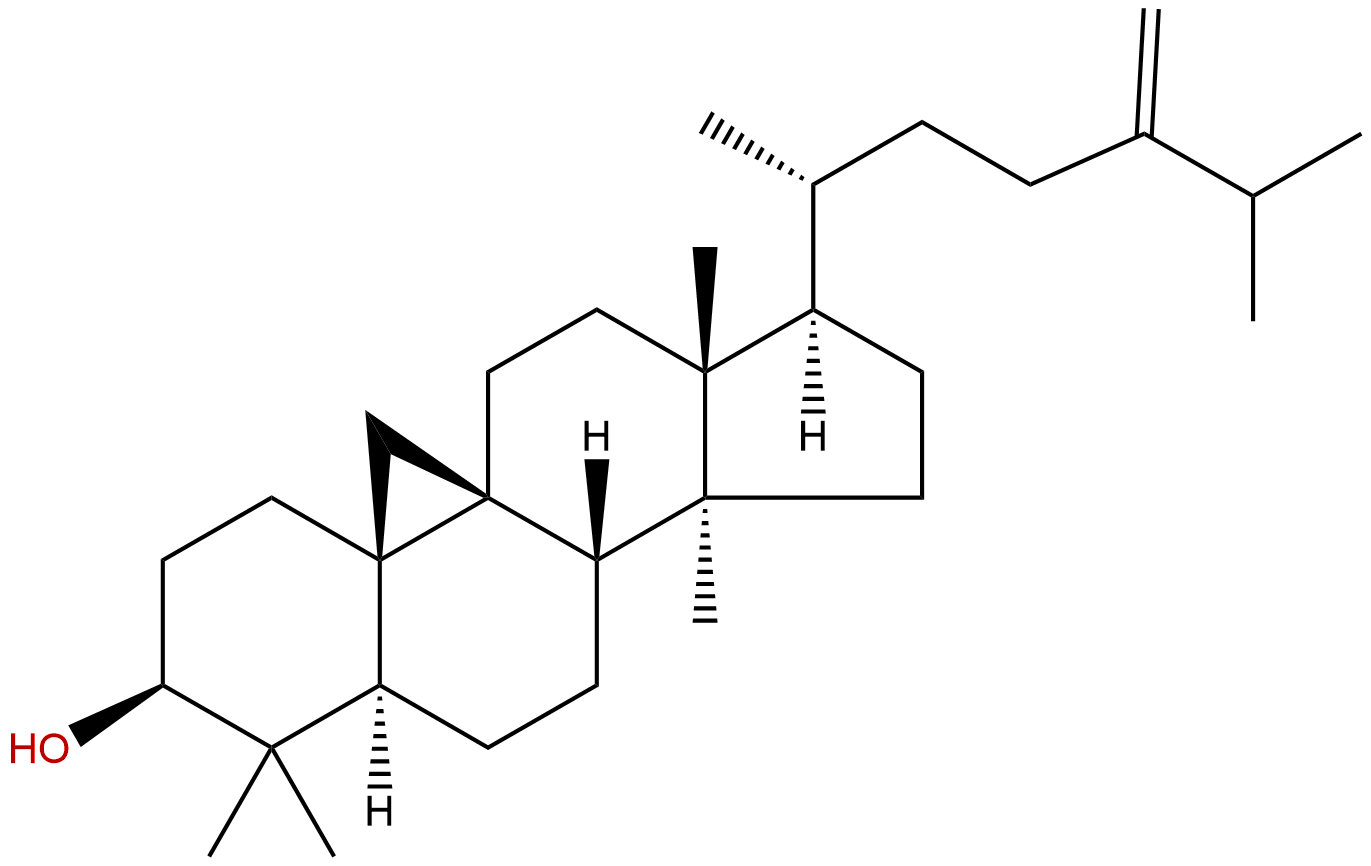


Product name: 24-methylene cycloartanol
Synonym name: 24-Methylenecycloartan-3β-ol
Catalogue No.: SBP00972
Cas No.: 1449-09-8
Formula: C31H52O
Mol Weight: 440.756
Botanical Source:
Physical Description: Powder
Type of Compound: Triterpenoids
Purity: 95%~99%
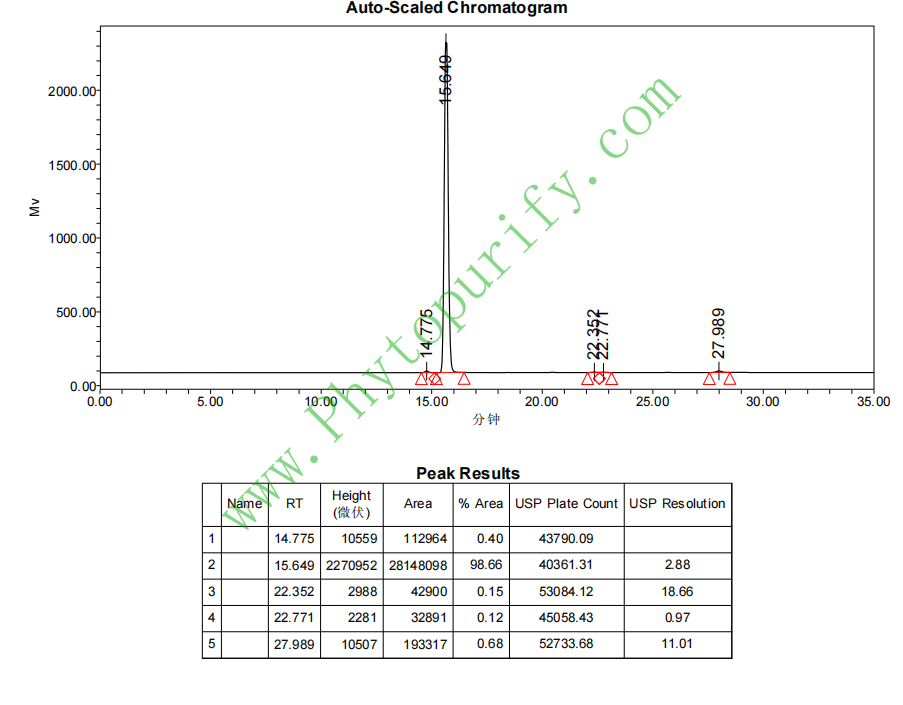
Analysis Method: HPLC-DAD or/and HPLC-ELSD
Identification Method: Mass, NMR
Packing: Brown vial or HDPE plastic bottle
The product could be supplied from milligrams to grams. Inquire for bulk scale.
We provide solution to improve the water-solubility of compounds, thereby facilitating the variety of activity tests and clinic uses.
For Reference Standard and R&D, Not for Human Use Directly.
HPLC of 24-methylene cycloartanol
Storage conditions:Short-term storage at 2~8℃, long-term storage at -20 ~ -80℃
20.2300
8.9712
8.9723
.0000
8.6560
11.2106
High
94.0901
5.4468
No
No
No
No
No
No
0.0
No
No
No
No
24 methylene cycloartanol (CAS: 1449-09-8) is a structurally unique pentacyclic triterpenoid compound belonging to the cycloartane triterpenoid family. Its chemical essence is (9 β) -24-methylene-9,19-cyclolanostane, which carries a hydroxyl group at the 3 β position. As a secondary metabolite of plants, it is widely distributed in various plants, such as Euphorbia, Epididrum, Psychotria, and Sideritis. Traditional Chinese medicinal plants Wolf Venom The compound was also isolated from the roots of Stellera chamaejasme L., providing a partial chemical basis for its traditional medicinal value.
In the fields of natural product chemistry and drug discovery, cyclobutane triterpenoids have attracted much attention due to their complex cyclopropane structure and diverse biological activities. As a member of this group, the research value of 24 methylene cycloartenol lies not only in its role as an important precursor or intermediate in the biosynthesis pathway of plant sterols (such as the synthesis of brassinosteroids), but also in its potential biological activity. Preliminary modern pharmacological studies have revealed that this compound may exert its effects by acting on multiple key targets closely related to inflammation, such as TNF, PTGS2 (COX-2), NF - κ B, IL-6, and IL-1 βanti-inflammatory Function. This makes it a worthwhile subject for further exploration in the search for novel anti-inflammatory lead compounds from natural products. This article will systematically summarize the scientific connotation of this compound from its chemical structure, plant origin, pharmacological mechanism, medicinal evaluation, and research prospects.
The molecular formula of 24 methylene cycloartenol is C31H52O, with a molecular weight of 440.7560 g/mol. Its structural core is characteristic 9β, 19 cyclopropane ring(Cyclobutane skeleton), a unique structure that forms a ternary ring between C-9 and C-19, endows the molecule with a certain degree of rigidity and stereochemical complexity. In addition, there is a methylene(=CH2), This is the basis for its naming. The β - configuration hydroxyl group at C-3 position is its main polar functional group.
Analyze its physicochemical properties based on the provided pharmacological parameters:
- fat-soluble The calculated LogP value is as high as 8.97, and the LogD value is also close to 8.97, which clearly indicates that the compound has Extremely strong lipophilicity A high LogP value means that it has a high tendency to distribute in a lipid environment, while its solubility in water is extremely low (water_stolubility is 0.0000), which is consistent with the characteristics of most triterpenoids.
- Polar Surface Area The topological polar surface area (TPSA) is only 20.23 Å ², mainly contributed by a single hydroxyl group, indicating that the overall polarity of the molecule is very low.
- Permeability and Distribution The extremely high Caco-2 cell permeability (11.21) and predicted "high" blood-brain barrier (BBB) permeability are directly related to their high lipid solubility and low polarity. This suggests that the compound may have good membrane permeability and potential for distribution in the central nervous system in vivo.
- Protein binding rate The predicted plasma protein binding rate (PPB) is as high as 94.09%, which means that after entering the bloodstream, the vast majority of molecules will bind to plasma proteins (mainly albumin), which may affect their free concentration and efficacy.
These physical and chemical properties determine the behavior of 24 methylenecycloartanol in vivo: it is insoluble in water, but easily penetrates biofilms, may accumulate in the central nervous system, and its distribution in vivo is significantly affected by protein binding.
24- Methylene cycloartenol is relatively widely distributed in nature. The database information clearly indicates that it can be accessed from Wolf Venom Separated from Stellera chamaejasme L. Wolf venom, also known as Rui Xiang Wolf Venom, is a plant in the Rui Xiang family. Its dried roots are used as medicine and have a long history in traditional Chinese medicine and folk medicine. Traditionally, wolf venom has a bitter, pungent, and mild taste, is toxic, and possesses Dispelling phlegm, breaking down accumulation, and killing insects by driving water away Its efficacy is commonly used to treat conditions such as edema, bloating, phlegm retention, and scabies. Modern research has shown that wolf venom extract has various pharmacological activities such as anti-tumor, antibacterial, antiviral, and immune regulation. The isolation of 24 methylenecycloartanol from wolfberry provides clues for the material basis of its traditional efficacy, especially the anti-inflammatory activity that may be related to "anti-inflammatory" and "dispersing" effects.
In addition to wolfberry, this compound also exists in various plants such as Euphorbia. In many plants, cyclohexanol and its derivatives (such as 24 methylene cyclohexanol) are key intermediates for the synthesis of plant sterols (such as campesterol and sitosterol), playing important roles in plant membrane structure and growth and development. Therefore, it is not only the life substance of plants themselves, but also may serve as a "chemical defense" component, and its biological activity is the result of long-term evolution of plants. The discovery of this ingredient from traditional medicinal plants reflects the idea of "medicinal phylogenetics" - plants with similar genetic relationships may contain structurally similar active ingredients.
According to the provided target information, the potential pharmacological activity of 24 methylenecycloartanol is mainly concentrated in anti-inflammatory field The five key targets of its action, TNF, PTGS2, NFKB1, IL6, and IL1B, are the core nodes in the inflammatory network.
Core inflammatory mediator targets:
Inflammatory signaling hub targets:
Speculation on the mechanism of action:
24 Methylene cycloartenol may pass through a Multi target and network regulation The way to exert anti-inflammatory effects. Its mode of action may include:
- Direct inhibition The molecule may directly bind to the active site of COX-2 enzyme, inhibiting the synthesis of prostaglandins; Or interfere with the binding or signal transduction of cytokines such as TNF and IL-1 β to their receptors.
- Upstream regulation More likely, it is achieved through inhibition NF - κ B signaling pathway Activation of TNF, IL-6, IL-1 β, COX-2 and other downstream effector molecules are simultaneously downregulated at the transcriptional level. This strategy of acting on the "master switch" is often more effective in controlling complex inflammatory networks than single target inhibition.
- synergistic effect Simultaneous regulation of multiple key targets may produce synergistic anti-inflammatory effects and help avoid compensatory or side effects caused by single pathway inhibition.
This multi-target characteristic is consistent with the action characteristics of many natural products, and also makes it potentially advantageous in the treatment of chronic and complex inflammatory diseases such as rheumatoid arthritis and inflammatory bowel disease. However, the specific molecular binding modes, binding sites, and signaling pathway details still require further verification through cellular and molecular biology experiments.
Based on the provided computational pharmacokinetic parameters, we conducted a preliminary evaluation of the potential of 24 methylenecycloartanol as an oral drug lead compound, and combined it with Lipinski's Five Rules(Rule of Five, Ro5) for analysis:
Lipinski Five Rule Compliance:
Conclusion: 24 Methylene cycloartenol LogP value too high This seriously violates the Lipinski rule, indicating that its oral bioavailability may be extremely low and its pharmacokinetic properties may be poor.
Analysis of other key parameters:
Comprehensive evaluation and optimization direction:
Overall, 24 methylene cycloartenol serves as a Natural lead compounds with clear anti-inflammatory pharmacological activity The prospect of directly developing it into oral medication is due to Poor physical and chemical properties (especially high lipid solubility)And facing enormous challenges. Future research should focus on structural optimization:
At present, research on 24 methylene cycloartenol is still in progress Basic Stage The existing literature mainly focuses on its phytochemical isolation, structural identification, and function as an intermediate in sterol biosynthesis. The specific biological activity experimental data (such as IC50 values, anti-inflammatory effects in cell and animal models) targeting the above-mentioned inflammatory targets are not yet sufficient in public databases, and require in-depth retrieval and validation from more professional scientific literature databases. The background of medicinal plants such as wolfberry provides support for the ethnic pharmaceutical basis of its anti-inflammatory activity.
Application Prospects Mainly reflected in the following aspects:
1. Optimizing medicinal chemistry as a lead compound Despite its poor self pharmacological properties, its unique cyclic acetyltransferase skeleton and clear anti-inflammatory target orientation make it a valuable candidate lead compound By rational structural modification, it is expected to significantly improve its water solubility and pharmacokinetic properties while maintaining its activity, and develop new anti-inflammatory small molecule drugs with independent intellectual property rights.
2. As a natural anti-inflammatory ingredient used in health products or plant-based medicines Under the premise of clear safety, plant extracts rich in this ingredient (such as specific varieties of wolfberry extracts) may be developed as dietary supplements or modern plant medicines with anti-inflammatory and health benefits. This requires systematic toxicology research and standardized quality control.
3. As a tool molecule for studying inflammation mechanisms The multi-target action of this compound on the inflammatory core network makes it a tool molecule for studying the relationship between the NF - κ B pathway and cytokine storms, which helps to deepen the understanding of the pathological mechanisms of complex inflammatory diseases.
4. Potential applications in agriculture or cosmetics Based on its plant origin and potential antibacterial and anti-inflammatory properties, its application in plant protectants or anti-inflammatory and soothing cosmetics may be explored.
Future research directions Should include:
- Activity verification Systematically evaluate its anti-inflammatory activity and dose-response relationship in cellular and animal inflammation models.
- Deepening mechanism Clarify whether it affects each target through direct binding or upstream regulation, and draw a detailed signaling pathway diagram of its action.
- structural optimization Conduct systematic structure-activity relationship research and carry out structural modifications aimed at improving solubility and pharmacokinetic properties.
- safety evaluation Conduct comprehensive preclinical toxicology studies to lay a safe foundation for its subsequent application.
In summary, 24 methylenecycloartanol is a natural triterpenoid compound with multi-target anti-inflammatory potential found in traditional medicinal plants. Although its inherent physicochemical properties pose challenges for direct drug development, through the modification of modern medicinal chemistry and pharmacology methods, it is expected to regain new vitality, provide new candidate molecules for anti-inflammatory drug research and development, and also make scientific contributions to explaining the traditional pharmacological effects of plants such as wolfberry.
