


Product name: Ardisiacrispin A
Synonym name: Saxifragifolin B; Deglucocyclamin I
Catalogue No.: BP0188
Cas No.: 23643-61-0
Formula: C52H84O22
Mol Weight: 1061.22
Botanical Source: Ardisia crispa
Physical Description:
Type of Compound: Triterpenoids
Purity: 95%~99%
Analysis Method: HPLC-DAD or/and HPLC-ELSD
Identification Method: Mass, NMR
Packing: Brown vial or HDPE plastic bottle
Storage: Store in a well closed container, protected from air and light. Put into refrigerate or freeze for long term storage.
Whenever possible, you should prepare and use solutions on the same day. However, if you need to make up stock solutions in advance, we recommend that you store the solution as aliquots in tightly sealed vials at -20℃. Generally, these will be useable for up to two weeks.
The product could be supplied from milligrams to grams
Inquire for bulk scale.
Chengdu Biopurify Phytochemicals Ltd. is a leading company in the research, development, manufacture and marketing of High Quality Phytochemicals and Extracts(especially Active Ingredients from Traditional Chinese Medicine,TCM), Natural Active Pharmaceutical Ingredients worldwide.
The main services:
A. Supply active ingredients and reference standards of TCM, from mgs to kgs scale
B. Custom extraction and purification, target Herb Active Ingredients
C. Custom synthesis and semi-synthesis for Natural Active Ingredients
D. CR(contract research), CM(contract manufacture) and PD(process development) services from lab scale, pilot scale to commercial scale(GMP is also available)
E. TCM compounds library for drug screen,more than 3000 compounds available, many of them are rare and unique.
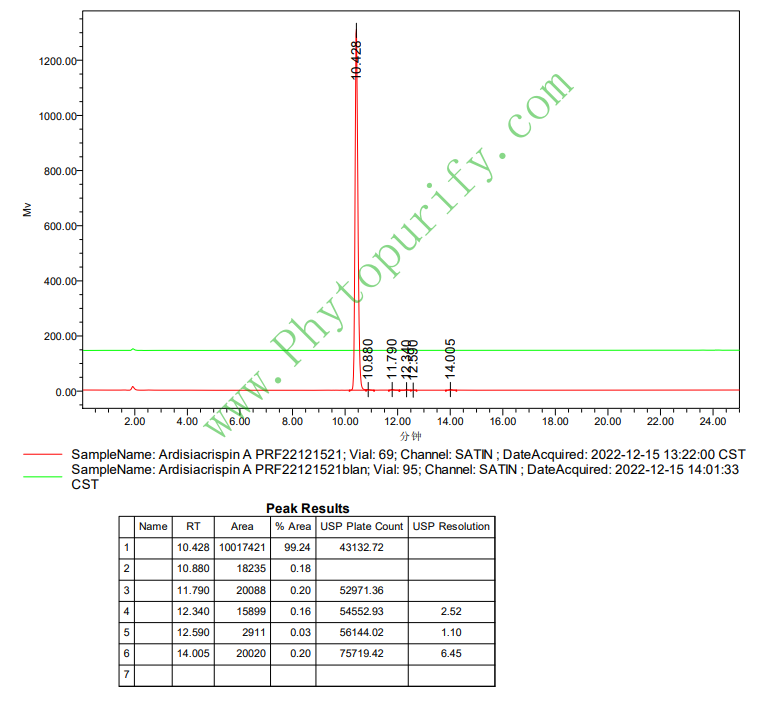
HPLC of Ardisiacrispin A
Storage conditions:Short-term storage at 2~8℃, long-term storage at -20 ~ -80℃
Ardisiacrispin A is a substance derived from the genus Taurus(Ardisia The natural triterpenoid saponins of spp have received widespread attention in recent years due to their significant biological activity, especially their potential applications in anti-tumor and immune regulation fields. Plants of the genus Taurus are widely used in traditional medicine to treat various diseases, and their active ingredients are diverse, among which triterpenoid saponins are one of the main bioactive substances. Bai Liang Jin Su A, as a representative of this class of compounds, exhibits cytotoxic effects on various cancer cell lines, especially on liver cancer cells (such as HepG2 and Bel-7402) and human myeloid leukemia cells (HL-60) with significant inhibitory effects. In addition, Bai Liang Jin Su A and its related compounds also exhibit certain immunomodulatory and antiviral activities, indicating their potential value in the treatment of various diseases.
This article aims to systematically review the chemical structure and physicochemical properties, plant sources and extraction methods, pharmacological activity and mechanism of action of Bai Liang Jin Su A, and explore its clinical application prospects and development directions based on current pharmacological evaluations, providing theoretical basis and reference for subsequent drug development and basic research.
The molecular formula of Bai Liang Jin Su A is C54H86O22, with a molecular weight of 1093.20 Da, and it belongs to the typical triterpenoid saponin natural product. The core of its structure is a pentacyclic triterpenoid skeleton, which connects multiple sugar residues to form a complex glycoside structure. The LogP value of this compound is about 0.10, indicating its strong hydrophilicity and a high polar surface area (TPSA) of 399 Å ². The number of hydrogen bond acceptors is as high as 22. These physical and chemical properties suggest that Bailiangjin A has strong water solubility, but may limit its cell membrane penetration ability.
The polysaccharide groups in the molecular structure not only affect its solubility and stability, but also have important impacts on its biological activity and molecular targeting. The complex sugar chain structure of Bai Liang Jin Su A may mediate its biological function through specific binding to cell surface receptors or intracellular targets. In addition, the compound is not easily able to pass through the blood-brain barrier, indicating that its main target of action may be limited to peripheral tissues.
Bai Liang Jin Su A mainly comes from plants in the genus Taurus, especially Ardisia crenata This plant is widely used in traditional Asian medicine. Purple Taurus plants are generally rich in various triterpenoid saponins, which have diverse structures and rich biological activities. Bai Liang Jin Su A, as a representative compound, has been isolated and identified multiple times from the roots, stems, and leaves of this genus of plants.
The common methods for extracting Bai Liang Jin Su A include organic solvent extraction and column chromatography separation. Generally, methanol or ethanol is used as the extraction solvent, combined with ultrasound assisted extraction or reflux extraction techniques to improve extraction efficiency. After concentration, the extract was separated and purified using techniques such as silica gel column chromatography and reverse phase high performance liquid chromatography (RP-HPLC) to obtain high-purity berberine A. In recent years, the introduction of supercritical CO2 extraction and membrane separation technology has provided new technical means for the efficient extraction and purification of berberine A.
Bai Liang Jin Su A has shown significant cytotoxic effects in various tumor cell lines. Its half maximal inhibitory concentration (GI_50) for human liver cancer cell HepG2 is 1.56 μ M, indicating strong anti proliferative ability. For another liver cancer cell line Bel-7402, berberine A can significantly inhibit cell proliferation by inducing apoptosis and microtubule depolymerization. In addition, when used in combination with its homolog Ardisiacrispin B, it exhibits potent inhibitory effects on human acute myeloid leukemia cell line HL-60 by blocking the S phase of the cell cycle and inducing apoptosis.
The triterpenoid saponins in plants of the genus Taurus generally have immunomodulatory functions, and Bailiangjinsu A also exhibits similar characteristics. Related studies have shown that Bai Liang Jin Su A can regulate macrophage function, promote cytokine secretion, and enhance the body's immune response. In addition, Bai Liang Jin Su A and its derivatives have inhibitory effects on certain viruses in vitro experiments, indicating their potential application value in the field of antiviral therapy.
In recent years, Bai Liang Jin Su A has also attracted attention in research related to hyperglycemia. Although there are few reports on its direct hypoglycemic activity, its target proteins involve multiple key proteins related to glucose metabolism and insulin signaling, such as EHMT2, UBP2, PAI1, AMPK, SGLT2, GCK, APP, BACE1, CES1, and PTPN1. This suggests that resveratrol A may participate in glucose metabolism balance through multi-target regulation and may become a new candidate molecule for treating metabolic diseases.
The anti-tumor mechanism of Bai Liang Jin Su A mainly includes inducing cell apoptosis, cell cycle arrest, and microtubule cytoskeleton destruction. Specifically, the compound activates the mitochondrial dependent apoptotic pathway, promotes cytochrome C release, activates the caspase family, and ultimately leads to programmed cell death. At the same time, Bai Liang Jin Su A can disrupt the microtubule structure, interfere with the dynamic balance of the cytoskeleton, prevent cell mitosis, and cause the cell cycle to stagnate in the S phase.
In terms of molecular targets, Bai Liang Jin Su A exhibits multi-target action characteristics. Its effect on tumor cells involves regulating key signaling pathways such as PI3K/Akt, MAPK, and NF - κ B pathways, which affect cell proliferation, apoptosis, and inflammatory response. For targets related to hyperglycemia, Bai Liang Jin Su A may promote energy metabolism balance by regulating AMPK activity; Reduce renal glucose reabsorption by inhibiting SGLT2; Regulating PTPN1 enhances insulin signaling and other mechanisms, exerting potential hypoglycemic effects.
In addition, the immunomodulatory activity of Bai Liang Jin Su A may be related to its effects on macrophage surface receptors and nuclear factor regulatory factors, regulating the activation status of immune cells and cytokine secretion profiles, thereby enhancing the body's disease resistance.
From the perspective of drug development, the molecular weight of Bai Liang Jin Su A is relatively high (1093.20 Da), far exceeding the recommended upper limit of 500 Da by Lipinski's rule. It also has a high polar surface area and hydrogen bond receptor count, indicating that its oral bioavailability may be low and its cell membrane permeability may be limited. In addition, its LogP value is close to 0, indicating strong hydrophilicity, but it may affect transmembrane absorption.
Bai Liang Jin Su A is not easily able to pass through the blood-brain barrier, which limits its application in central nervous system diseases. There is currently a lack of data on its hepatotoxicity, cardiotoxicity, and hERG channel inhibition, and further systematic evaluation is needed to ensure safety. The mutagenicity test data of Ames has not been reported yet, and toxicology research should be strengthened in the future.
In terms of pharmacokinetics, the in vivo absorption, distribution, metabolism, and excretion (ADME) characteristics of Bai Liang Jin Su A have not been systematically elucidated. Due to its large molecule and highly polar structure, there may be risks of poor intestinal absorption, slow metabolism, and accumulation in the body. In the future, it is necessary to combine in vitro and in vivo experiments to clarify its metabolic pathways and drug interactions, providing scientific basis for clinical applications.
Bai Liang Jin Su A has the potential to become a new candidate molecule for anti-cancer drugs due to its significant anti-tumor activity and multi-target regulatory ability. Especially in the treatment of liver cancer and leukemia, Bai Liang Jin Su A exerts anti-tumor effects by inducing apoptosis and cell cycle arrest, providing new ideas for the development of targeted therapies. At the same time, its immune regulation and antiviral properties have expanded its application scope, and it is expected to play a role in immunotherapy and anti infection fields in the future.
Regarding the multiple regulation of targets related to hyperglycemia, Bai Liang Jin Su A may become a novel molecule for comprehensive treatment of metabolic diseases, especially suitable for multi-target drug development strategies. However, its poor pharmacological properties limit the development of oral formulations, requiring methods such as structural modification, nanocarrier encapsulation, or optimized delivery routes to enhance bioavailability and targeting.
Future research should focus on the following aspects: (1) systematically elucidating the detailed mechanism of action and molecular target network of Bailiangjinsu A; (2) Conduct comprehensive pharmacokinetic and toxicological evaluations to ensure safety; (3) Improve the drug properties through pharmaceutical chemical modification and formulation optimization; (4) Conduct animal models and preclinical studies to evaluate their therapeutic efficacy and potential side effects.
Bai Liang Jin Su A, as an important triterpenoid saponin in the genus Taurus, exhibits broad medicinal value due to its diverse biological activities and unique molecular structure. Its potential applications in anti-tumor, immune regulation, and metabolic diseases provide rich materials and directions for natural product pharmacology research. Although there are still challenges in drug development and clinical translation, with the development of modern drug research and development technology, Bai Liang Jin Su A is expected to become an important candidate for the new generation of multifunctional natural medicines. In the future, through interdisciplinary cooperation, in-depth exploration of its mechanism of action and optimization of drug properties will promote the application of Bai Liang Jin Su A and its derivatives in clinical treatment, achieving the successful transformation of natural products into clinical drugs.
