


Product name: 2,3,5,4'-Tetrahydroxyl-diphenylethylene-2-O-beta-D-glucoside
Synonym name: 2,3,5,4'-Tetrahydroxytoluylene-2-beta-D-glucoside ; 2,3,5,4'-Tetrahydroxystilbene 2-O-glucosid; 55327-45-2
Catalogue No.: BP0039
Cas No.: 82373-94-2
Formula: C20H22O9
Mol Weight: 406.387
Botanical Source:
Physical Description: White powder
Type of Compound: Phenols
Purity: 95%~99%
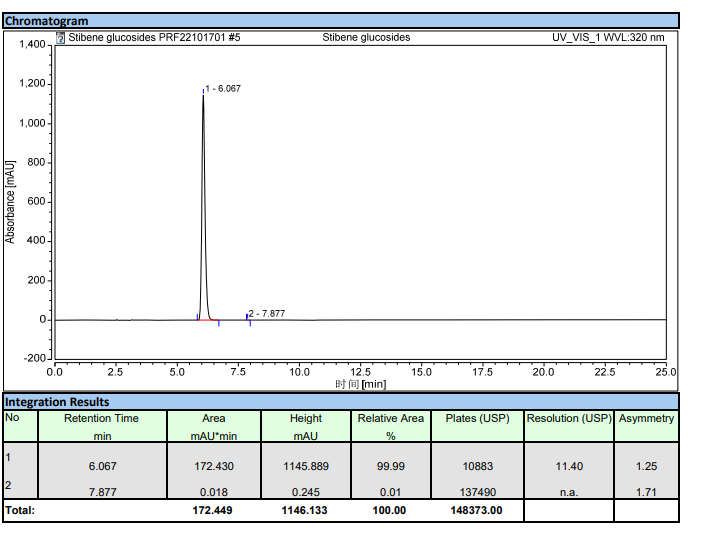
Analysis Method: HPLC-DAD or/and HPLC-ELSD
Identification Method: Mass, NMR
Packing: Brown vial or HDPE plastic bottle
Storage: Store in a well closed container, protected from air and light. Put into refrigerate or freeze for long term storage.
Whenever possible, you should prepare and use solutions on the same day. However, if you need to make up stock solutions in advance, we recommend that you store the solution as aliquots in tightly sealed vials at -20℃. Generally, these will be useable for up to two weeks.
The product could be supplied from milligrams to grams, up to kilograms
Inquire for bulk scale.
Descriptions:
2,3,5,4'-Tetrahydroxyldiphenylethylene-2-O-glucoside(TSG) blocks the proliferation of PASMCs induced by PDGF-BB through arresting the cell cycle in G0 / G1 phase, indicates that TSG suppress PDGF-BB-induced PASMCs proliferation is associated with an inhibition of AKT / GSK3β signaling pathways.[1]
Stilbeneglycoside has protective effects of preconditioning in an ischemia/reperfusion model of HUVECs.[2]
Stilbene glycoside has active effect on proliferation and differentiation of rat's osteoblasts, can promote the mature of osteoblasts.[3]
References:
[1] Guan W J, Xu C. J Med Res, 2015, 44 (06): 122-6.
[2]Li-ping, Zhang-ping, LIAO, et al. Acta Pharmacol Sin, 2010, 31(4):405-12.
[3] Jiwei W U. Hebei MedJ, 2014(05):654-6.
[4] Gang D , An S F, Liu CY. West China J Pharm Sci, 2003, 17(4):297-9.
HPLC of 2,3,5,4'-Tetrahydroxyl-diphenylethylene-2-O-beta-D-glucoside
Storage conditions:Short-term storage at 2~8℃, long-term storage at -20 ~ -80℃
184.7600
-1.0000
-1.5000
Low
No
No
No
No
No
No
Polygonum multiflorum glycoside (2,3,5,4 '- Tetrahydroxyl-diphenylethene-2-O-beta-D-glucoside) is a typical natural product of stilbene, mainly found in the traditional Chinese medicine Polygonum multiflorum. As one of the main active ingredients in Polygonum multiflorum, Polygonum multiflorum glycoside has attracted widespread attention due to its diverse biological activities. In recent years, with the advancement of natural product pharmacology and molecular biology techniques, the mechanisms of action of Polygonum multiflorum glycosides in antioxidant, anti-inflammatory, cardioprotective, and cell apoptosis regulation have gradually been elucidated, especially in the prevention and treatment of cardiovascular diseases such as heart failure, showing great potential for application. This article will provide a systematic review of the chemical structure, physicochemical properties, plant sources, extraction methods, pharmacological activity, mechanism of action, pharmacological evaluation, and clinical application prospects of Polygonum multiflorum glycosides, aiming to provide scientific basis and theoretical support for research and drug development in related fields.
The chemical structure of Polygonum multiflorum glycoside is a trans stilbene skeleton, with a molecular formula of C21H26O10 and a molecular weight of 422.39. Its structural characteristics are that hydroxyl groups are substituted at positions 2, 3, 5, and 4 ', and the hydroxyl group at position 2 is β - D-glucosylated, forming stable glycosidic bonds. This structure endows it with strong hydrophilicity, with a LogP value of approximately -1.0, indicating good water solubility. The extremely high polar surface area (TPSA 184.76 Å ²) and number of hydrogen bond receptors (10) suggest that its distribution and membrane permeability in vivo may be limited, especially with low blood-brain barrier permeability.
In terms of physicochemical properties, Polygonum multiflorum glycoside exhibits good chemical stability, especially under neutral and weakly acidic conditions. The glycosidic bond structure may hydrolyze in acidic environments, releasing the corresponding styrene alcohol parent nucleus. This type of structural feature may release active ingredients through enzymatic hydrolysis during in vivo metabolism, enhancing bioavailability. The UV absorption peak of Polygonum multiflorum glycoside is mainly concentrated around 280 nm, which is suitable for qualitative and quantitative analysis by high performance liquid chromatography (HPLC).
Polygonum multiflorum glycoside mainly exists in the roots of Polygonum multiflorum and is a representative component of stilbene compounds in this plant. Polygonum multiflorum, as a traditional Chinese medicinal herb, is widely distributed in southern China and East Asia. Its rhizome contains abundant compounds of stilbene glycosides, anthraquinones, and polyphenols.
The common methods for extracting Polygonum multiflorum glycosides include water extraction, alcohol extraction, and ultrasound assisted extraction. Traditional extraction processes often use 70% -80% ethanol as a solvent, combined with reflux heating extraction, which can effectively dissolve and extract the target components. In recent years, the application of ultrasound assisted extraction and microwave-assisted extraction technologies has significantly improved extraction efficiency and purity. After concentration, liquid-liquid distribution, and column chromatography purification, high-purity Polygonum multiflorum glycoside can be obtained from the extract.
During the purification process, silica gel column chromatography, reverse phase C18 column chromatography, and high-performance liquid chromatography (HPLC) techniques are commonly used for separation and identification. Mass spectrometry (MS) and nuclear magnetic resonance (NMR) techniques are used for structural confirmation. To ensure the activity and stability of the extract, the extraction conditions need to be strictly controlled by temperature, pH, and time.
Polygonum multiflorum glycoside exhibits various significant pharmacological activities, including antioxidant, anti-inflammatory, antiplatelet aggregation, cell apoptosis inhibition, and cardiac protection.
antioxidant activity
Polygonum multiflorum glycoside significantly enhances cellular antioxidant capacity by scavenging free radicals and inhibiting lipid peroxidation. In vitro DPPH and ABTS free radical scavenging experiments and cell models, Polygonum multiflorum glycoside showed concentration dependent antioxidant effects. Its multi hydroxyl structure provides electrons for free radicals, stabilizes free radical intermediates, and reduces oxidative stress damage.
anti-inflammatory effect
Polygonum multiflorum glycoside can inhibit the release of inflammatory mediators, reduce the expression of cyclooxygenase-2 (COX-2) and lipoxygenase 15 (ALOX15), and alleviate inflammatory reactions. The in vivo inflammation model shows that Polygonum multiflorum glycoside can significantly reduce the levels of inflammatory factors such as TNF - α, IL-6, and IL-1 β, exerting anti-inflammatory and protective effects.
Platelet aggregation inhibition
Polygonum multiflorum glycoside inhibits platelet signaling pathways, reduces platelet aggregation, and lowers the risk of thrombosis. This effect has a positive significance in preventing cardiovascular and cerebrovascular events.
Inhibition of cell apoptosis
In various cell models, Polygonum multiflorum glycoside can regulate the expression of apoptosis related proteins, inhibit cell apoptosis, and protect cells from oxidative stress and inflammation induced damage, especially in cardiomyocyte protection.
Cardioprotective effect
Polygonum multiflorum glycoside effectively improves cardiac function in heart failure models by regulating myocardial cell metabolism, antioxidant and anti-inflammatory mechanisms through multiple targets. Its functions include activating the AMPK signaling pathway, inhibiting myocardial fibrosis, improving myocardial energy metabolism, and reducing myocardial injury.
The pharmacological effects of Polygonum multiflorum glycosides involve multiple molecular targets and signaling pathways, particularly closely related to key proteins associated with heart failure.
AMPK (PRKAA1) activation
AMPK, as the core regulatory factor of cellular energy metabolism, is activated by Polygonum multiflorum glycoside to promote energy metabolism balance in myocardial cells, inhibit fatty acid synthesis, enhance mitochondrial function, and alleviate myocardial energy metabolism disorders.
EHMT2 (histone methyltransferase) regulation
EHMT2 is involved in epigenetic regulation, and Polygonum multiflorum glycoside may regulate EHMT2 activity, affect gene expression in myocardial cells, and inhibit myocardial fibrosis and inflammatory response.
APP (amyloid precursor protein) regulation
APP plays a role in myocardial cell apoptosis and oxidative stress, and Polygonum multiflorum glycoside reduces myocardial cell damage by regulating APP expression.
PTPN1 (protein tyrosine phosphatase 1B) inhibition
PTPN1 is a key enzyme that negatively regulates insulin signaling and energy metabolism. Polygonum multiflorum glycoside inhibits PTPN1 activity, improves myocardial cell insulin sensitivity, and promotes metabolic homeostasis.
MAOA (monoamine oxidase A) regulation
MAOA participates in the regulation of neurotransmitters and myocardial metabolism, and Polygonum multiflorum glycoside reduces myocardial oxidative damage by regulating MAOA activity.
ESR2 (estrogen receptor beta) activation
ESR2 mediates cardioprotective effects, and Polygonum multiflorum glycoside may exert anti-inflammatory and anti apoptotic effects by activating ESR2.
Regulation of ABC transporters (ABCB1, ABCG2)
Polygonum multiflorum glycoside affects the expression of ABC transporters, regulates the extracellular excretion of drugs and metabolites, and affects drug metabolism and myocardial protection.
ALOX15 (lipoxygenase 15) inhibition
ALOX15 is involved in lipid metabolism and inflammatory response, while Polygonum multiflorum glycoside inhibits its activity and reduces the production of inflammatory mediators.
FEN1 (Flipping Enzyme 1) regulation
FEN1 is involved in DNA repair and cell survival, while Polygonum multiflorum glycoside promotes cell repair and anti apoptosis by regulating FEN1.
In summary, Polygonum multiflorum glycosides regulate myocardial cell energy metabolism, antioxidant defense, inflammatory response, and cell apoptosis through multi-target and multi pathway synergistic effects, exerting cardioprotective and anti heart failure effects.
The pharmacological evaluation of Polygonum multiflorum glycoside shows that it has good safety and potential drug development value.
Molecular weight and physicochemical properties
The molecular weight is 422.39 and the LogP is -1.0, indicating its strong hydrophilicity, which may affect oral absorption and cell membrane permeability. The TPSA reached 184.76 Å ², indicating a low ability to penetrate the blood-brain barrier and suitable for targeting peripheral tissues.
Toxicity evaluation
Both in vitro and in vivo studies have shown that Polygonum multiflorum glycosides have no significant hepatotoxicity, cardiotoxicity, or hERG channel inhibition effects, and the Ames mutagenicity test is negative, indicating high safety.
Pharmacokinetic characteristics
At present, there is limited systematic pharmacokinetic data on Polygonum multiflorum glycosides, but their glycosidic bond structure suggests that they may be hydrolyzed by gut microbiota in the gastrointestinal tract, releasing active maternal nuclei and affecting bioavailability. Its hydrophilicity and high polarity may lead to limited oral absorption, but through appropriate drug design (such as nanocarriers, liposomes), absorption and targeting are expected to be improved.
Blood-brain barrier permeability
Polygonum multiflorum glycosides have low blood-brain barrier permeability and are suitable for treating peripheral cardiovascular diseases, reducing the risk of central nervous system side effects.
metabolic pathway
It is speculated that it is mainly metabolized by the liver, involving glucosidase mediated hydrolysis and corresponding phase I and phase II metabolic reactions, and further research is needed on its metabolites and metabolic kinetic characteristics.
Polygonum multiflorum glycoside, as a multifunctional natural active ingredient, has shown great potential for application in the prevention and treatment of heart failure and related cardiovascular diseases. Its multi-target mechanism of action and high safety provide a theoretical basis for the development of new cardiac protective drugs.
Heart Failure Treatment
Based on its activation of AMPK, inhibition of inflammation, and antioxidant effects, Polygonum multiflorum glycoside is expected to become a new candidate drug for adjuvant therapy of heart failure. In the future, systematic preclinical and clinical studies need to be conducted to verify its efficacy and safety.
Anti inflammatory and antioxidant applications
The anti-inflammatory and antioxidant properties of Polygonum multiflorum glycosides make them potentially applicable in chronic inflammatory diseases, metabolic syndrome, and neurodegenerative diseases.
Drug combination therapy
Considering its regulation of multiple molecular targets, Polygonum multiflorum glycoside can be used in combination with existing cardiovascular drugs to exert synergistic effects, reduce drug dosage and side effects.
Pharmaceutical improvement
Given its high water solubility but limited oral absorption, future pharmaceutical improvements such as nanocarriers, liposome encapsulation, and structural modifications will help improve its bioavailability and targeting.
Security monitoring
Although there are currently no apparent toxicity reports, the safety of long-term high-dose use still needs further evaluation, especially in terms of its impact on liver and kidney function and immune system.
Polygonum multiflorum glycoside, as an important stilbene glycoside compound in Polygonum multiflorum, has shown broad research and application prospects in cardiovascular protection, antioxidant and anti-inflammatory fields due to its unique chemical structure and diverse biological activities. Its multi-target and multi mechanism mode of action provides new ideas for the treatment of complex diseases such as heart failure. In the future, by combining modern pharmacology, molecular biology, and pharmaceutical technology, in-depth exploration of the pharmacokinetic characteristics and clinical efficacy of Polygonum multiflorum glycosides will help promote its clinical application and innovative development of natural product drugs.
