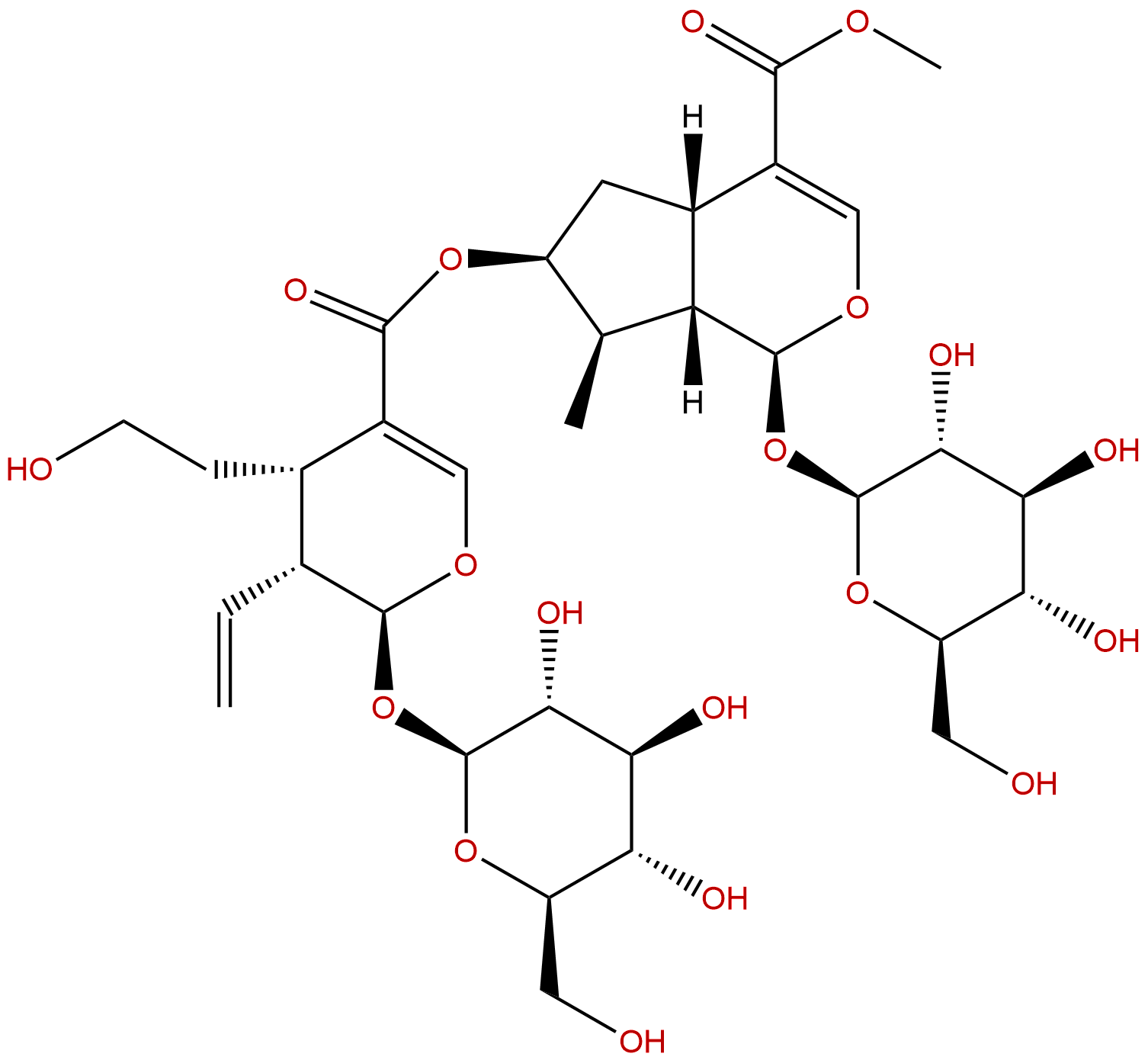
Linshengxuduan glycoside I: a natural iridoid glycoside with anti osteoporosis potential
1. Overview
Sylvestroside I is a natural iridoid glycoside isolated from plants. Its CAS number is 71431-22-6, molecular formula is C33H48O19, and molecular weight is approximately 748.73 g/mol. This compound was initially reported from Continuation (Dipsacus japonicum) Separated from the middle, Xuduan is a plant of the Caprifoliaceae family, belonging to the genus Chuanxuduan. Its dried roots are commonly used in traditional Chinese medicine for strengthening muscles and bones, and for treating fractures and joint diseases. The research value of Lin Sheng Xuduan glycoside I, as an active ingredient in Xuduan, is increasingly prominent.
The existing description suggests that Lin Sheng Xuduan Glycoside I may have analgesic effects. However, deeper research has revealed its more significant pharmacological potential. According to the provided target information, the compound interacts with multiple targets closely related to bone metabolism, including estrogen receptor 1 (ESR1), Runt related transcription factor 2 (RUNX2), transcription factor SP7 (Osterix), bone morphogenetic protein 2 (BMP2), and alkaline phosphatase (ALP). These targets collectively point to a core disease domain——osteoporosis Therefore, the research on Lin Sheng Xuduan Glycoside I has shifted from its initial analgesic activity to its potential applications in promoting bone formation and anti osteoporosis, providing important scientific clues for the development of new bone protective drugs from traditional Chinese medicine.
2. Chemical structure and physicochemical properties
The chemical structure of Linshengxuduan glycoside I belongs to the class of iridoid glycosides. The SMILES string provides a detailed description of its complex stereochemical structure, including multiple chiral centers, glycosidic bonds, and unsaturated bonds. The molecular formula C33H48O19 indicates that it is a large molecular glycoside compound containing 33 carbon atoms, 48 hydrogen atoms, and 19 oxygen atoms. The significant feature of it is the high number of oxygen atoms (19), which directly affects its physical and chemical properties.
From the perspective of pharmacological parameters:
- Molecular weight (MW):748.73 g/mol, Significantly exceeding the typical 500 Da limit for traditional small molecule drugs.
- Lipid water partition coefficient (LogP/LogD)-1.532 indicates that the compound has extremely strong hydrophilicity and is almost insoluble in lipid environments. This is completely consistent with the structural characteristics of molecules containing multiple hydroxyl and sugar groups (such as glucose units).
- Topological Polarity Surface Area (TPSA)Up to 290.05 Å ², this further confirms the presence of a large number of polar groups (such as - OH) on the surface of the molecule, leading to its strong ability to form strong hydrogen bonds with water molecules.
- Water solubility The value is 23.7258 (usually measured in mg/mL or μ M, depending on the context), and combined with its high hydrophilicity, it can be inferred that Linshengduan glycoside I has good solubility in water.
- Permeability Caco-2 cells have low permeability (0.6147) and effective permeability (Peff, 0.4896), indicating poor ability to cross the intestinal epithelial cell membrane through passive diffusion. The blood-brain barrier (BBB) penetration is labeled as "low", which is consistent with the characteristics of high TPSA and low LogP, meaning it is difficult to enter the central nervous system.
These physical and chemical properties collectively depict a typical High polarity, high molecular weight, good water solubility but poor membrane permeability The image of natural products. This poses a huge challenge to its oral bioavailability, as drugs need to cross the intestinal barrier to enter the systemic circulation and exert their effects.
3. Plant sources and traditional applications
The main plant source of Linshengxuduan glycoside I is Continuation (Dipsacus japonicum)That is, Japan's continuation. Xuduan is an essential medicine in traditional Chinese medicine orthopedics, with a long history of medicinal use. According to traditional Chinese medicine theory, Xuduan has a bitter and pungent taste, a slightly warm nature, and is associated with the liver and kidney meridians Tonifying liver and kidney, strengthening muscles and bones, continuing injuries, stopping collapse and leakage The efficacy. It is commonly used in clinical practice to treat conditions such as soreness and weakness of the waist and knees, rheumatism and rheumatism, collapse and leakage, fetal leakage, falls and falls, muscle injuries and fractures. In famous bone setting formulas such as "Xuduan Dan" and "Jiegu San", Xuduan is the core component drug.
Traditional applications are mainly based on their "sustained fracture" effect, which intuitively points to their repairing effect on the skeletal system. Modern pharmacological research has confirmed that the ethanol or water extracts of Xuduan indeed have the effect of promoting fracture healing, increasing bone density, and improving the bone microstructure of osteoporotic animal models. As a specific cyclohexene ether terpenoid glycoside component in Panax notoginseng, Lin Sheng Xuduan glycoside I is considered as one of the substance bases contributing to these pharmacological activities. From the experience of traditional "strengthening muscles and bones" to the research on modern "anti osteoporosis" targets, it reflects the reverse mining approach of "from clinical to laboratory" in the modernization of traditional Chinese medicine research, and also provides a specific molecular level scientific explanation for elucidating the traditional efficacy of "tonifying the kidney and strengthening bones" in Chinese medicine.
4. Pharmacological activity and mechanism of action
The most notable pharmacological activity of Linshengxuduan glycoside I is its potential anti-osteoporosis Function. Osteoporosis is a systemic bone disease characterized by reduced bone mass, destruction of bone microstructure, and increased bone fragility. The pathogenesis is complex, with the core being the disruption of the dynamic balance between bone resorption and bone formation. The target network of Lin Sheng Xuduan Glycoside I precisely covers multiple key links regulating bone formation and metabolism:
-
Acting on the nuclear receptor ESR1 (estrogen receptor alpha)Estrogen plays a crucial role in maintaining bone homeostasis. The decrease in estrogen levels in postmenopausal women is the main cause of osteoporosis. ESR1 is the main receptor for the action of estrogen. If Lin Sheng Xuduan Glycoside I can act as a plant estrogen or ESR1 regulator, mimicking the partial effects of estrogen, it may protect bones by inhibiting osteoclast activity and promoting osteoblast differentiation. This provides a new candidate structure for the development of selective estrogen receptor modulators (SERMs) as bone protective drugs.
-
Regulating core transcription factors RUNX2 and SP7 (Osterix)RUNX2 and SP7 are the most critical transcription factors in the process of osteoblast differentiation and bone formation. RUNX2 is considered the "main switch" for osteogenic differentiation, which initiates the differentiation of mesenchymal stem cells into osteogenic precursor cells. SP7 acts downstream of RUNX2 and is necessary for mature osteoblasts to perform their functions. If Lin Sheng Xuduan Glycoside I can activate the expression or activity of RUNX2 and SP7, it will directly Promote new bone formation Fundamentally reversing the pathological process of osteoporosis.
-
Affects growth factor BMP2 (bone morphogenetic protein 2)BMP2 is a member of the TGF - β superfamily and a powerful bone formation inducing factor. It can strongly promote the differentiation of mesenchymal stem cells into osteoblasts and induce ectopic bone formation. The BMP2 signaling pathway is closely related to the activation of RUNX2. Linshengxuduan glycoside I may synergistically promote osteogenic differentiation by upregulating the expression of BMP2 or enhancing its signal transduction.
-
Enhance the activity of osteoblast marker ALP (alkaline phosphatase)ALP is a classic biomarker for early differentiation and functional activity of osteoblasts, involved in the mineralization process of bone matrix. Elevated ALP activity usually indicates increased osteogenic activity. The positive effect of Lin Sheng Xuduan Glycoside I on ALP is direct evidence of its promotion of osteoblast maturation and function.
Integration of mechanism of action Overall, Lin Sheng Xuduan Glycoside I may exert its anti osteoporosis effect through multi-target and multi pathway synergy. The potential mechanism may be: on the one hand, by acting on ESR1, it simulates the bone protective effect of estrogen and inhibits excessive bone resorption; On the other hand, more importantly, by activating the BMP2 signaling pathway and upregulating the expression of core transcription factors RUNX2 and SP7, it drives the differentiation, maturation, and functional activation of osteoblasts (manifested as increased ALP activity), thereby significantly promoting bone formation. This dual mode of action of "open source" (promoting formation) and "throttling" (inhibiting absorption) theoretically has the potential to become an efficient anti osteoporosis drug.
5. Evaluation of drug properties
Based on the provided pharmacological parameters, we can conduct a preliminary evaluation of the potential for the development of Lin Sheng Xu Duan Glycoside I as an oral medication. Main references for evaluation Lipinski's Five Rules The Rule of Five and other standards are used to predict the oral absorption characteristics of compounds.
-
Lipinski's Five Rules Compliance Analysis:
- Hydrogen bond donor (HBD)The molecule contains a large number of hydroxyl groups, and the number of HBDs far exceeds 5 (rule requirement ≤ 5).
- Hydrogen bond acceptor (HBA)There are numerous oxygen atoms in the molecule, and the number of HBAs far exceeds 10 (the rule requires ≤ 10).
- Molecular weight (MW)748.73>500 Da (rule requirement<500 Da).
- Lipid water partition coefficient (LogP)-1.532<5 (the rule requires LogP<5, which is met, but too low also indicates poor permeability).
- Conclusion Lin Sheng Xuduan Glycoside I seriously violated three of Lipinski's five rules (HBD, HBA, MW), with only LogP meeting the criteria. This strongly indicates that it Oral bioavailability may be extremely low。
-
Interpretation of other key parameters:
- Permeability and absorption The extremely low Caco-2 permeability and Peff value, as well as high TPSA, confirm its difficulty in transmembrane transport, making it difficult to be effectively absorbed by the intestine after oral administration.
- distribution The low penetration of BBB indicates that it is not easily able to enter the central nervous system, which may reduce central side effects for drugs that mainly act on the peripheral skeletal system and is an advantageous characteristic. The plasma protein binding rate (PPB) is 41.11%, which is a moderately low level, indicating that there are more free drugs available for distribution to the target tissue.
- Metabolism and toxicity:
- Genotoxicity The Ames test is negative (0.0), indicating no mutagenicity. But labeling 'chromosomal aberration' as' present 'is a highly vigilant concern Potential genetic toxicity risk signals Strict evaluation must be conducted in subsequent development.
- cardiotoxicity HERG inhibition is' no ', which reduces the risk of causing QT interval prolongation in the heart.
- Hepatotoxicity The elevated indicators of serum alanine aminotransferase (ALT), aspartate aminotransferase (AST), gamma glutamyltransferase (GGT), and alkaline phosphatase (ALP) are all marked as "yes".This suggests that Lin Sheng Xuduan Glycoside I may have a potential risk of liver injury It is worth noting that the elevation of one of its pharmacological targets, ALP, has become a hallmark of liver toxicity here, and it is necessary to carefully distinguish between pharmacological effects (bone derived ALP elevation) and liver injury (liver derived ALP elevation).
- Other toxicities No skin, respiratory sensitization, or phototoxicity.
Comprehensive Assessment Lin Sheng Xuduan Glycoside I The prospect of pharmacological activity (multi-target anti osteoporosis) is clear, but there are serious challenges in drug development (especially oral absorption and potential toxicity)Its class of drugs has poor properties and is not suitable for development as a direct oral small molecule drug candidate. Future research may need to shift towards:
1. Structural modification Improve its permeability and drug like properties through prodrug strategies such as esterifying hydroxyl groups on sugar groups to enhance lipid solubility, or simplifying the structure to find its minimum active pharmacophore.
2. New drug delivery system Develop delivery systems such as nanomaterials, liposomes, and microemulsions to encapsulate the large molecule and highly hydrophilic compound, promoting its intestinal absorption or achieving targeted delivery.
3. In depth security evaluation It is necessary to conduct in-depth mechanism research on chromosomal aberrations and hepatotoxic signals, and clarify their safety window.
6. Research Status and Application Prospects
At present, research on Linshengxuduan glycoside I is still in progress Pre clinical basic research stage The existing literature mainly focuses on its isolation and identification from plants such as Panax notoginseng, preliminary activity screening, and target prediction based on network pharmacology or molecular docking. The clear mechanism of its anti osteoporosis effect, especially the experimental verification of key targets such as RUNX2, SP7, BMP2, still requires a large number of cell and animal model studies to provide direct evidence.
Application Prospects Mainly reflected in the following aspects:
1. New lead compounds for anti osteoporosis Despite its poor self pharmacological properties, its unique iridoid glycoside skeleton and multi-target mechanism of action provide valuable insights for medicinal chemists Lead compound structure Through rational structural optimization, it is expected to develop derivatives with higher activity and better drug properties.
2. Quality marker for traditional Chinese medicine continuous interruption (Q-Marker)Lin Sheng Xuduan Glycoside I can be used as a medicinal herb for Xuduan and its related preparations (such as bone strengthening drugs and bone injury drugs)Potential quality indicators Used to control the intrinsic quality of medicinal herbs and products, associated with their traditional efficacy of "strengthening muscles and bones".
3. Bone tissue engineering and regenerative medicine Given its regulatory potential on key osteogenic factors such as BMP2 and RUNX2, Lin Sheng Shen Duan Glycoside I or its derivatives can be used as bioactive factors loaded into bone repair scaffold materials for local application in fracture or bone defect sites,Promote bone tissue regeneration To avoid absorption and toxicity issues of systemic administration.
4. Mechanism of Action Research Tool As a study of plant derived compounds regulating bone metabolism signaling pathways (such as BMP/Smad, Runx2/Osterix)molecular probe It helps to deepen the modern scientific connotation of the kidney tonifying and bone strengthening effects of natural products.
Summary Lin Sheng Xuduan Glycoside I is a natural product discovered from the traditional Chinese medicine Xuduan, which has clear anti osteoporosis targeting potential. It is like a precise "multi key" that can simultaneously unlock multiple "locks" that promote bone formation, such as ESR1, RUNX2, SP7, BMP2, etc. However, its characteristics of being "too big" (high molecular weight) and "too hydrophilic" (low LogP) make it difficult to become an oral drug, and the potential risks of genetic toxicity and liver toxicity also need to sound the alarm. Future research will be a tough battle of "highlighting strengths and avoiding weaknesses": on the one hand, it will deeply explore its outstanding pharmacological mechanisms, and on the other hand, it will transform its "shortcomings" through modern medicinal chemistry and pharmacy methods. Whether it is ultimately the molecule itself or the new molecule optimized based on it that can enter clinical practice, the research on Lin Sheng Shen Duan Glycoside I provides us with a vivid and profound example for exploring modern disease treatment plans from the vast treasure trove of traditional Chinese medicine.