


Synonym name: Thalicsimine; Thaliximine
Catalogue No.: BP0721
Cas No.: 6681-13-6
Formula: C39H44N2O7
Mol Weight: 652.788
Botanical Source: Alkaloid from Thalictrum hernandezii, Thalictrum fendleri, Thalictrum podocarpum, Thalictrum rochebrunianum and other Thalictrum spp. (Ranunculaceae)
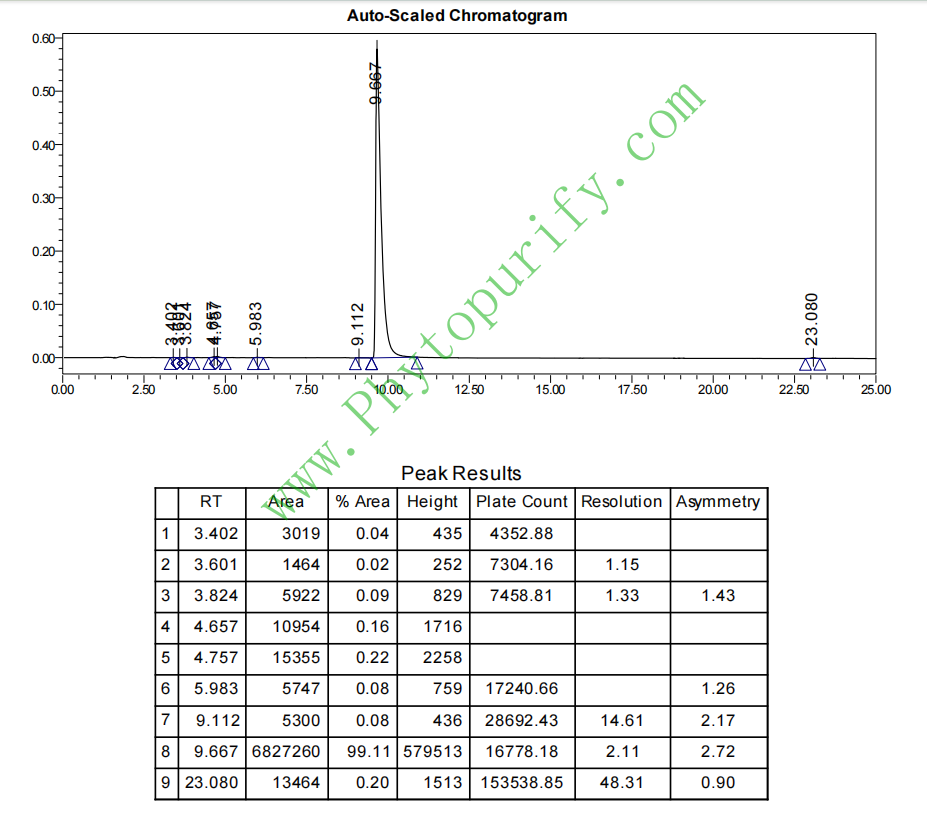
Purity: 95%~99%
Analysis Method: HPLC-DAD or/and HPLC-ELSD
Identification Method: Mass, NMR
Packing: Brown vial or HDPE plastic bottle
Can be supplied from milligrams to grams.
For Reference Standard and R&D, Not for Human Use Directly.
Inquire for bulk scale.
HPLC of Hernandezine
Storage conditions:Short-term storage at 2~8℃, long-term storage at -20 ~ -80℃
71.0900
6.0036
5.4251
.0020
4.2075
26.6546
High
90.9578
5.8436
No
No
Yes
Yes
No
No
0.0
Yes
No
No
Yes
Natural products, as important resources for drug discovery, occupy an irreplaceable position in the development of anti-tumor drugs. Hernandezine, a typical bisbenzylisoquinoline alkaloid, has attracted widespread attention in the field of anti-tumor, especially lung cancer, in recent years due to its unique chemical structure and multi-target regulatory ability. Lung cancer is one of the malignant tumors with the highest incidence rate and mortality in the world, and its treatment still faces great challenges. Traditional chemotherapy and targeted therapy have problems such as drug resistance and side effects, and there is an urgent need to develop new, efficient, and safe anti lung cancer drugs. Due to its multi-target regulatory properties, Hesperidine has demonstrated excellent anti-cancer potential and has become a hot topic in natural product pharmacology research.
This article will provide a systematic review of the chemical structure and physicochemical properties, plant sources and extraction methods, pharmacological activity and mechanism of action, pharmacological evaluation, and pharmacokinetic characteristics of Hesperidine. The focus will be on exploring its molecular targets and mechanisms in the treatment of lung cancer, and finally looking forward to its clinical application prospects and future research directions.
Heshi Tangsongcao alkaloid (CAS number: 6681-13-6) belongs to the bisbenzylisoquinoline alkaloid class, with a molecular formula of C37H44N2O6 and a molecular weight of 652.7880. The compound structure contains two benzylisoquinoline units, which are connected by specific carbon carbon bonds to form a complex three-dimensional conformation. Its molecular structure contains multiple aromatic rings and polar functional groups, such as hydroxyl and methoxy, giving it unique chemical properties.
In terms of physical and chemical properties, the LogP value of Hesperidine is 6.0036, indicating its strong hydrophobicity and extremely low water solubility (0.0020 mg/mL), which has a significant impact on its in vivo distribution and bioavailability. Its topological polar surface area (TPSA) is 71.09 Å ², indicating that it has moderate polarity and is conducive to passing through the cell membrane. It is worth noting that Hesperidine has a high blood-brain barrier penetration ability, suggesting its potential role in central nervous system diseases as well. In addition, the compound exhibits hERG channel inhibitory activity, suggesting caution in evaluating cardiac toxicity. The Ames test result was 0.0, indicating no significant mutagenicity.
Heshi Tangsongcao alkaloid mainly comes from plants in the Tangsongcao family, especially some traditional Chinese medicinal materials such as Heshi Tangsongcao plants with high content. In traditional Chinese medicine, these plants are commonly used for clearing heat, detoxification, and anti-tumor treatment. Through systematic screening and chemical analysis of these plants, modern research has successfully isolated Hedyotis hemprichii alkaloids.
The extraction method usually uses organic solvent extraction combined with column chromatography separation technology. The specific steps include:
1. Collect dry plant materials and crush them into fine powder.
2. Use methanol or ethanol for extraction to extract alkaloid components.
3. Remove fat soluble impurities through liquid-liquid distribution.
4. Purification was carried out using techniques such as silica gel column chromatography and reverse phase high performance liquid chromatography (RP-HPLC).
5. Confirm the structure through mass spectrometry and nuclear magnetic resonance (NMR).
In recent years, the application of supercritical CO2 extraction and microwave-assisted extraction technology has improved the extraction efficiency and purity, providing technical support for the large-scale preparation of Sophora flavescens alkaloids.
As a type of bisbenzylisoquinoline alkaloid, Hesperidine exhibits various biological activities, especially in the field of anti-tumor therapy, with significant potential. A large number of in vitro and in vivo experiments have shown that hesperidine has inhibitory effects on various tumor cell lines, with lung cancer cells being the most sensitive.
Hesperidine can significantly inhibit the proliferation, migration, and invasion of lung cancer cells. Its function is manifested as inducing cell cycle arrest, promoting apoptosis, and inhibiting tumor related signaling pathways. Multiple studies have reported that Hedyotis diffusa alkaloids exhibit dose-dependent cytotoxicity in lung cancer cell lines such as A549 and H1299, with IC50 values at the micromolar level.
The occurrence and development of lung cancer are closely related to chronic inflammation. Hesperidine exerts anti-inflammatory effects by regulating inflammatory mediators and immune signaling pathways. It can inhibit TLR4 mediated inflammatory response, reduce the expression of pro-inflammatory cytokines such as TNF - α and IL-6, thereby improving the tumor microenvironment.
In addition to anti-tumor and anti-inflammatory effects, Hesperidine also exhibits certain neuroprotective and antioxidant activities, indicating its potential application value in neurodegenerative diseases and oxidative stress-related diseases.
The anti lung cancer mechanism of Hesperidine involves multiple signaling pathways and molecular targets, reflecting its multi-target regulation characteristics.
BCL2 protein is a key regulatory factor of cell apoptosis, and overexpression is common in lung cancer cells, promoting tumor cell survival. Hesperidine promotes mitochondrial mediated apoptosis and enhances the sensitivity of tumor cells by downregulating BCL2 expression.
ABCA1 is involved in cholesterol efflux and membrane lipid metabolism, affecting the membrane structure and signal transduction of tumor cells. The regulation of ABCA1 expression by Hesperidine may interfere with the metabolic adaptability of tumor cells, inhibit their growth and metastasis.
TLR4, as an important receptor of the immune system, regulates inflammation in the tumor microenvironment. Hesperidine inhibits the TLR4 signaling pathway, reduces the release of pro-inflammatory cytokines, suppresses tumor associated inflammation, and improves the tumor microenvironment.
STAT3 and RELA (NF - κ B p65 subunit) are key transcription factors that regulate tumor cell proliferation, survival, and immune escape. Hesperidine promotes tumor cell apoptosis by inhibiting the activity of STAT3 and RELA, blocking the expression of downstream anti apoptotic and pro-inflammatory genes.
ESR2 (estrogen receptor β) is expressed in lung cancer cells and participates in regulating cell proliferation and differentiation. Hesitanine may affect the growth dynamics of lung cancer cells by regulating ESR2 activity.
MAPT (microtubule associated protein Tau) regulates the stability of the cytoskeleton, affecting cell migration and division. The regulation of MAPT by Hesperidine may interfere with the migration and invasion ability of tumor cells.
MMP2 participates in the degradation of tumor extracellular matrix and promotes metastasis. Hesperidine inhibits the expression and activity of MMP2, blocking the infiltration and metastasis of tumor cells.
PIK3CG (PI3K γ subtype) and MAPK1 (ERK2) are important signaling molecules that regulate cell proliferation, survival, and migration. Hesperidine blocks the proliferation signal of tumor cells by inhibiting the activation of PIK3CG and MAPK1.
In summary, the synergistic effect of Hedyotis diffusa alkaloids on lung cancer through multiple targets and pathways demonstrates the advantages of multi-target pharmacology of natural products.
The pharmacological evaluation of Heshitangsongcao alkaloid shows that it has certain development potential, but there are also challenges.
At present, there is limited research on the pharmacokinetics of Hesperidine. Preliminary in vivo experiments indicate that its oral absorption is limited, its half-life is moderate, and it is mainly metabolized through the liver. Its high lipid solubility and low water solubility result in low bioavailability, and the liver first pass effect is significant. Future research needs to delve into its metabolic pathways, distribution characteristics, and excretion mechanisms.
As a multi-target natural product for anti lung cancer, Hesperidine has good pharmacological activity and potential clinical application value. It inhibits tumor cell proliferation and invasion, improves the tumor microenvironment, and demonstrates promising anti-cancer prospects by regulating key targets such as BCL2, STAT3, and TLR4.
Future research should focus on the structural modification and drug delivery technology of Hesperidine and optimize its pharmacological properties; Thoroughly analyze its molecular mechanism and expand the scope of indications; And conduct preclinical safety and efficacy assessments to lay the foundation for its clinical translation.
As a typical bisbenzylisoquinoline alkaloid, Hesperidine has shown broad application prospects in the field of lung cancer treatment due to its unique chemical structure and multi-target anti-tumor activity. It synergistically inhibits tumor cell proliferation, migration, and inflammatory response by regulating key molecules such as BCL2, STAT3, and TLR4, demonstrating the advantages of multi-target pharmacology of natural products. However, drug limitations such as low water solubility, high hydrophobicity, and potential cardiac toxicity still need to be overcome. In the future, modern drug design and nanotechnology should be combined to optimize its pharmacokinetics and safety, and promote the clinical translation of Hesperidine. The pharmacological mechanism research and preclinical evaluation of the system will provide a solid foundation for its development, and help natural products play a greater role in the field of anti lung cancer.
