Introduction/Overview
Natural products have always been an important source of innovative drug discovery, among which traditional Chinese medicine has become a treasure trove for screening active lead compounds due to its long history of application and rich chemical diversity. Schisandra chinensis(Schisandra chinensis Turcz. Baill., as a famous tonifying traditional Chinese medicine, has the effects of astringency, tonifying qi and generating fluids, and nourishing the kidneys and heart. Modern pharmacological research has shown that its pharmacological activity is extensive, mainly attributed to a series of biphenyl cyclooctadiene type lignans contained in it. Schisanhenol B (CAS number: 102681-52-7) is one of the lignin monomers with significant biological activity. In recent years, with the deepening of research on schisandrin B, it has shown potential not only in traditional fields such as antioxidant and liver protection, but also in new pharmacological effects such as anti-inflammatory, neuroprotective, and cardiovascular disease intervention. In particular, its use as a tyrosinase inhibitor and good binding activity with PI3K γ (PIK3CG) provide scientific basis for its application in heart failure, inflammatory diseases, and pigment related diseases. This article aims to systematically review the chemical structure, plant origin, pharmacological activity, mechanism of action, medicinal properties, and clinical application prospects of schisandrin B, in order to provide comprehensive references for the in-depth research and development of this compound.
Chemical structure and physicochemical properties
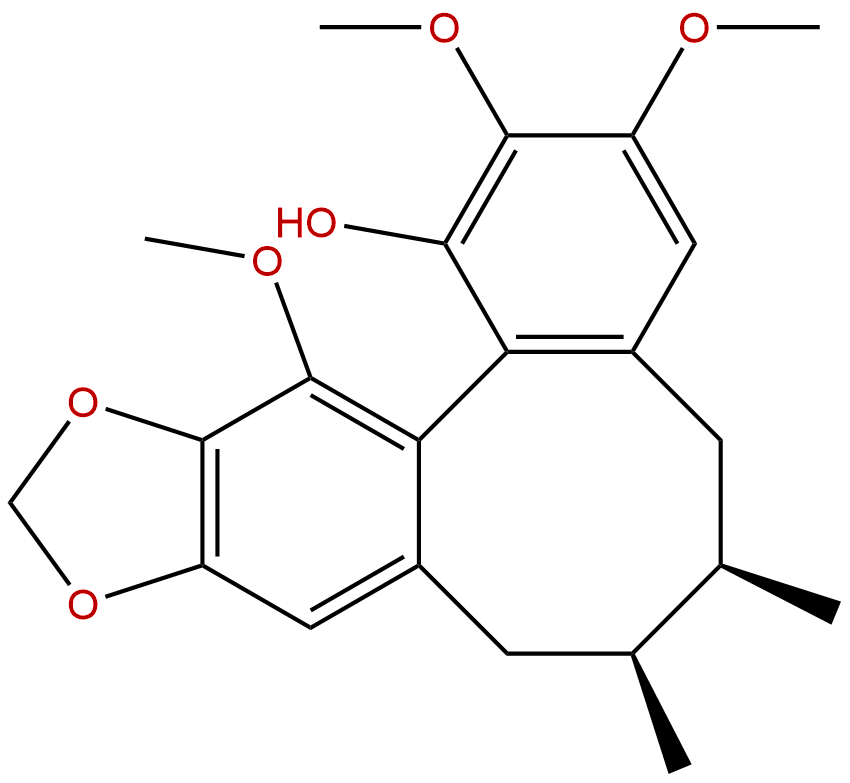
Schisandrin B belongs to the biphenyl cyclooctadiene type lignans, with a molecular formula of C23H28O5 and a molecular weight of 386.4440. Its basic skeleton is composed of two benzene rings (A ring and B ring) connected by an octane ring (C ring), forming a unique three-dimensional structure of "biphenyl cyclooctadiene". This structure is the material basis for its various biological activities. Compared with structurally similar compounds such as Schisandrol B, the specific hydroxyl and methoxy substitution patterns on the benzene ring of Schisandrol B are key to its unique pharmacological effects.
From the analysis of physical and chemical properties, the lipid water partition coefficient (LogP) of schisandrin B is 4.1086, indicating its good lipophilicity. Its topological polar surface area (TPSA) is 66.3800 Å ², which is relatively small. These parameters collectively determine its low water solubility (approximately 0.0021 mg/mL), making it a poorly soluble compound. A higher lipophilicity also suggests that it may have good cell membrane penetration ability. It is worth noting that based on its physicochemical properties, schisandrin B has a high blood-brain barrier permeability, which provides favorable pharmacological properties for its potential therapeutic applications in central nervous system related diseases such as neuroinflammation and neurodegenerative diseases. In addition, preliminary drug safety screening showed a result of 0.6 in the Ames test (usually considered negative if<1.5), indicating a low risk of mutagenicity; At the same time, no significant hERG potassium channel inhibitory activity was shown, indicating that its potential arrhythmogenic risk is relatively low, providing preliminary safety support for its further development.
Plant sources and extraction methods
Schisandrin B is mainly derived from plants of the Schisandra genus in the Schisandraceae family, among which Schisandra is one of the main sources(Schisandra chinensis)And Huazhong Schisandra chinensis(Schisandra sphenanthera)As the main source. These plants are mainly distributed in Northeast, North, Central China, as well as the Far East regions of Korea, Japan, and Russia. Schisandrin B has a relatively low content in plants and often coexists with other lignans such as wuweizi A, schisandrin A, and schisandrin ester A.
The extraction and separation method follows the conventional process of natural product chemistry. Firstly, alcohol solvents (such as ethanol, methanol) or alcohol water mixed solvents are usually used for reflux extraction or ultrasound assisted extraction of dried Schisandra fruit to fully obtain lignin components. After the crude extract was concentrated under reduced pressure, it was preliminarily separated using a system solvent extraction method (such as sequentially extracting with petroleum ether, ethyl acetate, and n-butanol). Schisandrin ethyl was mainly enriched in the ethyl acetate extraction site due to its equipolarity.
Further purification relies on modern chromatographic techniques. Silica gel column chromatography is commonly used for preliminary separation, with different ratios of petroleum ether ethyl acetate or chloroform methanol gradient elution. Then, fine purification was carried out in combination with reversed-phase silica gel column chromatography (such as ODS, C18), preparative high performance liquid chromatography (Prep HPLC) and gel chromatography (such as Sephadex LH-20) to finally obtain high-purity schisandrin B monomer. In recent years, preparative chromatography techniques such as high-speed counter current chromatography have also been applied for the separation of lignin due to their high recovery rate and avoidance of irreversible adsorption. The optimization of extraction processes, such as combining response surface methodology design, aimed at improving the yield and purity of target compounds, is an important direction of related research.
Pharmacological activity research
A large number of in vitro and in vivo studies have confirmed that schisandrin B has various pharmacological activities, and its core functions can be summarized as anti-inflammatory, antioxidant, neuroprotective, and potential cardiovascular protection.
1. Anti inflammatory activity: This is one of the most concerned pharmacological effects of schisandrin B. Research has shown that in lipopolysaccharide (LPS) - induced macrophage (such as RAW264.7) inflammation models, schisandrin B can dose dependently inhibit the production of inflammatory mediators such as nitric oxide (NO) and prostaglandin E2 (PGE2). Meanwhile, it can significantly downregulate the expression and release of various pro-inflammatory cytokines, including tumor necrosis factor - α (TNF - α), interleukin-6 (IL-6), and interleukin-1 β (IL-1 β). In animal models such as acute inflammation models such as mouse ear swelling and rat paw swelling, as well as chronic inflammation models such as collagen induced arthritis, schisandrin B has shown good anti-inflammatory effects, reducing tissue edema and inflammatory cell infiltration.
2. Antioxidant and anti apoptotic activity: The phenolic hydroxyl group in the structure of Schisandra chinensis gives it strong free radical scavenging ability, which can effectively inhibit lipid peroxidation and protect cells from oxidative stress damage. In the liver cell injury model induced by hydrogen peroxide (H2O2) or acetaminophen (APAP), schisandrin B exerts liver protection by enhancing the activity of endogenous antioxidant enzymes such as superoxide dismutase (SOD) and glutathione peroxidase (GSH Px), reducing malondialdehyde (MDA) levels, and inhibiting cell apoptosis in the mitochondrial pathway.
3. Neuroprotective activity: Thanks to its excellent blood-brain barrier permeability and antioxidant and anti-inflammatory properties, schisandrin B has shown potential in neurological disease models. In Alzheimer's disease cell models induced by β - amyloid protein (A β) or memory impairment mouse models induced by scopolamine, schisandrin B can improve cognitive function, and its mechanism may be related to inhibiting neuroinflammation, reducing oxidative damage, and regulating the cholinergic system.
4. Tyrosinase inhibitory activity: Schisandrin B has been proven to be an effective tyrosinase inhibitor. Tyrosinase is a key enzyme in melanin biosynthesis, and its excessive activity is associated with pigmentation disorders such as melasma and freckles. Therefore, Schisandrin B has promising applications in the development of skin whitening agents or the treatment of pigmentary diseases.
5. Cardiovascular related activities: Preliminary research suggests that schisandrin B may affect cardiovascular function by acting on specific targets (such as PI3K γ), but its specific myocardial protective and anti heart failure activities require more direct in vitro and in vivo experimental evidence.
Mechanism of action and molecular targets
The multiple pharmacological activities of schisandrin B stem from its regulation of multiple intracellular signaling pathways, and its mechanism of action is complex and has multi-target characteristics.
1. Core signaling pathways for anti-inflammatory effects:
- NF - κ B signaling pathway: This is the key mechanism of the anti-inflammatory effect of schisandrin B. Under stimulation such as LPS, schisandrin B can inhibit the activation of I κ B kinase (IKK, composed of subunits such as IKBKB), prevent the phosphorylation and degradation of I κ B α, and thus inhibit the nuclear translocation of nuclear transcription factor - κ B (NF - κ B, composed of subunits such as RELA/p65). This directly leads to a decrease in transcription of downstream genes such as TNF - α, IL-6, IL-1 β, inducible nitric oxide synthase (iNOS/NOS2), and cyclooxygenase-2 (COX-2/PTGS2).
- MAPK signaling pathway: Research has shown that schisandrin B can also inhibit LPS induced phosphorylation of p38 MAPK, JNK, and ERK1/2, thereby suppressing the production of inflammatory mediators on another level.
- NLRP3 inflammasome pathway: There is evidence to suggest that schisandrin B may inhibit the assembly and activation of NLRP3 inflammasomes, reduce the activation of caspase-1 (CASP1), and thus inhibit the maturation and release of IL-1 β and IL-18.
- STAT3 signaling pathway: Continuous STAT3 activation promotes inflammation and cell survival in chronic inflammation or tumor microenvironment. Schisandrin B has been shown to inhibit the phosphorylation (activation) of STAT3, which may be related to its inhibition of cytokine production such as IL-6 and direct interference with STAT3 function.
- Ion channel regulation: The potential regulatory effect on pain and inflammation related ion channels such as TRPV1 and TRPA1 may be another pathway for their anti-inflammatory and analgesic effects.
2. Interactions with specific disease targets:
- PI3Kγ(PIK3CG): This is a highly attractive target for schisandrin B. PI3K γ is highly expressed in immune cells and myocardial cells, and is an important regulatory factor for inflammatory response and myocardial contractility. Inhibiting PI3K γ has become a new strategy for treating heart failure (especially ejection fraction preserved heart failure) and inflammatory diseases. Molecular docking and preliminary binding experiments have shown that schisandrin B has a good binding affinity with the ATP binding pocket of PI3K γ, providing a direct molecular basis for its use in heart failure research.
- Tyrosinase: Schisandrin B binds to the active center of tyrosinase through competitive or non competitive means, inhibiting its catalytic activity in converting tyrosine to dopaquinone, thereby blocking the melanin synthesis pathway.
In summary, Schisandrin B synergistically acts on multiple inflammation related pathways such as NF - κ B, MAPK, STAT3, NLRP3, and targets key nodes such as PI3K γ, forming a multidimensional and networked spectrum of anti-inflammatory and action mechanisms.
Evaluation of drug properties and pharmacokinetics
Although Schisandrin B exhibits outstanding pharmacological activity, its pharmacological properties still need to be comprehensively evaluated.
Pharmacokinetic characteristics: The current pharmacokinetic studies on schisandrin B are relatively limited. Based on the study of its homologues (such as schisandrin B), speculation can be made. This type of lignans has moderate absorption after oral administration, but the first pass effect may be more pronounced. It has a wide distribution in the body, thanks to its high lipid solubility and blood-brain barrier permeability, and can enter brain tissue to play a central role. In terms of metabolism, lignans are mainly metabolized in the liver through the cytochrome P450 enzyme system (such as CYP3A4) for oxidation and demethylation in phase I, and combine with glucuronic acid or sulfuric acid to form phase II complexes, which are excreted through bile and urine. The specific metabolites, main metabolic enzymes, and excretion pathways of schisandrin B need to be clarified through radioactive labeling or high-sensitivity mass spectrometry technology.
Challenges and optimization strategies for drug development:
- Poor water solubility: This is the main obstacle to the development of oral or injectable formulations. To solve this problem, strategies that can be adopted include: ① Formulation technology: preparing solid dispersions, cyclodextrin inclusion complexes, liposomes, nanocrystals, or self microemulsion delivery systems to improve their solubility and dissolution rate. ② Precursor design: Introducing hydrophilic groups (such as phosphate esters and amino acid esters) into phenolic hydroxyl groups and other sites to produce prodrugs, which release the original drug through enzymatic interpretation in vivo.
- Metabolic stability: It is necessary to evaluate its metabolic stability in liver microsomes. If metabolism is too fast, structural modifications can be considered to block easily metabolized sites (such as methoxy adjustment), or in combination with CYP enzyme inhibitors.
- Systemic toxicity: Although the preliminary Ames test and hERG screening results are optimistic, a comprehensive preclinical safety evaluation is still needed, including acute toxicity, long-term toxicity, reproductive toxicity, etc.
In the future, standardized animal pharmacokinetic studies need to be conducted to clarify key parameters such as absolute bioavailability, tissue distribution characteristics, half-life, etc., providing a basis for dosage form design and administration plan formulation.
Clinical application prospects and prospects
The multi-target and multi pathway properties of schisandrin B provide broad prospects for its application in various disease fields.
1. Inflammatory disease treatment drugs:
- Rheumatoid arthritis (RA) and osteoarthritis (OA): Its strong anti-inflammatory and potential cartilage protective effects make it promising for development as a novel anti rheumatic drug, or as a supplement or alternative to existing nonsteroidal anti-inflammatory drugs (NSAIDs) and disease modified anti rheumatic drugs (DMARDs).
- Inflammatory diseases of the nervous system: Neuroinflammation after Alzheimer's disease, Parkinson's disease, multiple sclerosis, and ischemic stroke. Its ability to penetrate the blood-brain barrier is a key advantage.
- Skin inflammatory diseases: For conditions such as atopic dermatitis and psoriasis, the development of topical preparations may be considered.
2. Medications for the treatment of heart failure: Targeting PI3K γ is an emerging field in the treatment of heart failure. Schisandrin B, as a natural PI3K γ inhibitor, has the potential to be developed into a "one stone, two birds" drug - it can inhibit myocarditis and fibrosis, and directly improve myocardial function. This may be its most distinctive development direction.
3. Dermatology medication: As a tyrosinase inhibitor, it can be used to formulate functional cosmetics or treat hyperpigmentation disorders.
4. Liver protective adjuvant drugs: It has potential value in the prevention and treatment of drug-induced liver injury, alcoholic liver disease, and other conditions.
Outlook and Challenges:
Future research should focus on: ① Deep exploration of mechanisms: Using gene knockout CRISPR-Cas9、 Proteomics and other techniques are used to accurately elucidate the details of its interactions with targets such as PI3K γ and downstream effects. ② Disease model validation: Confirm the efficacy in animal models of heart failure and neurodegenerative diseases that are closer to clinical practice. ③ Structural optimization and derivative development: A systematic structure-activity relationship study and structural modification were conducted using schisandrin B as the lead compound, aiming to improve its activity, water solubility, metabolic stability, and targeting selectivity, and obtain candidate molecules with better drug properties. ④ Exploration of combination therapy: Studying its synergistic effect with existing standard therapeutic drugs may result in better efficacy and reduce side effects.
Conclusion
Schisandrin B, as an important biphenyl cyclooctadiene type lignan in Schisandra chinensis, exhibits significant pharmacological activities in anti-inflammatory, antioxidant, neuroprotective, and potential cardiovascular protection due to its unique chemical structure and multi-target mechanism of action. Especially its discovery as a natural PI3K γ inhibitor provides new ideas and candidate molecules for solving the major clinical challenge of heart failure. Despite facing challenges such as poor water solubility in drug development, these obstacles are expected to be overcome through the optimization of modern medicinal chemistry and pharmacology methods. With deeper analysis of its mechanism of action and systematic advancement of preclinical research, Schisandrin B is expected to gradually develop from a potential natural active molecule into an innovative drug for treating inflammatory diseases, heart failure, and neurodegenerative diseases, fully reflecting the translational medical value from traditional Chinese medicine to modern drugs. Continuous and in-depth research on it will not only help to reveal the modern scientific connotation of the traditional efficacy of Schisandra chinensis, but also inject new vitality into the development of new drugs based on natural products.