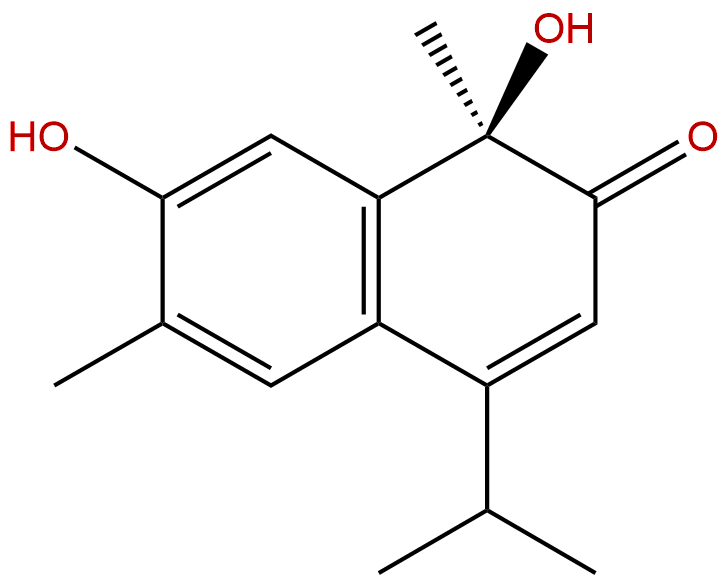
| Catalog No | Package | Original Price | Price | Inventory | Quantity | Operating |
|---|---|---|---|---|---|---|
| BP1866-5mg | 5mg | $260.00 | Sign in |
|


Product name: Lacinilene C
Synonym name: 3,10-Dihydroxy-1,3,5,7-cadinatetraen-9-one
Catalogue No.: BP1866
Cas No.: 41653-72-9
Formula: C15H18O3
Mol Weight: 246.306
Physical Description: Yellow powder
Purity: 95%~99%
Analysis Method: HPLC-DAD or/and HPLC-ELSD
Identification Method: Mass, NMR
Packing: Brown vial or HDPE plastic bottle
Can be supplied from milligrams to grams. Inquire for bulk scale.
For Reference Standard and R&D, Not for Human Use Directly.
Storage conditions:Short-term storage at 2~8℃, long-term storage at -20 ~ -80℃
57.5300
2.6674
2.6656
.1629
2.8585
12.3978
High
85.8529
3.4279
No
No
No
No
Yes
Yes
0.0
Yes
Yes
Yes
Yes
Natural products, as an important source of drug discovery, play an irreplaceable role in the long history of human fight against diseases. Isolating and identifying small molecule compounds with biological activity from traditional herbs, and elucidating their pharmacological mechanisms, is an important paradigm in modern medicinal chemistry and pharmacology research. Among the many plants with medicinal value, kapok family plants have attracted much attention for their rich secondary metabolites and extensive traditional applications. Among them, from kapok(Bombax malabaricum, also known as Bombax ceiba)Lacinilene C, obtained from root separation, as a structurally unique sesquiterpene like compound, has gradually entered the field of researchers in recent years and demonstrated potential biological activity, especially in the field of anti-tumor.
Qingyu ene C is not a completely new compound, and its first isolation and structural identification can be traced back to the 1970s. The initial research focus was mostly on its role as a stress metabolite in cotton plants, related to the disease resistance of cotton. However, with the advancement of separation technology and the deepening of biological activity screening, researchers have found that this compound also has significant content in the roots of cotton flowers and exhibits various pharmacological activities, especially potential inhibitory effects on malignant tumors such as ovarian cancer. Ovarian cancer, as one of the most deadly gynecological malignancies, has the characteristics of insidious onset, easy recurrence, and easy development of drug resistance, making the search for new, efficient, and low toxicity therapeutic drugs an urgent clinical problem to be solved. The emergence of iridoid C provides a new candidate molecule for the treatment strategy of ovarian cancer.
This review aims to systematically review the current research status of iridoid C, and conduct in-depth exploration from multiple dimensions such as chemical structure, plant origin, pharmacological activity, mechanism of action, and drug efficacy evaluation. It evaluates its value as a lead compound or potential drug molecule, and looks forward to its future research directions and clinical application prospects, in order to provide a comprehensive and professional reference material for researchers in the field of natural product pharmacology.
The chemical structure of Lacinilene C is the basis for its biological activity. From a chemical classification perspective, it belongs to the sesquiterpenoid class of compounds, whose skeleton is composed of three isoprene units. Specifically, the parent nucleus structure of green elmene C is 1,6-dimethyl-4- (1-methylethyl) naphthalene-2,7-diol. This structural feature endows it with unique physicochemical properties.
From the structural analysis, Qingyu ene C is a highly conjugated naphthalene ring system, with two phenolic hydroxyl groups (- OH) and one isopropyl side chain attached to it. The presence of phenolic hydroxyl groups gives it a certain polarity and the ability to form hydrogen bonds, which directly affects its solubility and interaction with biological targets. Its molecular formula is C ₁₅ H ₁₈ O3, with an accurate molecular weight of 246.3060 g/mol. This molecular weight meets the requirement of Lipinski's Rule of Five for molecular weight less than 500, providing a structural basis for its potential oral administration.
In terms of physical and chemical properties, Qingyuene C exhibits moderate lipid solubility. The calculated value of its oil-water partition coefficient (LogP) is 2.6674, indicating that the compound can penetrate the lipid bilayer well, facilitating transmembrane transport and binding to intracellular targets. The polar surface area (TPSA) is 57.53 Å ², which is lower than the thresholds commonly considered for good passive absorption (<140 Å ²) and blood-brain barrier penetration (<90 Å ²). In fact, its blood-brain barrier penetration prediction is "high", suggesting that the compound may have central nervous system activity, which is both an opportunity (such as treating brain metastases) and a challenge (possibly causing central neurotoxicity) in anti-tumor therapy. In terms of water solubility, its predicted water solubility is 0.1629 mg/mL, which belongs to the category of slight solubility. This may limit its bioavailability to some extent and needs to be improved through pharmaceutical methods. In addition, key pharmacological toxicology prediction indicators show that the inhibitory risk of Ulmaceae C on hERG potassium ion channels is "no", and the Ames test (bacterial recovery mutation test) result is 0.0, indicating that it does not have significant cardiac toxicity and genetic toxicity in preliminary predictions, which is a very favorable safety signal.
Qingyuene C was not originally discovered in cotton, but in cotton(Gossypium Phytoflexin was first reported as a phytoalexin in plants. When cotton is infected with pathogenic bacteria (such as Verticillium dahliae)When subjected to adverse stress such as infection or ultraviolet irradiation, it induces the synthesis of a series of sesquiterpenes, including iridoid C, to enhance its own resistance. However, extracting green elmene C from cotton usually results in lower yields and is limited by plant growth status and induction conditions.
At present, the main plant source of green elm C is kapok(Bombax malabaricum, also known as Bombax ceiba)The root. Kapok is a deciduous large tree widely distributed in tropical and subtropical regions of Asia. Its roots, bark, and flowers are used in traditional medicine and are commonly used to treat diseases such as inflammation, diarrhea, and fever. Research has shown that the roots of cotton trees contain abundant secondary metabolites such as terpenes, flavonoids, phenolic acids, etc. Among them, green elmene C is one of its characteristic components. Compared to the inducible production in cotton, the roots of cotton can stably accumulate higher levels of green elmene C, making it a more ideal natural source.
For the extraction and separation of iridoid C, classical natural product chemistry methods are usually used. The basic process includes:
1. Raw material pretreatment Collect the roots of kapok, wash, slice, dry in the shade or at low temperature, and grind them into coarse powder.
2. Solvent extraction According to the moderate polarity of Ulumen C, organic solvents with moderate polarity are often selected for extraction. Common solvents include ethanol, methanol, or their aqueous solutions. For example, by cold soaking or heating reflux extraction with 95% ethanol or methanol, a total extract containing iridoid C can be obtained.
3. Liquid-liquid extraction Suspend the total extract in water and extract it sequentially with solvents of different polarities such as petroleum ether, ethyl acetate, n-butanol, etc. Due to the LogP of Ulumene C being approximately 2.67, it is usually enriched in the ethyl acetate extraction layer.
4. chromatographic separation Systematic chromatographic separation of ethyl acetate extract. Common methods include silica gel column chromatography (gradient elution with different proportions of petroleum ether ethyl acetate or chloroform methanol system), Sephadex LH-20 gel column chromatography (elution with methanol or chloroform methanol system) and preparative high-performance liquid chromatography (Pre HPLC). Through repeated column chromatography and recrystallization, high-purity Ulumene C monomer compounds can be obtained.
5. Structural Identification Using modern spectroscopic techniques such as nuclear magnetic resonance (¹ H-NMR, ¹ ³ C-NMR, HMBC, HSQC), high-resolution mass spectrometry (HR-ESI-MS), etc., the isolated compounds were structurally confirmed and compared with literature reported data.
The pharmacological activity research of Ulmaceae C is still in the early exploration stage, but existing studies have revealed its potential effects in multiple aspects, among which anti-tumor activity is the most prominent highlight.
Multiple in vitro cell experiments have shown that iridoid C has a proliferative inhibitory effect on various tumor cell lines. Of particular concern is its activity against ovarian cancer cells. Research has shown that iridoid C can inhibit the proliferation of human ovarian cancer cell lines (such as SKOV3, A2780, etc.) and induce cell apoptosis in a dose-dependent and time-dependent manner. Its mechanism of action involves multiple signaling pathways and molecular targets, which will be detailed in the next chapter. In addition to ovarian cancer, celulene C also showed certain cytotoxicity to breast cancer, lung cancer, liver cancer and other cell lines, but its selectivity and efficacy varied with cell type. It is worth noting that its toxicity to normal cells is relatively low, demonstrating a certain degree of selectivity, which is an important advantage as a candidate molecule for anti-tumor drugs.
In addition to its anti-tumor effect, green elmene C has also been reported to have other biological activities:
- Antibacterial activity Due to its role as a phytoprotective agent in cotton, Ulumen C has inhibitory effects on certain plant pathogenic fungi and bacteria. There are research reports that it has certain antibacterial activity against Staphylococcus aureus, Bacillus subtilis, and other bacteria.
- anti-inflammatory activity Partial studies suggest that Ulumen C may exert anti-inflammatory effects by inhibiting the production of inflammatory mediators (such as NO, PGE2) or downregulating inflammatory signaling pathways (such as NF - κ B). This is consistent with the experience of using kapok roots in traditional medicine to treat inflammatory diseases.
- antioxidant activity The phenolic hydroxyl group in its molecular structure endows it with certain free radical scavenging ability, which may exert antioxidant effects by directly clearing reactive oxygen species (ROS) or activating the endogenous antioxidant enzyme system.
Although the above-mentioned activities have been preliminarily reported, most studies are still at the in vitro level, and in vivo pharmacological validation is not yet sufficient. The breadth and depth of its pharmacological effects need further exploration.
A deep understanding of the mechanism of action of iridoid C, especially its molecular basis for anti ovarian cancer, is the key to advancing it to preclinical research. Based on existing research and computer-aided drug design (such as molecular docking) predictions, it is possible that iridoid C exerts its anti-tumor effects through multi-target and multi pathway pathways. For ovarian cancer, its potential mechanisms of action and target network mainly include the following aspects:
Inducing cell apoptosis:
Intervention of estrogen signaling:
Inhibit tumor invasion and metastasis:
Regulating oxidative stress and hypoxic microenvironment:
Affects drug transport and genomic stability:
In summary, the anti ovarian cancer effect of iridoid C is not driven by a single target, but through a complex network that simultaneously acts on multiple biological processes such as apoptosis, proliferation, metastasis, angiogenesis, and drug resistance. This "multi-target" characteristic is a major advantage of it as a natural product, but it also increases the complexity of mechanism research.
To promote the clinical application of iridoid C from laboratory research, a comprehensive pharmacological evaluation must be conducted. Based on the provided parameters and existing knowledge, we can conduct a preliminary assessment of its pharmacokinetic (ADME) properties and potential risks.
The molecular weight (246.3), LogP (2.67), and number of hydrogen bond donors/acceptors (phenolic hydroxyl groups) of Ulumen C all conform to the Lipinski Five Rules, indicating its fundamental potential as an oral drug. The TPSA is 57.53 Å ², indicating good oral absorption and cell membrane permeability. However, its low water solubility (0.1629 mg/mL) may become a bottleneck limiting its oral bioavailability. In the development of formulations, it may be necessary to use solubilization techniques such as solid dispersions, liposomes, cyclodextrin inclusion complexes, etc. to improve their solubility and dissolution rate.
The key toxicological predictions are encouraging. The risk of hERG inhibition is' no ', greatly reducing its risk of causing QT interval prolongation and fatal arrhythmias. The Ames test result is 0.0, indicating that it has no mutagenicity in the bacterial recovery mutation test, and the genetic toxicity risk has been preliminarily ruled out. However, this is only an in vitro prediction, and comprehensive toxicological evaluation (including acute toxicity, chronic toxicity, reproductive toxicity, carcinogenicity, etc.) still needs to be conducted in animal models.
As a natural product with novel structure and multi-target anti-tumor activity, the clinical application prospects of green elmene C are mainly reflected in the following aspects:
Lead compounds for new drugs against ovarian cancer Given its significant activity against ovarian cancer cells and preliminary safety advantages, Ulmaceae C is an ideal lead compound for the development of novel anti ovarian cancer drugs. Future research should focus on:
Overcoming multidrug resistance The potential regulatory effect of iridoid C on ABCB1 makes it a potential adjuvant drug for reversing tumor multidrug resistance. By inhibiting the drug efflux pump, it can increase the accumulation of chemotherapy drugs in drug-resistant tumor cells and restore their sensitivity.
Treat other illnesses Based on its anti-inflammatory, antioxidant and antibacterial activities, celulene C or its derivatives also have certain development potential in the treatment of chronic inflammatory diseases (such as arthritis, enteritis), oxidative stress related diseases (such as neurodegenerative diseases) and infectious diseases. Especially its high blood-brain barrier penetration gives it a unique advantage in treating brain diseases such as glioblastoma and Alzheimer's disease.
As a pharmacological tool The unique "multi-target" mode of action of iridoid C makes it an excellent chemical probe for studying the regulation of signal networks in complex diseases such as cancer. Studying its interactions with different targets can help reveal new mechanisms of disease occurrence and development.
Ulumen C, a sesquiterpene like compound originating from the roots of cotton, is gradually transforming from a plant stress metabolite into a small molecule with potential medicinal value. Its unique naphthalene ring skeleton, good drug like properties, preliminary safety signals, and pharmacological activity against multiple targets such as ovarian cancer make it a natural product lead compound worthy of further research. However, current research is still in a very early stage, and the road from "compounds" to "drugs" is still long and challenging. Low water solubility, potential metabolic instability, and complex multi-target mechanisms are the main bottlenecks it faces.
The future research focus should be on: optimizing the structure through systematic structure-activity relationship studies to improve its pharmacokinetic properties and enhance targeting; Utilizing modern molecular biology techniques such as CRISPR-Cas9 gene editing and proteomics to elucidate its precise targets and signaling network in vivo; And rigorously validate its efficacy and safety in various in vivo models. Only in this way can we fully tap into the medicinal potential of Ulmaceae C and bring new hope for the treatment of difficult to treat diseases such as ovarian cancer. The excavation of the treasure trove of natural products is endless, and the story of green elmene C has just begun.
Batch can search by a CAS number,one per line
