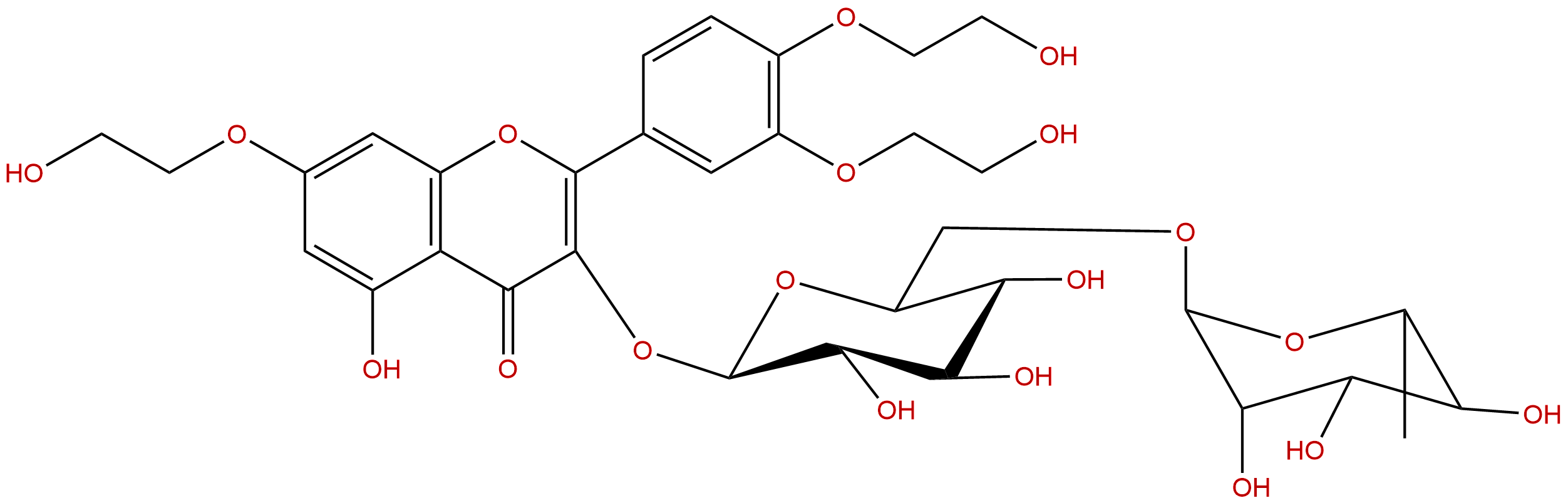


Synonym name:
Catalogue No.: BP1414
Cas No.: 7085-55-4
Formula: C33H42O19
Mol Weight: 742.68
Botanical Source:
Purity: 95%~99%
Analysis Method: HPLC-DAD or/and HPLC-ELSD
Identification Method: Mass, NMR
Packing: Brown vial or HDPE plastic bottle
Can be supplied from milligrams to grams.
For Reference Standard and R&D, Not for Human Use Directly.
Inquire for bulk scale.
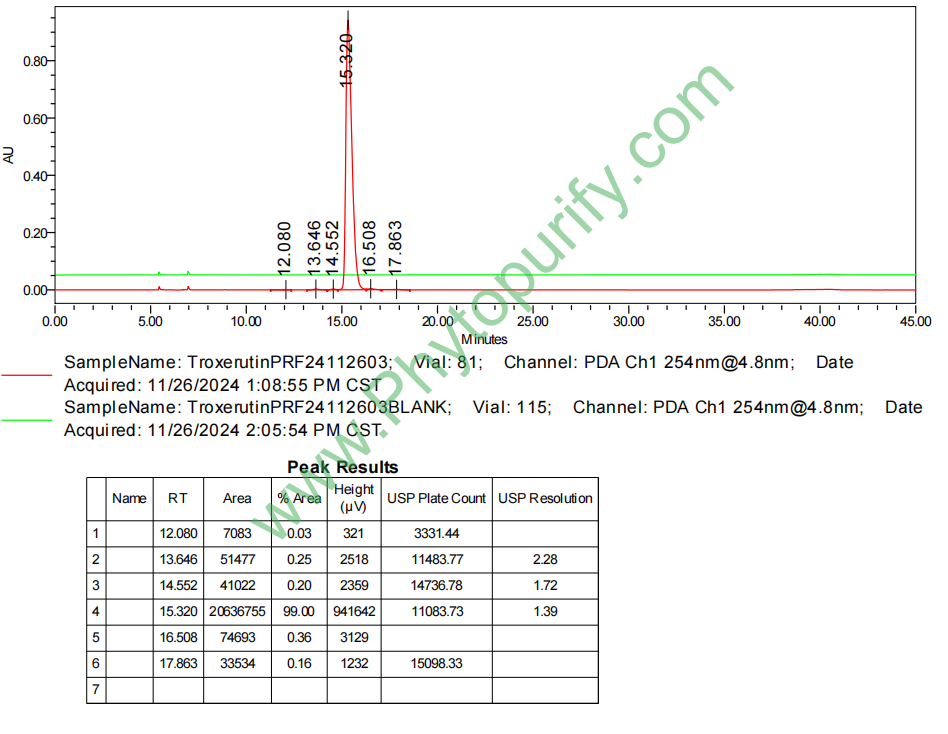
HPLC of Troxerutin
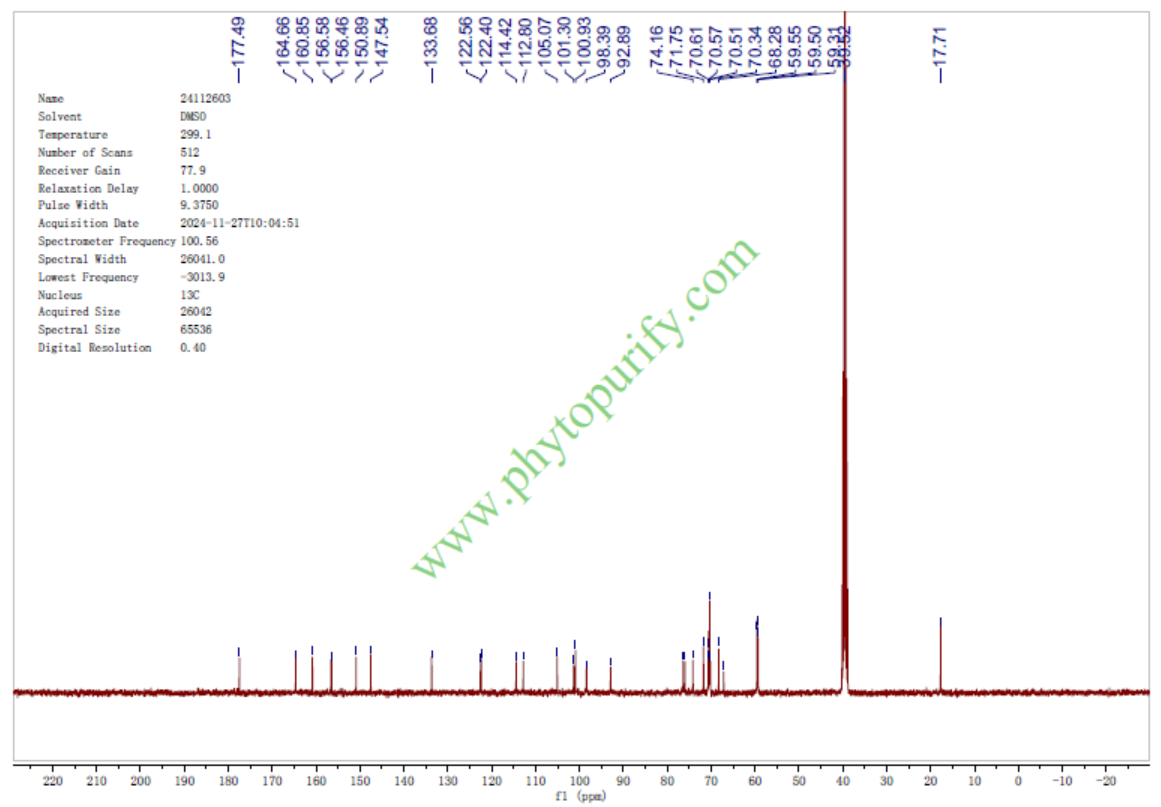
NMR of Troxerutin
Storage conditions:Short-term storage at 2~8℃, long-term storage at -20 ~ -80℃
297.1200
-.4050
-.4094
4.5724
.4233
.1856
Low
75.2897
4.9747
Yes
No
No
No
No
No
0.0
Yes
Yes
Yes
Yes
In the vast arsenal of natural products, bioflavonoids have attracted much attention for their extensive biological activity and low toxicity. Troxerutin, also known as trihydroxyethylrutin, is a semi synthetic derivative of the classic flavonoid compound rutin and is commonly referred to as vitamin P4. Since its discovery, Troxerutin has been widely used as a drug for the treatment of vascular diseases such as chronic venous insufficiency and increased capillary fragility in many European and Asian countries due to its excellent vascular protective activity. Compared with the parent rutin, quercetin has significantly improved its water solubility and bioavailability through hydroxyethyl modification, laying the foundation for its full pharmacological effects.
Modern pharmacological research has surpassed its traditional understanding of "vascular strengthening agents" and revealed more profound and diverse biological activities of quercetin. Its core mechanism involves strong antioxidant stress resistance, which can effectively inhibit the generation of reactive oxygen species (ROS) and regulate the endoplasmic reticulum (ER) stress signaling pathway, thereby affecting the activation of inflammasomes such as NOD like receptors. These effects demonstrate potential therapeutic value in the fields of inflammatory diseases, metabolic syndrome, neurodegenerative diseases, and ischemia-reperfusion injury. This article aims to systematically review the chemical properties, plant sources, pharmacological activities, molecular mechanisms of action, pharmacological characteristics, and clinical application prospects of quercetin, in order to provide comprehensive academic references for the in-depth research and development of this compound.
The chemical structure of quercetin (CAS number: 7085-55-4) is derived from the chemical modification of the natural flavonoid glycoside rutin (Quercetin-3-O-rutinoside). Its system is named 7,3 ', 4' - tris (2-hydroxyethoxy) ethylrutin. Specifically, a hydroxyethyl group (- CH2CH2OH) is introduced at the 3 'and 4' positions of the B ring and the 7-position phenolic hydroxyl group of the A ring in the rutin molecule to form a trihydroxylated derivative. This modification retains the basic flavonoid nucleus and glycoside structure of rutin, but greatly alters its physicochemical properties.
Its molecular formula is C33H42O19 and its molecular weight is 742.6800. The key parameters related to drug properties show that the calculated LogP value is -0.4050, indicating that the compound has a high degree of hydrophilicity; The topologically polar surface area (TPSA) is as high as 297.1200 Å ², further confirming the presence of a large number of polar groups (hydroxyl, sugar, ether bonds) in its molecules; Its water solubility value is 4.5724 (usually referring to LogS or similar indicators, indicating good solubility). These data collectively demonstrate the excellent solubility of quercetin in aqueous media, which is closely related to the development of its clinical formulations such as oral tablets and injections. However, high polarity and large TPSA also lead to its ability to cross the blood-brain barrier being predicted as' low ', which to some extent limits its direct effect on central nervous system diseases. In addition, key toxicity warning indicators showed no inhibition of hERG potassium channels (indicating low risk of cardiac toxicity), and the Ames test result was 0.0 (indicating no mutagenicity), providing preliminary chemical information support for the safety of its long-term use.
Rutin itself is not a natural product directly present in plants, but is prepared through a semi synthetic process using rutin, which is widely distributed in nature, as a precursor. Therefore, its "plant origin" is essentially the source of its parent compound rutin.
Rutin is widely distributed in the plant kingdom, especially rich in various medicinal plants and foods. Traditionally, the leaves and grains of Sophora japonica L. and Fagopyrum esculentum Moench are the main commercial sources for extracting rutin. In addition, tobacco leaves, eucalyptus leaves, vanilla, and fruits of various Rosaceae plants also contain a considerable amount of rutin. The classic methods for extracting rutin from plant materials include hot water extraction, alkaline aqueous solution extraction acid precipitation, and organic solvent (such as methanol, ethanol) reflux extraction. Among them, the alkaline extraction and acid precipitation method is widely used in industrial production due to its simple operation, low cost, and high yield. The principle is to utilize the phenolic hydroxyl groups in the structure of rutin to form salts and dissolve them under alkaline conditions, followed by neutralization with acid, causing rutin to crystallize again due to reduced solubility.
After obtaining high-purity rutin, hydroxyethyl is introduced through chemical synthesis steps. The typical synthetic route is to undergo nucleophilic substitution reaction between rutin and 2-chloroethanol or epoxyethane in the presence of alkaline catalysts such as sodium hydroxide and potassium carbonate, and then hydroxyethyl the designated phenolic hydroxyl group. After the reaction, it needs to go through steps such as separation and purification (such as column chromatography, recrystallization) to obtain quercetin that meets pharmaceutical standards. Modern technology continuously optimizes reaction conditions (such as phase transfer catalysis, microwave-assisted synthesis) with the aim of improving selectivity, yield, and environmental friendliness.
The pharmacological activity research of quercetin has gone through decades and has expanded from the initial vascular pharmacology to multiple disease fields. Its core activities can be summarized as follows:
The multiple pharmacological activities of quercetin stem from its diverse regulation of cellular signaling networks. Its mechanism of action is intertwined with molecular targets, forming a complex network. Regarding its outstanding vascular protective activity, research has focused on multiple key targets:
Integration of core mechanisms:
In addition to the specific targets mentioned above, the core mechanism of quercetin can be integrated into two main lines:Antioxidant anti endoplasmic reticulum stress axis and Anti inflammatory immune regulation axis。
1. Antioxidant and endoplasmic reticulum stress regulation Troxerutin maintains intracellular redox balance by directly clearing ROS and activating the Nrf2/ARE antioxidant pathway. The restoration of redox homeostasis directly reduces the oxidative pressure within the endoplasmic reticulum cavity and suppresses excessive UPR. Especially, it blocks the activation of downstream JNK and CHOP by inhibiting the IRE1 α and PERK pathways, thereby Inhibited the assembly and activation of NOD like receptors (such as NLRP3) inflammasomes mediated by endoplasmic reticulum stress The NLRP3 inflammasome is a key hub connecting metabolic stress, oxidative stress, and inflammatory response. Its activation leads to caspase-1 cleavage and mature release of IL-1 β and IL-18, triggering intense inflammation.
2. Anti inflammatory and signaling pathway regulation Troxerutin can extensively inhibit the activation of pro-inflammatory signaling pathways such as NF - κ B and MAPK (p38, JNK, ERK). It reduces the production of inflammatory mediators and may exert anti-inflammatory and cell protective effects by regulating the activity of deacetylases such as SIRT1.
Therefore, the effect of quercetin can be seen as a cascade network from molecular targets (such as ACE, eNOS) to key signaling nodes (Nrf2, PERK, NF - κ B), to cellular functions (antioxidant, anti-inflammatory, anti apoptotic) and ultimately organ protection (vascular, neural, metabolic).
Based on the physical and chemical parameters mentioned earlier, quercetin exhibits good drug like characteristics. Its high water solubility is beneficial for the development of formulations and oral absorption (dissolution in aqueous gastrointestinal environments). However, as a flavonoid glycoside derivative with a large molecular weight and high polarity, it is speculated that its transmembrane passive diffusion ability is limited. This is consistent with its pharmacokinetic properties.
Absorption, distribution, metabolism, and excretion (ADME) research indicate:
* absorb After oral administration, quercetin is rapidly but incompletely absorbed in the gastrointestinal tract, and its absolute bioavailability is relatively low. This is related to its high polarity, which may be influenced by gut microbiota metabolism and intestinal epithelial cell efflux pumps (such as P-glycoprotein). Compared with rutin, hydroxyethyl modification improves its hydrophilicity, but does not fundamentally change the poor absorption of flavonoid glycosides.
* distribution After absorption, it is mainly distributed in tissues and organs rich in blood, such as the liver, kidneys, lungs, etc. Due to its low fat solubility and high TPSA, as predicted, it is difficult to freely penetrate the blood-brain barrier and has limited distribution in the central nervous system.
* Metabolism Troxerutin mainly undergoes II combination reactions such as hydrolysis (dehydrohydroxyethyl?), glucuronidation, and sulfation in the body. Its metabolites may include rutin, quercetin, and their complexes. The gut microbiota also plays an important role in its metabolism.
* excretion Mainly excreted in the form of metabolites through the kidneys and urine, with some excreted through bile.
safety evaluation Long term clinical application history and extensive preclinical studies have shown that troxerutin is well tolerated at therapeutic doses, with mild and rare side effects (occasional gastrointestinal discomfort, headache, etc.). The lack of hERG inhibition and mutagenicity prediction and experimental evidence further support its good safety. However, long-term toxicity data at high doses still need to be improved under stricter new drug development standards.
At present, troxerutin has been marketed as a prescription or over-the-counter drug in dozens of countries around the world. The main dosage forms include tablets, capsules, and injections, with indications focused on vascular protection, such as varicose veins, chronic venous insufficiency, hemorrhoids, and capillary bleeding. This is its most direct and mature clinical application.
Looking ahead, its clinical application prospects can be expanded in the following directions:
1. Adjuvant therapy for metabolic diseases: Based on its potential to reduce glucose, regulate lipid, improve insulin resistance and prevent and treat complications (kidney disease, neuropathy, vascular disease) in diabetes animal models, troxerutin is expected to be developed as an auxiliary treatment drug for diabetes and its complications, especially for the core pathological links of oxidative stress and chronic inflammation.
2. Potential drugs for neurological disorders Although the blood-brain barrier has low permeability, its protective effect in various neural injury models suggests that improving dosage forms (such as nano delivery systems and prodrug strategies) to increase brain concentration or indirectly affecting neuroinflammation through peripheral anti-inflammatory effects may provide new treatment ideas for diseases such as Alzheimer's disease, Parkinson's disease, and stroke.
3. Adjuvant protective agents for chemotherapy or radiotherapy Its powerful antioxidant and anti-inflammatory properties can be used to alleviate normal tissue damage (such as mucosal inflammation, cardiomyopathy, neurotoxicity) caused by radiotherapy and chemotherapy in cancer patients, improve their quality of life and treatment tolerance.
4. Development of new formulations Developing new drug delivery systems is an important direction to address the issue of low oral bioavailability. For example, technologies such as phospholipid complexes, cyclodextrin inclusion complexes, nanoemulsions, and solid dispersions are expected to significantly improve their solubility, membrane permeability, and stability, thereby enhancing therapeutic efficacy.
5. Deep exploration of the mechanism of action Further fundamental research is needed to investigate the specific molecular details of its inhibition of "ER stress-induced NOD activation" and its interaction with energy metabolism receptors such as SIRT1 and AMPK. These studies may reveal novel targets and indications for it.
As a successful derivative of rutin, quercetin has bridged the gap from traditional medicinal plants to modern semi synthetic drugs. It not only inherits and enhances the vascular protective essence of flavonoids, but also demonstrates multidimensional biological activities such as antioxidant, anti-inflammatory, and anti endoplasmic reticulum stress in modern pharmacological research. Its clear targets (such as ACE, eNOS) and core signaling pathways (Nrf2, NF - κ B, UPR) form a systemic action network from molecules to the whole. Despite the challenges of low oral bioavailability and low blood-brain barrier permeability in drug development, its excellent safety, extensive pharmacological activity, and solid clinical application foundation have laid a solid foundation for its future development. Through continuous and in-depth research on its mechanism of action, expansion of indications, and innovation in formulations based on new delivery technologies, the "old drug" troxerutin is expected to shine with new vitality in the prevention and treatment of modern major chronic diseases such as metabolic diseases and neurodegenerative diseases, achieving a leap from "vascular protection expert" to "multi system disease regulator".
