| Catalog No | Package | Original Price | Price | Inventory | Quantity | Operating |
|---|---|---|---|---|---|---|
| BP4190-5mg | 5mg | $260.00 | Sign in |
|


Storage conditions:Short-term storage at 2~8℃, long-term storage at -20 ~ -80℃
194.2100
2.5025
.6259
.0814
.6213
.6877
Low
83.6136
5.4931
No
No
No
No
No
No
0.0
Yes
No
No
No
Natural products, as important resources for drug discovery, especially triterpenoid saponins, have shown broad application prospects in fields such as anti-inflammatory, anti-tumor, and immune regulation due to their diverse structures and rich biological activities. Ilexhainanoside D is a compound derived from Hainan holly(Ilex hainanensis The main triterpenoid saponins isolated from Merr. have attracted widespread attention in recent years due to their significant anti-inflammatory activity. This compound not only has a unique chemical structure and physicochemical properties, but also plays a regulatory role in various inflammation related signaling pathways, especially exhibiting synergistic anti-inflammatory effects when used in combination with Ilexsaponin A1. This article will systematically review the chemical characteristics, extraction process, pharmacological activity, mechanism of action, pharmacological evaluation, and clinical application potential of Hainan holly glycoside D. The aim is to provide a theoretical basis and reference for the in-depth research and drug development of this natural product.
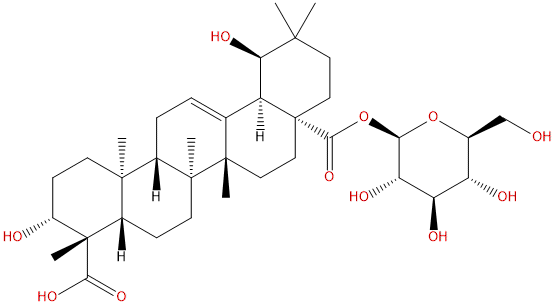
Hainan holly glycoside D is a typical triterpenoid saponin with a molecular weight of 664.8330. Its molecular formula and specific structural characteristics reflect its complex glycosidic chain and triterpenoid skeleton. Its LogP value is 2.5025, indicating that the compound has moderate lipid solubility, which facilitates cell membrane penetration while maintaining a certain degree of water solubility. The TPSA (polar surface area) is 194.2100, indicating a high molecular polarity that may affect its bioavailability and intracellular distribution. The water solubility is 0.0814, which belongs to low solubility compounds, indicating the need to consider solubility enhancement strategies in formulation development. The low permeability of the blood-brain barrier suggests that its main target may be limited to peripheral tissues, reducing the risk of central nervous system side effects. The hERG inhibition experiment showed a negative result, indicating a low risk of cardiac toxicity. The Ames test result is 0.0, indicating no significant mutagenicity and high safety.
In the chemical structure of Hainan holly glycoside D, the triterpenoid skeleton is a five ring structure that connects multiple sugar units. The type and connection mode of glycosidic chains have a significant impact on its biological activity. The structure has been analyzed in detail using modern analytical techniques such as nuclear magnetic resonance (NMR) and mass spectrometry (MS), laying the foundation for subsequent studies on the structure-activity relationship.
Hainan holly glycoside D is mainly derived from Hainan holly(Ilex hainanensis Merr.), This plant belongs to the holly family and is widely distributed in Hainan Province and its surrounding areas in China. Hainan holly has become a hot topic in natural medicine research due to its abundant triterpenoid saponins and traditional medicinal value.
The process of extracting Hainan holly glycoside D usually includes the following steps: first, ethanol or methanol is used as the solvent for crude extraction, and ultrasound assisted extraction or reflux extraction is used to improve the extraction efficiency; Subsequently, high-purity Hainan holly glycoside D was obtained through separation and purification techniques such as liquid-liquid distribution, silica gel column chromatography, and reverse phase high performance liquid chromatography (RP-HPLC). In recent years, supercritical fluid extraction and membrane separation techniques have also been introduced to improve extraction efficiency and purity, reduce the use of organic solvents, and comply with green chemistry principles.
During the extraction process, parameters such as temperature, solvent polarity, pH value, and extraction time have a significant impact on the yield of the product and the stability of the active ingredient. Therefore, it is necessary to optimize the process to ensure the quality and biological activity of Hainan holly glycoside D.
The pharmacological activity of Hainan holly glycoside D mainly focuses on anti-inflammatory effects. Multiple in vitro and in vivo experiments have shown that Hainan holly glycoside D can significantly inhibit the production of inflammatory mediators and alleviate inflammatory reactions. When used in combination with Ilexsaponin A1, its anti-inflammatory effect shows a synergistic enhancement, demonstrating superior therapeutic efficacy.
At the cellular level, Hainan holly glycoside D can inhibit the expression of pro-inflammatory factors such as tumor necrosis factor alpha (TNF - α) and interleukin-6 (IL-6) in macrophages and other immune cells, reducing cytokine storm. In animal model studies, Hainan holly glycoside D significantly reduced edema, cell infiltration, and tissue damage in inflammatory tissues, demonstrating good anti-inflammatory and protective effects.
In addition, Hainan holly glycoside D also exhibits certain antioxidant activity, which can clear free radicals and slow down the inflammatory response caused by oxidative stress. It has good safety, no obvious toxic side effects, and is suitable for long-term use.
The anti-inflammatory mechanism of Hainan holly glycoside D involves multiple signaling pathways and molecular targets, mainly including:
These multi-target and multi-path regulatory mechanisms endow Hainan holly glycoside D with broad-spectrum and multi efficacy in anti-inflammatory treatment, enhancing its potential as a natural anti-inflammatory drug.
The pharmacological parameters of Hainan holly glycoside D show that it has good potential for drug development. Moderate LogP values are beneficial for cell membrane permeability and in vivo distribution. Although its water solubility is low, its bioavailability can be improved through formulation optimization (such as nanoparticle and liposome encapsulation). Low blood-brain barrier permeability reduces the risk of central nervous system toxicity and is suitable for targeting peripheral inflammatory diseases.
In terms of safety, Hainan holly glycoside D did not exhibit hERG channel inhibition, reducing the risk of cardiac toxicity; Ames test negative, indicating no mutagenicity and high safety.
At present, there is limited pharmacokinetic research on Hainan holly glycoside D. Preliminary data indicate that its oral absorption is slow, the plasma half-life is moderate, and it is mainly excreted through liver metabolism. Further systematic pharmacokinetic and toxicological evaluations are needed in the future to provide a basis for clinical applications.
Given the significant activity and good safety demonstrated by Hainan holly glycoside D in the field of anti-inflammatory, its clinical application prospects are broad. Inflammation is the core pathological process of various chronic diseases, such as rheumatoid arthritis, inflammatory bowel disease, chronic obstructive pulmonary disease, etc. Hainan holly glycoside D is expected to serve as a new natural anti-inflammatory drug to fill the gaps in existing treatment methods.
The synergistic effect of Ilexsaponin A1 provides a new approach for the development of compound formulations, which may achieve comprehensive therapeutic effects with multiple targets and mechanisms. In addition, the potential of Hainan holly glycoside D in pain relief and immune regulation is also worth further exploration.
Future research should focus on:
Hainan holly glycoside D, as a source from Ilex hainanensis The main triterpenoid saponins, with their unique chemical structure and excellent physicochemical properties, exhibit significant anti-inflammatory activity and multi-target regulatory mechanisms. It has good safety, excellent pharmacological indicators, and high drug development value. In the future, through in-depth pharmacological mechanism research, pharmacokinetic optimization, and clinical validation, Hainan holly glycoside D is expected to become an important member in the field of natural anti-inflammatory drugs, providing new strategies and choices for the treatment of inflammatory diseases.
