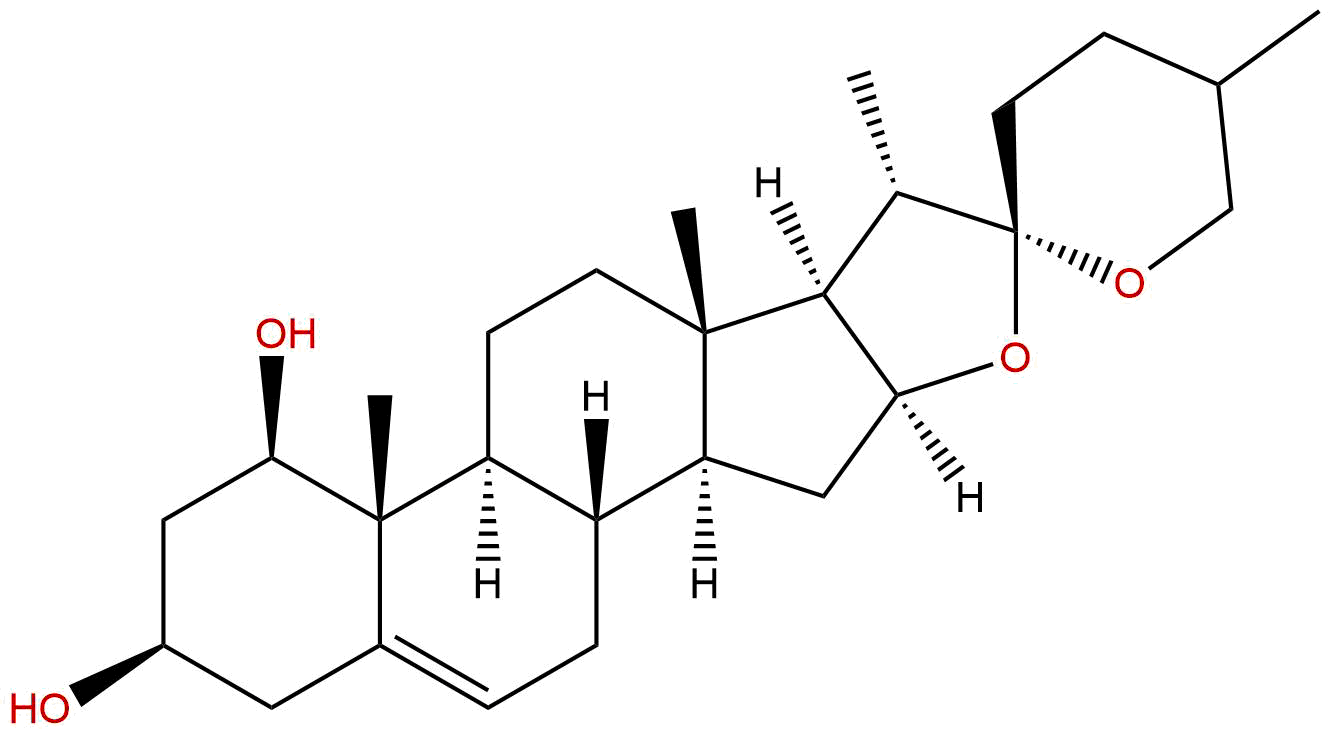


Product name: (25RS)-Ruscogenin
Synonym name:
Catalogue No.: BP4726
Cas No.: 874485-32-2
Formula: C27H42O4
Mol Weight: 430.629
Botanical Source:
Type of Compound: Steroids
Purity: 95%~99%
Analysis Method: HPLC-DAD or/and HPLC-ELSD
Identification Method: Mass, NMR
Packing: Brown vial or HDPE plastic bottle
Storage: Store in a well closed container, protected from air and light. Put into refrigerate or freeze for long term storage.
Whenever possible, you should prepare and use solutions on the same day. However, if you need to make up stock solutions in advance, we recommend that you store the solution as aliquots in tightly sealed vials at -20℃. Generally, these will be useable for up to two weeks.
The product could be supplied from milligrams to grams
Inquire for bulk scale.
For Reference Standard and R&D, Not for Human Use Directly.
Storage conditions:Short-term storage at 2~8℃, long-term storage at -20 ~ -80℃
(25RS) - Ruscin is a natural product of steroidal saponins with significant biological activity, widely present in plants of the Ruscus genus. As an important active ingredient in traditional herbal medicine, (25RS) - roscurogenin has received increasing attention in recent years due to its diverse pharmacological activities, especially its potential in the field of anti-inflammatory. Inflammatory response plays a key role in the pathogenesis of various diseases, and the development of natural products targeting inflammation related targets has become one of the hotspots in new drug research. This article will provide a systematic review of the chemical structure and physicochemical properties, plant sources and extraction methods, pharmacological activity and mechanism of action, drug efficacy evaluation and pharmacokinetic characteristics of (25RS) - roscurogenin, and explore its clinical application prospects and future research directions.
The molecular formula of (25RS) - roscurogenin is C27H42O4, with a molecular weight of 430.6290, belonging to the class of steroidal saponins. Its structural core is a steroid skeleton, and the 25th carbon atom presents an R/S configuration isomer, hence it is named (25RS). The molecule contains multiple hydroxyl and ketone groups, giving it certain polarity characteristics. In terms of physicochemical properties, the LogP value of (25RS) - roscurogenin is 4.3260, indicating its strong lipophilicity, which is beneficial for penetrating cell membranes and the blood-brain barrier (BBB). The TPSA (topological polar surface area) is 58.92 Å ², indicating its moderate polarity and contribution to maintaining bioavailability. Very low water solubility (0.0011 mg/mL) suggests limited solubility in aqueous phase, which may affect oral absorption. The negative result of hERG channel inhibition experiment indicates a low risk of cardiac toxicity; The Ames test result is 0, indicating no significant genetic toxicity risk.
(25RS) - Ruskosaponin mainly comes from plants of the Ruscus genus, especially Ruscus aculeatus and Ruscus hypopoglossum. This genus of plants is widely used in traditional medicine in Europe and some parts of Asia, mainly for the treatment of diseases such as varicose veins, hemorrhoids, and chronic venous insufficiency. During the extraction process, alcohol solvents (such as ethanol and methanol) are usually used to reflux or ultrasound assisted extraction of dried plant rhizomes, followed by purification to obtain sapogenins through liquid-liquid distribution, column chromatography, and other methods. In recent years, the application of supercritical CO2 extraction and high-performance liquid chromatography (HPLC) purification technology has improved extraction efficiency and purity, providing a high-quality sample basis for subsequent pharmacological research.
The pharmacological activity of (25RS) - roscurogenin is most prominent in its anti-inflammatory effect. Multiple in vitro and in vivo experiments have shown that this compound can significantly inhibit the release of inflammatory mediators and the activation of inflammatory signaling pathways. Specifically, it is manifested by inhibiting the expression of pro-inflammatory cytokines such as IL-6 and TNF - α, and reducing the damage to inflammatory tissues. In addition, (25RS) - roscurogenin also exhibits the potential to regulate immune responses, resist oxidation, and protect endothelial function. Some studies have pointed out its application value in alleviating inflammation related to chronic inflammatory diseases, neuroinflammation, and metabolic syndrome. In animal models, (25RS) - roscurogenin can effectively alleviate inflammatory symptoms through oral or injection administration, verifying its good in vivo activity.
The anti-inflammatory mechanism of (25RS) - roscurogenin involves multiple molecular targets and signaling pathways. Its main targets include:
The synergistic regulation of the above targets enables (25RS) - roscurogenin to exert anti-inflammatory effects on multiple levels and pathways, demonstrating its potential as a natural anti-inflammatory drug.
From the perspective of pharmacological analysis, (25RS) - roscurogenin has high lipid solubility (LogP=4.3260), which is beneficial for cell membrane penetration and blood-brain barrier permeability, supporting its application in central nervous system inflammation. TPSA is moderate and meets the requirements of drug molecules for biofilm permeability. Low water solubility suggests that the design of oral formulations should consider solubility enhancement strategies, such as nanoparticle carriers, solid dispersions, etc. The negative results of hERG channel inhibition and Ames test indicate high safety and low risk of cardiac and genetic toxicity.
Pharmacokinetic studies have shown that (25RS) - roscurogenin is absorbed rapidly after oral administration, with moderate peak plasma concentration and widespread tissue distribution, especially in liver, kidney, and brain tissues where it accumulates significantly. The metabolic pathway is mainly modified by hydroxylation and glycosylation through the liver enzyme system, and the activity and toxicity of metabolites need further research. Excretion is mainly through bile and urine, with a moderate half-life, supporting the rational design of clinical dosing frequency.
Based on its significant anti-inflammatory activity and good safety, (25RS) - roscurogenin has broad clinical application prospects in chronic inflammatory diseases (such as rheumatoid arthritis, inflammatory bowel disease), neuroinflammation (such as Alzheimer's disease, Parkinson's disease), and vascular related diseases (such as varicose veins, chronic venous insufficiency). In addition, its ability to penetrate the blood-brain barrier provides the possibility for developing novel therapeutic drugs for central nervous system diseases.
Future research should focus on:
(25RS) - Roskosaponin, as a natural steroidal saponin with multi-target anti-inflammatory activity, exhibits good pharmacological activity and potential for drug development. Its unique chemical structure endows it with excellent biofilm penetration ability and safety features, making it a powerful candidate molecule for anti-inflammatory drug development. In the future, through interdisciplinary research and technological innovation, it is expected to promote the translation of (25RS) - roscurogenin into clinical applications, benefiting patients with inflammation related diseases.
