
| Catalog No | Package | Original Price | Price | Inventory | Quantity | Operating |
|---|---|---|---|---|---|---|
| BP0640-100mg | 100mg | $20.00 | Sign in |
|


Synonym name: Geranyl alcohol; Lemonol; Beta-Geraniol
Catalogue No.: BP0640
Cas No.: 106-24-1
Formula: C10H18O
Mol Weight: 154.253
Botanical Source: Found in free state and as esters in many essential oils including geranium oil. Honeybee Apis mellifera Nasonov pheromone lure. Most prolific natural source is palmarosa oil (70-85%). Detected by gc-ms in the bryozoan Conopeum seuratum
Purity: 95%~99%
Analysis Method: HPLC-DAD or/and HPLC-ELSD
Identification Method: Mass, NMR
Packing: Brown vial or HDPE plastic bottle
Can be supplied from milligrams to grams.
For Reference Standard and R&D, Not for Human Use Directly.
Inquire for bulk scale.
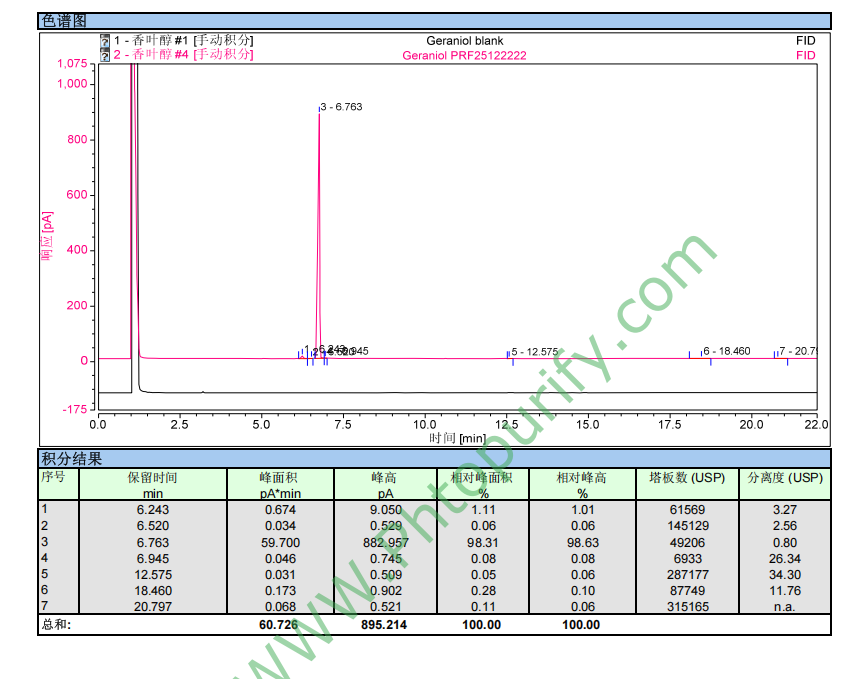
HPLC of Geraniol
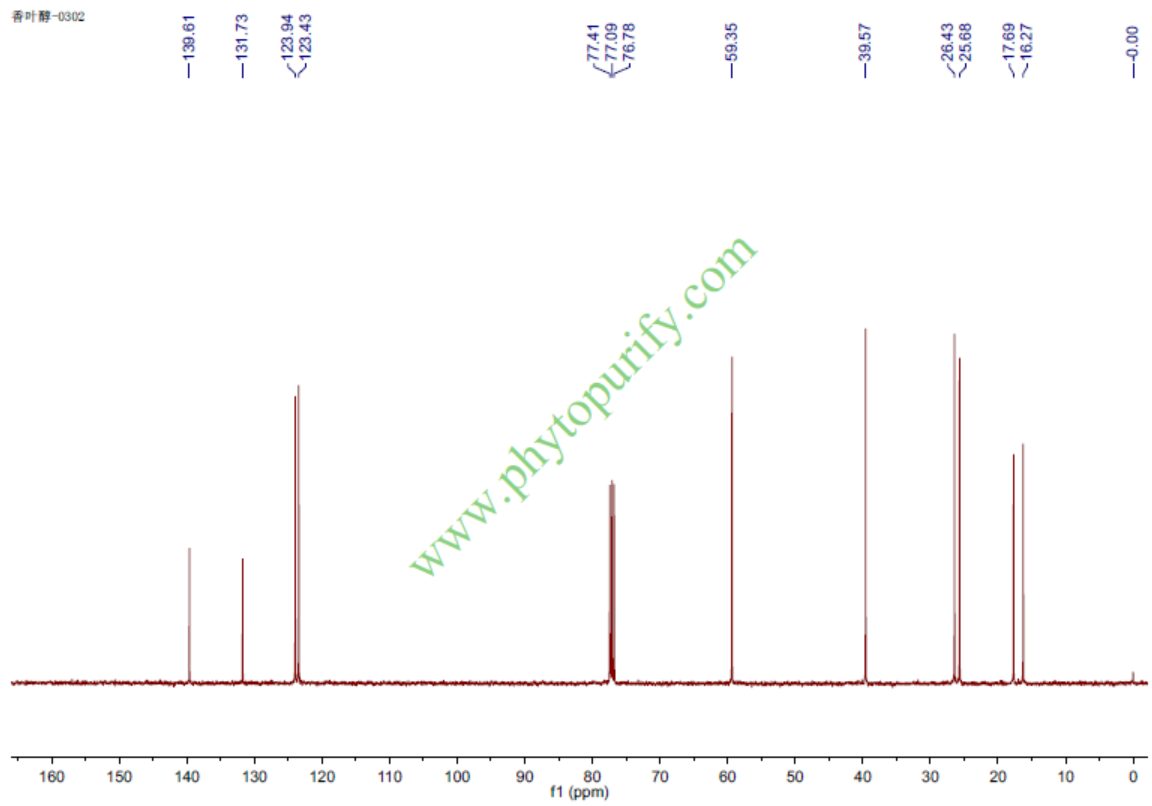
NMR of Geraniol
Storage conditions:Short-term storage at 2~8℃, long-term storage at -20 ~ -80℃
20.2300
3.6912
3.6908
.7058
5.0481
9.8077
High
81.2944
2.6811
Yes
Yes
No
No
No
No
0.0
No
Yes
Yes
Yes
Geraniol (CAS number: 106-24-1) is a naturally occurring monoterpene alcohol compound widely distributed in various aromatic plants, such as roses, lemongrass, lemongrass, and geranium. As an olefin terpene with significant biological activity, geraniol is widely used in traditional flavor and essence industry, and its research in pharmacology has gradually deepened in recent years. Numerous studies have shown that geraniol not only has excellent antibacterial, antifungal, antioxidant, and anti-inflammatory activities, but also exhibits significant anti-tumor potential, especially in regulating cell proliferation and inducing cell apoptosis, demonstrating unique advantages. In addition, the application of geraniol in metabolic diseases, especially in the pathological state related to diabetes, has also been gradually carried out, showing its pharmacological characteristics of multiple targets and mechanisms.
This review aims to systematically summarize the chemical structure and physicochemical properties, plant sources, and extraction methods of geraniol, with a focus on its pharmacological activity and mechanism of action. It delves into its molecular targets, analyzes its pharmacokinetic characteristics based on drug parameters, and finally looks forward to its clinical application prospects and research directions, providing comprehensive reference for researchers in the field of natural product pharmacology.
Xiangye alcohol is a monoterpene alcohol with a molecular formula of C10H18O and a molecular weight of 154.2530. Its chemical structure consists of a linear olefin skeleton containing two double bonds, with a hydroxyl group (- OH) at the end, giving it both hydrophobic olefin properties and hydrophilic alcohol properties. Its structural formula can be described as 3,7-dimethyl-2,6-octadien-1-ol, which belongs to allyl alcohols.
In terms of physicochemical properties, the LogP value of geraniol is 3.6912, indicating that it has good lipid solubility and is conducive to passive diffusion through the cell membrane. The topological polar surface area (TPSA) is 20.23 Å ², and a lower polarity area contributes to its cell membrane permeability and blood-brain barrier penetration ability. Low water solubility (0.7058 mg/mL) suggests limited solubility in aqueous phase, but is suitable for the development of lipid soluble drug formulations such as liposomes or nanocarriers. Xiangye alcohol can efficiently penetrate the blood-brain barrier (BBB), providing a foundation for its potential application in central nervous system diseases. The safety assessment shows that geraniol does not inhibit hERG channels and the Ames mutagenicity test is negative, indicating that it has low risks in terms of cardiac toxicity and genotoxicity, and has a good safety foundation.
Xiangye alcohol is widely present in the essential oils of various aromatic plants, especially in plants such as Rosa damascena, Cymbopogon citratus, Pelargonium graveolens, and Cymbopogon flexiosus, where the content is relatively high. Its natural form mainly exists in a free state or coexists with other terpenoids.
Distillation extraction
Traditional steam distillation is the main method for extracting vanillin, which is suitable for aromatic plants with abundant content. This method uses water vapor to remove volatile components and then condenses to collect essential oils. The distillation method is easy to operate, but it may cause thermal degradation or isomerization of some aromatic alcohols due to high temperatures.
Solvent extraction
Extract plant materials using organic solvents such as ethanol and ether, and then concentrate the extract through vacuum distillation or rotary evaporation. This method is suitable for extracting thermosensitive components, but attention should be paid to solvent residue and purification process.
Supercritical CO2 extraction
In recent years, supercritical carbon dioxide extraction technology has been widely used for the extraction of vanillin due to its advantages of low temperature and no solvent residue. This method can efficiently preserve the natural active ingredients of geraniol and extract them with high purity.
Membrane separation and chromatographic purification
To obtain high-purity geraniol, separation techniques such as liquid chromatography and gas chromatography are often used for purification to meet medicinal and research needs.
The pharmacological activities of Xiangye alcohol cover multiple aspects such as antibacterial, antifungal, antioxidant, anti-inflammatory, and anti-tumor. Research has gradually revealed its complex network of multi-target and multi mechanism effects.
Xiangye alcohol exhibits broad-spectrum antibacterial and antifungal activity, especially with inhibitory effects on various drug-resistant fungi and bacterial strains. Its antifungal activity is associated with multiple key targets, including:
The multi-target inhibitory effect of vanillin gives it potential advantages in the treatment of fungal infections, especially drug-resistant fungal infections.
Xiangye alcohol has significant free radical scavenging ability and can effectively reduce oxidative stress levels. Its antioxidant mechanism is mainly achieved by activating the endogenous antioxidant enzyme system (such as superoxide dismutase (SOD), glutathione peroxidase (GPx)) and directly clearing reactive oxygen species (ROS). In the inflammatory model, geraniol can downregulate the expression of pro-inflammatory factors such as TNF - α, IL-1 β, IL-6, inhibit the NF - κ B signaling pathway, and alleviate tissue inflammatory response.
Xiangye alcohol exhibits inhibitory activity on proliferation and induces cell apoptosis in various tumor cell lines. Its anti-tumor mechanism involves:
The research of geraniol in diabetes and its complications is increasing gradually. It has the potential to regulate blood sugar and protect pancreatic function by regulating glucose metabolism, reducing pancreatic beta cell damage, and improving insulin signaling pathways through antioxidant, anti-inflammatory, and insulin signaling pathways. In addition, geraniol also showed some protective effects on cardiovascular and neuropathy related to diabetes.
The multiple pharmacological effects of Xiangyechun are attributed to its regulation of multiple molecular targets, involving cell membrane structure, signal transduction, gene expression, and metabolic pathways.
Membrane target regulation
The hydrophobicity of geraniol enables it to insert into the lipid bilayer of the cell membrane, alter membrane fluidity and protein function, affect receptor and transporter activity, and thereby regulate cell signaling.
Enzyme activity inhibition
Inhibition of fungal specific enzymes such as ERG11 (CYP51) and FKS1 disrupts fungal cell membrane and cell wall synthesis, leading to cell death.
Signal pathway regulation
The anti-inflammatory effect is mainly achieved by inhibiting the NF - κ B and MAPK signaling pathways, and reducing the expression of pro-inflammatory cytokines; The anti-tumor effect involves the regulation of PI3K/Akt, mTOR, and JNK pathways, promoting apoptosis and inhibiting proliferation.
Transcription factor regulation
Xiangye alcohol can regulate the activity of Nrf2 transcription factor, enhance cellular antioxidant defense ability, and alleviate oxidative damage.
Multidrug resistance protein inhibition
By inhibiting efflux pumps such as CDR1, CDR2, and MDR1, the intracellular accumulation of antifungal drugs is enhanced, thereby improving therapeutic efficacy.
metabolic regulation
In the diabetes model, geraniol regulates AMPK and insulin signaling pathways to improve glucose uptake and metabolism.
The pharmacological parameters of Xiangye alcohol show that it has good potential for drug development:
In terms of pharmacokinetics, Xiangye alcohol is well absorbed after oral administration and widely distributed in the body, especially able to penetrate the blood-brain barrier. Metabolism is mainly carried out through the liver enzyme system for oxidation and binding reactions, and the metabolites are relatively non-toxic. The main excretion pathways are urine and bile. Its half-life is moderate and suitable for daily administration. The current research still needs to further clarify the specific metabolic enzymes and drug interaction risks in the human body.
Xiangye alcohol, as a multifunctional natural product, has a wide range of clinical application potential:
Anti-infection therapy
For drug-resistant fungal infections, vanillin can be used as an adjuvant or combination therapy to enhance the efficacy of existing antifungal drugs and reduce the risk of drug resistance. In the future, targeted drugs targeting fungal membrane synthases and multidrug resistance pumps can be developed.
Development of anti-tumor drugs
Its ability to induce tumor cell apoptosis and inhibit tumor growth provides new ideas for adjuvant therapy of tumors. Combining nano delivery systems to improve bioavailability and targeting will be a future research focus.
Anti inflammatory and antioxidant properties
In chronic inflammatory diseases, metabolic syndrome, and neurodegenerative diseases, geraniol can act as a natural anti-inflammatory antioxidant to slow down disease progression.
Metabolic disease management
The potential of geraniol to regulate glucose metabolism and islet function provides a new natural drug candidate for the treatment of diabetes and its complications.
Safety and Formulation Development
Low toxicity and good safety lay the foundation for clinical translation. In the future, dosage forms need to be optimized to improve water solubility and bioavailability, such as new formulations such as nanoemulsions and liposomes.
Clinical trials and standardized research
At present, there is limited clinical research on Xiangyechun, and there is an urgent need to conduct systematic clinical trials to verify its efficacy and safety, and promote its transition from laboratory to clinical application.
Xiangye alcohol, as a natural monoterpene alcohol with a simple structure but diverse functions, has shown broad prospects for drug development due to its multiple pharmacological activities such as antibacterial, antifungal, antioxidant, anti-inflammatory, and anti-tumor. Its mechanism of action involves multiple molecular targets and signaling pathways, reflecting the advantages of multi-target regulation of natural products. The pharmacological parameters and safety evaluation both support its value as a potential drug candidate.
Future research should focus on the pharmacokinetic optimization, formulation innovation, and clinical efficacy verification of geraniol, especially its application in drug-resistant infections, tumors, and metabolic diseases. Through interdisciplinary collaboration, geraniol is expected to become an important breakthrough in the field of natural product pharmacology, contributing new natural medicinal resources to human health.
