| Catalog No | Package | Original Price | Price | Inventory | Quantity | Operating |
|---|---|---|---|---|---|---|
| BPF0659-5mg | 5mg | $290.00 | Sign in |
|


Storage conditions:Short-term storage at 2~8℃, long-term storage at -20 ~ -80℃
274.7500
2.2738
.4275
.1163
.5809
.1623
Low
78.9618
6.2948
No
No
Yes
No
No
No
0.0
Yes
No
No
No
Natural products, as an important source of drug discovery, play an irreplaceable role in the long history of human struggle against diseases. From the classic analgesic morphine to the antimalarial drug artemisinin, the diverse and unique secondary metabolites in nature continue to provide valuable lead compounds for modern drug development. Among numerous natural products, triterpenoid saponins derived from plant rhizomes have attracted much attention due to their wide range of biological activities, particularly their significant anti-tumor potential. Triterpenoid saponins are a complex class of compounds formed by the connection of triterpenoid glycosides and sugar chains through glycosidic bonds. Their structural diversity endows them with rich pharmacological functions, including anti-inflammatory, immunomodulatory, antiviral, and anti-tumor effects.
Among numerous bioactive triterpenoid saponins, Raddeanoside 20 is a compound derived from plants of the Ranunculaceae family and the Silver Lotus genus Anemone raddeana The natural products isolated from the rhizomes of silver lotus have attracted the interest of researchers in recent years.Anemone raddeana In traditional Chinese medicine, it is often used to treat rheumatism, rheumatism, pain, swelling, and other diseases. The study of its chemical composition and pharmacological activity is an important topic in the fields of natural product chemistry and pharmacology. Raddeanoside 20, as an active ingredient in this plant, has a unique chemical structure and preliminary revealed biological activity, especially its ability to inhibit superoxide production, suggesting its potential application value in oxidative stress-related diseases and tumor treatment. This review aims to systematically review the current research status of Raddeanoside 20, including its chemical structure and physicochemical properties, plant sources and extraction methods, pharmacological activity, mechanism of action, drug evaluation, and clinical application prospects, in order to provide valuable references for the subsequent research and development of this natural product.
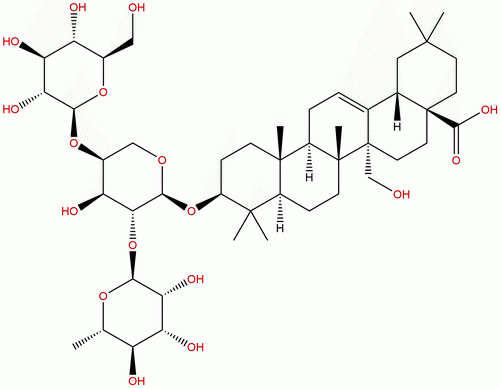
Raddeanoside 20 is a typical triterpenoid saponin compound. Its chemical structure consists of two parts: triterpenoid glycosides and sugar chains. Triterpenoid glycosides are typically of the Oleanane type, a pentacyclic triterpenoid skeleton, which is one of the most common types of glycosides in triterpenoid saponins. The oleane skeleton is composed of six isoprene units, with five rings A, B, C, D, and E, where the E ring is a six membered ring. The glycoside portion of Raddeanoside 20 typically contains multiple hydroxyl groups, which are critical sites for sugar chain linkage. The sugar chain is usually composed of multiple monosaccharide molecules (such as glucose, xylose, arabinose, arabinose, etc.) connected by glycosidic bonds. The specific sugar chain composition and connection sequence of Raddeanoside 20 are key to its structural identification, which usually requires the use of modern analytical techniques such as nuclear magnetic resonance spectroscopy (NMR) and mass spectrometry (MS) for analysis. Its molecular formula is C ₄₇ H ₇₆ O ₁₇, and its molecular weight is 913.1080 Da, which reflects its complex sugar chain structure.
In terms of physicochemical properties, the LogP value of Raddeanoside 20 is 2.2738, indicating that it has a certain degree of lipophilicity, but not strong lipophilicity. This characteristic is related to the presence of both lipophilic triterpenoid frameworks and hydrophilic sugar chains in its molecular structure. Its polar surface area (TPSA) is as high as 274.7500 Å ², mainly attributed to the large number of hydroxyl and ether oxygen atoms in the molecule. A high TPSA value usually indicates that the compound has good water solubility, but the water solubility measurement value of Raddeanoside 20 is 0.1163 mg/mL, which belongs to the category of slight solubility. This may be because its large sugar chains increase polarity but also increase molecular volume, affecting the effective encapsulation of water molecules. Its blood-brain barrier penetration ability was evaluated as "low", which is consistent with the high TPSA and "Lipinski Five Rules" with a molecular weight greater than 400 Da, indicating that the compound is difficult to enter the central nervous system through passive diffusion, which to some extent reduces its potential neurotoxic risk. In addition, the hERG inhibition prediction result is "no", and the Ames test result is 0.0, indicating that it has low risks in terms of cardiac toxicity and genetic toxicity. These preliminary drug efficacy evaluation results provide positive signals for its subsequent development.
The main plant source of Raddeanoside 20 is the Ranunculaceae family, specifically the Silver Lotus genus(Anemone)Plants - mostly silver lotus flowers(Anemone raddeana Regel)。 The Silver Lotus, also known as the Two Headed Tip and Bamboo Knot Fragrant Attachment, is a perennial herbaceous plant mainly distributed in Northeast China, the Korean Peninsula, and the Russian Far East. Its root and stem are used as medicinal herbs in traditional Chinese medicine, with the effects of dispelling wind and dampness, and reducing carbuncles and swelling. It is commonly used to treat conditions such as wind cold dampness, limb spasms, joint pain, and carbuncles and sores. Modern pharmacological studies have shown that the rhizomes of silver lotus contain abundant triterpenoid saponins, which are considered the material basis for its pharmacological effects. Raddeanoside 20 is one of the many triterpenoid saponins isolated and identified from the rhizome of this plant.
from Anemone raddeana The extraction of Raddeanoside 20 from rhizomes usually follows the standard process of natural product chemistry, which mainly includes the following steps:
Raw material processing and extraction Dry lotus roots are often crushed into coarse powder. In order to improve extraction efficiency, polar solvents are usually used for extraction, with methanol or ethanol (such as 70% -95% ethanol) being the most commonly used. The extraction methods include cold soaking, percolation, or heating reflux. Heating reflux extraction has a high efficiency, but it is important to control the temperature to avoid degradation of thermosensitive components. The extract is filtered and concentrated under reduced pressure to obtain the total extract.
Preliminary separation and enrichment The total extract is usually suspended in water and then subjected to liquid-liquid extraction using organic solvents of different polarities (such as petroleum ether, ethyl acetate, n-butanol) in sequence. Due to Raddeanoside 20 being a triterpenoid saponin with high polarity, it is mainly enriched in the n-butanol extraction layer. After vacuum concentration of n-butanol extract, crude saponin extract was obtained.
Chromatographic Separation and Purification The crude extract of saponins needs to be separated and purified through a series of chromatographic techniques. Common methods include:
Structural Identification The isolated pure product was structurally confirmed by modern spectroscopic techniques, mainly including:
The pharmacological activity research of Raddeanoside 20 is still in its early stages, but existing studies have revealed its potential in anti-tumor and antioxidant aspects.
1. Antitumor activity
The anti-tumor activity is the most studied direction of Raddeanoside 20. Preliminary in vitro cell experiments have shown that Raddeanoside 20 exhibits proliferative inhibitory effects on various tumor cell lines. For example, some studies have reported that it has certain cytotoxicity to lung cancer cells (such as A549), breast cancer cells (such as MCF-7), liver cancer cells (such as HepG2) and leukemia cells. Its anti-tumor activity usually exhibits dose - and time-dependent effects. Compared to many traditional chemotherapy drugs, Raddeanoside 20 may have relatively mild cytotoxicity, but its mechanism of action may be more unique, providing the possibility for it to be used as a novel anti-tumor candidate or adjuvant therapy drug.
2. Antioxidant activity
The literature clearly states that Raddeanoside 20 can inhibit the production of superoxide. Superoxides (O ₂⁻) are important members of the reactive oxygen species (ROS) family and are byproducts produced during cellular metabolism. Excessive superoxide can cause oxidative stress, damage DNA, proteins, and lipids, leading to various diseases including cancer, cardiovascular disease, neurodegenerative diseases, and inflammation. Raddeanoside 20 may exert antioxidant stress effects by inhibiting the production of superoxide. This activity may be closely related to its anti-tumor effect, as many tumor cells are in a state of high oxidative stress. By inhibiting the production of ROS, apoptosis or proliferation of tumor cells can be induced. In addition, the antioxidant activity also suggests that Raddeanoside 20 has potential application value in anti-inflammatory and anti-aging aspects.
3. Other potential activities
Given its antioxidant and anti-tumor activities, Raddeanoside 20 may also have other pharmacological effects. For example, by inhibiting ROS production in inflammation related signaling pathways, it may exert anti-inflammatory effects. In addition, triterpenoid saponins generally have immunomodulatory activity, and further research is needed to determine whether Raddeanoside 20 can also regulate immune cell function. At present, there is a relative lack of in vivo pharmacological research on Raddeanoside 20. Whether its anti-tumor activity can be reproduced in animal models, as well as its metabolic and toxicity characteristics in vivo, are the key directions that future research needs to focus on.
A deep understanding of the mechanism of action of Raddeanoside 20 is key to its transition from a natural product to a drug candidate. Although its exact mechanism has not been fully elucidated, existing studies combined with information on its structural analogues suggest that it may exert anti-tumor effects through multi-target and multi pathway pathways. The relevant targets mentioned in the literature include MCL1, BCL2, STAT3, MMP2, TOP1, HIF1A, TOP2A, MAPK1, ESR1, and CYP19A1, which cover multiple key biological processes such as cell apoptosis, signal transduction, tumor metastasis, DNA topoisomerase, and hypoxia response.
1. Inducing cell apoptosis
2. Inhibit tumor metastasis
3. Interference with DNA replication and transcription
4. Anti angiogenesis and hypoxia response
5. Regulating signal transduction and hormone signaling
In summary, the anti-tumor mechanism of Raddeanoside 20 may involve a complex network of multiple signaling pathways and molecular targets. It may produce synergistic anti-tumor effects and reduce the risk of single target drug resistance by simultaneously acting on multiple processes such as apoptosis, metastasis, DNA damage, angiogenesis, and hormone signaling.
Developing natural products into clinical drugs requires not only clear pharmacological activity and mechanism of action, but also good drug properties, including appropriate physicochemical properties, pharmacokinetic characteristics, and safety. For Raddeanoside 20, the preliminary pharmacological evaluation results have both positive aspects and revealed the challenges it faces.
1. Physical and chemical properties and drug like properties
2. Pharmacokinetic characteristics
At present, there is very limited in vivo pharmacokinetic research data on Raddeanoside 20. Based on its physical and chemical properties, it can be inferred that:
- absorb Due to its high polarity and high molecular weight, the absorption of Raddeanoside 20 in the gastrointestinal tract will be very difficult, and its oral bioavailability is extremely low. Intravenous injection may be a more feasible route of administration.
- distribution After intravenous administration, its distribution volume may be relatively small, mainly distributed in the blood and extracellular fluid. Due to its hydrophilicity, it is difficult to penetrate the cell membrane and enter the cell.
- Metabolism Triterpenoid saponins undergo metabolic reactions such as deglycosylation and oxidation in the body. The liver and gut microbiota are its main metabolic sites. Metabolites may have different pharmacological activities.
- excretion Due to its hydrophilicity, Raddeanoside 20 and its metabolites may be primarily excreted through bile and urine.
3. Safety evaluation
Summary of Medicinal Properties The main challenges facing the pharmacological properties of Raddeanoside 20 are its extremely poor membrane permeability and oral bioavailability. Its advantage lies in the optimistic preliminary safety evaluation results (low hERG risk, no mutagenicity). Future drug efficacy optimization strategies may include: 1) developing non oral drug delivery systems such as liposomes, nanoparticles, microemulsions, etc. to improve their delivery efficiency and bioavailability; 2) Perform structural modifications, such as simplifying or modifying sugar chains, or modifying aglycones, in order to improve physicochemical properties while maintaining activity; 3) Explore its potential as a prodrug by designing prodrugs that can be activated by specific enzymes (such as enzymes highly expressed in tumor tissue) in vivo to improve targeting and efficacy.
Raddeanoside 20, as a natural triterpenoid saponin with multi-target anti-tumor and antioxidant activities, has broad clinical application prospects but also faces many challenges.
1. Potential application areas
2. Challenges faced and future research directions
Raddeanoside 20 is a triterpenoid saponin with a unique structure isolated from traditional Chinese medicine commonly found in silver lotus flowers. It exhibits dual pharmacological activities of inhibiting superoxide production and anti-tumor activity through multi-target and multi pathway approaches, involving the regulation of multiple key targets such as MCL1, BCL2, STAT3, MMP2, TOP1, HIF1A, etc. The preliminary pharmacological evaluation shows that it has low hERG inhibition risk and low genetic toxicity, but the extremely poor membrane permeability and oral bioavailability are major obstacles to its development as an oral drug.
Although research on Raddeanoside 20 is still in its early stages of exploration, its unique chemical framework and clear biological activity make it a highly valuable natural product for research. Future research should focus on further elucidating its mechanism of action, overcoming pharmacokinetic bottlenecks, conducting systematic in vivo efficacy and safety evaluations, and exploring its potential as a lead compound for structural optimization. With the continuous advancement of medicinal chemistry, pharmacy, and molecular biology technologies, Raddeanoside 20 is expected to find its place in the treatment of anti-tumor and oxidative stress-related diseases, providing new ideas and candidate molecules for innovative drug development. The continuous in-depth research on these natural products not only helps to reveal the scientific connotation of traditional Chinese medicine, but also provides an inexhaustible source for modern drug discovery.
Batch can search by a CAS number,one per line
