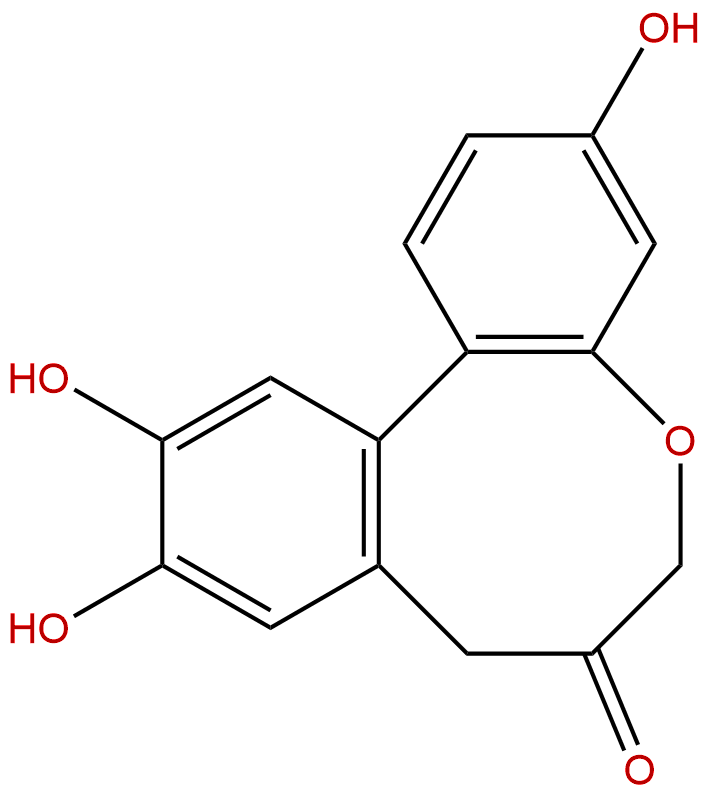


Product name: protosappanin A
Synonym name:
Catalogue No.: BP3329
Cas No.: 102036-28-2
Formula: C15H12O5
Mol Weight: 272.256
Botanical Source:
Physical Description:
Type of Compound: Miscellaneous
Purity: 95%~99%
Analysis Method: HPLC-DAD or/and HPLC-ELSD
Identification Method: Mass, NMR
Packing: Brown vial or HDPE plastic bottle
The product could be supplied from milligrams to grams. Inquire for bulk scale.
We provide solution to improve the water-solubility of compounds, thereby facilitating the variety of activity tests and clinic uses.
For Reference Standard and R&D, Not for Human Use Directly.
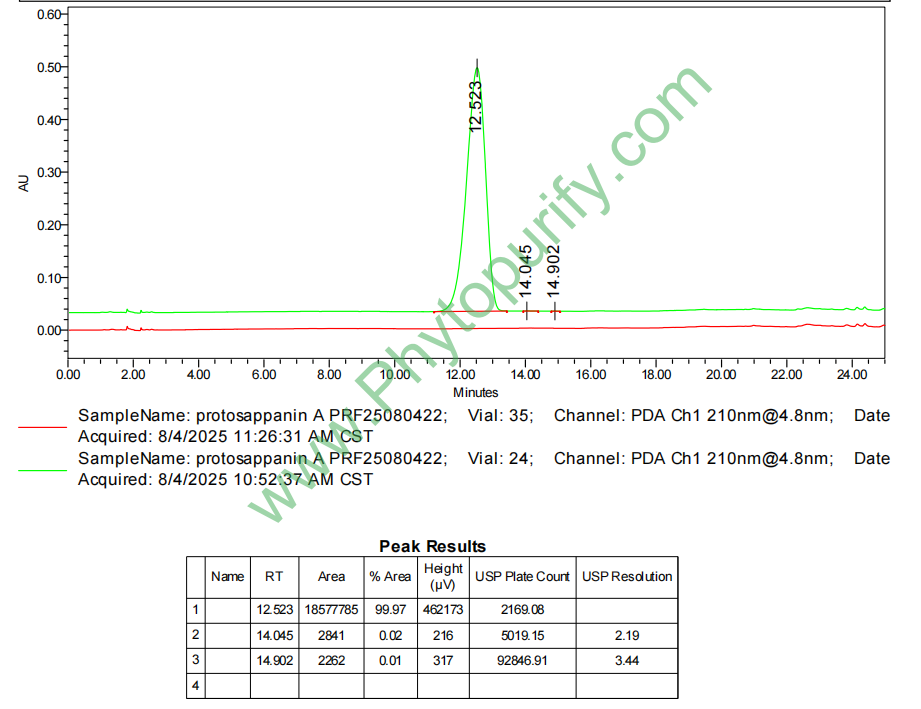
HPLC of protosappanin A
Storage conditions:Short-term storage at 2~8℃, long-term storage at -20 ~ -80℃
86.9900
1.5412
1.5153
.2631
3.4130
8.9808
Low
81.5810
2.6354
No
No
No
No
Yes
Yes
0.6
Yes
Yes
Yes
Yes
Natural products have long been an important treasure trove for innovative drug discovery, with many compounds receiving significant attention due to their unique chemical structures and broad biological activities. Protosapanin A (PTA), CAS number 102036-28-2, is derived from the traditional Chinese medicine Su Mu(Caesalpinia sappan L. A major biphenyl type compound isolated from the heartwood of (). As a commonly used medicinal herb for promoting blood circulation, removing blood stasis, reducing swelling and relieving pain, the research on the pharmacological active substance basis of Su Mu has always been a hot topic. PTA, as one of its iconic components, has been proven to have significant immunomodulatory and anti-inflammatory activities in recent years. Its core mechanism lies in downregulating the phosphorylation of JAK2 and STAT3, thereby inhibiting the JAK2/STAT3 dependent inflammatory signaling pathway. It is worth noting that in addition to its clear anti-inflammatory effects, an increasing number of studies have revealed the enormous potential of PTA in the field of anti-tumor treatment. Its effects involve inducing apoptosis, inhibiting proliferation, anti angiogenesis, and reversing drug resistance, targeting multiple key molecules including MCL1, BCL2, STAT3, MMP2, TOP1/2A, HIF1A, MAPK1, ESR1, and CYP19A1. This article aims to systematically review the chemical properties, plant sources, pharmacological activities, molecular mechanisms of action, pharmacological evaluation, and clinical application prospects of hematoxylin A, in order to provide comprehensive academic references for the in-depth research and development of this compound.
Yuansu lignin A is a natural biphenyl product with the chemical name (6aS, 12aS) -5,6,6a, 7,12,12-hexahydro-6,6,9-trimethyl-4H-benzofuran [3,2-c] chromene-3,10-diol. Its molecular formula is C16H16O5 and its molecular weight is 272.2560. Structurally, PTA has a [3,2-c] benzopyranophene skeleton and belongs to the class of new lignans. The structure contains two phenolic hydroxyl groups, which are crucial for its antioxidant properties and interaction with target proteins.
Its physicochemical properties directly affect its bioavailability and potential as a drug. The calculated lipid water partition coefficient (LogP) is 1.5412, indicating that PTA has moderate lipophilicity and is conducive to transmembrane transport. The topologically polar surface area (TPSA) is 86.99 Å ², which is relatively low and usually favorable for cell permeability. The water solubility value is 0.2631 (usually measured in mg/mL or log mol/L, indicating limited solubility), suggesting that it is a poorly soluble compound and may require consideration of solubilization strategies in formulation development. These basic physicochemical parameters (molecular weight<500, moderate LogP, low TPSA) preliminarily comply with the five rules of drug class, laying the foundation for further optimization.
The main source of Yuansu lignin A comes from the Yunzhen plant of the legume family, Sumu(Caesalpinia sappan L. Dry heartwood. Sumu is mainly produced in Southeast Asia and Guangxi, Yunnan, Guangdong and other places in China. Its heartwood is reddish yellow or brownish red, rich in pigments and various bioactive ingredients. In addition to PTA, it also includes Brazilian sumu and sumu chalcone.
The extraction and separation of PTA from Sumu are usually carried out using organic solvent extraction combined with modern chromatographic techniques. The classic process is as follows: after crushing the heartwood of Su Mu, methanol, ethanol, or aqueous ethanol is commonly used for heating reflux or ultrasound assisted extraction. The extract is concentrated under reduced pressure to obtain a paste, which is then subjected to gradient extraction using solvents of different polarities (such as petroleum ether, ethyl acetate, n-butanol). PTA is mainly enriched in the ethyl acetate fraction. Further purification is often carried out using silica gel column chromatography with gradient elution in solvent systems such as chloroform methanol, combined with preparative high-performance liquid chromatography (HPLC) or recrystallization techniques, to obtain high-purity precursor of hematoxylin A. In recent years, efficient separation techniques such as high-speed countercurrent chromatography have also been applied to the rapid preparation of PTA. The optimization of extraction process, such as using response surface methodology to determine the optimal extraction conditions, aims to improve the yield and purity of PTA to meet the needs of pharmacological research and subsequent development.
A large number of in vitro and in vivo studies have confirmed that lignin A has various pharmacological activities, among which anti-inflammatory and anti-tumor effects are the two most deeply studied fields.
Anti inflammatory and immune regulatory activity PTA has been clearly identified as an immunosuppressant. PTA can significantly inhibit the production of pro-inflammatory cytokines (such as TNF - α, IL-1 β, IL-6) and the release of nitric oxide (NO) in macrophage inflammation models induced by lipopolysaccharide (LPS), mouse acute lung injury models, and rheumatoid arthritis models, thereby reducing tissue inflammatory damage. Its anti-inflammatory effect is the core manifestation of its immunosuppressive activity.
Antitumor activity PTA has inhibitory activity on a variety of tumor cells, including breast cancer, liver cancer, lung cancer, colon cancer, leukemia, etc. Its anti-tumor effect is manifested as:
Other activities In addition, studies have reported that PTA has potential activities such as antioxidant, neuroprotective, and anti fibrotic effects, but its research depth is not as deep as anti-inflammatory and anti-tumor effects.
The pharmacological effects of lignin A, especially anti-inflammatory and anti-tumor effects, are achieved by intervening in multiple key signaling pathways and molecular targets, forming a multi-target action network.
Core pathway: JAK2/STAT3 signaling pathway This is the most clear mechanism by which PTA exerts immunosuppressive and anti-inflammatory effects. PTA can effectively inhibit tyrosine phosphorylation of JAK2 and transcription factor STAT3, prevent STAT3 dimerization, nuclear translocation, and transcription of downstream target genes such as Bcl-2, Mcl-1, Cyclin D1, VEGF. The inhibition of this pathway is the core of its anti-inflammatory, apoptosis inducing, and proliferation inhibiting properties.
Key molecular targets:
These targets are not isolated, but intertwined with each other. For example, the inhibition of STAT3 can simultaneously lead to the downregulation of multiple downstream target genes such as MCL1, BCL2, Cyclin D1, VEGF, etc., thereby synergistically exerting anti-tumor effects. The multi-target action characteristic of PTA enables it to intervene in disease progression from multiple levels, but also increases the complexity of its mechanism research.
Based on its physicochemical parameters and preliminary biological data, a preliminary evaluation of the pharmacological properties of original hematoxylin A.
Yuansu lignin A exhibits broad clinical application potential, but also faces many challenges.
Potential application areas:
challenges faced:
Future Prospects Future research should focus on: ① using advanced formulation technology to solve the delivery problem of PTA; ② Using chemical biology methods (such as chemical proteomics) to more accurately identify its direct target of action; ③ Conduct systematic preclinical ADME and toxicology studies to assess their development risks; ④ Explore precise treatment strategies based on biomarkers. As an active molecule derived from traditional Chinese medicine, the modern research on lignin A is a typical case of modernization and internationalization of traditional Chinese medicine. Its successful development will help reveal the modern scientific connotation of the "blood activating" effect of Su Mu.
As one of the core active ingredients of traditional Chinese medicine Su Mu, Yuansu lignin A exhibits anti-inflammatory and immune regulatory effects centered on inhibiting the JAK2/STAT3 pathway, as well as multi-target anti-tumor activity, thanks to its unique biphenyl chemical structure. From MCL1 and BCL2 to MMP2 and TOP1/2A, their action networks are extensive and complex, reflecting the characteristics of multi-target intervention of natural products in diseases. Despite facing challenges such as poor water solubility in drug development, its preliminary good safety features (such as lack of hERG inhibition) provide hope for its further development. Through the intervention of modern pharmacology, medicinal chemistry, and systems biology methods, the molecular mechanism of protoporphyrin A is deeply elucidated, and its pharmacokinetic properties are optimized. As a potential lead compound, protoporphyrin A is expected to develop into an innovative drug candidate for the treatment of inflammatory diseases and tumors, making substantial contributions to the inheritance and development of traditional Chinese medicine.
