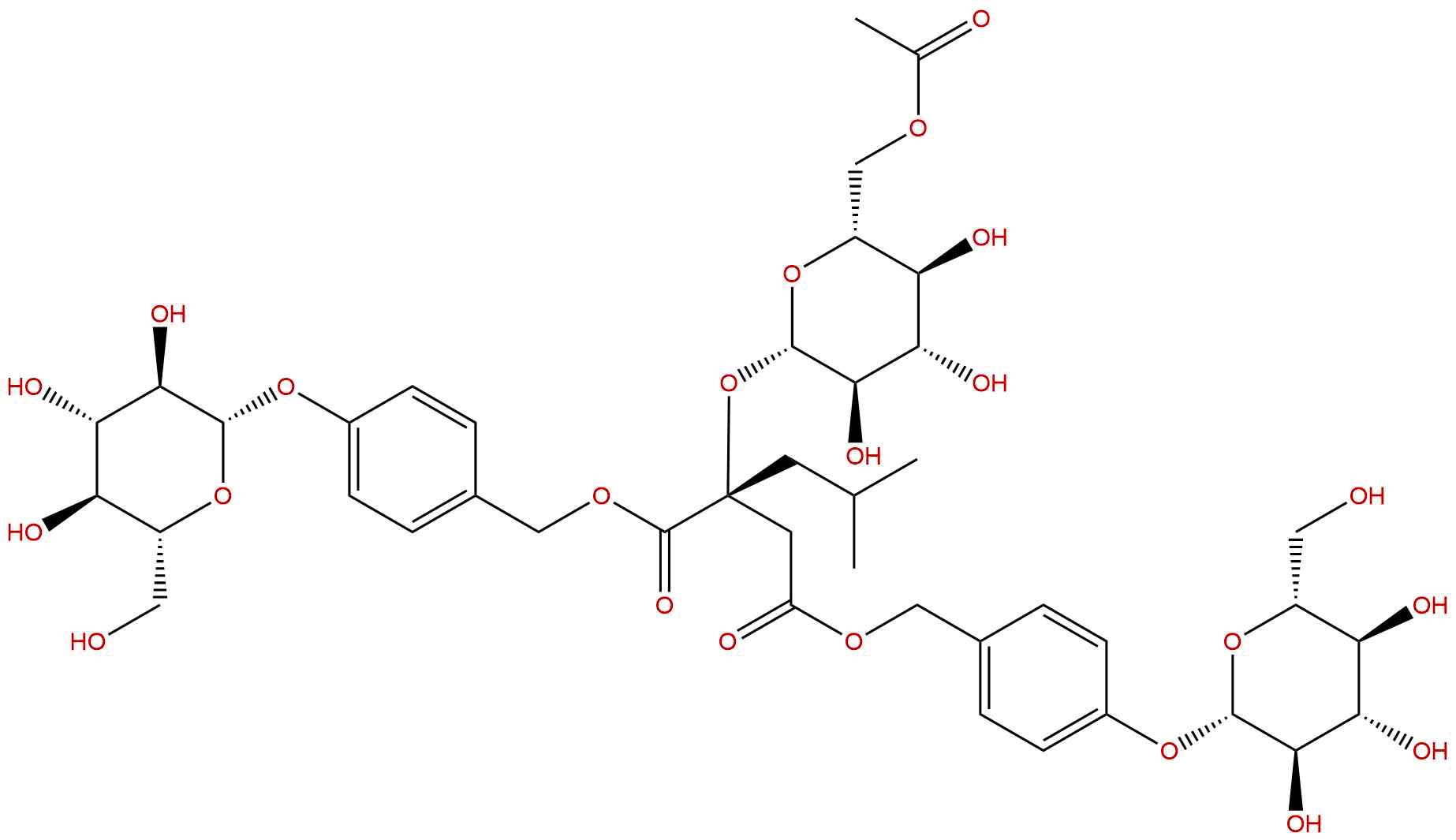


Product name: Gymnoside III
Synonym name:
Catalogue No.: BP2130
Cas No.: 899430-03-6
Formula: C42H58O23
Mol Weight: 930.903
Botanical Source: Bletillae Rhizoma
Type of Compound: Phenols
Purity: 95%~99%
Analysis Method: HPLC-DAD or/and HPLC-ELSD
Identification Method: Mass, NMR
Packing: Brown vial or HDPE plastic bottle
Storage: Store in a well closed container, protected from air and light. Put into refrigerate or freeze for long term storage.
Whenever possible, you should prepare and use solutions on the same day. However, if you need to make up stock solutions in advance, we recommend that you store the solution as aliquots in tightly sealed vials at -20℃. Generally, these will be useable for up to two weeks.
The product could be supplied from milligrams to grams
Inquire for bulk scale.
For Reference Standard and R&D, Not for Human Use Directly.
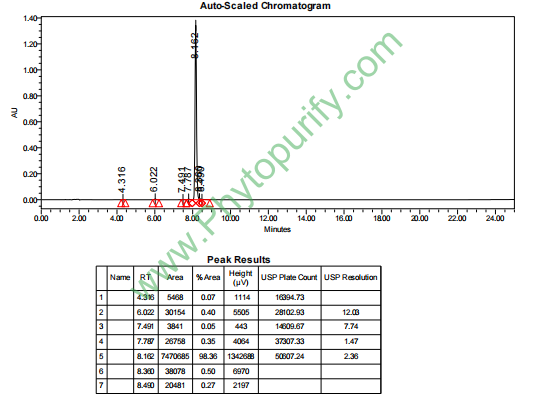
HPLC of Gymnoside III
Storage conditions:Short-term storage at 2~8℃, long-term storage at -20 ~ -80℃
356.8100
.1243
.1244
3.0622
.4476
.0691
Low
66.6460
5.6582
Yes
No
No
No
No
No
0.0
Yes
Yes
No
Yes
Gymnoside III, CAS number 899430-03-6, is a natural product isolated from the tubers of the orchid plant Gymnadenia conopsea (commonly known as ginseng). This compound belongs to the group of 2-isobutyl malic acid glucosoxybenzyl esters, and has attracted widespread attention in the field of natural product pharmacology in recent years due to its unique chemical structure and potential biological activity. Especially in the treatment research of neurodegenerative diseases, especially Alzheimer's disease (AD), hand ginseng glycoside III has shown good pharmacological activity and potential for action.
Alzheimer's disease, as the most common type of dementia worldwide, has a complex pathological mechanism involving multiple molecular targets and signaling pathways. Traditional treatment methods often focus on symptom relief and lack fundamental pathological intervention. In recent years, the development of multi-target drugs based on natural products has become a research hotspot. Hand ginseng glycoside III exhibits the potential for multi-target synergistic effects by regulating key targets related to AD, such as APP, BACE1, MAPT, PSEN1, and APOE4, which deserves further exploration.
This article aims to systematically review the chemical structure and physicochemical properties, plant sources and extraction methods, pharmacological activity and mechanism of action, pharmacological evaluation and pharmacokinetic characteristics of hand ginseng glycoside III. Combining with current research progress, it looks forward to its clinical application prospects in Alzheimer's disease and related neurodegenerative diseases, providing theoretical basis and reference for subsequent research and drug development.
The chemical name of Hand Ginseng Glycoside III is 2-Isobutyl Malic Acid Glucosoxybenzyl Ester, with a molecular formula of C45H70O18 and a molecular weight of 930.9030. Its structure contains multiple glycosidic and ester bonds, exhibiting typical characteristics of multiple hydroxyl and ester groups, endowing it with good water solubility and biocompatibility. The LogP value of the compound is 0.1243, indicating its strong hydrophilicity and weak hydrophobicity, which is consistent with the properties of polysaccharide natural products.
The topological polar surface area (TPSA) is 356.8100 Å ², indicating a high distribution of polar regions, which has a significant impact on its binding to biomolecule targets. The water solubility index is 3.0622, indicating that the solubility of hand ginseng glycoside III in the aqueous phase is moderate, which is beneficial for absorption and distribution in vivo. However, the low permeability of the blood-brain barrier (BBB) suggests its limited ability to directly enter the central nervous system, posing a challenge for its development as a neurological drug.
In terms of safety, hand ginseng glycoside III did not exhibit hERG channel inhibitory activity, reducing the risk of cardiac toxicity; The Ames test result is 0.0, indicating no significant mutagenicity and good safety.
Hand ginseng glycoside III mainly comes from the tubers of the orchid plant Gymnadenia conopsea. This plant is widely distributed in temperate and subarctic regions of the Eurasian continent. Its tubers are commonly used as medicine in traditional medicine, and have the effects of moistening the lungs, relieving cough, tonifying the kidneys, and nourishing qi. Modern research has found that its tubers are rich in various bioactive components, among which hand ginseng glycoside III, as one of the representative components, has significant pharmacological activity.
The common methods for extracting hand ginseng glycoside III include:
Solvent extraction method
Using ethanol or methanol as the main solvent, polysaccharide components in tubers can be effectively dissolved through reflux or ultrasound assisted extraction. After concentration of the extraction solution, the liquid-liquid distribution method is used to remove lipid soluble impurities.
Column chromatography separation
Separate and purify using silica gel or reverse phase C18 column. Through gradient elution, hand ginseng glycoside III can be enriched under specific elution conditions. The purified compound was identified and quantified by high-performance liquid chromatography (HPLC).
Crystallization and Recrystallization
In the further purification step, an appropriate solvent system is used for crystallization to improve purity and stability.
In recent years, the application of supercritical CO ₂ extraction and membrane separation technology has also provided new ideas for the efficient extraction of ginsenoside III, improving extraction efficiency and environmental friendliness.
The pharmacological activity of hand ginseng glycoside III mainly focuses on neuroprotection and anti Alzheimer's disease fields. Related in vitro and in vivo studies have shown that this compound has multiple biological effects:
Neuroprotective effect
Hand ginseng glycoside III can significantly inhibit neuronal apoptosis and alleviate oxidative stress damage. In vitro models, it protects neurons from peroxide damage by clearing free radicals and regulating antioxidant enzyme activity.
anti-inflammatory effect
In the neuroinflammatory model, hand ginseng glycoside III inhibits the expression of pro-inflammatory factors such as TNF - α and IL-1 β, reduces neuroinflammatory responses, and improves the neuromicroenvironment.
Inhibition of β - amyloid protein (A β) production
By regulating BACE1 enzyme activity, reducing the production and deposition of A β, and alleviating the pathological characteristics of AD.
Regulating abnormal phosphorylation of Tau protein
By affecting MAPT gene expression and related kinase activity, reducing abnormal aggregation of Tau protein and preventing the formation of neurofibrillary tangles.
Improvement of cognitive function
Animal behavior experiments have shown that hand ginseng glycoside III can improve the learning and memory abilities of AD model animals, suggesting its potential cognitive protective effect.
In addition, the potential activities of hand ginseng glycoside III in cardiovascular protection, anti-tumor and other aspects have gradually been reported, but the relevant mechanisms still need further clarification.
The mechanism of action of hand ginseng glycoside III involves multiple signaling pathways and key molecular targets, particularly in the pathological regulation of Alzheimer's disease. Its main targets include:
Starch like precursor protein (APP)
APP is the precursor protein of A β peptide. Hand ginseng glycoside III regulates the expression and processing of APP, reducing the production of harmful A β and blocking plaque formation.
β - secretase 1 (BACE1)
BACE1 is a key enzyme that cleaves APP to generate A β. Hand ginseng glycoside III inhibits BACE1 activity, reduces A β levels, and slows down the progression of AD.
Microtubule associated protein Tau (MAPT)
The abnormal phosphorylation of Tau protein is the core of AD neurofibrillary tangles. Hand ginseng glycoside III inhibits Tau abnormal aggregation and protects neuronal structural integrity by regulating the activity of related kinases such as GSK-3 β and CDK5.
Premature aging protein 1 (PSEN1)
PSEN1, as a component of the gamma secretase complex, participates in the cleavage of APP. Hand ginseng glycoside III may affect the A β production pathway by regulating the expression or function of PSEN1.
Apolipoprotein E4 (APOE4)
APOE4 is a genetic risk factor for AD, affecting A β metabolism and neuroinflammation. The regulatory effect of hand ginseng glycoside III on APOE4 is still in the exploratory stage, and preliminary data suggests that it may improve the pathological state mediated by APOE4.
Molecular docking and cell signaling pathway analysis showed that hand ginseng glycoside III can synergistically act on multiple targets, regulate the internal and external environment of neurons, alleviate AD pathological damage, and demonstrate the advantages of natural product multi-target drugs.
The pharmacological evaluation of Hand Ginseng Glycoside III is based on its physicochemical properties, safety indicators, and in vivo pharmacokinetic characteristics
Physicochemical properties
The molecular weight is approximately 931 Da, which limits its oral bioavailability and tissue penetration. The LogP value is close to zero, indicating strong hydrophilicity but insufficient hydrophobicity, which may affect cell membrane permeability. The high TPSA further limits its ability to pass through the blood-brain barrier.
Blood-brain barrier infiltration
Low BBB permeability is the main obstacle to the development of hand ginseng glycoside III as a central nervous system drug. In the future, drug delivery systems (such as nanoparticles, liposomes) or structural modifications can be used to enhance their brain distribution.
safety
No hERG channel inhibition, reducing the risk of cardiac toxicity; The Ames test is negative, indicating no mutagenicity and good safety.
pharmacokinetics
At present, there is limited data on the in vivo absorption, distribution, metabolism, and excretion (ADME) of ginsenoside III. Preliminary animal experiments suggest limited oral absorption and a long half-life, which may be metabolized through liver metabolic enzymes. In the future, systematic pharmacokinetic studies are needed to clarify its in vivo behavior and metabolic pathways.
Drug interactions
Due to the complex structure of hand ginseng glycoside III, it may interact with various drug metabolizing enzymes and transporters, and further evaluation of its drug interaction risk is needed.
In summary, hand ginseng glycoside III has certain potential for drug development, but it needs to overcome limitations such as high molecular weight and poor BBB permeability, and improve its clinical application value through drug design and administration optimization.
Alzheimer's disease, as a major public health challenge in an aging society worldwide, urgently requires safe and effective new therapeutic drugs. Hand ginseng glycoside III, with its multi-target regulatory ability and good safety, has shown the potential to become an adjuvant therapy or pathological intervention drug for AD.
The future clinical application prospects are mainly reflected in the following aspects:
adjuvant therapy
Combined with existing drugs, hand ginseng glycoside III can be used as an adjuvant drug to synergistically improve cognitive function and neuroprotection, and slow down disease progression.
Drug delivery system development
By using nanotechnology, liposome encapsulation and other methods, the delivery efficiency in the brain can be improved, enhancing the therapeutic effect.
Structural optimization and derivative development
By chemical modification to reduce molecular weight, improve lipid solubility, and design derivatives with more pharmacokinetic advantages.
Multi target combination therapy strategy
By utilizing the multi-target properties of hand ginseng glycoside III and combining it with other targeted drugs, a comprehensive treatment plan is formed.
Expansion of other neurodegenerative diseases
Explore its potential application in neurological diseases such as Parkinson's disease and post-stroke sequelae.
However, the clinical translation of hand ginseng glycoside III still faces many challenges, including drug formulation development, in vivo stability, effective dose determination, and long-term safety evaluation. In the future, it is necessary to strengthen preclinical research, conduct systematic toxicological and pharmacological evaluations, and lay the foundation for clinical trials.
Hand ginseng glycoside III, as a natural product derived from Gymnadenia conopsea, has shown broad application prospects in pharmacological research of Alzheimer's disease due to its unique chemical structure and multi-target regulatory ability. It exerts multiple effects such as neuroprotection, anti-inflammatory, and anti A β production by regulating key targets such as APP, BACE1, MAPT, PSEN1, and APOE4, demonstrating the advantages of natural products in the treatment of complex diseases.
Despite the limitations of poor blood-brain barrier permeability and high molecular weight, hand ginseng glycoside III still has good safety and potential pharmacological activity. In the future, through innovation in drug delivery technology, structural optimization, and systematic pharmacokinetic research, it is expected to promote its clinical translation process.
In summary, hand ginseng glycoside III not only enriches the research content of natural product pharmacology, but also provides new ideas and candidate molecules for multi-target treatment strategies of Alzheimer's disease. Looking forward to more in-depth basic and clinical research in the future, revealing its comprehensive mechanism of action and clinical application value, and promoting it as an important drug in the treatment of neurodegenerative diseases.
