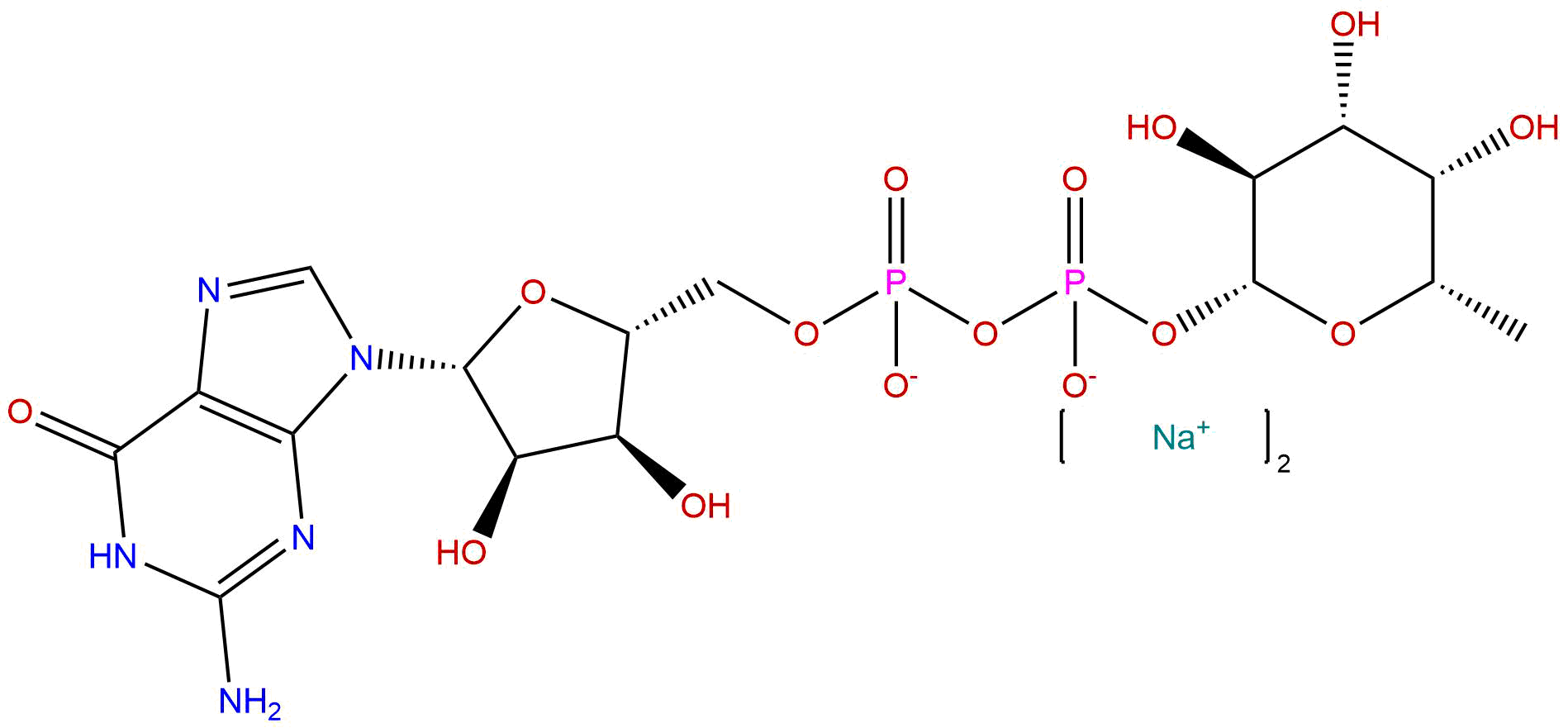


Product name: GDP-L-Fuc.2Na
Synonym name: Guanosine 5'-diphospho-β-L-fucose;GDP-L-fucose disodium salt;Guanosine diphosphate fucose; Guanosine diphosphofucose
Catalogue No.: BP5148
Cas No.: 15839-70-0
Formula: C16H23N5Na2O15P2
Mol Weight: 633.307
Botanical Source:
Type of Compound:
Purity: 95%~99%
Analysis Method: HPLC-DAD or/and HPLC-ELSD
Identification Method: Mass, NMR
Packing: Brown vial or HDPE plastic bottle
Storage: Store in a well closed container, protected from air and light. Put into refrigerate or freeze for long term storage.
Whenever possible, you should prepare and use solutions on the same day. However, if you need to make up stock solutions in advance, we recommend that you store the solution as aliquots in tightly sealed vials at -20℃. Generally, these will be useable for up to two weeks.
The product could be supplied from milligrams to grams
Inquire for bulk scale.
For Reference Standard and R&D, Not for Human Use Directly.
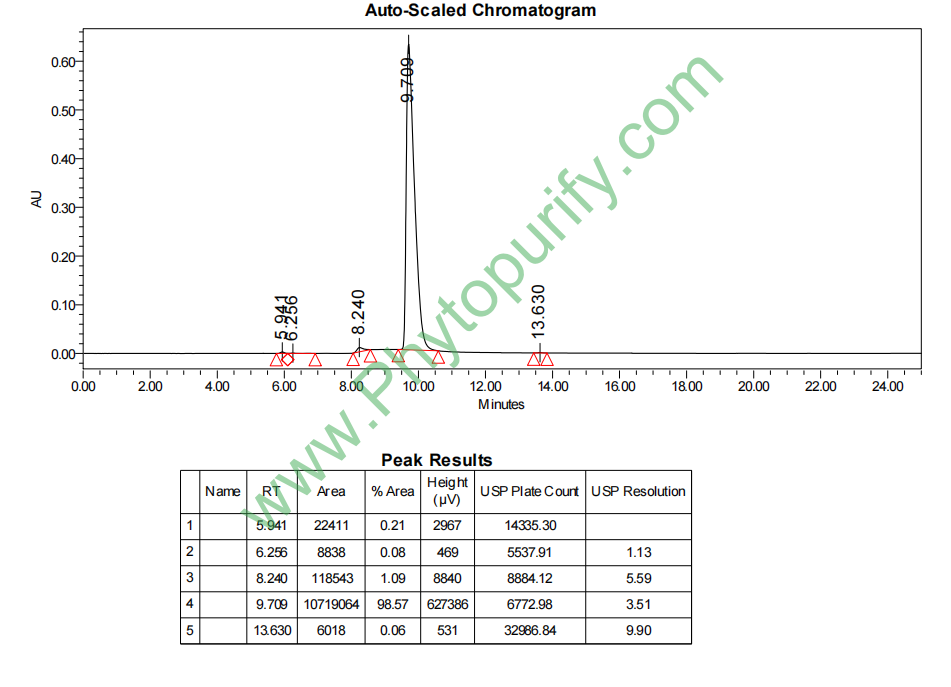
HPLC of GDP-L-Fuc.2Na
Storage conditions:Short-term storage at 2~8℃, long-term storage at -20 ~ -80℃
311.4900
-2.2847
-3.0440
7.4856
.1986
.0709
Low
37.9622
5.6535
No
No
No
No
No
No
0.3
Yes
No
No
No
GDP-L-Fuc.2Na (CAS number: 15839-70-0) is an important nucleoside diphosphate derivative and a key donor molecule in glycosyltransferase reactions. As a rare six carbon deoxyglucose, fucose (L-fucose) is widely present in various biomolecules, especially playing an important role in the modification of glycoproteins and glycolipids. GDP-L-Fuc, as an activated form of fucose, is an essential substrate for fucosyltransferase to catalyze the transfer of fucose residues to receptor molecules. It participates in regulating various biological processes such as intercellular recognition, signal transduction, and immune responses.
In recent years, with the rapid development of glycobiology and glycomics, the biological functions of GDP-L-Fuc and its role in diseases have gradually received attention. Its potential target value in tumor, inflammation, autoimmune diseases and infectious diseases provides a theoretical basis and practical guidance for the development of new drugs. In addition, the physicochemical properties, pharmacological parameters, and metabolic behavior of GDP-L-Fuc in vivo also lay the foundation for its research as a candidate drug molecule or drug excipient.
This article aims to systematically review the chemical structure and physicochemical properties, plant sources and extraction methods, pharmacological activity and mechanism of action, pharmacological evaluation and pharmacokinetic characteristics of GDP-L-Fuc. Combined with its clinical application prospects, it comprehensively evaluates the research progress and future development directions of this compound in the field of natural product pharmacology.
GDP-L-Fuc.2Na is a nucleotide sugar derivative formed by the glycosidic bond between guanine nucleoside diphosphate (GDP) and L-fucose. Its molecular formula is C16H23N5O15P2Na2, with a molecular weight of 589.3440 Da. Structurally, the GDP portion provides guanine bases and ribose skeletons, and the diphosphate bridge connects to the C1 position of the fucose residue. The fucose exists in the L-configuration, reflecting its stereochemical specificity.
In terms of physical and chemical properties, GDP-L-Fuc exhibits high polarity with a LogP value of -2.2847, indicating strong hydrophilicity. Its water solubility reaches 7.4856 mg/mL, making it suitable for the development of aqueous formulations. Its topological polar surface area (TPSA) is 311.4900 Å ², indicating that the molecule has a large number of polar groups, which facilitate the formation of hydrogen bonds and polar interactions with enzyme active sites. The low permeability of the blood-brain barrier suggests its limited role in the central nervous system. The negative result of hERG channel inhibition experiment indicates a low risk of cardiac toxicity. The Ames mutagenicity test value is 0.3, indicating that its genotoxicity risk is relatively low and has a certain safety basis.
The stability of this compound is affected by environmental pH and temperature, and the diphosphate bond is easily hydrolyzed by phosphatase, so it needs to be stored under suitable conditions. Its sodium salt form improves water solubility and stability, making it easier to prepare and store solution formulations.
GDP-L-Fuc, as a nucleotide sugar, naturally exists in various plant cells, especially in plant tissues rich in fucoidan polysaccharides and glycoproteins. Fucosan is mainly distributed in the cell wall polysaccharides of brown algae plants (such as kelp and bok choy) and certain higher plants. Although GDP-L-Fuc itself has a low content in plants, it is synthesized through plant cell metabolic pathways and participates in the biosynthesis of cell walls.
Traditional extraction methods often rely on extracting fucoidan polysaccharides from plant tissues, followed by enzymatic hydrolysis and purification to obtain GDP-L-Fuc. The specific steps include:
Raw material pretreatment Select brown algae plants rich in fucoidan for cleaning, drying, and crushing.
Polysaccharide extraction Using hot water extraction or acid-base hydrolysis methods to extract polysaccharide components with high fucoidan content.
Enzymatic hydrolysis reaction Using specific fucosyltransferase or phosphorylase to hydrolyze polysaccharides and release GDP-L-Fuc.
Purification and Separation: To separate and purify GDP-L-Fuc through multi-step chromatographic techniques such as ion exchange chromatography and gel filtration chromatography.
Preparation in salt form Convert purified GDP-L-Fuc into disodium salt to improve its stability and water solubility.
In recent years, the development of genetic engineering and microbial fermentation technology has provided new avenues for the production of GDP-L-Fuc. By expressing the enzyme system related to fucose synthesis through engineering strains, the biosynthesis and large-scale production of GDP-L-Fuc have been achieved, overcoming the low efficiency and high cost issues of traditional extraction methods.
GDP-L-Fuc, as an activated form of fucoidan, participates in various biological processes, especially playing a key role in fucosylation modification of glycoproteins and glycolipids. Its pharmacological activity is mainly reflected in the following aspects:
Fungal glycation modification is widely present in the surface glycoproteins of immune cells, affecting cell recognition, adhesion, and signal transduction. GDP-L-Fuc, as a donor for fucosyl transfer, regulates the surface sugar chain structure of immune cells, thereby affecting immune response. Research has shown that changes in GDP-L-Fuc levels can regulate T cell activation, macrophage phagocytic function, and inflammatory cytokine secretion, with potential anti-inflammatory and immunomodulatory effects.
Fungal glycation modification plays an important role in the invasion, metastasis, and immune escape of tumor cells. GDP-L-Fuc, as a precursor of fucosylation, is closely related to the occurrence and development of various cancers due to its metabolic abnormalities. By regulating the supply of GDP-L-Fuc, the surface sugar chain structure of tumor cells can be affected, inhibiting their adhesion and migration, and enhancing the immune system's ability to recognize and clear tumors.
The sugar chains of fucosylation are important targets for various pathogenic microorganisms to recognize host cells. GDP-L-Fuc is involved in regulating the fucosylation status of host cell surface sugar chains, affecting the adhesion and invasion processes of pathogens. Some studies suggest that regulating GDP-L-Fuc levels can enhance host defense mechanisms and reduce the risk of infection.
In addition, GDP-L-Fuc is also involved in cell signaling, extracellular matrix construction, and intercellular communication, demonstrating a wide range of biological activities and potential applications.
The main mechanism of action of GDP-L-Fuc is based on its role as a substrate for fucosyltransferase, participating in glycosylation modification processes. Its molecular targets mainly include:
Fucosyltransferase is a type of enzyme that catalyzes the transfer of fucose residues from GDP-L-Fuc to specific sugar chains. This enzyme family is expressed in various subcellular structures within cells, regulating the fucosylation of N-sugar chains, O-sugar chains, and glycolipids. GDP-L-Fuc completes the transfer reaction of fucose by binding with fucosyltransferase, affecting the sugar chain structure and function.
GDP-L-Fuc regulated fucosylation modification affects the functions of various cell surface receptors (such as selectins, integrins) and glycoproteins, thereby regulating cell adhesion, migration, and signal transduction. For example, the leukocyte rolling mediated by selective factors depends on the sugar chain structure of fucosylation, and the supply of GDP-L-Fuc directly affects this process.
The biosynthesis and metabolism of GDP-L-Fuc involve multiple enzymes (such as fucosyl-1-phosphate guanosine transferase) and nucleotide sugar transporters, regulating its intracellular concentration and distribution, and affecting the overall fucosylation level.
By regulating the synthesis, metabolism, and transport of GDP-L-Fuc, various biological processes can be indirectly regulated, providing potential targets for disease treatment.
The pharmacological evaluation of GDP-L-Fuc is based on its physicochemical properties, safety indicators, and in vivo metabolic characteristics.
GDP-L-Fuc has a high molecular weight (589.3440 Da), strong polarity (LogP-2.2847, TPSA 311.4900), and good water solubility (7.4856 mg/mL), making it suitable for the development of water-soluble formulations. However, its high polarity and molecular weight limit its oral bioavailability and may require effective delivery through injection or local administration.
The hERG channel inhibition experiment showed a negative result, indicating a low risk of cardiac toxicity; The Ames mutagenicity test value is 0.3, indicating low genotoxicity and a good safety basis. There are no obvious reports of cytotoxicity, suitable for further pharmacological and toxicological research.
Due to the complex molecular structure of GDP-L-Fuc, metabolism in the body is mainly carried out through phosphatase and nucleotide sugar metabolism pathways. Its blood-brain barrier permeability is low, which limits the function of the central nervous system. Metabolites are mainly excreted through the liver and kidneys, with a short half-life, and the dosing regimen needs to be optimized to maintain effective concentrations.
At present, detailed pharmacokinetic data on GDP-L-Fuc is relatively limited, and there is an urgent need for systematic in vivo absorption, distribution, metabolism, and excretion (ADME) studies to provide a basis for clinical applications.
GDP-L-Fuc, as a key donor for fucosylation modification, has a wide range of biological functions and potential clinical application value.
By regulating the fucosylation status on the surface of tumor cells, the GDP-L-Fuc related metabolic pathway has become a new target for the development of anti-tumor drugs. In the future, targeted drug design can be combined to utilize GDP-L-Fuc to regulate the tumor immune microenvironment and enhance the efficacy of immunotherapy.
GDP-L-Fuc regulates immune cell function and provides a new therapeutic strategy for autoimmune diseases and chronic inflammation. Developing immune modulators based on GDP-L-Fuc is expected to improve immune dysregulation.
By influencing the interaction between pathogens and host cells, GDP-L-Fuc related mechanisms can be used for the development of anti infective drugs, especially for the inhibition of bacterial and viral adhesion.
GDP-L-Fuc, as a substrate for glycosyltransferase reactions, has important application value in glycoprotein engineering and biopharmaceuticals. Its high-purity preparation and stability improvement contribute to the structural modification and functional optimization of biomolecules.
In the future, the clinical translational potential of GDP-L-Fuc will be further enhanced by combining genetic engineering, nanotechnology, and drug delivery systems.
As an important donor molecule for fucosyl transfer, 5 '- diphosphate guanidine fucose disodium salt (GDP-L-Fuc.2Na) has shown broad research and application prospects in the field of natural product pharmacology due to its unique chemical structure and biological functions. Its potential pharmacological activities in immune regulation, tumor suppression, and anti infection, combined with good safety and drug characteristics, provide a solid foundation for the development of new drugs.
However, the current research on the in vivo metabolic mechanism, pharmacokinetic characteristics, and clinical applications of GDP-L-Fuc is still relatively limited, and there is an urgent need for in-depth and systematic basic and translational studies. In the future, through interdisciplinary collaboration, optimizing its preparation process and administration methods, combined with precision medicine concepts, GDP-L-Fuc is expected to become an important drug molecule for the treatment of glycosylation related diseases, promoting innovative development in natural product pharmacology.
