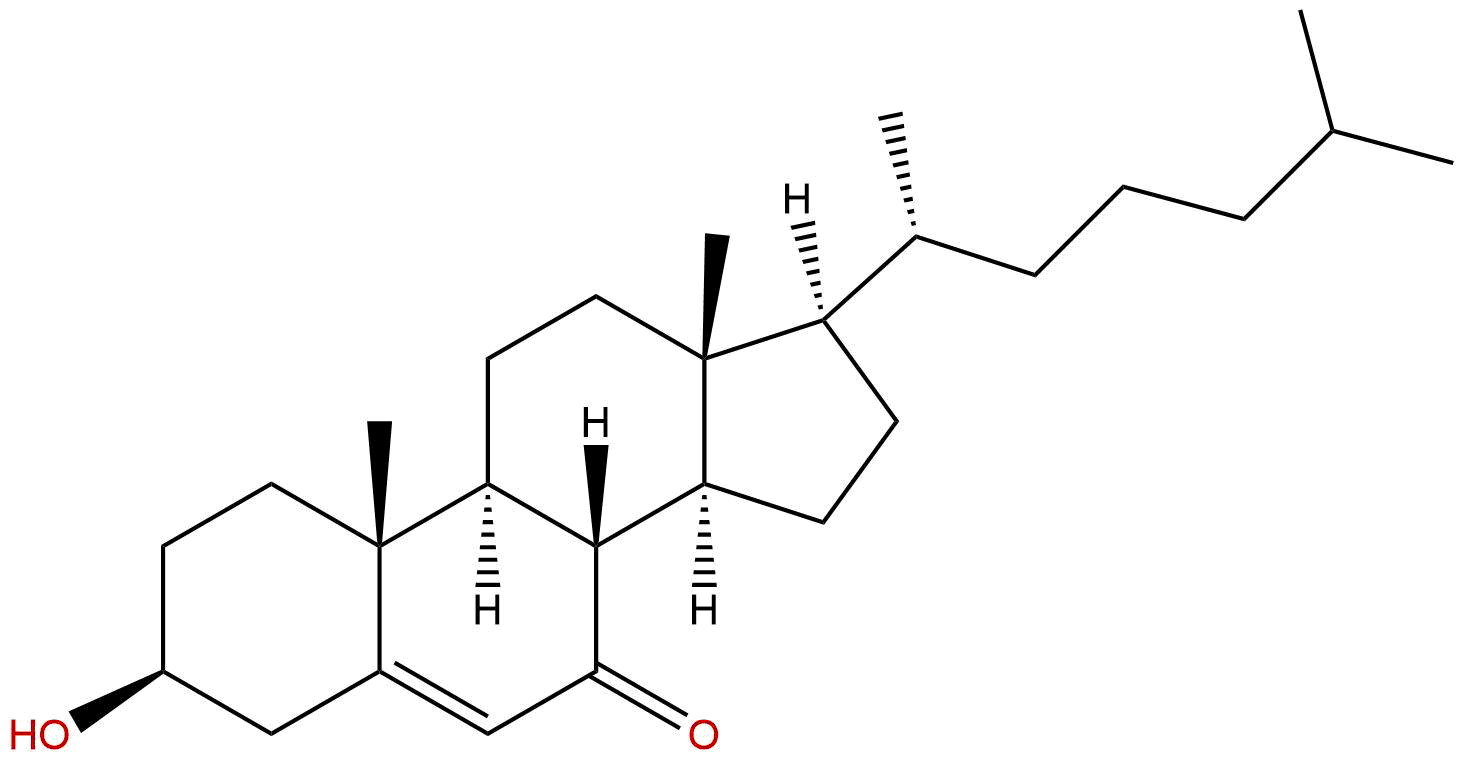


Product name: 7-Ketocholesterol
Synonym name: 7-Oxocholesterol
Catalogue No.: BP4652
Cas No.: 566-28-9
Formula: C27H44O2
Mol Weight: 400.647
Botanical Source:
Type of Compound: Steroids
Purity: 95%~99%
Analysis Method: HPLC-DAD or/and HPLC-ELSD
Identification Method: Mass, NMR
Packing: Brown vial or HDPE plastic bottle
Storage: Store in a well closed container, protected from air and light. Put into refrigerate or freeze for long term storage.
Whenever possible, you should prepare and use solutions on the same day. However, if you need to make up stock solutions in advance, we recommend that you store the solution as aliquots in tightly sealed vials at -20℃. Generally, these will be useable for up to two weeks.
The product could be supplied from milligrams to grams
Inquire for bulk scale.
For Reference Standard and R&D, Not for Human Use Directly.
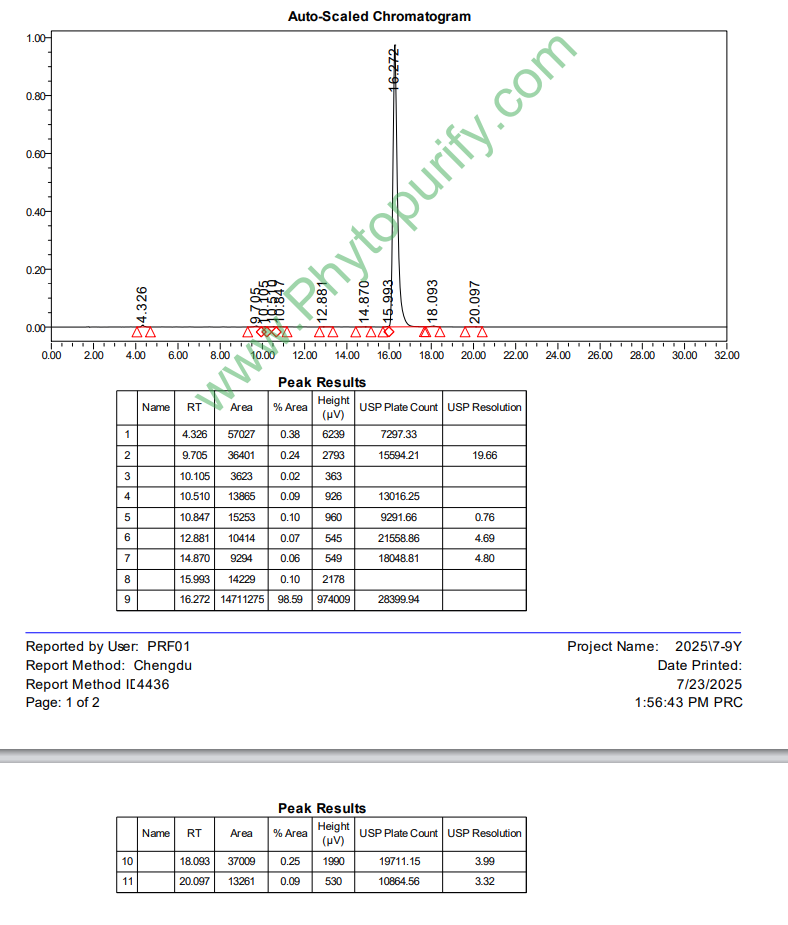
HPLC of 7-Ketocholesterol
Storage conditions:Short-term storage at 2~8℃, long-term storage at -20 ~ -80℃
7-Ketocholesterol (7-KC, CAS number: 566-28-9) is an important member of the class of oxidized cholesterol (oxysterols) as an oxidation product of cholesterol. It plays a complex and key role in the physiological and pathological processes in vivo and in vitro, especially in the pathogenesis of cardiovascular diseases such as atherosclerosis. 7-KC is not only a marker of cholesterol oxidation, but also considered as one of the key pathogenic factors for atherosclerotic plaque formation and development because of its stronger proinflammatory and pro apoptotic effects than cholesterol. In recent years, with the in-depth study of the biological functions of oxidized cholesterol, the pharmacological properties, molecular mechanisms of action, and potential clinical application value of 7-KC have gradually attracted attention.
This article provides a systematic review of the chemical structure and physicochemical properties, plant sources and extraction methods, pharmacological activity, mechanism of action and molecular targets, pharmacological evaluation, and pharmacokinetic characteristics of 7-ketocholesterol. Finally, it explores its prospects and challenges in clinical applications, aiming to provide a theoretical basis and reference for natural product pharmacology and cardiovascular disease research.
7-ketocholesterol is an oxidized cholesterol with the chemical formula C27H44O2 and a molecular weight of 400.6470. Its structural feature is the introduction of a ketone group (C=O) on the 7th carbon atom of cholesterol, which significantly changes its molecular polarity and biological activity. The chemical structure of 7-KC determines its high lipid solubility, with a LogP value of up to 6.6655, indicating extremely strong hydrophobicity. Its polar surface area (TPSA) is 37.3 Å ², and its water solubility is extremely low (0.0005 mg/mL), which makes 7-KC have strong penetration ability in biological membranes and easy to accumulate in lipid environments.
In addition, 7-KC has a high blood-brain barrier penetration ability, which suggests its potential impact in central nervous system diseases. Toxicological evaluation shows that 7-KC does not have hERG channel inhibitory activity, and the Ames mutagenicity test result is negative, indicating that it has low risks in terms of cardiac toxicity and genotoxicity.
7-ketocholesterol mainly exists in animal tissues as the oxidation product of cholesterol, especially in atherosclerotic plaque and oxidized low density lipoprotein (oxLDL). Although 7-KC has a low content in plants, trace amounts of it can also be detected in some plant oils and oxidized plant extracts.
At present, the extraction of 7-KC is mostly achieved by separating and purifying it from animal tissues or oxidized LDL. Common methods include organic solvent extraction (such as chloroform methanol mixed solvent), silica gel column chromatography, and high-performance liquid chromatography (HPLC) purification. Due to its extremely low water solubility, attention should be paid to avoiding excessive oxidation and degradation during the extraction process. In recent years, supercritical CO2 extraction technology and solid-phase extraction technology have shown advantages in the efficient separation of 7-KC, which can improve purity and yield.
The pharmacological activities of 7-ketocholesterol mainly focus on its role in atherosclerosis and related cardiovascular diseases. Numerous in vitro and in vivo studies have shown that 7-KC has significant pro-inflammatory, pro apoptotic, and cytotoxic effects.
Pro-inflammatory effect 7-KC can activate multiple inflammatory signaling pathways, induce macrophages and endothelial cells to secrete inflammatory factors such as tumor necrosis factor alpha (TNF - α), interleukin-6 (IL-6), and monocyte chemoattractant protein-1 (MCP-1). By activating nuclear factor kappa B (NF - κ B) and NLRP3 inflammasome, it promotes inflammatory cascade reaction and promotes the formation and instability of atherosclerotic plaque.
Promoting apoptosis effect 7-KC can induce programmed cell death in various cell types, including endothelial cells, smooth muscle cells, and macrophages. The mechanism involves mitochondrial dysfunction, increased generation of reactive oxygen species (ROS), and endoplasmic reticulum stress response, ultimately activating the caspase family and triggering the apoptotic pathway.
Inhibition of cholesterol metabolism enzyme activity 7-KC can inhibit key rate limiting enzymes in cholesterol metabolism, such as cholesterol 7 α - hydroxylase (CYP7A1) and HMG CoA reductase, affecting bile acid synthesis and endogenous cholesterol synthesis, thereby regulating cholesterol homeostasis.
Oxidative stress and cellular dysfunction The oxidative stress damage induced by 7-KC is the core of its toxic effects, leading to membrane lipid peroxidation, protein dysfunction, and DNA damage, further exacerbating vascular disease.
7-ketocholesterol mediates its biological effects through multiple signaling pathways and targets, involving cellular metabolism regulation, inflammatory response, and cell survival regulation.
AMPK(PRKAA1)As a key regulator of cellular energy metabolism, AMPK is involved in regulating the metabolic stress response induced by 7-KC. 7-KC can affect AMPK activity, thereby regulating cellular autophagy and metabolic homeostasis.
EHMT2(G9a)EHMT2 is a histone methyltransferase involved in epigenetic regulation. 7-KC may affect the transcription of inflammation and apoptosis related genes by regulating gene expression mediated by EHMT2.
MCL1 and BCL2 These two anti apoptotic proteins are important regulatory factors for cell survival. During the process of cell apoptosis induced by 7-KC, the expression of MCL1 and BCL2 is downregulated, promoting the activation of apoptotic signals.
RECQ1 As a DNA helicase, RECQ1 participates in DNA repair. The oxidative stress induced by 7-KC may damage DNA, and the dysfunction of RECQ1 exacerbates cellular damage.
LOX-1 (oxidized low-density lipoprotein receptor 1)LOX-1 is a receptor that recognizes oxidized LDL, and 7-KC, as an important component of oxLDL, promotes endothelial dysfunction and inflammatory response through the LOX-1 mediated signaling pathway.
ABCA1 As a key transport protein for cholesterol efflux, ABCA1 regulates intracellular cholesterol levels. The regulation of ABCA1 by 7-KC affects cholesterol metabolism and plaque stability.
IDO1 (Indoleamine 2,3-dioxygenase 1)IDO1 is involved in immune regulation, and 7-KC may regulate the local immune environment and promote inflammatory response by affecting IDO1 activity.
The interaction of these targets constitutes a complex interaction network of 7-KC, revealing its multidimensional regulation mechanism in atherosclerosis and related diseases.
The pharmacological evaluation of 7-ketocholesterol shows that it has certain challenges. The high LogP value (6.6655) and extremely low water solubility limit its oral bioavailability and in vivo distribution uniformity. However, 7-KC has a high ability to penetrate the blood-brain barrier, suggesting that it may affect the central nervous system and potential neurotoxic risks need to be considered.
Toxicological data indicate that 7-KC has no hERG channel inhibitory effect, reducing the risk of cardiac toxicity; A negative Ames test indicates low genotoxicity, which is beneficial for drug safety evaluation. In terms of pharmacokinetics, 7-KC is mainly metabolized through the liver in vivo, and further research is needed on the metabolites and their clearance pathways.
Due to the toxic characteristics of promoting inflammation and apoptosis, 7-KC has limitations in its direct application as a drug. However, its structure and mechanism of action provide important clues for designing derivatives or antagonists.
7-ketocholesterol, as a key pathogenic factor of atherosclerosis, its detection and regulation have potential value in clinical diagnosis and treatment. 7-KC can be used as a biomarker of atherosclerosis and related cardiovascular diseases to help assess disease risk and progress.
Future research can focus on the following directions:
Drug development targeting 7-KC: To design molecules that can specifically clear or neutralize 7-KC, or to develop small molecule drugs that block its interaction with key targets (such as LOX-1, AMPK, etc.) to slow down the process of atherosclerosis.
Antioxidant and anti-inflammatory strategies Combining the pro-inflammatory and pro apoptotic properties of 7-KC, develop a combination of antioxidant and anti-inflammatory drugs to improve treatment efficacy.
Metabolic regulation research Thoroughly analyze the regulatory mechanism of 7-KC on cholesterol metabolism enzymes and explore new strategies for regulating cholesterol homeostasis.
Neurological effects Given the blood-brain barrier penetrability of 7-KC, investigate its role and potential risks in neurodegenerative diseases.
Biological analysis and detection technology Establish a highly sensitive 7-KC detection method to promote its application in clinical and basic research.
In summary, 7-ketocholesterol, as an important oxidized cholesterol in natural products, provides new perspectives and targets for the prevention and treatment of cardiovascular diseases due to its multidimensional biological functions and complex mechanisms of action.
7-ketocholesterol, as a cholesterol oxidation product, plays a key role in the pathological process of atherosclerosis. Its unique chemical structure endows it with strong pro-inflammatory and pro apoptotic activity, affecting cholesterol metabolism and cellular function. Although there are some limitations on its pharmaceutical properties, the in-depth study of 7-KC not only helps to reveal the pathogenesis of atherosclerosis, but also provides an important basis for the diagnosis and treatment of related diseases. In the future, by combining precise regulation of molecular targets and novel drug design, it is expected to achieve effective intervention in 7-KC related pathological processes, promoting the development of natural product pharmacology and cardiovascular disease treatment.
