


Product name: Dictamnine
Synonym name: 4-Methoxyfuro[2,3-b]quinoline
Catalogue No.: BP0487
Cas No.: 484-29-7
Formula: C12H9NO2
Mol Weight: 199.209
Botanical Source: Densefruit Pittany Root-bark
Physical Description:
Type of Compound: Alkaloids
Purity: 95%~99%
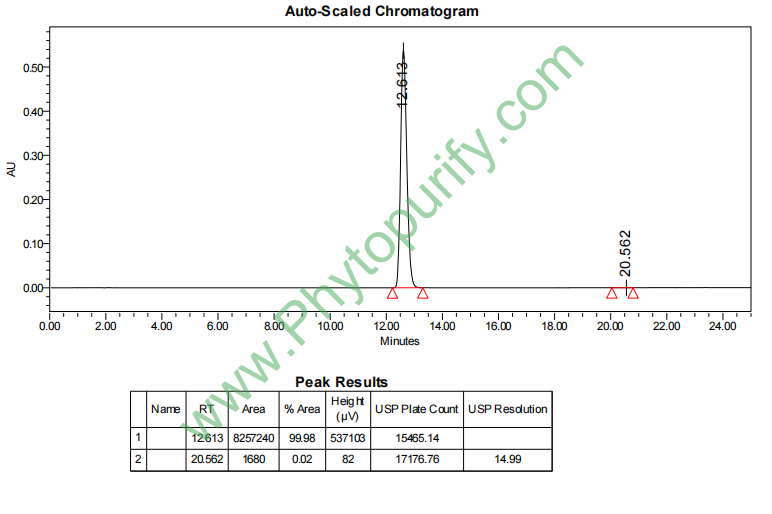
Analysis Method: HPLC-DAD or/and HPLC-ELSD
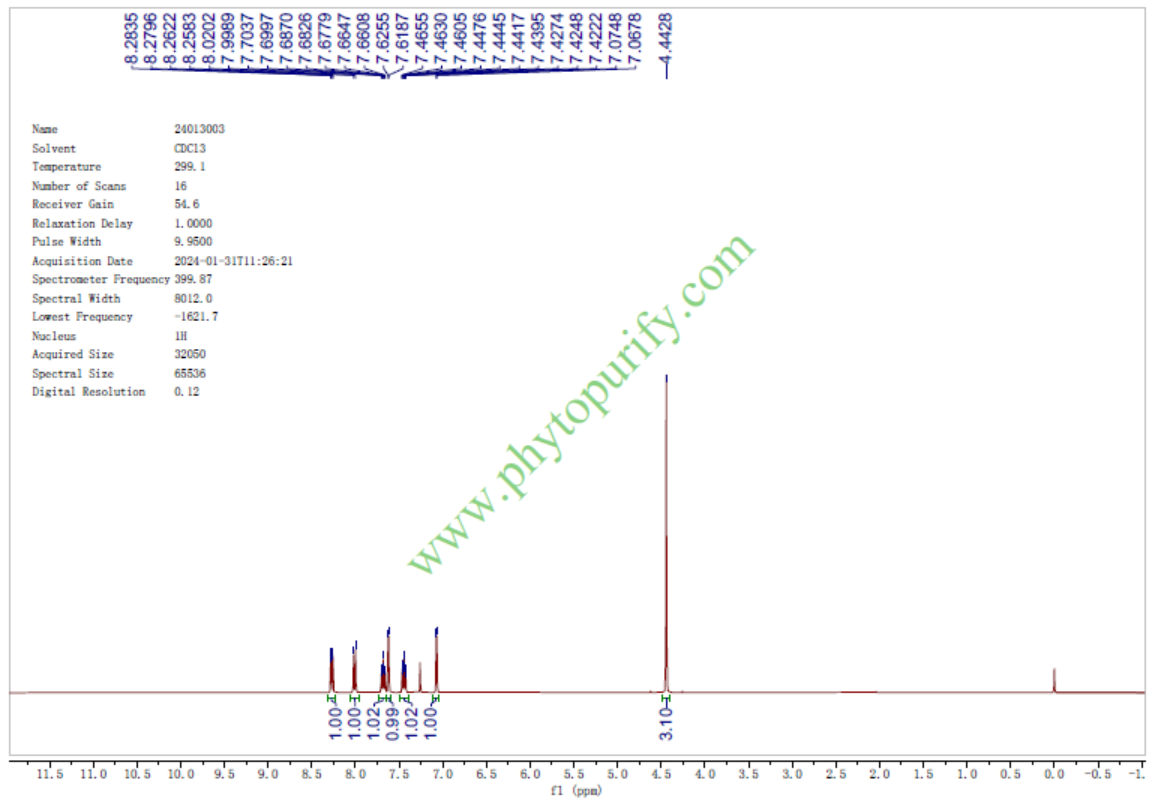
Identification Method: Mass, NMR
Packing: Brown vial or HDPE plastic bottle
Storage: Store in a well closed container, protected from air and light. Put into refrigerate or freeze for long term storage.
Whenever possible, you should prepare and use solutions on the same day. However, if you need to make up stock solutions in advance, we recommend that you store the solution as aliquots in tightly sealed vials at -20℃. Generally, these will be useable for up to two weeks.
The product could be supplied from milligrams to grams
Inquire for bulk scale.
Description:
Dictamnine shows anticholinesterase, anti-inflammatory, mutagenic, and has antimicrobial activity against bacteria and fungi. It has the ability to exert cytotoxicity in human cervix, colon, and oral carcinoma cells, it at higher concentrations(≥100uM) has potential hepatotoxicity because of the cell membrane damage and mitochondrial membrane damage.
References:
Rev. Bras. Farmacogn., 2012, 22(2):374-80.
Anticholinesterase activity evaluation of alkaloids and coumarin from stems of Conchocarpus fontanesianus
METHODS AND RESULTS:
Conchocarpus fontanesianus (A. St.-Hill.) Kallunki & Pirani, Rutaceae, popularly known as pitaguará, is a native and endemic tree from São Paulo and Rio de Janeiro States, Brazil. Based in the information that anticholinesterasic derivatives could act as new prototypes to treatment of Alzheimer disease, this work describes the fractionation guided by evaluation of the anticholinesterase activity of the ethanolic stems extract from C. fontanesianus.
CONCLUSIONS:
This procedure afforded the alkaloids Dictamnine (1), γ-fagarine (2), skimianine (3), and 2-phenyl-1-methyl-4-quinolone (4), as well as the coumarin marmesin (5).
Yeast. 2008 Sep;25(9):631-41.
Global gene expression profile of Saccharomyces cerevisiae induced by dictamnine.
Dictamnine, a natural plant product, has been reported to have antimicrobial activity against bacteria and fungi; however, the Dictamnine response mechanisms of microorganisms are still poorly understood.
METHODS AND RESULTS:
We have shown that Dictamnine has antimicrobial activities against the model fungus Saccharomyces cerevisiae, with a minimum inhibitory concentration (MIC) value of 64 microg/ml. Commercial oligonucleotide microarrays were used to determine the global transcriptional response of S. cerevisiae triggered by treatment with Dictamnine. We interpreted our microarray data using the hierarchical clustering tool, T-profiler. Several major transcriptional responses were induced by Dictamnine. The first was the induced environmental stress response, mainly under the control of the Msn2p and Msn4p transcription factors, and the repressed environmental stress response in genes containing the PAC (RNA polymerase A and C box) and rRPE (ribosomal RNA processing element) motifs. The second was the Upc2p-mediated response involved in lipid biosynthesis. The third comprised the PDR3- and RPN4-mediated responses involved in multidrug resistance (MDR). Finally, the TBP-mediated response was induced with Dictamnine treatment.
CONCLUSIONS:
TBP is an essential general transcription factor involved in directing the transcription of genes. Quantitative real-time RT-PCR was performed on selected genes to verify the microarray results. Furthermore, morphological transitions during Dictamnine exposure to S. cerevisiae L1190 (MATa/alpha) were examined, using confocal laser microscopy.
Chinese Agricultural Science Bulletin, 2009, 25(16): 21-4.
Study on in Vitro Antifungal Activity of Dictamnine against Candida albicans.
Candida albicans (C. albicans) and other fungi important human and veterinary pathogens.
METHODS AND RESULTS:
The minimal inhibitory concentration (MIC) of Dictamnine alone and in combination with fluconazole (FLC) against clinical 22 clinical Candida albicans were tested, and checkerboard assay was used to analyze the ractional inhibitory concentration index (FICI) of the combination of Dictamnine and FLC.
CONCLUSIONS:
The result showed that Dictamnine had good antifungal activity alone and in combination with FLC against Candida albicans.
Chinese Journal of Experimental Traditional Medical Formulae, 2012, 18(14):128-31.
Isolation and Anti-inflammatory Effect of Dictamnine Extracted from Dictamni Cortex.
To detect the anti-inflammatory effects of ethanol extracts and Dictamnine extracted and isolated from Dictamni Cortex.
METHODS AND RESULTS:
High performance centrifugal partition chromatography method was used for separation of the essential Dictamnine,and anti-inflammatory effects of ethanol extracts and Dictamnine were investigated by xylene-induced aruical swelling in mice and the abdominal capillary permeability in mice.Separation was performed with a two-phase solvent system composed of hexane ethylacetate-ethanol-water(1∶1∶1∶1).The purity of Dictamnine obtained was 98% determined by high performance liquid chromatograph.The results showed that each dosage of ethanol extracts could significantly(P0.05) suppress the mouse auricle which caused by the xylene swelling(being 44.26%,52.46%,44.26%,respectively),as compared with the control group.The medium-dosage group of Dictamnine could obviously(P0.01) suppress the mouse auricle but the dosage was not increased significantly in abdominal capillary permeability in mice compared with control group.
CONCLUSIONS:
HPCPC is a recommendable method to prepare and purify the dictamnie with good separation and the method is simple,accurate and easy to operate.The results showed that ethanol extracts and Dictamnine showed different anti-inflammatory effect in variety of animal models of anti-inflammatory.
HPLC of Dictamnine
HNMR of Dictamnine
Storage conditions:Short-term storage at 2~8℃, long-term storage at -20 ~ -80℃
35.2600
2.4892
2.4892
.0286
4.6973
38.3521
High
87.7189
2.2725
Yes
No
Yes
No
Yes
Yes
1.8
Yes
No
Yes
No
In the vast field of natural product chemistry and pharmacology research, alkaloid compounds have always occupied a core position due to their structural diversity and significant biological activity. Among them, furan quinoline alkaloids, as an important secondary metabolite, are widely distributed in plants such as the Rutaceae and Bitterwood families, demonstrating pharmacological potential in anti-inflammatory, anti-tumor, antibacterial, and antiparasitic aspects. Dictamine, as a typical furan [2,3-b] quinoline alkaloid, has attracted much attention since its discovery due to its unique chemical structure and extensive biological activity. Its CAS number is 484-29-7 and molecular formula is C12H9NO2. It is one of the main active ingredients in various traditional medicinal plants, such as Dictamnus dasycarpus and Tetradium ruticarpum. Traditionally, these plants have been used to treat skin diseases, inflammatory diseases, and infections, and their efficacy is closely related to the activity of berberine revealed by modern pharmacology.
In recent years, with the increase of incidence rate of fungal infections, especially invasive fungal infections, and the emergence of drug-resistant strains around the world, the development of new, efficient and low toxic antifungal drugs has become an urgent clinical need. The significant activity exhibited by Baixian alkaloid and its derivatives in the field of antifungal activity makes it a highly promising candidate molecule. Research has shown that berberine exhibits good inhibitory effects on various clinically relevant pathogenic fungi, such as Candida albicans and Aspergillus fumigatus. Its mechanism of action involves interfering with fungal cell membrane ergosterol synthesis, inhibiting drug efflux pumps, and disrupting cell wall integrity, among other key targets such as ERG11/CYP51, CDR1, FKS1, etc. This provides a new approach to overcome the problem of resistance to existing antifungal drugs.
This article aims to provide a systematic review of the chemical structure, plant sources, extraction methods, pharmacological activity (with a focus on antifungal effects), mechanism of action and molecular targets, pharmacological evaluation, and clinical application prospects of berberine, in order to provide comprehensive scientific references for the in-depth research and development of this natural product.
The chemical name of Baixian alkaloid is 4-methoxyfuran [2,3-b] quinoline, which is a tricyclic aromatic system composed of a fused quinoline ring and a furan ring. Its basic skeleton is furan [2,3-b] quinoline, with a methoxy group (- OCH3) attached to the 4th position of the quinoline ring. This rigid planar aromatic structure is the structural basis for its interaction with biomolecules such as DNA and enzyme active centers, resulting in various biological activities.
From the analysis of physical and chemical properties, the molecular weight of Baixian alkaloid is 199.2090 g/mol. The calculated lipid water partition coefficient (LogP) is approximately 2.49, indicating that the compound has moderate lipophilicity, which facilitates its penetration of cell membranes but may also affect its water solubility. According to the predicted data, its water solubility is relatively low (about 0.0286 mg/mL), which to some extent limits its formulation development. The topologically polar surface area (TPSA) is 35.26 Å ², which is relatively small, further confirming its good membrane permeability. Pharmacokinetic predictions indicate that berberine has a high potential to penetrate the blood-brain barrier, suggesting its potential therapeutic value for fungal infections in the central nervous system. In terms of preliminary safety evaluation, predicted data showed no significant inhibitory effect on hERG potassium channels, reducing the risk of inducing cardiac toxicity (such as long QT syndrome). However, its Ames test value is 1.8, indicating a potential mutagenic risk, which is a key concern in subsequent structural optimization and safety evaluation.
Bai Xian alkali mainly comes from various plants in the Rutaceae family. Among them, the most famous source is the original plant of the traditional Chinese medicine Bai Xian Pi - Bai Xian (Dictamnus dasycarpus Turcz.), whose root bark is rich in Bai Xian alkali and other furan quinoline alkaloids. In addition, this compound can often be isolated from the fruits of plants in the Rutaceae family, such as Tetradium ruticarpum (A. Juss.) T.G. Hartley, and plants in the Zanthoxylum spp. genus. These plants have a long history of application in traditional medical systems in Asia, especially in China, South Korea, and Japan.
The extraction and separation of berberine from plant materials usually follow the conventional process of natural product chemistry. Firstly, organic solvents such as methanol, ethanol, chloroform, or mixed solvents are used to extract or reflux the dried and crushed plant tissues (roots, fruits, etc.). After filtration and concentration, the crude extract is preliminarily enriched using an acid-base treatment method: under acidic conditions (such as dilute hydrochloric acid), alkaloids form salts and dissolve in the aqueous phase; After alkalization (such as ammonia water), free alkaloids precipitate and can be extracted by organic solvents (such as chloroform, ethyl acetate). Further purification relies on various chromatographic techniques. Silica gel column chromatography is the most commonly used method, which uses gradient elution of petroleum ether ethyl acetate or chloroform methanol in different ratios. High performance liquid chromatography (HPLC), especially preparative HPLC, is a key step in obtaining high-purity berberine monomers. Modern technologies such as high-speed countercurrent chromatography (HSCCC) have also been applied for the separation and purification of such alkaloids due to their high efficiency and no loss of solid adsorbents. Structural identification is accomplished through methods such as nuclear magnetic resonance (NMR, including 1H NMR and 13C NMR), mass spectrometry (MS), infrared spectroscopy (IR), and comparison with standard samples.
Baixian alkaloid exhibits a wide range of pharmacological activities, mainly including antifungal, anti-inflammatory, anti-tumor, antibacterial (bacterial), and cardiovascular protective effects. Given the urgency of current antifungal drug development, their antifungal activity has become a research hotspot in recent years.
1. Antifungal activity:
Numerous in vitro studies have shown that berberine has significant inhibitory activity against various pathogenic fungi. It exhibits strong inhibitory effects on standard strains and some clinical isolates of Candida albicans, with minimum inhibitory concentration (MIC) values typically in the micromolar range. In addition, it has shown varying degrees of inhibitory effects on non Candida albicans (such as Candida albicans, Candida krusei), Cryptococcus neoformans, as well as filamentous fungi such as Aspergillus fumigatus and dermatophytes (such as Trichophyton). It is worth noting that research suggests that berberine still maintains activity against certain azole resistant Candida strains, such as fluconazole, providing hope for overcoming clinical resistance issues.
2. Anti inflammatory activity:
Baixian alkaloid is one of the important substance bases for the anti-inflammatory effect of traditional Chinese medicine Baixian skin. Research has shown that it can inhibit the production of nitric oxide (NO), prostaglandin E2 (PGE2), and pro-inflammatory cytokines (such as TNF - α, IL-1 β, IL-6) by macrophages (such as RAW 264.7 cells) induced by stimuli such as lipopolysaccharide (LPS). Its mechanism of action is related to the inhibition of the activation of nuclear factor kappa B (NF - κ B) and mitogen activated protein kinases (MAPKs) signaling pathways.
3. Antitumor activity:
Dichloramine showed cytotoxicity to a variety of human cancer cell lines, including liver cancer, breast cancer, lung cancer, colon cancer and leukemia cells. Its anti-tumor mechanism is complex, involving inducing cell cycle arrest (such as G2/M phase), triggering mitochondrial pathway induced apoptosis, increasing intracellular reactive oxygen species (ROS) levels, inhibiting topoisomerase, and anti angiogenesis.
4. Other activities:
Baixian alkaloid also has biological activities such as antibacterial (such as Staphylococcus aureus), antiparasitic (such as Plasmodium), antiviral, and vasodilatory effects, demonstrating its multi-target properties.
The antifungal mechanism of Baixian alkaloid is multi-target and multi pathway, which may be its advantage in not easily developing drug resistance. The study has preliminarily revealed multiple key processes in which it acts on fungal cells:
1. Interference with cell membrane structure and function:
This is one of the core mechanisms of action of Baixian alkaloid. Its main target is considered to be The ERG11 gene encodes lanosterol 14 α - demethylase (CYP51A1)This enzyme is a key enzyme in the fungal ergosterol biosynthesis pathway, catalyzing the conversion of lanosterol to ergosterol precursors. Ergosterol is an important component of fungal cell membranes, similar to cholesterol in mammalian cells, and is crucial for maintaining membrane fluidity, integrity, and multiple enzyme functions. Baixian alkaloid may inhibit its catalytic function by binding to the active center of the enzyme, leading to the accumulation of toxic sterols and the depletion of ergosterol, thereby disrupting cell membrane integrity, increasing membrane permeability, and ultimately causing leakage of cell contents and cell death. This is similar to the target of commonly used azole antifungal drugs (such as fluconazole) in clinical practice, but due to its unique chemical structure, it may have a different binding mode with CYP51, which may be effective against azole resistant strains.
2. Inhibit drug efflux pump:
One of the important mechanisms of fungal resistance is overexpression of drug efflux pump proteins, such as CDR1, CDR2 (belonging to the ABC transporter family) and MDR1 (belonging to the major transporter superfamily)These pump proteins can actively expel drugs that enter the cell, reducing the concentration of drugs inside the cell. Research has shown that berberine not only directly inhibits fungal growth, but also suppresses the function of these efflux pumps or downregulates their expression, thereby reversing fungal resistance to existing antifungal drugs and exerting synergistic antibacterial effects.
3. Disruption of cell wall synthesis:
The fungal cell wall is another important target. Baixian alkaloid may affect the synthesis of cell wall polysaccharides. There are studies suggesting that it may be related toβ -1,3-glucan synthase encoded by FKS1 gene The subunit interactions interfere with the synthesis of β -1,3-glucan. In addition, it may also affect chitin synthase (such as...)CHS3)The activity. Obstruction of cell wall synthesis can lead to fragility, deformation, and ultimately lysis of the cell wall.
4. Inhibit hyphal formation and virulence:
For biphasic fungi such as Candida albicans, the transition from yeast phase to hyphal phase is an important virulence factor. Baixian alkaloid has been proven to inhibit the formation of hyphae, which may interfere with it ALS3 (lectin like sequence 3) Related to adhesion factors or related signaling pathways. Inhibiting hyphal formation can weaken the invasion of fungi into host tissues and their ability to form biofilms.
5. Inducing oxidative stress:
Baixian alkaloid may interfere with the redox balance of fungal cells, leading to excessive accumulation of reactive oxygen species (ROS) and causing oxidative damage, thereby promoting cell death.
In summary, Baixian alkaloid synergistically acts on multiple targets such as ERG11/CYP51, CDR1, FKS1, MDR1, CHS3, ALS3, etc., disrupting the survival basis of fungi from multiple levels and forming an efficient and potentially low risk antifungal network.
Despite its significant in vitro activity, the pharmacological properties of Baixian still need to be comprehensively evaluated.
Pharmacokinetic (PK):
At present, research on the pharmacokinetics of berberine in vivo is relatively limited. Based on its physicochemical properties (moderate LogP, small TPSA), it is predicted that its oral absorption may be acceptable, but its absolute bioavailability is limited by first pass effects and solubility. Its higher predictive value for blood-brain barrier permeability is a positive feature. Metabolism in the body may mainly occur through oxidation and demethylation reactions by the liver cytochrome P450 enzyme system (such as CYP3A4), generating hydroxylated or demethylated metabolites. Its excretion pathway may involve bile and urine. The detailed parameters of in vivo distribution, metabolism, and excretion (ADME) need to be further clarified through animal experiments (rats, mice, etc.).
Challenges and optimization directions for drug development:
1. Water solubility and bioavailability: Low water solubility is one of its main drawbacks, which can affect the dissolution and absorption of oral preparations. Improvements can be made through pharmaceutical methods such as salt formation techniques (such as forming hydrochloride salts), preparation of nanocrystals, solid dispersions, liposomes, or cyclodextrin inclusion complexes.
2. Potential toxicity: The potential positive signal of Ames test (1.8) is a major safety concern. More comprehensive genetic toxicity testing (such as micronucleus test, chromosome aberration test) and long-term toxicology studies must be conducted. Its antifungal target CYP51 is homologous to CYP51 in mammalian cholesterol synthesis, and its potential selective toxicity to host cells needs to be evaluated.
3. Structural optimization: Structural modification based on the core skeleton of berberine is a key strategy to enhance its medicinal properties. For example, introducing hydrophilic groups to improve solubility; Modify methoxy, furan or quinoline rings to enhance antifungal activity, reduce toxicity or improve pharmacokinetic properties; Develop prodrugs to improve absorption.
4. Selectivity: Further validation is needed to confirm its selectivity towards fungal targets and homologous human targets, ensuring a sufficiently wide therapeutic window.
As a natural lead compound with multi-target antifungal mechanism, the clinical application prospects of Baixian alkaloid are mainly reflected in the following aspects:
1. Development of new antifungal drugs:
In the face of increasingly severe drug-resistant fungal infections, berberine can be directly used as a lead compound to develop new structures, mechanisms of action, or antifungal drugs that can overcome existing drug resistance through rational drug chemistry optimization. Especially for invasive candidiasis and aspergillosis.
2. Antifungal sensitizer:
Given its inhibitory effect on efflux pumps (CDR1, MDR1), berberine or its optimized derivatives can be used in combination with existing antifungal drugs such as azoles and echinocandins as sensitizers or resistance reversal agents to restore the sensitivity of drug-resistant strains to existing drugs and prolong their clinical lifespan.
3. Local topical preparations:
For superficial fungal infections (such as dermatophytosis, candidal dermatitis), the development of topical preparations such as cream, gel or spray containing dictamnine can avoid the risk of systemic toxicity and directly exert the efficacy. This is consistent with the records of traditional medicinal parts (skin) used to treat skin diseases.
4. The manifestation of multi-target therapy strategy:
Its multi-target mechanism of action conforms to the modern design concept of multi-target drugs for complex diseases such as chronic and drug-resistant infections, and may be less likely to develop resistance than single target drugs.
Future research should focus on:
- In depth mechanism research: By utilizing techniques such as molecular docking, surface plasmon resonance (SPR), and X-ray crystallography, the precise binding mode between Baixian alkaloid and key targets such as ERG11/CYP51 was identified.
- Systematic drug evaluation: Complete standardized preclinical pharmacodynamic (in vivo infection model), pharmacokinetic, and toxicological studies.
- Structure Activity Relationship (SAR) Study: Systematically synthesize a series of derivatives, clarify their antifungal activity and toxicity pharmacophores, and guide the design of efficient and low toxicity candidate drugs.
- Explore combination therapy regimens: Systematic evaluation of the synergistic effect of berberine with existing antifungal drugs in vitro and in vivo models.
As a type of furan quinoline alkaloid discovered from traditional medicinal plants, Baixian alkaloid has become a highlight in the field of natural product drug development due to its unique chemical structure and multi-target antifungal pharmacological activity. It exhibits great potential in combating drug-resistant fungal infections by acting on multiple key targets such as ERG11/CYP51, drug efflux pumps, and cell wall synthases. Despite facing challenges such as water solubility and potential genetic toxicity in drug development, these obstacles are expected to be overcome through the intervention of modern medicinal chemistry, formulation, and pharmacology methods. The research process of Baixian alkaloid, from traditional wisdom to modern scientific verification, reflects the sustained value of natural products in innovative drug discovery. In the future, with a deeper analysis of its mechanism of action and rational optimization based on its structure, Baixian alkaloid is expected to derive a new generation of antifungal drugs or therapeutic adjuvants, providing new solutions to address the global fungal resistance crisis.
