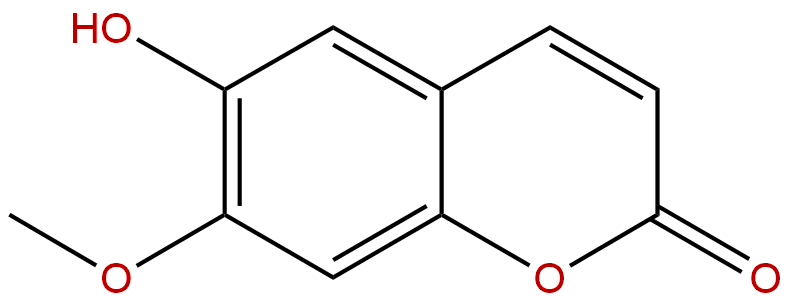


Product name: Isoscopoletin
Synonym name:
Catalogue No.: BP3215
Cas No.: 776-86-3
Formula: C10H8O4
Mol Weight: 192.17
Botanical Source:
Physical Description: Powder
Type of Compound: Coumarins
Purity: 95%~99%
Analysis Method: HPLC-DAD or/and HPLC-ELSD
Identification Method: Mass, NMR
Packing: Brown vial or HDPE plastic bottle
The product could be supplied from milligrams to grams. Inquire for bulk scale.
We provide solution to improve the water-solubility of compounds, thereby facilitating the variety of activity tests and clinic uses.
For Reference Standard and R&D, Not for Human Use Directly.
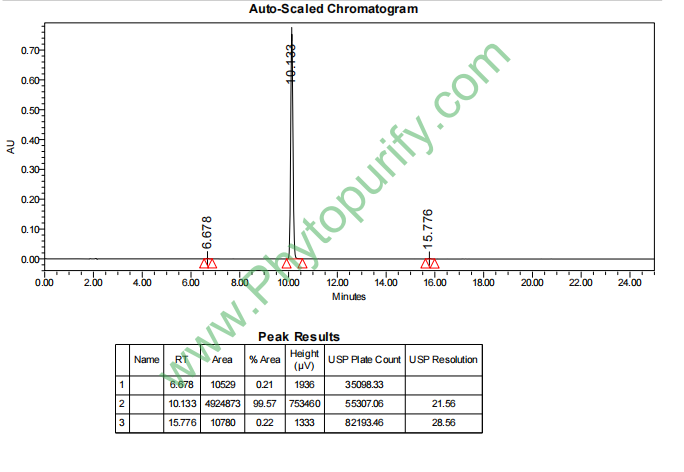
HPLC of Isoscopoletin
Storage conditions:Short-term storage at 2~8℃, long-term storage at -20 ~ -80℃
59.6700
1.5346
1.5257
.5016
5.5524
20.1037
High
78.4853
2.0498
Yes
No
Yes
No
Yes
Yes
0.9
Yes
No
Yes
Yes
Isoscopolatin, also known as 6-hydroxy-7-methoxycoumarin, is a natural coumarin compound with significant biological activity. Its CAS number is 776-86-3, molecular formula is C10H8O4, and molecular weight is 192.17 g/mol. This compound is widely present in various medicinal plants, especially in the Asteraceae plant Laggera alata as the main source. Coumarin compounds are an important member of plant secondary metabolites and have attracted much attention in the field of natural product pharmacy research due to their diverse biological activities.
The research background of isoproterenol is profound. It is not only an important metabolite of plants themselves, but also the main primary metabolite of its precursor compound, scoparone, in vivo. In recent years, with the deepening of natural product separation and identification technology and molecular pharmacology research, the various pharmacological activities of isoproterenol have gradually been revealed. Existing studies have shown that this compound exhibits significant proliferative inhibitory activity against various tumor cell lines, particularly human CCRF-CEM leukemia cells and their multidrug-resistant subtype CEM/ADR5000, in vitro, with IC50 values of 4.0 μ M and 1.6 μ M, respectively. In addition, it has shown potential applications in anti hepatitis B virus (HBV) replication, antioxidant, and potential pain relief. These findings have transformed it from a traditional phytochemical composition into a candidate drug molecule with clear targets and mechanisms of action, providing important chemical entities and theoretical basis for subsequent drug development.
The chemical structure of isoproterenol belongs to hydroxycoumarin derivatives. Its core structure is benzo [a] - pyranone (coumarin nucleus), which is connected to a hydroxyl group (- OH) at position 6 and a methoxy group (- OCH3) at position 7 of the benzene ring. This specific substitution pattern of hydroxyl and methoxy groups is the key structural basis for its biological activity. Its SMILES representation (COc1cc2oc (=O) ccc2cc1O) accurately describes its atomic connection sequence and functional group positions.
From the analysis of physical and chemical properties, its molecular weight (MW) is 192.17 g/mol, which is consistent with the typical range of small molecule drugs (usually<500 Da). The topologically polar surface area (TPSA) is 59.67 Å ², which is moderate and reflects the presence of polar groups such as hydroxyl and carbonyl in the molecule. This has a significant impact on its water solubility and hydrogen bonding interactions with biological targets. Its lipid water partition coefficient (LogP) is 1.53, and its LogD (partition coefficient at a specific pH) is 1.53, indicating that the compound has moderate lipophilicity, which is beneficial for its penetration of cell membranes, but will not cause metabolic or distribution problems due to high lipid solubility.
Preliminary evaluation based on the famous "Lipinski Rule of Five": ① Molecular weight<500 (compliant); ② Calculate LogP<5 (compliant, measured at 1.53); ③ The number of hydrogen bond donors (HBD) is 1 (hydroxyl group, consistent with<5); ④ The number of hydrogen bond acceptors (HBA) is 4 (two carbonyl oxygen, one hydroxyl oxygen, and one methoxy oxygen, consistent with<10). Therefore, isoproterenol fully complies with Lipinski's rules, indicating its good oral absorption potential. Its water solubility is 0.50 mg/mL, which is slightly soluble, but with the assistance of pharmaceutical formulation technology, its solubility barrier can be overcome.
The main plant source of isoproterenol is the Asteraceae plant Laggera alata The genus Lampyrida has a long history of application in traditional medicine systems in Asia and Africa. In China, especially among the folk in Yunnan and other places, Erigeron breviscapus is often used to treat inflammation, fever, pain and infectious diseases. The whole plant or above ground parts are often taken orally in decoction or crushed and applied externally, reflecting the traditional effects of "clearing heat and detoxifying, promoting blood circulation and relieving pain".
The empirical wisdom of traditional applications provides valuable clues for modern scientific research. Scutellaria baicalensis is rich in various coumarins, flavonoids, and volatile oil components, among which scopoletin, as one of the active ingredients, is likely to play an important role in traditional therapeutic effects. For example, its anti-inflammatory and analgesic effects are closely related to its effects on targets such as TRPV1 and opioid receptors, as revealed by modern research; Its "clearing heat and detoxifying" effect may also be related to its antiviral (such as HBV) and antioxidant activity. This research model of isolating and identifying active ingredients from traditional medicinal plants, and elucidating their scientific connotations, is a classic paradigm in natural medicine chemistry and pharmacology research. The in-depth study of traditional medicinal plants such as Lamplighter not only validates the scientific value of their traditional practices, but also provides a treasure trove of resources for discovering lead compounds with novel structures and unique functions.
The pharmacological activities of isoproterenol are diverse, and its mechanism of action involves multiple key biological targets, forming a multi-target network.
4.1 Antitumor activity
The existing description clearly indicates that isoproterenol has a potent inhibitory effect on leukemia cell CCRF-CEM and its multidrug-resistant strain CEM/ADR5000, and has stronger activity against drug-resistant cells (IC50: 1.6 μ M vs 4.0 μ M). This feature is highly valuable because multidrug resistance in tumors is the main cause of clinical chemotherapy failure. Its mechanism of action and inhibition MAPK/NF-κB/STAT/AKT The signaling pathway is closely related. These pathways are the core regulatory networks for cell proliferation, survival, invasion, and drug resistance. MAPK pathway regulates cell growth and differentiation; NF - κ B is a key inflammatory and anti apoptotic transcription factor; The STAT pathway is involved in cytokine signaling transduction and tumorigenesis; AKT (PKB) is a downstream key kinase of the PI3K pathway, promoting cell survival. Isoscopoletin can simultaneously inhibit these pathways, thereby synergistically inducing tumor cell cycle arrest and apoptosis, and reversing drug resistance phenotype.
4.2 Analgesic activity and related targets
The database information reveals the association between isoproterenol and "analgesic" diseases, and points to five potential targets:
- TRPV1 (Transient receptor potential vanillic acid subtype 1)A non selective cation channel activated by capsaicin, heat (>43 ° C), and protons, it is a key sensor mediating inflammatory pain and thermal pain. Antagonism against TRPV1 is one of the strategies for developing novel analgesics.
- OPRD1 and OPRM1 (delta and μ opioid receptors)The classic G protein coupled receptor is a target for potent analgesic effects of endogenous opioid peptides and drugs such as morphine. Stimulating these receptors can produce central analgesia.
- DRD2 (dopamine D2 receptor)One of the dopamine receptors, it plays a complex role in pain regulation in the central nervous system and may be involved in pain relief and reward circuits.
- COMT (catechol-O-methyltransferase)Responsible for degrading catecholamine neurotransmitters such as dopamine, norepinephrine, and adrenaline. Inhibiting COMT can increase the levels of these neurotransmitters, which may indirectly affect pain perception and emotions.
Isoscopoletin may exert multimodal analgesic effects by simultaneously regulating these targets: it may inhibit pain transmission by acting on peripheral TRPV1 receptors, or regulate pain signal integration and emotional responses through central opioid receptors and dopamine systems. This multi-target characteristic may lead to better efficacy than single target drugs and reduce the common addiction and tolerance risks of opioid drugs.
4.3 Antiviral and antioxidant activity
Isoscopoletin can inhibit the replication of hepatitis B virus (HBV), and the specific mechanism may involve interfering with the virus's lifecycle, such as viral DNA replication or protein expression. Its antioxidant activity is achieved by inhibiting signaling pathways such as MAPK/NF - κ B. Oxidative stress activates these pathways, leading to inflammation and cellular damage; On the contrary, inhibiting these pathways can reduce the production of reactive oxygen species (ROS) and enhance the antioxidant defense ability of cells, thereby protecting them from oxidative damage.
Based on the provided pharmacological parameters, a systematic evaluation of the potential of isoproterenol as a drug lead compound can be conducted:
Absorption and distribution:
- Caco-2 permeability The value of 20.10 × 10 ⁻⁶ cm/s is relatively high, indicating that it has good passive diffusion ability of intestinal epithelial cells and good oral absorption potential.
- Blood-brain barrier permeability (BBB)Annotated as' high '. This is consistent with a moderate LogP value (~1.53) and a smaller molecular weight, indicating that the compound can effectively penetrate the blood-brain barrier, which is crucial for its central analgesic effect.
- Plasma protein binding rate (PPB)78.49%, belonging to the moderate to high level. Higher protein binding can affect the free concentration and distribution volume of drugs, and dose adjustments may need to be considered in actual medication, but still within an acceptable range.
Metabolism and toxicity:
- AMES test A value of 0.9 is generally considered to indicate a low risk of mutagenicity if it is less than 1.5, which is a positive signal.
- chromosome aberration Marked as' yes', it indicates that there may be a genetic toxicity risk under specific experimental conditions, which is a key focus in subsequent safety evaluations.
- HERG inhibition No "indicates that it has a low risk of inhibiting the cardiac potassium channel hERG, reducing concerns about cardiac toxicity such as QT interval prolongation and apical torsion ventricular tachycardia.
- Effective permeability (Peff)5.55, usually measured in units of × 10 ⁻⁴ cm/s, higher values once again confirm its good membrane permeability.
- Hepatotoxicity markers: Serum ALT、AST、ALK Raise the prompt 'Yes', and GGT For 'no'. This suggests that in animal experiments, isoproterenol may cause liver cell damage (ALT/AST elevation) or bile stasis related changes (ALK elevation),Hepatotoxicity is a key safety issue that requires in-depth evaluation。
- Other toxicities: Having Phototoxicity (Photo_tox) and Respiratory sensitization (Resp_Sens) Risk, which is not uncommon in coumarin compounds, needs to be considered in dosage form design and medication warnings.
Comprehensive Assessment:
Isoscopoletin in Pharmacokinetic properties Outstanding performance in various aspects: small molecular weight, compliance with Lipinski rules, moderate lipid solubility, good prediction of oral absorption and blood-brain barrier penetration ability. This lays the foundation for its use as an oral or central acting drug. However, it Toxicity characteristics It is the main obstacle to development, especially potential hepatotoxicity, genetic toxicity, and phototoxicity. These toxicities may be related to their chemical structure (coumarin nucleus) or specific metabolites. In medicinal chemistry optimization, structural modifications (such as introducing or changing substituents) can be used to attempt to reduce these toxicity risks while retaining core pharmacological activity. For example, improving metabolic pathways to avoid the generation of toxic metabolites.
At present, research on isoproterenol is still ongoing Preclinical stage The main focus is on activity screening, preliminary exploration of the mechanism of action, and preliminary drug efficacy evaluation. Existing research has clearly outlined its role as a Multi targeted and multifunctional The outline of natural active molecules shows potential in anti-tumor (especially for drug-resistant tumors), analgesic, antiviral, and antioxidant aspects.
Future research directions It may focus on the following levels:
1. Deepening the mechanism of action More precise clarification is needed on its binding mode, affinity, and functional regulation details with specific targets such as TRPV1 and opioid receptors, to determine whether it is an agonist or antagonist.
2. Research on Structural Optimization and Structure Activity Relationship (SAR)Using it as the parent nucleus, carry out systematic chemical modifications to synthesize a series of derivatives. Aim to improve its anti-tumor or analgesic efficacy, while focusing on addressing its hepatotoxicity, phototoxicity, and potential genotoxicity issues, and searching for safer candidate compounds.
3. Preclinical comprehensive evaluation Conduct standardized pharmacological (validated in more complex animal models of diseases), pharmacokinetic (absorption, distribution, metabolism, excretion), and toxicological (long-term toxicity, reproductive toxicity, etc.) systematic studies on the selected candidate compounds.
4. Exploration of combination therapy Given its sensitivity to multidrug-resistant cells, investigate its potential for combination with existing chemotherapy drugs to overcome tumor resistance.
5. Development of new formulations To address the issues of general water solubility and phototoxicity, new drug delivery systems such as nano formulations, liposomes, and cyclodextrin inclusion complexes can be explored to improve their stability, targeting, and safety.
Application Prospects In terms of development, the most likely direction for isoproterenol is antineoplastic drugs(especially for the treatment of drug-resistant leukemia or solid tumors) and New multimodal analgesic drugs Its natural product identity and clear multi-target mechanism are in line with the current trend of "multi-target drugs" and "naturally derived" new drug development. However, the journey from lead compounds to successful drugs is a long and challenging one, with the core challenge being Balancing effectiveness and safety Whether it is possible to "promote its strengths and avoid its weaknesses" through chemical means will determine whether isoproterenol can ultimately move from the laboratory to clinical application.
In summary, isoproterenol is a highly valuable natural product lead compound for research. It is like a multi toothed key, with the potential to open the door to the treatment of multiple diseases. Further in-depth and rigorous research will reveal whether this key can ultimately be polished into a precise 'drug key' that is truly applicable to clinical practice.
