


Product name: Trachelogenin
Synonym name:
Catalogue No.: BPF0598
Cas No.: 34209-69-3
Formula: C21H24O7
Mol Weight: 388.416
Botanical Source:
Physical Description: Powder
Type of Compound: Lignans
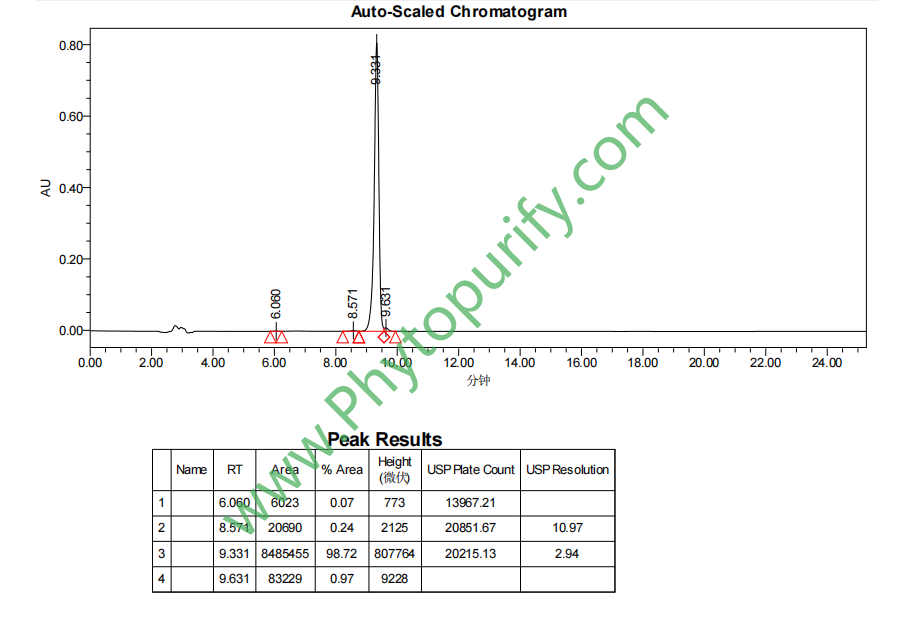
Purity: 95%~99%
Analysis Method: HPLC-DAD or/and HPLC-ELSD
Identification Method: Mass, NMR
Packing: Brown vial or HDPE plastic bottle
The product could be supplied from milligrams to grams. Inquire for bulk scale.
We provide solution to improve the water-solubility of compounds, thereby facilitating the variety of activity tests and clinic uses.
For Reference Standard and R&D, Not for Human Use Directly.
HPLC of Trachelogenin
Storage conditions:Short-term storage at 2~8℃, long-term storage at -20 ~ -80℃
94.4500
2.3925
2.3913
.1125
3.6021
2.8192
High
88.1188
3.2661
No
No
No
No
No
No
0.0
No
No
No
Yes
Natural products, as an important source of drug discovery, play an irreplaceable role in the long history of human struggle against diseases. From the classic analgesic morphine to the antimalarial drug artemisinin, the chemical diversity found in nature provides endless inspiration and lead compounds for modern drug development. In the field of antiviral and anti-inflammatory drug research, the search for highly efficient and low toxicity new active molecules from traditional medicinal plants has always been a focus of attention in both academia and industry. Trachelogenin, as a lignan derived from various plants in the Apocynaceae family, has attracted widespread research interest in recent years due to its unique biological activity, particularly as an inhibitor of hepatitis C virus (HCV) entry and significant anti-inflammatory and analgesic effects.
Luoshiyuan, chemically known as (-) - Luoshiyuan, is a bisbenzylbutyrolactone type lignan. It was originally derived from the traditional Chinese medicine Luo Shi(Trachelospermum jasminoides)It is named after its separation and identification. However, its distribution is not limited to plants of the Araceae genus, and it has also been found in various plants such as Asteraceae and Thymelaeaceae. Early research mainly focused on its traditional pharmacological activities such as anti-inflammatory and analgesic effects. In recent years, with a deeper understanding of the HCV lifecycle and the mechanism of virus entry into host cells, roscurogenin has been identified as a novel HCV entry inhibitor, exhibiting broad-spectrum antiviral activity and being effective against multiple genotypes of HCV with low cytotoxicity. This discovery provides a highly promising candidate molecule for the development of novel anti HCV drugs, especially inhibitors targeting the entry stage of the virus.
Given that HCV infection remains a global public health challenge, despite the great success of direct antiviral drugs (DAAs), issues such as drug resistance, treatment costs, and treatment needs of special populations (such as liver transplant patients) still exist. Therefore, developing anti HCV drugs with novel mechanisms of action, such as virus entry inhibitors, has important clinical significance. Meanwhile, inflammation is the common pathological basis of many diseases, and finding safe and effective anti-inflammatory drugs is also an eternal theme in drug development. Rhodiola rosea has dual antiviral and anti-inflammatory activities, making it uniquely advantageous in the treatment of viral hepatitis and its associated liver inflammation and fibrosis. This article aims to provide a systematic review of the chemical structure, plant origin, pharmacological activity, mechanism of action, medicinal characteristics, and clinical application prospects of the nucleoside complex, in order to provide comprehensive references for the in-depth research and development of this natural product.
Trachelogenin belongs to the typical dibenzylbutyrolactone class of lignans. The core of its chemical structure is a gamma butyrolactone ring, with two benzyl groups attached to the ring. One of the benzyl groups is usually substituted with hydroxyl and methoxy groups on the benzene ring. Specifically, the chemical name of the compound is (3R, 4R) -3,4-di (4-hydroxy-3-methoxybenzyl) dihydrofuran-2 (3H) - one, with a molecular formula of C ₂ ₁ H ₂ ₄ O ₇ and a molecular weight of 388.4160 g/mol. This molecule contains two chiral centers (C-3 and C-4), and the naturally occurring (-) - complex aglycone is in the (3R, 4R) configuration. Its structural formula is as follows (here text description replaces the structural formula): a five membered lactone ring with a carbonyl group at position 2, and a benzyl group (i.e. 4-hydroxy-3-methoxybenzyl, also known as vanillyl) substituted with hydroxyl and methoxy groups at positions 3 and 4, respectively.
From the perspective of physical and chemical properties, quercetin has a certain polarity. Its topological polar surface area (TPSA) is 94.45 Å ², indicating that it contains multiple hydrogen bond donors (phenolic hydroxyl) and acceptors (ether oxygen, carbonyl oxygen), which facilitate the formation of hydrogen bond interactions with biological targets. Its lipid water partition coefficient LogP is 2.39, which is within a relatively moderate range, indicating that the compound has both lipid solubility to penetrate cell membranes and water solubility to transport in body fluids. However, its water solubility (0.1125 mg/mL) is relatively low, which may to some extent affect its oral bioavailability and formulation development. It is worth noting that the computer predicted roscurogenin has a high blood-brain barrier (BBB) penetration ability, which suggests that it may act on central nervous system targets, consistent with its potential analgesic activity. In addition, the predicted results showed that roscurogenin does not possess hERG (human ether-a-go-go related gene) potassium channel inhibitory activity (hERG inhibition: no), and the Ames test result was negative (0.0), indicating a low risk of cardiac and genetic toxicity, which is a positive signal for its potential as a candidate drug. These physicochemical property parameters provide important foundational data for subsequent formulation design, pharmacokinetic studies, and safety evaluations.
Rhodiola rosea is not an exclusive component of a single plant, but is widely present in various medicinal plants, especially in the Apocynaceae family and the Rhodiola genus(Trachelospermum)Plants are the most famous. The traditional Chinese medicine "Luoshi Teng" is also known as Luoshi(Trachelospermum jasminoides (Lindl. Lem.) dried rattan stems with leaves have the effects of dispelling wind, unblocking meridians, cooling blood, and reducing swelling. Rhodiola rosea is considered one of its important active ingredients. In addition, in Asteraceae plants such as Tianming Jing(Carpesium abrotanoides)Thymelaeaceae plants, such as the King of Ge(Wikstroemia indica)Various plants in the Aristolochiaceae and Euphorbiaceae families have been reported to contain crocheloside or its glycosidic form (such as crocheloside). This widespread distribution suggests that quercetin may be a relatively conserved secondary metabolite in the plant kingdom, and may play important roles in plant defense, signal transduction, and other aspects.
Extracting nucleosides from plants usually follows the classic process of natural product chemistry, which mainly includes the following steps:
Raw material preparation and extraction Crush dried plant materials (such as rattan stems) and extract them using organic solvents. Due to the moderate polarity of quercetin, commonly used extraction solvents include methanol, ethanol, or their aqueous solutions. To improve extraction efficiency, techniques such as heating reflux, ultrasound assisted extraction, or microwave-assisted extraction can be used. For example, heating reflux extraction with 70% -95% ethanol is a commonly used method in laboratory and industrial production.
Preliminary separation and enrichment After concentrating the extract under reduced pressure to obtain a paste, it is usually dispersed in water and then subjected to liquid-liquid extraction using organic solvents of different polarities (such as petroleum ether, ethyl acetate, n-butanol) in sequence. Due to the moderate polarity of the aglycone, it is usually enriched in the ethyl acetate extraction layer. This step can effectively remove a large amount of water-soluble impurities (such as polysaccharides, tannins) and fat soluble impurities (such as chlorophyll, wax).
Chromatographic Separation and Purification This is a key step in obtaining high-purity nucleoside complexes. Common chromatographic techniques include:
Structural Identification The purified compound was structurally confirmed by spectroscopic methods, mainly including nuclear magnetic resonance spectroscopy (¹ H-NMR, ¹ ³ C-NMR, 2D-NMR) and mass spectrometry (MS) analysis. Its absolute configuration was determined by comparing with literature data or X-ray single crystal diffraction.
It is worth noting that roscurogenin is also commonly present in plants in the form of glycosides (roscurogenin). Therefore, sometimes it is necessary to break the glycosidic bond through acid hydrolysis or enzyme hydrolysis, release the aglycone, and then separate and purify it to improve the overall yield. The optimization of extraction methods requires comprehensive consideration of factors such as cost, efficiency, environmental protection, and the stability of the target compound.
The pharmacological activity research of Rhodiola rosea covers multiple fields such as antiviral, anti-inflammatory, analgesic, anti-tumor, etc., demonstrating multiple pharmacological effects.
The most notable pharmacological activity of roscurogenin is its discovery as an inhibitor of hepatitis C virus (HCV) entry. Research has shown that berberine can effectively inhibit HCV infection, and its mechanism of action is unique, targeting the early steps of virus entry into host cells.
Traditionally, quercetin and its derived plants have been used to treat inflammation related diseases. Modern pharmacological research has confirmed its anti-inflammatory effect.
Accompanying its anti-inflammatory activity is its analgesic effect.
In addition to the main activities mentioned above, literature has also reported that roscurogenin has other pharmacological effects, such as:
* Antitumor activity Partial studies have shown that nucleosides have a proliferative inhibitory effect on certain tumor cell lines (such as liver cancer and lung cancer cells), which may be achieved by inducing apoptosis or cell cycle arrest.
* antioxidant activity The phenolic hydroxyl group in its molecular structure endows it with certain free radical scavenging ability, which may be related to its anti-inflammatory, anti-tumor and other activities.
The pharmacological effects of roscurogenin are multi-target and multi pathway. Based on existing research, its mechanism of action can be summarized into the following aspects and associated with known molecular targets.
The mechanism of action of roscurogenin against HCV is a highlight of its research. Its core lies in blocking the binding and fusion process between viral particles and host cells.
* target At present, it is believed that its main targets are the envelope glycoproteins E1 and E2 of HCV. By directly binding to the E1/E2 proteins, roscurogenin may induce conformational changes, thereby preventing its interaction with host cell surface receptor complexes (including CD81, SR-BI, Claudin-1, and Occludin). Due to the crucial role of these receptors in HCV infection of different genotypes, nucleosides exhibit broad-spectrum antiviral activity. Another possibility is that the aglycone binds to host cell receptors, altering their conformation or distribution and indirectly inhibiting virus entry.
* signaling pathway After the virus enters, it triggers a signaling cascade reaction within the host cell. Rhodiola rosea may inhibit viral internalization or membrane fusion by interfering with early signaling events such as activation of EGFR and EphA2 receptors.
The anti-inflammatory effect of roscurogenin is mainly achieved by inhibiting key inflammatory signaling pathways.
* NF - κ B pathway NF - κ B is a core transcription factor that regulates the expression of various inflammatory genes, such as TNF - α, IL-6, IL-1 β, COX-2, iNOS. Research has shown that roscurogenin can inhibit the activity of I κ B kinase (IKK, composed of subunits such as IKBKB), prevent the phosphorylation and degradation of I κ B α, and thus retain NF - κ B (composed of subunits such as RELA/p65) in the cytoplasm, preventing it from entering the nucleus to initiate the transcription of inflammatory genes. Therefore, its targets include IKBKB and RELA。
* STAT3 pathway STAT3 is another important transcription factor for inflammation and immune regulation. Rhodiola rosea has been found to inhibit the phosphorylation (activation) and nuclear translocation of STAT3, thereby downregulating the expression of downstream target genes such as IL-6. Therefore,STAT3 It is its direct or indirect target.
* Inflammasome CASP1 (Caspase-1) is a key effector enzyme for inflammasome activation, responsible for cleaving pro-IL-1 β and pro-IL-18 into mature forms. Rhodiola rosea may inhibit the assembly or activity of inflammasomes, reduce the activation of CASP1, and thus decrease the secretion of IL-1 β. Therefore,CASP1 It is its potential target.
* Inflammatory mediator synthase Rhodiola rosea can directly inhibit PTGS1(COX-1) and PTGS2 The activity or expression of COX-2 reduces the synthesis of PGE ₂; Simultaneously suppress NOS2 The expression of iNOS reduces the production of NO. These are the direct effects of its anti-inflammatory action.
The analgesic mechanism of roscurogenin is relatively complex, involving both peripheral and central levels.
* Peripheral mechanism Mainly through its anti-inflammatory effect, it reduces the production of inflammatory mediators (such as PGE ₂, TNF - α, IL-1 β), thereby alleviating the stimulation of pain nerve endings.
* Central mechanism Given its high BBB penetration, roscurogenin may directly act on the central nervous system. The target list includes TRPV1 and TRPA1 TRPV1 (capsaicin receptor) and TRPA1 (mustard oil receptor) are non selective cation channels expressed on primary sensory neurons, which can be activated by various pain inducing substances such as heat, acid, capsaicin, and inflammatory mediators, mediating the transmission of pain signals. Rhodiola rosea may act as antagonists or modulators of these channels, directly blocking the generation and transmission of pain signals. In addition, it may also affect the central nervous system TNF and IL-6 Waiting for cytokine levels to regulate pain.
In summary, roscurogenin acts on IKBKB、RELA、STAT3、CASP1、PTGS1、NOS2、TRPV1、TRPA1、TNF、IL-6 Multiple molecular targets have formed a complex network regulatory mechanism, thereby exerting its comprehensive pharmacological effects of antiviral, anti-inflammatory, and analgesic effects. This multi-target mode of action is its unique advantage over single target drugs, but it also poses a challenge to accurately elucidate its core mechanism of action.
The evaluation of drug properties is a crucial step in pushing natural products from laboratory discoveries to clinical applications. The pharmacological characteristics of roscurogenin present both opportunities and challenges.
Given the good pharmacological basis of roscurogenin but the problems of poor water solubility and missing pharmacokinetic data, future research should focus on:
1. Establish sensitive biological sample analysis methods Develop LC-MS/MS method for quantitative determination of quercetin concentration in biological matrices such as plasma and tissues.
2. Conduct pharmacokinetic studies in vivo Measure absolute bioavailability, distribution volume, clearance rate, half-life and other parameters through oral and intravenous administration in rats or mice.
3. Metabolite identification Using in vitro liver microsomes or in vivo experiments, identify the main metabolites and metabolic pathways, and evaluate whether the metabolites are active or toxic.
4. Formulation development To address the issue of poor water solubility, explore appropriate drug delivery systems and formulation strategies to improve its oral bioavailability.
The unique pharmacological activity and mechanism of action of Rhodiola rosea have opened up broad prospects for its clinical application, especially in the following directions:
Although highly efficient DAAs have become the mainstream for HCV treatment, nucleosides as HCV entry inhibitors have their unique application value.
* combination therapy The combination of nucleosides and DAAs targeting viral replication (such as NS5A inhibitors, NS3/4A protease inhibitors, NS5B polymerase inhibitors) can form a multi-target combination therapy of "entry+replication". This strategy theoretically can more thoroughly eliminate the virus and reduce or delay the development of drug resistance.
* Preventing reinfection after liver transplantation Liver transplantation is an effective treatment for patients with end-stage liver disease, but the rate of HCV reinfection after transplantation is extremely high. Virus entry inhibitors can protect newly transplanted liver cells from HCV invasion, therefore, nucleosides have unique advantages in preventing HCV reinfection after liver transplantation.
* Dealing with special populations For patients who are resistant or intolerant to existing DAAs, roscurogenin provides a novel treatment option.
Rhodiola rosea has both anti-inflammatory and analgesic activities, and may act on both central and peripheral targets, making it potential for the treatment of chronic inflammatory pain.
* Chronic inflammatory diseases Such as rheumatoid arthritis, osteoarthritis, inflammatory bowel disease, etc. Its multi-target anti-inflammatory mechanism may have advantages over single target nonsteroidal anti-inflammatory drugs (NSAIDs) or biologics, and may have fewer side effects.
* Neuropathic Pain In view of its potential regulatory effect on TRPV1 and TRPA1 channels and its high BBB penetrability, aragonin may be effective for neuropathic pain (such as postherpetic neuralgia and diabetes peripheral neuropathy), which is an area lacking effective therapeutic drugs at present.
In order to translate the potential of roscurogenin into clinical reality, future research should focus on the following aspects:
Luoshiyuan, a natural lignan derived from traditional medicinal plants, is gradually moving from behind the scenes to the forefront due to its unique chemical structure and multi effect pharmacological activity, becoming a remarkable new star in the field of natural product drug development. The discovery of it as an HCV entry inhibitor provides a new approach and strategy for antiviral therapy, especially in addressing viral resistance and special clinical scenarios such as liver transplantation, demonstrating irreplaceable value. At the same time, its clear anti-inflammatory and analgesic effects have laid the foundation for the development of new, safe, and multi-target anti-inflammatory and analgesic drugs.
However, the path from natural products to clinical drugs has never been smooth. At present, roscurogenin still faces key challenges such as poor water solubility, unclear pharmacokinetic properties, and unclear details of its mechanism of action. Future research needs to be based on a deep understanding of its mechanism of action, and utilize modern medicinal chemistry, pharmacy, and pharmacology methods to systematically optimize its structure and modify its drug properties. We have reason to believe that with the continuous deepening of research, berberine and its derivatives are expected to bring new therapeutic hope to millions of HCV infected individuals and patients suffering from inflammation and pain worldwide in the near future, continuing the glorious chapter of natural products in human health.
