


Synonym name:
Catalogue No.: BP0540
Cas No.: 16844-71-6
Formula: C30H52O
Mol Weight: 428.745
Botanical Source: Widespread in plants, e.g. Aster tataricus
Purity: 95%~99%
Analysis Method: HPLC-DAD or/and HPLC-ELSD
Identification Method: Mass, NMR
Packing: Brown vial or HDPE plastic bottle
Can be supplied from milligrams to grams.
For Reference Standard and R&D, Not for Human Use Directly.
Inquire for bulk scale.
HPLC of Epifriedelanol
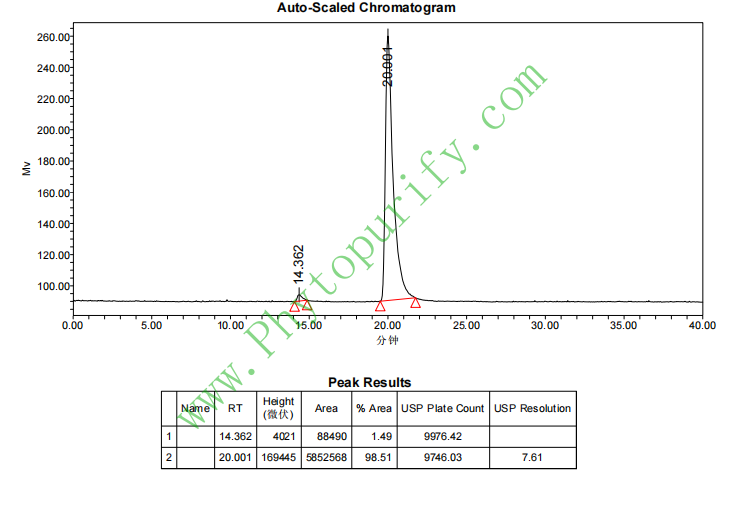
Storage conditions:Short-term storage at 2~8℃, long-term storage at -20 ~ -80℃
20.2300
8.6400
8.6389
.0000
9.9331
7.3297
High
92.4373
4.7947
No
No
No
No
No
No
0.0
No
No
No
No
Epifolidelanol is a triterpenoid natural product derived from the root bark of Ulmus davidiana, a plant in the genus Ulmus. As an important member of triterpenoids, suberin has attracted widespread attention in the field of natural product pharmacology in recent years due to its unique structure and diverse biological activities. Previous studies have shown that suberin not only has significant anti-tumor and anti-inflammatory effects, but also effectively induces tumor cell apoptosis and inhibits cell aging, especially in the treatment research of malignant tumors such as lung cancer, demonstrating potential application value.
Lung cancer, as a malignant tumor with extremely high incidence rate and mortality worldwide, urgently needs to develop new efficient and low toxic therapeutic drugs. Epicatechol exhibits multiple mechanisms of inhibiting tumor cell proliferation, promoting cell apoptosis, and anti-inflammatory effects by regulating multiple signaling pathways and molecular targets, making it an important candidate compound for studying new strategies for lung cancer treatment. In addition, the inhibitory effect of suberin on human primitive cell aging also provides a new research direction for its application in anti-aging and related disease prevention and treatment.
This article provides a systematic review of the chemical structure and physicochemical properties, plant sources, and extraction methods of suberin, combined with the latest pharmacological activity research, to explore its mechanism of action and molecular targets, evaluate its pharmacological properties and pharmacokinetic characteristics, and finally look forward to its clinical application prospects, in order to provide theoretical basis and research reference for the further development and clinical translation of this natural product.
Epifolidelanol is a typical triterpenoid compound with the molecular formula C30H52O and a molecular weight of 428.7450. Its structure is based on the Friedelane skeleton and has a high degree of hydrophobicity, with a LogP value of up to 8.64, demonstrating extremely strong lipid solubility. Its extremely low polarity is manifested in a lower topological polar surface area (TPSA) of 20.23 Å ² and extremely poor water solubility (close to 0), which is closely related to its highly hydrophobic triterpenoid skeleton.
From a chemical structure perspective, suberin contains a hydroxyl functional group that endows it with a certain polarity and potential hydrogen bond donor ability. However, the overall molecule is mainly composed of non-polar carbon hydrogen frameworks, resulting in extremely low solubility in aqueous phase. Its structure is stable and there is no obvious aromatic ring structure, which conforms to the typical characteristics of triterpenoids.
Epicatechol has a high blood-brain barrier penetration ability, which is of great significance for the potential treatment of central nervous system related diseases. In addition, suberin did not exhibit hERG channel inhibitory activity, indicating a low risk of cardiac toxicity. The Ames test result is 0, indicating that it has no significant genotoxicity and good safety.
In summary, the physicochemical properties of suberin determine its distribution characteristics and pharmacokinetic behavior in vivo, and also pose challenges to the design of its pharmaceutical formulations, especially in improving its water solubility and bioavailability, which require further optimization.
Epicatechol was first isolated and identified from the root bark of Ulmus davidiana, a plant in the genus Ulmus. Ulmus davidiana is widely distributed in East Asia. As a traditional Chinese medicinal herb, its root bark is used in folk medicine to treat various inflammatory and tumor related diseases. The discovery of suberin has enriched the chemical composition spectrum of this plant and provided a new molecular basis for its pharmacological activity research.
The common methods for extracting suberin mainly include solvent extraction and chromatographic separation techniques. Generally, ethanol or methanol is used as the initial extraction solvent to obtain the crude extract through reflux extraction. Subsequently, polar impurities were removed using liquid-liquid distribution technology, and purified using methods such as silica gel column chromatography and reverse phase high-performance liquid chromatography (RP-HPLC). During the purification process, thin layer chromatography (TLC), mass spectrometry (MS), and nuclear magnetic resonance (NMR) techniques are used to identify and confirm the structure of the target compound.
In recent years, supercritical CO2 extraction technology has also been attempted for the extraction of suberin, which has gradually become a research hotspot due to its environmental friendliness, high efficiency, and ability to maximize the structural integrity of active ingredients. In addition, the study of plant cell culture and biosynthetic pathways provides new ideas for the sustainable production of suberin.
The pharmacological activity research of suberin mainly focuses on three aspects: anti-tumor, anti-inflammatory, and anti-aging.
Multiple in vitro studies have shown that suberin can significantly induce apoptosis in human prostate cancer cell line DU145, demonstrating good anti-tumor potential. Its mechanism of action involves regulating the cell cycle, inducing mitochondrial dependent apoptosis pathways, and inhibiting tumor cell proliferation. Especially in lung cancer cell models, suberin significantly inhibits the migration and invasion ability of tumor cells through multi-target regulation.
In addition, resveratrol has regulatory effects on various tumor related signaling pathways, such as STAT3, MAPK1, etc., further enhancing its anti-tumor effect. Its low toxicity and high selectivity make it an important candidate for the development of natural anti-cancer drugs.
Epicatechol exhibits significant anti-inflammatory activity and can inhibit the expression of inflammatory factors such as tumor necrosis factor alpha (TNF - α) and interleukin-6 (IL-6), thereby reducing the inflammatory response. Its anti-inflammatory mechanism mainly involves regulating the TLR4 mediated signaling pathway, inhibiting NF - κ B (RELA) activation, reducing the release of inflammatory mediators, and thus exerting a protective effect on tissues.
In recent years, studies have found that suberin can inhibit the aging process of human primitive cells and delay the appearance of cell aging related phenotypes. This effect may be closely related to its regulation of intracellular oxidative stress levels, maintenance of mitochondrial function, and regulation of cell cycle related protein expression. The anti-aging effect of suberin provides a theoretical basis for its application in delaying aging and related degenerative diseases.
The multiple pharmacological effects of suberin stem from its regulation of multiple molecular targets and signaling pathways. Research on lung cancer and related diseases has revealed its main targets, including:
The synergistic regulation of these targets enables suberin to exert anti-tumor and anti-inflammatory effects on multiple layers, and its complex mechanism of action reflects the characteristics of natural products with multiple targets and pathways.
The pharmacological evaluation of suberin shows that it has certain advantages and challenges:
Regarding its physical and chemical properties, the drug development of suberin needs to focus on solving the problems of poor water solubility and low oral bioavailability. Strategies such as nanocarriers, liposome encapsulation, and structural modification are feasible directions.
Epicatechol, as a natural triterpenoid compound with multiple biological activities, has shown broad application prospects in the fields of anti-tumor, anti-inflammatory, and anti-aging. Especially in the treatment of lung cancer, through multi-target regulation of key oncogenic signaling pathways, suberin is expected to become an effective ingredient in novel adjuvant or combination drugs.
Future clinical translation needs to focus on the following aspects:
In addition, the potential of suberin in the field of anti-aging is also worth paying attention to. In the future, it can be combined with stem cell technology and regenerative medicine to explore its application in delaying aging and related degenerative diseases.
Epicatechol, as a natural triterpenoid compound derived from Ulmus davidiana root bark, exhibits significant anti-tumor, anti-inflammatory, and anti-aging potential due to its unique chemical structure and multi-target pharmacological activity. Its mechanism of action involves multiple key cellular signaling pathways, especially in the treatment of lung cancer, which has important research value. Although its physical and chemical properties pose certain challenges for drug development, through modern pharmaceutical formulation technology and structural optimization, epigallocatechin gallate is expected to become an important candidate for new natural medicines.
In the future, combining systematic pharmacokinetic studies and preclinical safety evaluations, promoting the clinical translation of epicatechin will provide new ideas and strategies for the treatment of lung cancer and related diseases. With the in-depth analysis of its molecular mechanism, suberin is expected to occupy a more important position in the field of natural product pharmacology and become a model for promoting the innovative development of natural medicines.
