| Catalog No | Package | Original Price | Price | Inventory | Quantity | Operating |
|---|---|---|---|---|---|---|
| BP3173-20mg | 20mg | $20.00 | Sign in |
|


Storage conditions:Short-term storage at 2~8℃, long-term storage at -20 ~ -80℃
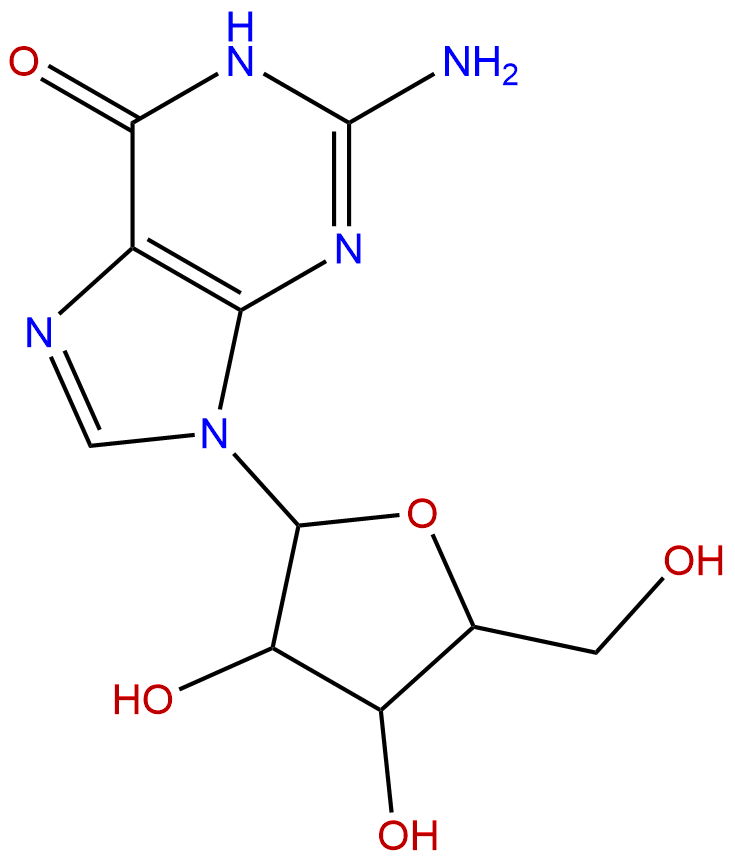
Guanosine, CAS number 118-00-3, is an important natural nucleoside compound formed by the β - N9 glycosidic bond between guanine and ribose in purine bases. As one of the basic building blocks of nucleic acids, guanosine plays a crucial role in nucleic acid metabolism, energy conversion, and signal transduction within cells. In recent years, with the deepening development of natural product pharmacology, guanosine has become an important candidate molecule for antiviral drug development due to its significant antiviral activity, especially its inhibitory effect on herpes simplex virus (HSV). In addition, the potential role of guanine nucleoside in regulating immune response, neuroprotection, and cellular metabolism has also attracted widespread attention.
This article aims to systematically review the chemical structure and physicochemical properties, plant sources and extraction methods, pharmacological activity and mechanism of action, pharmacological evaluation and pharmacokinetic characteristics of guanine nucleoside, and explore its clinical application prospects and future research directions, providing comprehensive and in-depth reference materials for researchers in the field of natural product pharmacology.
The chemical structure of guanine nucleoside consists of the purine base guanine and ribose, which are connected by a β - N9 glycosidic bond to form a typical nucleoside structure. Its molecular formula is C10H13N5O5, with a molecular weight of 283.2440. The guanine moiety in the structure contains multiple nitrogen atoms, endowing it with strong polarity and hydrogen bond donor/acceptor ability; The hydroxyl group of the ribose ring enhances its water solubility.
In terms of physical and chemical properties, the LogP value of guanine nucleoside is -1.8247, indicating its strong hydrophilicity and easy solubility in water (solubility of approximately 4.1618 mg/mL). Its polar surface area (TPSA) is 159.5100 Å ², indicating a high molecular polarity that may limit its passive diffusion ability through lipid membranes. The low permeability of the blood-brain barrier indicates limited distribution in the central nervous system. The hERG channel inhibition experiment showed a negative result, indicating a low risk of cardiac toxicity. The Ames mutagenicity test result is 1.2, indicating that its genotoxicity risk is relatively low and has a good safety basis.
Guanosine is widely present in various organisms, especially in higher plants, microorganisms, and animal tissues. It mainly exists as an intermediate product of nucleic acid metabolism in plants, with relatively low levels. Common plant sources include the nuclei and cytoplasm of certain medicinal plants, such as ginkgo leaves, goji berries, astragalus, etc., but purity and content are greatly affected by plant species, growth environment, and harvesting period.
In terms of extraction methods, traditional guanine nucleoside extraction often uses water extraction or buffer extraction combined with organic solvent separation. The specific steps include:
In recent years, the application of modern technologies such as ultrasound assisted extraction, microwave-assisted extraction, and enzymatic assisted extraction has improved extraction efficiency and purity, providing technical support for industrial production.
The most well-known pharmacological activity of guanine nucleoside is its antiviral effect, especially its inhibitory effect on herpes simplex virus (HSV). Multiple in vitro experiments have shown that guanosine can effectively reduce the replication of HSV-1 and HSV-2, inhibit viral DNA synthesis, and slow down the process of viral infection. Its antiviral activity is not limited to HSV, but also involves various viruses such as human immunodeficiency virus (HIV) and cytomegalovirus (CMV).
Guanosine exerts certain immunomodulatory effects by regulating the function of immune cells. Research has shown that guanosine can affect macrophage peroxidase (MPO) activity, regulate inflammatory responses, and reduce oxidative stress levels. In addition, its regulation of chemokine receptors CCR5 and CXCR4 helps to inhibit the cellular invasion of HIV virus.
In recent years, research on guanine nucleoside in the field of neuroprotection has gradually increased. It exhibits potential neuroprotective functions by regulating neuronal energy metabolism, resisting oxidative stress, and promoting nerve regeneration. In animal models, guanosine has a certain alleviating effect on cerebral ischemia, neurodegenerative diseases, etc.
Guanosine nucleoside is involved in various biological processes such as cell proliferation, apoptosis regulation, and metabolic regulation, demonstrating a wide range of biological activities. Its potential in the fields of tumors, metabolic diseases, and others is worth further exploration in the future.
The antiviral mechanism of guanine nucleoside is mainly achieved by interfering with key enzymes and proteins in the viral replication cycle. Specific targets include:
In addition, guanosine also enhances antiviral defense by regulating the host immune system. Its inhibition of macrophage MPO activity reduces the release of inflammatory mediators and minimizes tissue damage.
The pharmacological evaluation of guanine nucleoside shows that it has certain advantages and challenges:
Based on the above characteristics, developing derivatives of guanine nucleoside or using nanocarrier systems to improve its pharmacokinetic properties is a key direction to enhance its clinical application value.
Although guanosine has shown good antiviral and immunomodulatory activity in basic research, its clinical application is still in its infancy. The future development directions include:
With the advancement of molecular biology and medicinal chemistry, guanine nucleosides and their derivatives are expected to become important components of future antiviral and multifunctional therapeutic drugs.
Guanosine nucleoside, as a natural nucleoside compound, exhibits broad pharmacological potential due to its unique chemical structure and diverse biological activities. Its research achievements in the fields of antiviral, immune regulation, and neuroprotection provide valuable theoretical and practical foundations for natural product pharmacology. Despite challenges in terms of drug efficacy and pharmacokinetics, the application of structural modifications and advanced drug delivery technologies holds promise for breaking through existing limitations and achieving clinical translation. In the future, in-depth mechanism research and application development around guanine nucleoside will promote its important position in new drug development and contribute new therapeutic strategies to human health.
