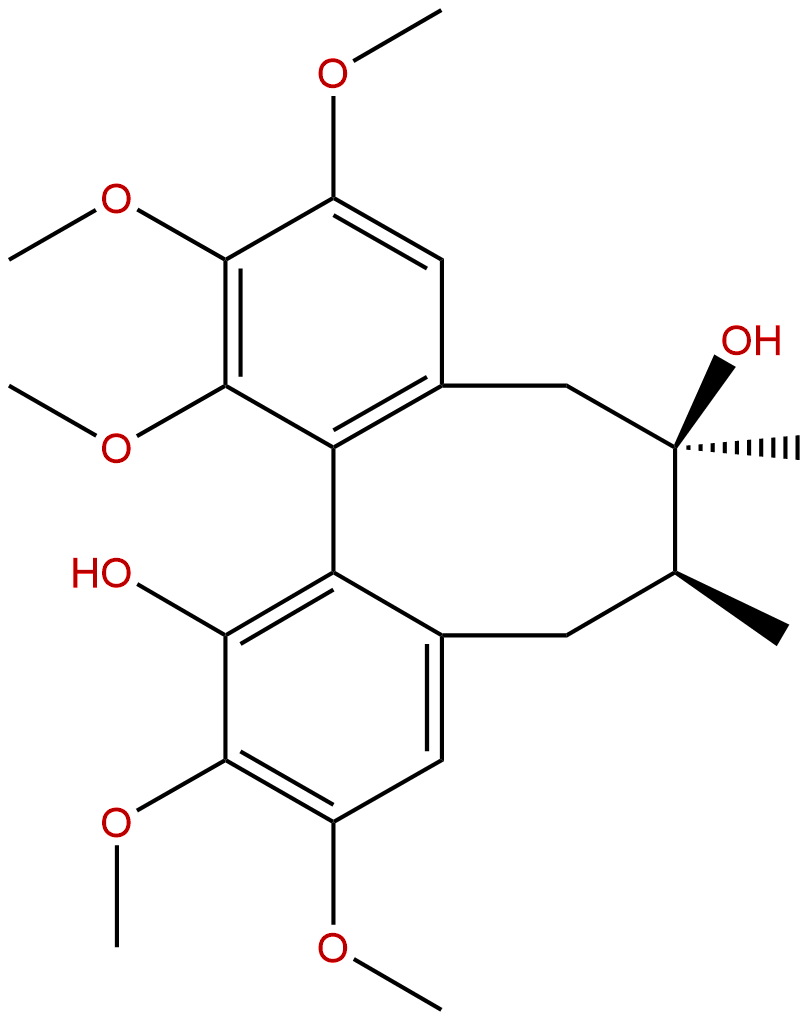


Product name: Gomisin H
Synonym name:
Catalogue No.: BP3168
Cas No.: 66056-20-0
Formula: C23H30O7
Mol Weight: 418.486
Botanical Source:
Physical Description: Powder
Type of Compound: Lignans
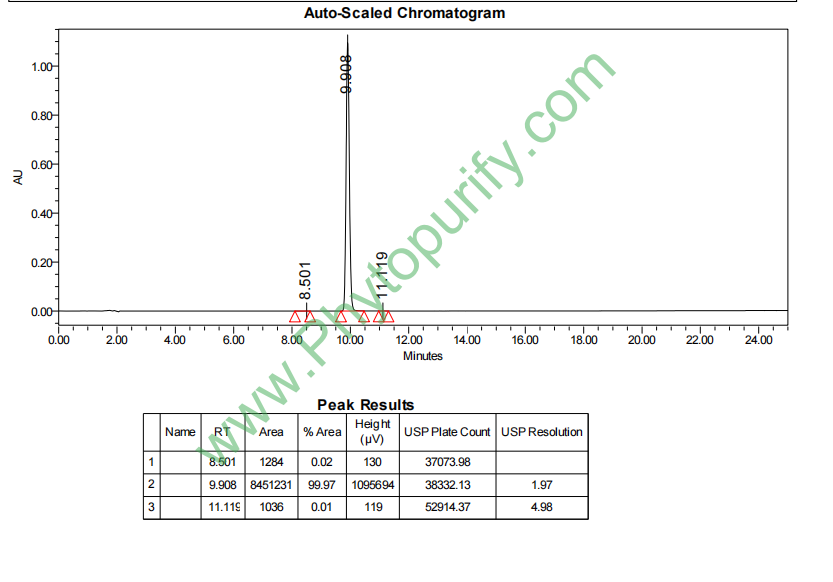
Purity: 95%~99%
Analysis Method: HPLC-DAD or/and HPLC-ELSD
Identification Method: Mass, NMR
Packing: Brown vial or HDPE plastic bottle
The product could be supplied from milligrams to grams. Inquire for bulk scale.
We provide solution to improve the water-solubility of compounds, thereby facilitating the variety of activity tests and clinic uses.
For Reference Standard and R&D, Not for Human Use Directly.
HPLC of Gomisin H
Storage conditions:Short-term storage at 2~8℃, long-term storage at -20 ~ -80℃
86.6100
3.1782
3.1757
.0153
4.5179
11.0068
High
88.3853
3.5147
Yes
No
Yes
No
No
Yes
0.6
Yes
No
Yes
No
Biphenylcyclooctadiene lignans are a class of natural products with unique structures and diverse biological activities, mainly derived from plants in the Schisandraceae family. Among them, Schisandra chinensis(Schizandra chinensis BAILL, as a traditional Chinese medicine, has been used for thousands of years for its effects of "tonifying qi, generating fluids, nourishing the kidneys, and calming the heart". Modern research has revealed that the material basis of its pharmacological effects is closely related to this type of lignans. Gomisin H (CAS number: 66056-20-0) is an important biphenyl cyclooctadiene lignan monomer isolated from Schisandra chinensis. In recent years, with the deepening development of natural product chemistry and molecular pharmacology, GOMIXIN H has attracted much attention for its broad-spectrum and significant antiviral activity, especially for major viral diseases such as herpes virus and human immunodeficiency virus (HIV), showing potential therapeutic value. This article aims to systematically review the chemical structure, plant origin, pharmacological activity, mechanism of action, pharmacological characteristics, and clinical application prospects of Gomixin H, in order to provide comprehensive scientific references for the in-depth research and development of this compound.
The molecular formula of Gomisin H is C23H28O7, with a molecular weight of 418.4860. Its core skeleton is a typical biphenyl cyclooctadiene structure, where two benzene rings are connected by an octadiene lactone ring. This structure has multiple chiral centers, endowing it with a specific stereochemical configuration, which is crucial for its biological activity. Its structure often contains substituents such as methoxy and methylenedioxy, which have a significant impact on its physicochemical properties and pharmacological activity.
From the analysis of parameters related to drug properties, the lipid water partition coefficient (LogP) of Gomisine H is 3.1782, indicating its moderate lipophilicity, which is conducive to transmembrane transport and absorption. The topological polar surface area (TPSA) is 86.6100 Å ², which is relatively moderate and suggests that it may have good membrane permeability. However, its water solubility is relatively low (about 0.0153 mg/mL), which may be a limiting factor for its oral bioavailability and needs to be improved through formulation methods such as solid dispersions, nanocrystals, cyclodextrin inclusion complexes, etc. It is worth noting that GOMIXIN H exhibits high blood-brain barrier permeability prediction, which provides potential advantages for its treatment of central nervous system viral infections such as herpesvirus encephalitis. In terms of early safety indicators, GOMIXIN H has no significant inhibitory effect on hERG potassium channels, indicating a low risk of causing QT interval prolongation in the heart. The Ames test result is 0.6, indicating a low risk of mutagenicity, but further in vivo genetic toxicity studies are needed to confirm.
Gomisin H mainly comes from plants in the Schisandra family, including Schisandra chinensis(Schizandra chinensis BAILL's dried and ripe fruits are the main source. Schisandra chinensis is mainly distributed in Northeast China, South Korea, Japan, and the Far East of Russia. Gomisin H has relatively low content in plants and often coexists with other structurally similar lignans such as Gomisin A, B, C, G, N, etc.
Its extraction and separation usually follow the conventional process of natural product chemistry. Firstly, the dried Schisandra fruit is crushed and subjected to reflux extraction or ultrasound assisted extraction using organic solvents such as methanol, ethanol, or acetone. The crude extract obtained was concentrated under reduced pressure and subjected to gradient extraction using solvents such as petroleum ether, ethyl acetate, and n-butanol. Gomisine H was mainly enriched in the ethyl acetate fraction. Further purification depends on a variety of chromatographic techniques, including silica gel column chromatography, reverse phase silica gel (such as ODS) column chromatography, Sephadex gel (LH-20) column chromatography, and high performance liquid chromatography (HPLC). Modern separation techniques such as high-speed countercurrent chromatography (HSCCC) have also been successfully applied to the efficient preparation and separation of biphenyl cyclooctadiene lignans due to their high recovery rate and avoidance of irreversible adsorption. The optimization of extraction processes (such as solvent selection, temperature, time) and the use of green technologies such as supercritical fluid extraction are key research directions for improving the yield and purity of Gomisine H.
The pharmacological activity research of GOMIXIN H mainly focuses on the field of antiviral, and exhibits the characteristics of multi-target and multi link action.
1. Antiherpesvirus activity:
Research has shown that Gomisin H has a significant inhibitory effect on herpes simplex virus types 1 (HSV-1) and 2 (HSV-2). Its function is not only reflected in inhibiting virus replication, but also directly inactivating free virus particles. Gomisin H can inhibit the expression of the key immediate early protein ICP27 in HSV-1, interfering with the transcription and regulation of viral genes. At the same time, it can also affect the function of the virus DNA polymerase helper protein UL42, thereby inhibiting the synthesis of virus DNA. For the thymidine kinase (TK) and glycoprotein D (gD) of HSV-1, there may also be interactions between Gomisin H, which interfere with the virus's nucleoside metabolism and cellular adsorption/invasion processes.
2. Anti human immunodeficiency virus (HIV) activity:
Gomesin H is a potential HIV-1 inhibitor. Its mechanism of action involves multiple links: firstly, as an antagonist or regulator of CCR5 and CXCR4, Gomixin H can block HIV-1 from using these co receptors to enter host cells, especially inhibiting R5 (using CCR5) and X4 (using CXCR4) virus strains. Secondly, studies have shown that gomisin H can inhibit the activity of HIV-1 integrase (INT), preventing the integration of viral cDNA into the host genome, which is one of the key targets for anti HIV therapy. In addition, it also has a certain inhibitory effect on HIV-1 protease (HIV1-PR), which may interfere with the processing and maturation of viral polyproteins.
3. Other potential antiviral activities:
In addition to HSV and HIV, the inhibitory effects of GOMIXIN H on other viruses are also being explored. For example, it may indirectly affect the progression of viral infection by modulating the inflammatory response through affecting the myeloperoxidase (MPO) - related pathway. There have been sporadic reports on the study of viruses such as cytomegalovirus (CMV), but systematic validation is still needed.
4. Other pharmacological activities:
Although antiviral activity is its main highlight, some studies also suggest that GOMIXIN H may have activities such as hepatoprotective, anti-inflammatory, antioxidant, and neuroprotective effects, which are consistent with the traditional efficacy of its parent plant Schisandra chinensis. These activities may be achieved by regulating signaling pathways such as NF - κ B and Nrf2.
The antiviral mechanism of Gomisin H is complex, involving interference with multiple stages of the virus life cycle and regulation of host cytokines. Its targets are diverse.
Direct viral targets:
* Viral enzymes: Gomisin H can directly inhibit various viral enzymes. By inhibiting the DNA polymerase process factor UL42 and catalytic subunit UL54 of HSV, as well as the HIV integrase (INT) and protease (HIV1-PR), the core machinery of virus replication and assembly can be precisely targeted.
* Virus transcription regulatory factors: The inhibition of HSV ICP27 protein affects the coordinated expression of early and late genes of the virus, disrupting the timing of virus replication.
* Virus enters related proteins: May interfere with the binding of the virus to host cell receptors by interacting with HSV gD glycoprotein.
Host cell targets:
* Virus co receptor: The antagonistic effect of GOMIXIN H on cell surface chemokine receptors CCR5 and CXCR4 is a key mechanism for anti HIV entry. It may prevent the binding of HIV envelope protein gp120 to receptors by occupying receptor binding sites or inducing receptor conformational changes.
* Host enzymes and inflammatory mediators: The potential regulatory effect of myeloperoxidase (MPO) may play an adjuvant therapeutic role by reducing excessive oxidative stress and inflammatory damage caused by viral infection.
* Cellular signaling pathways: Gomisin H may indirectly exert antiviral effects by regulating signaling pathways such as MAPK, PI3K/Akt, NF - κ B, etc., affecting the replication environment, cell apoptosis, and inflammatory cytokine release of the virus.
This multi-target mode of action makes Gomixin H less prone to the common resistance issues of single target drugs, but it also brings complexity to its mechanism research and safety evaluation.
Although Gomixin H exhibits excellent antiviral activity in vitro, its successful development as a drug highly depends on systematic drug efficacy evaluation and pharmacokinetic studies.
Pharmacokinetic characteristics:
At present, research on the pharmacokinetics of Gomixin H in vivo is relatively limited and mostly based on animal experiments. Due to its low solubility and moderate LogP value, its oral absorption may be moderate and susceptible to first pass effects. It has a wide distribution in the body, and its high blood-brain barrier permeability prediction provides a pharmacokinetic basis for its treatment of central nervous system infections. In terms of metabolism, biphenyl cyclooctadiene lignans are mainly oxidized and demethylated in the liver through the cytochrome P450 enzyme system (especially CYP3A4), and may also undergo glucuronidation and sulfation binding reactions. Its metabolites may still be active. The main pathways of excretion may be through bile and urine. Clarifying its main metabolic enzymes and metabolites is crucial for evaluating drug interactions and individual differences.
Challenges and optimization strategies for drug development:
1. Water solubility and bioavailability: Low water solubility is the primary challenge. The solubility and dissolution rate can be significantly improved by preparing nano formulations, phospholipid complexes, cyclodextrin inclusion complexes, or prodrugs (such as phosphate esters and amino acid esters), thereby enhancing oral bioavailability.
2. Metabolic stability: Evaluate its metabolic stability in liver microsomes or liver cells, and modify the structure of easily metabolized sites (such as introducing fluorine atoms or changing the position of methoxy groups), which may result in more stable metabolism and longer half-life derivatives.
3. Safety evaluation: Although the preliminary hERG and Ames test results are good, a comprehensive preclinical safety evaluation is still needed, including acute toxicity, long-term toxicity, reproductive toxicity, as well as deeper genetic toxicity and cardiovascular safety studies.
4. Potential for drug interactions: As a substrate or regulator of CYP450 enzyme, it is necessary to evaluate its potential pharmacokinetic interactions when used in combination with commonly used antiviral drugs such as protease inhibitors and non nucleoside reverse transcriptase inhibitors.
Gomesin H, as a natural product with multi-target antiviral properties, has broad clinical application prospects, but also faces many challenges.
Potential application directions:
1. Anti HIV combination therapy: Given its unique dual mechanism of action (inhibition of entry and integration), Gomisine H or its derivatives are expected to be developed as novel HIV entry inhibitors or integrase inhibitors, to be used in combination with existing antiretroviral drugs, providing new treatment options for drug-resistant patients, or as part of simplified therapies.
2. Anti herpes virus infection: Gonimicin H can be used as a candidate for local or systemic medication for genital herpes, keratitis, encephalitis, etc. caused by HSV-1/2. Its high BBB permeability is particularly valuable for the treatment of herpesvirus encephalitis.
3. Multi virus co infection treatment: Its broad-spectrum antiviral properties may be applicable for the treatment of opportunistic infections such as HIV combined with HSV and CMV.
4. Optimization of lead compounds: By using it as the parent nucleus for structural modification, it is expected to obtain new antiviral drugs with stronger activity, higher selectivity, and better pharmacokinetic properties.
Future research prospects:
1. In depth mechanism research: Using chemical biology methods such as photoaffinity labeling and proteomics to accurately identify its direct target proteins and elucidate their molecular binding patterns.
2. Structure Activity Relationship (SAR) Study: Systematically synthesize a series of derivatives or analogues of Gomixin H, clarify the pharmacophores and key structural features of their antiviral activity, and guide rational drug design.
3. Formulation development: Vigorously carry out research on new drug delivery systems, solve their solubility and delivery efficiency issues, and explore formulations such as local administration (for eyes and skin) and long-acting injection.
4. Preclinical and clinical studies: Complete the pharmacological (multiple animal infection models), pharmacokinetic, and toxicological evaluations of the system, providing solid data for its application for clinical trials. Explore its synergistic effect with existing standard therapies.
5. Biological synthesis and synthetic biology: Analyzing the biosynthetic pathway of Gomisin H in Schisandra chinensis is expected to achieve efficient and sustainable production in microorganisms through synthetic biology methods, solving the problem of limited plant sources.
As a treasure contained in Schisandra chinensis, Gomisine H's unique biphenylcyclooctadiene structure endows it with excellent multi-target antiviral activity, especially showing great potential in anti HIV and anti HSV. The research process of GOMIXIN H, from traditional medicinal plants to clear active monomers and gradually revealing its mechanism of action, is a microcosm of modern natural product drug development. Despite facing challenges such as water solubility and metabolism in drug development, these challenges are expected to be overcome one by one through the comprehensive application of modern medicinal chemistry, pharmacy, and pharmacology technologies. In the future, with a more detailed analysis of its mechanism of action, rational design of derivatives, and the development of innovative formulations, GOMIXIN H is expected to move from the laboratory to clinical practice, providing new weapons for addressing the treatment challenges of viral diseases, and also providing successful examples for the development of innovative drugs based on traditional Chinese medicine resources.
