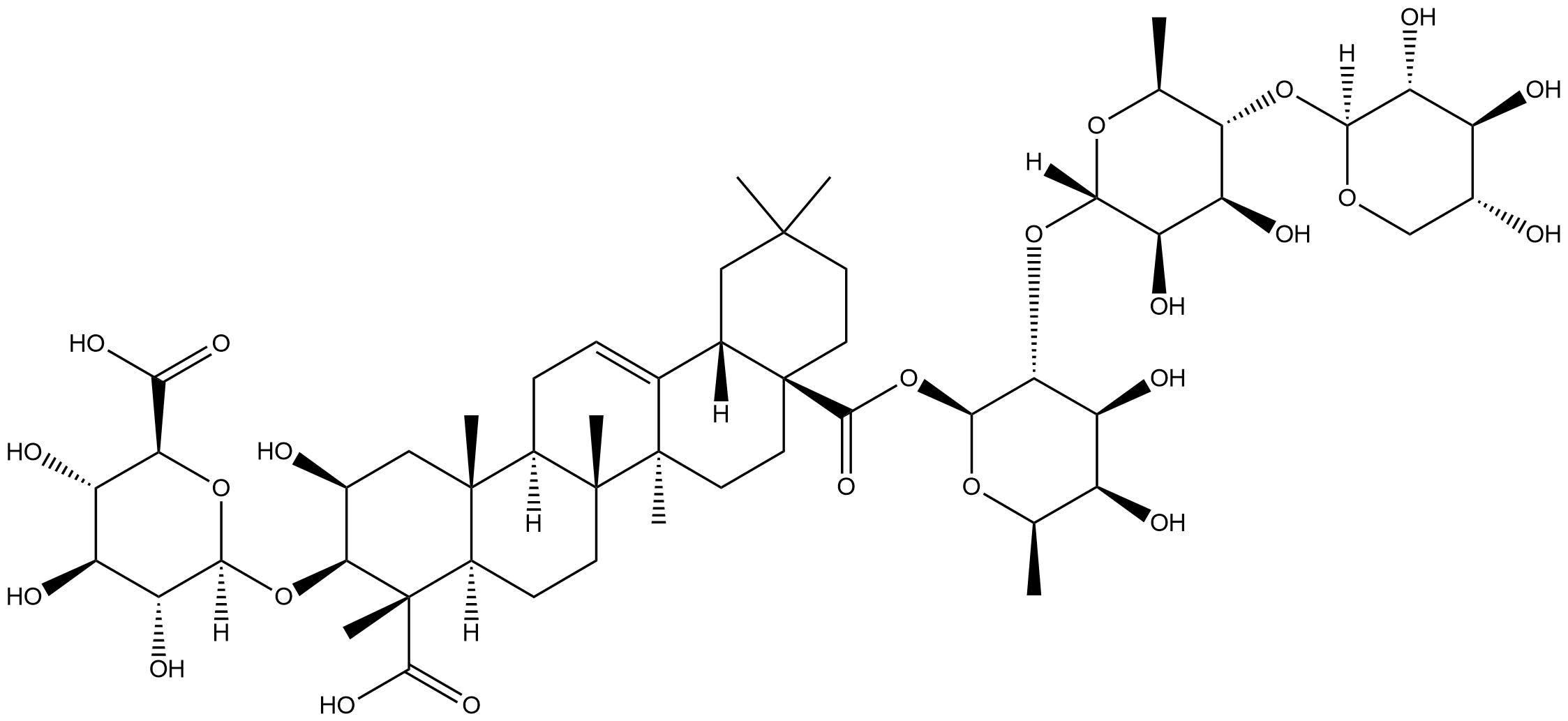


Product name: Celosin I
Synonym name:
Catalogue No.: BP4205
Cas No.: 1807732-38-2
Formula: C53H82O24
Mol Weight: 1103.22
Botanical Source:
Type of Compound: Triterpenoids
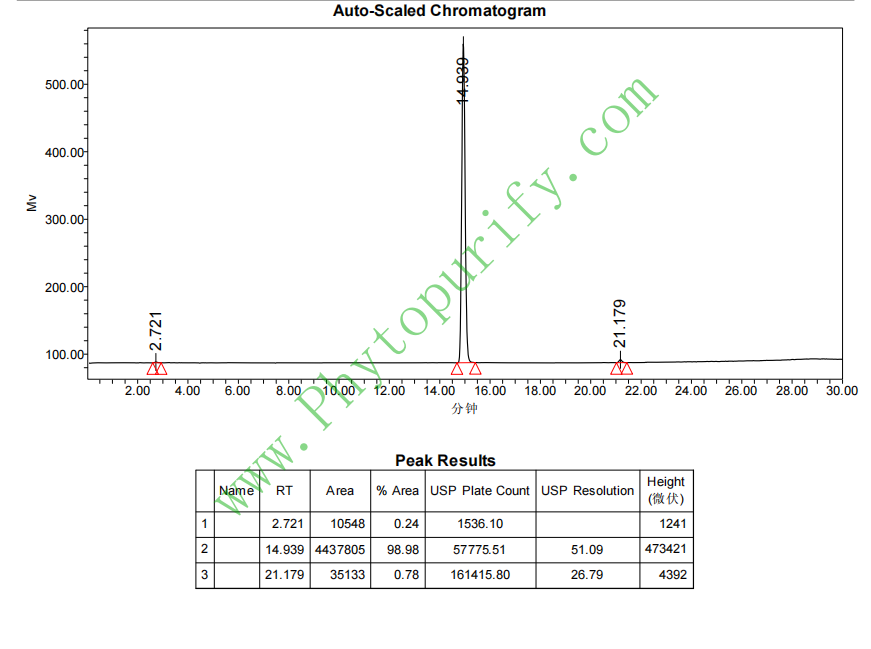
Purity: 95%~99%
Analysis Method: HPLC-DAD or/and HPLC-ELSD
Identification Method: Mass, NMR
Packing: Brown vial or HDPE plastic bottle
Storage: Store in a well closed container, protected from air and light. Put into refrigerate or freeze for long term storage.
The product could be supplied from milligrams to grams
Inquire for bulk scale.
For Reference Standard and R&D, Not for Human Use Directly.
Description:
Celosin H, celosin I, and celosin J could be used as chemical markers for the quality control of C. argentea seeds. Celosin I exhibited significant hepatoprotective effect on carbon tetrachloride-induced and N,N-dimethylformamide-induced hepatotoxicity in mice.
References:
Nat Prod Res. 2013 Aug;27(15):1353-60.
Novel triterpenoid saponins from the seeds of Celosia argentea L.
METHODS AND RESULTS:
Two new triterpenoid saponins Celosin I (1) and Celosin II (2) were isolated from the seeds of Celosia argentea L. (Amaranthaceae). The structures of the two new compounds were elucidated based on chemical analysis and spectral methods (IR, 1-D and 2-D NMR, ESI-MS, HR-ESI-MS).
CONCLUSIONS:
They exhibited significant hepatoprotective effect on carbon tetrachloride-induced and N,N-dimethylformamide-induced hepatotoxicity in mice.
HPLC of Celosin I
Storage conditions:Short-term storage at 2~8℃, long-term storage at -20 ~ -80℃
388.0400
1.3182
-1.4264
.6030
.5203
.2553
Low
79.5750
6.9320
Yes
No
Yes
No
No
No
0.0
Yes
No
No
No
Celosin I, a novel triterpenoid saponin natural product, was isolated and identified for the first time from the seeds of the traditional medicinal plant Celosia argentea L. As an important active ingredient in Celosia seeds, Celosidine I not only serves as a chemical marker for quality control of broad bean seeds, but also receives extensive attention from the pharmacological community due to its significant biological activity. In recent years, Celosidine I has shown promising pharmacological potential in the fields of anti-inflammatory and liver protection, particularly in liver injury models induced by carbon tetrachloride (CCl4) and N, N-dimethylformamide (DMF), demonstrating significant protective effects. This article aims to systematically review the chemical structure, physicochemical properties, plant sources, and extraction methods of Celosidine I, explore its pharmacological activity and mechanism of action, evaluate its pharmacological and pharmacokinetic characteristics, and prospect its clinical application potential, providing theoretical basis and research direction for natural product pharmacology and new drug development.
Celosidine I belongs to the triterpenoid saponin class, with a complex molecular formula and a molecular weight of 1103.2150. Its structural core is a typical triterpenoid skeleton, connecting multiple sugar residues to form a polysaccharide structure, endowing it with high polarity and water solubility. The LogP value of Celosidine I is 1.3182, indicating its moderate hydrophobicity, which facilitates its distribution and penetration through cell membranes in organisms. Its polar surface area (TPSA) is as high as 388.04 Å ², reflecting the presence of a large number of polar groups on the molecular surface, enhancing its water solubility (0.6030), but at the same time limiting its ability to pass through the blood-brain barrier, which has low permeability. Celosidine I does not have hERG channel inhibitory activity, indicating a low risk of cardiac toxicity, and the Ames test result is 0.0, indicating no significant genotoxicity risk.
From a chemical structure perspective, the triterpenoid skeleton of Celosidine I endows it with a bioactive basis, while the glycosyl portion may affect its bioavailability and targeting. The polar functional groups such as hydroxyl and carboxyl in the structure provide multiple possible hydrogen bonding and electrostatic interaction sites for its binding with target proteins.
The main source of Celosia argentea glycoside I comes from the seeds of Celosia argentea L. Celestine is a traditional Chinese medicinal herb widely distributed in tropical and subtropical regions, and its seeds contain abundant triterpenoid saponins. The extraction of Celosidine I is usually carried out by solvent extraction combined with chromatographic separation. The specific steps include:
In recent years, new green extraction technologies such as ultrasound assisted extraction and microwave-assisted extraction have also been attempted to be applied to the extraction of Celosidine I, improving extraction efficiency and purity, reducing solvent usage and energy consumption.
The pharmacological activity research of Celosidine I mainly focuses on its anti-inflammatory and liver protective effects. Multiple in vitro and in vivo experiments have shown that Celosidine I has significant protective effects on various liver injury models and exhibits good activity in regulating inflammatory responses.
The mouse liver injury model induced by carbon tetrachloride (CCl4) is a classic model for evaluating liver protective drugs. Research has found that Celosidine I can significantly reduce CCl4 induced hepatocyte necrosis and inflammatory infiltration, inhibit the increase of malondialdehyde (MDA) levels in liver tissue, enhance superoxide dismutase (SOD) activity, and alleviate oxidative stress damage. In addition, Celosidine I can also improve liver function indicators, such as serum alanine aminotransferase (ALT) and aspartate aminotransferase (AST) levels, showing good liver protective effects.
Similarly, in the N, N-dimethylformamide (DMF) - induced hepatotoxicity model, Celosidine I also showed anti liver injury effects, reduced liver cell inflammation and fibrosis processes, and promoted liver tissue repair.
Celosidine I exhibits significant anti-inflammatory activity in various inflammatory models. Its mechanism of action involves the regulation of multiple classic inflammatory signaling pathways, which can reduce the expression of pro-inflammatory cytokines such as TNF - α and IL-6, inhibit the activity of inflammatory mediator synthase PTGS2 (COX-2) and inducible nitric oxide synthase NOS2, thereby reducing inflammatory response.
In addition, Celosidine I has a regulatory effect on inflammation related ion channels TRPV1 and TRPA1, which may exert anti-inflammatory and analgesic effects by regulating neuroinflammation and pain transmission. Its inhibition of inflammasome associated protein CASP1 (caspase-1) also suggests its potential role in regulating inflammatory cell apoptosis and cytokine maturation.
The pharmacological effects of Celosidine I are mainly achieved through the synergistic action of multiple targets and pathways, involving multiple mechanisms such as immune regulation, antioxidant, and signal transduction.
Celosidine I significantly affects the IL-6/STAT3 signaling pathway. IL-6, as a key pro-inflammatory cytokine, promotes inflammatory response and cell survival by activating STAT3 transcription factor. Celosidine I can inhibit the expression of IL-6 and the phosphorylation activation of STAT3, block the transmission of inflammatory signals, and alleviate inflammatory reactions.
At the same time, Celosidine I inhibits the activation of the NFKB1 (NF - κ B) signaling pathway, reduces the transcriptional expression of pro-inflammatory genes, decreases the production of inflammatory mediators such as TNF - α and PTGS2, and exerts anti-inflammatory effects.
The inhibitory effect of Celosidine I on CASP1 suggests that it may regulate inflammasome activity, reduce the maturation and release of pro-inflammatory cytokines such as IL-1 β, alleviate inflammatory cell apoptosis and tissue damage.
The regulatory effect of Celosidine I on TRPV1 and TRPA1 may be achieved by inhibiting the influx of calcium ions mediated by these channels, blocking the transmission of neuroinflammatory signals, and alleviating inflammation related pain.
Celosidine I enhances antioxidant enzyme activity, reduces oxidative stress products, protects liver cells from free radical damage, and maintains intracellular redox balance.
The pharmacological evaluation of Celosidine I shows that it has good safety and potential drug development value.
At present, pharmacokinetic studies on Celosidine I are relatively limited. Preliminary data indicate that it is metabolically stable in vivo and mainly processed by the liver metabolic enzyme system. The excretion pathway still needs further clarification. In the future, systematic pharmacokinetic and toxicological studies need to be conducted to evaluate its absorption, distribution, metabolism, and excretion (ADME) characteristics, providing a basis for clinical applications.
Celosidine I, as a natural product with multi-target anti-inflammatory and liver protective activities, has great potential for clinical development. It has broad application prospects in liver diseases, especially in acute and chronic liver injury, drug-induced hepatitis, and liver fibrosis. At the same time, the characteristic of regulating the inflammatory signaling pathway by Celosidine I makes its potential therapeutic value in autoimmune diseases, inflammatory pain, and metabolic syndrome related inflammation worthy of further exploration.
Future research directions include:
Celosidine I, as a natural triterpenoid saponin with a clear source and unique structure, exhibits significant anti-inflammatory and hepatoprotective activities. Its multi-target regulation of inflammatory signaling pathways and antioxidant mechanisms provides a solid foundation for its pharmacological effects. The drug evaluation shows that it has good safety and potential clinical application value. In the future, with the in-depth analysis of pharmacological mechanisms and advances in drug development technology, Celosidine I is expected to become a new natural medicine for the treatment of liver diseases and inflammation related diseases, contributing important forces to the fields of natural product pharmacology and new drug research and development.
