| Catalog No | Package | Original Price | Price | Inventory | Quantity | Operating |
|---|---|---|---|---|---|---|
| BP3394-20mg | 20mg | $20.00 | Sign in |
|


Storage conditions:Short-term storage at 2~8℃, long-term storage at -20 ~ -80℃
Uridine (CAS number 58-96-8), as a fundamental ribonucleoside, plays an important biological role in living organisms. It is composed of uracil bases connected to ribofuranose through β - N1 glycosidic bonds and is one of the fundamental units in nucleic acid synthesis. Uridine not only participates in the synthesis and metabolism of nucleic acids, but also serves as a key intermediate in various biosynthetic pathways, widely present in animals and plants. In recent years, the research on uridine in pharmacology has gradually deepened, demonstrating its potential application value in antiviral, neuroprotective, and metabolic regulation. This article provides a systematic review of the chemical structure and physicochemical properties, plant sources and extraction methods, pharmacological activity and mechanism of action, pharmacological evaluation, pharmacokinetic characteristics, and clinical application prospects of uridine. The aim is to provide theoretical basis and practical guidance for natural product pharmacology research.
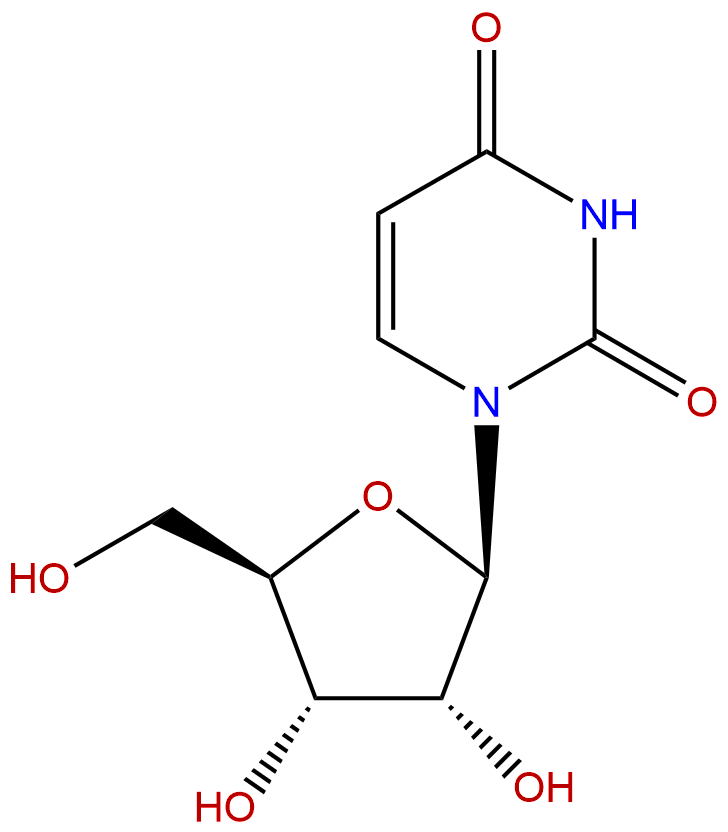
The chemical structure of uridine is composed of a uracil base and a five carbon sugar (ribofuranose) connected by a β - N1 glycosidic bond. Its molecular formula is C9H12N2O6 and its molecular weight is 244.2030. In the structural formula, the uracil ring is a nitrogen-containing pyrimidine base with two nitrogen atoms and two carbonyl groups, endowing it with strong polarity and hydrogen bonding ability. The hydroxyl group of the furan sugar provides water solubility and biocompatibility.
In terms of physical and chemical properties, the LogP value of uridine is -1.8621, indicating its high hydrophilicity. Its water solubility is 63.8493 mg/mL, indicating that it is easily soluble in water and difficult to dissolve in fat soluble solvents. The polar surface area (TPSA) is 124.78 Å ², indicating its strong polarity and hydrogen bond acceptor ability. The low blood-brain barrier permeability of uridine limits its potential for direct action on the central nervous system. In addition, uridine does not exhibit hERG channel inhibitory activity, indicating a low risk of cardiac toxicity. The Ames test result is 1.2, indicating a low risk of genotoxicity and good safety.
Uracil nucleoside is widely present in various plants and organisms, especially in plant tissues with high nucleic acid content. Common sources include grains, beans, leafy vegetables, and certain medicinal plants. Due to its nature as a nucleoside natural product, it usually exists in free form or as a nucleic acid hydrolysate.
The traditional extraction method mainly relies on a combination of water extraction and alcohol extraction. The specific steps include: crushing the plant raw materials, extracting them with hot water or buffer solution, removing large molecular impurities through alcohol precipitation, and then separating and purifying uridine using chromatography techniques such as ion exchange chromatography and reverse phase high-performance liquid chromatography. In modern technology, ultrasound assisted extraction and enzymatic hydrolysis are also applied to improve extraction efficiency and purity.
In addition, uridine can also be obtained through microbial fermentation or chemical synthesis, especially in industrial production, where fermentation is widely used due to its high efficiency and environmental friendliness.
The research on uridine in pharmacology mainly focuses on its antiviral activity, neuroprotective effects, and metabolic regulatory functions.
Uridine and its derivatives exhibit inhibitory effects on various viruses, especially against DNA viruses and retroviruses. Its targets include various viral proteins, including myeloperoxidase (MPO), herpes virus associated proteins UL42, UL54, ICP27, thymidine kinase (TK), viral glycoprotein D (gD), as well as HIV related CCR5, CXCR4 receptor, HIV-1 protease (HIV1-PR), and integrase (INT). Uridine inhibits virus proliferation and transmission by interfering with virus nucleic acid synthesis, protein translation, and virus replication processes.
Uridine, as an important component of nucleotide metabolism in the brain, participates in the synthesis of nerve cell membrane phospholipids, promoting neuronal repair and regeneration. Research has shown that uridine can exert protective effects against depression, improve cognitive function, and neurodegenerative diseases by regulating neurotransmitter release and enhancing neuronal metabolic activity.
Uridine is involved in pyrimidine nucleotide metabolism, regulating energy metabolism and cellular signaling. Its regulatory role in abnormal glucose and lipid metabolism, inflammatory response, and cell apoptosis suggests its potential application value in metabolic syndrome and inflammatory diseases.
The pharmacological mechanism of action of uridine is mainly based on its biological function as a nucleotide metabolite and its inhibitory effect on virus related proteins.
In terms of antiviral activity, uridine competitively inhibits the activity of viral DNA polymerase and related enzymes, blocking the synthesis of viral nucleic acids. It binds to the UL42 and UL54 proteins of herpes virus, inhibiting the assembly and function of the virus replication complex. For HIV virus, uridine affects the virus invasion process mediated by CCR5 and CXCR4 receptors, blocking the binding and fusion of the virus with host cells. In addition, the inhibition of HIV1 protease and integrase by uridine interferes with the maturation of viral proteins and genome integration, significantly reducing viral load.
In terms of neuroprotection, uridine, as a precursor of phospholipid synthesis, promotes the repair and regeneration of neuronal cell membranes. It enhances neuronal survival and functional recovery by regulating intracellular signaling pathways such as MAPK and PI3K/Akt pathways. Uridine can also regulate the synthesis and release of neurotransmitters, improving nerve conduction efficiency.
In terms of metabolic regulation mechanisms, uridine is involved in regulating the intracellular ATP/ADP ratio and affecting energy metabolism balance. Its regulatory effect on inflammatory signaling molecules, reducing cellular stress and apoptosis, and maintaining tissue homeostasis.
The pharmacological parameters of uridine demonstrate its excellent potential for drug development. Its molecular weight of 244.2030 conforms to the ideal range of drug molecular weight. A negative LogP value (-1.8621) indicates strong hydrophilicity and suitability for the development of water-soluble formulations, but may limit their passive diffusion through lipid membranes.
The polar surface area (TPSA) is 124.78 Å ², indicating a high polarity that may affect oral bioavailability and tissue distribution. High water solubility (63.8493 mg/mL) is beneficial for the dissolution and absorption of the formulation. The low permeability of the blood-brain barrier limits its direct application in central nervous system diseases, but brain delivery can be achieved through structural modification or delivery system optimization.
In terms of safety, uridine has no hERG channel inhibitory activity, reducing the risk of cardiac toxicity. The Ames test results showed low genotoxicity and high safety.
Pharmacokinetic studies have shown that uridine can be rapidly absorbed after oral administration, with a short plasma half-life and mainly excreted through the kidneys. It can be rapidly metabolized into uracil and related nucleotides in the body, participating in multiple metabolic pathways. The bioavailability of uridine is influenced by gastrointestinal enzymatic hydrolysis and cell membrane transporters, and future drug designs need to consider improving its stability and targeting.
Uracil nucleoside has broad clinical application potential due to its multiple biological functions. Its antiviral activity makes it a candidate drug for treating herpes virus, HIV, and other viral infections. Combining modern drug design techniques, uridine derivatives can optimize targeting and efficacy, enhancing clinical efficacy.
In the field of neuroprotection, uridine, as an adjuvant for nerve repair, has the potential to treat neurodegenerative diseases, brain injuries, and cognitive impairments. Its safety and biocompatibility advantages contribute to the development of long-term medication plans.
In addition, the regulatory role of uridine in metabolic and inflammatory diseases provides the possibility of expanding its new indications. In the future, by combining nanocarriers, targeted delivery technology, and structural modification, the pharmacokinetic properties and therapeutic effects of uridine are expected to be significantly improved.
Although uridine has shown good pharmacological activity and safety, further systematic clinical trials are needed to verify its efficacy and safety, clarify its optimal administration route and dosage regimen. Meanwhile, in-depth exploration of its molecular mechanisms and metabolic pathways can help guide the development and clinical application of new drugs.
Uracil nucleoside, as a natural ribonucleoside, has shown significant value in the field of natural product pharmacology due to its unique chemical structure and diverse biological functions. Its multiple pharmacological activities such as antiviral, neuroprotective, and metabolic regulation provide a solid foundation for its clinical application. The pharmacological evaluation shows that uridine has good safety and drug development potential, but its physicochemical properties pose challenges to pharmacokinetics, which need to be overcome through drug design and delivery technology.
In the future, combining modern molecular biology and medicinal chemistry techniques, uridine and its derivatives are expected to become new drugs for treating various diseases. The systematic clinical research and mechanism exploration will promote the transformation of uridine from basic research to clinical application, and promote the development and innovation of natural product pharmacology.
