
| Catalog No | Package | Original Price | Price | Inventory | Quantity | Operating |
|---|---|---|---|---|---|---|
| SBP00049-20mg | 20mg | $20.00 | Sign in |
|


Synonym name: Benzoic acid
Catalogue No.: SBP00049
Cas No.: 65-85-0
Formula: C7H6O2
Mol Weight: 122.123
Physical Description: Cryst.
Purity: 95%~99%
Analysis Method: HPLC-DAD or/and HPLC-ELSD
Identification Method: Mass, NMR
Packing: Brown vial or HDPE plastic bottle
Can be supplied from milligrams to grams. Inquire for bulk scale.
For Reference Standard and R&D, Not for Human Use Directly.
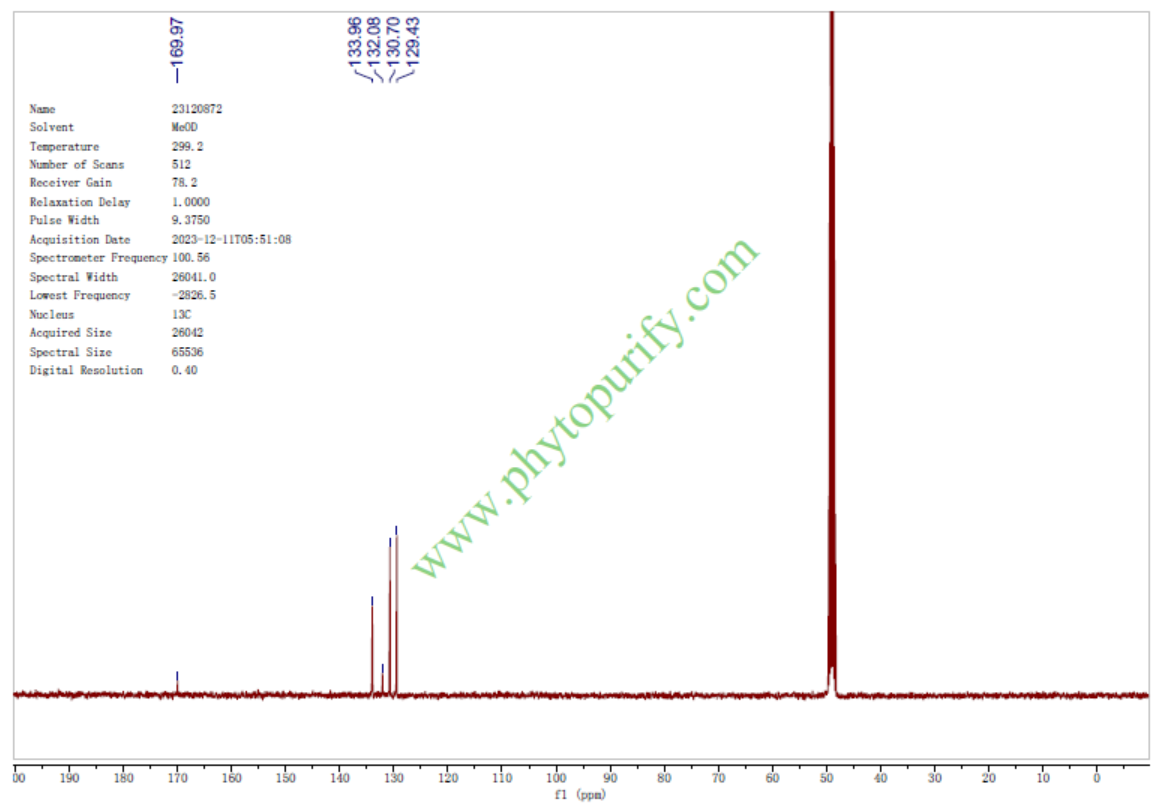
NMR of Benzoic acid
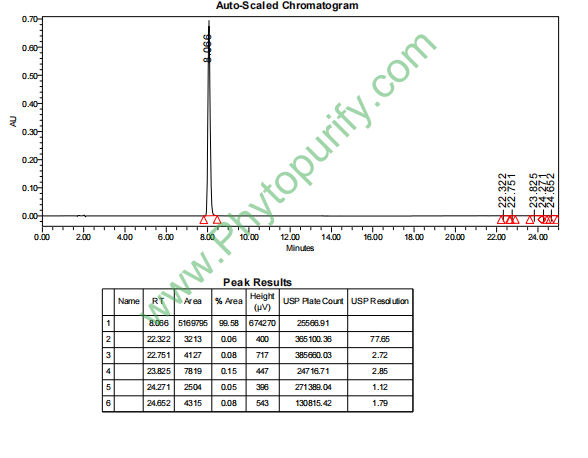
HPLC of Benzoic acid
Storage conditions:Short-term storage at 2~8℃, long-term storage at -20 ~ -80℃
37.3000
1.8651
-.9696
1.5308
3.4049
14.8871
Low
87.2524
1.0549
Yes
No
No
No
Yes
No
0.0
Yes
Yes
Yes
Yes
Benzoic acid (CAS number: 65-85-0), as a simple aromatic carboxylic acid natural product, is widely present in various plants, especially abundant in berries, fruits, and certain resins. Its structural feature is the connection of a carboxylic acid group to the benzene ring, endowing it with unique chemical and biological properties. Benzoic acid is not only commonly used as a preservative in various consumer goods such as food, beverages, and cosmetics, but also widely used due to its excellent antibacterial and antifungal activities. At the same time, it has shown various potential biological activities in pharmacological research. In recent years, with the deepening development of natural product pharmacology, the molecular mechanism of action, target spectrum, and pharmacological evaluation of benzoic acid have gradually become research hotspots, promoting its potential application exploration in the pharmaceutical field.
This article will systematically review the chemical structure and physicochemical properties, plant sources, and extraction methods of benzoic acid, describe its pharmacological activity and mechanism of action, evaluate its pharmacological parameters and pharmacokinetic characteristics, and finally look forward to its clinical application prospects, aiming to provide comprehensive scientific basis for the basic research and clinical development of benzoic acid.
The molecular formula of benzoic acid is C7H6O2, with a molecular weight of 122.1230. Its structural core consists of a benzene ring (aromatic nucleus) connected to a carboxylic acid (- COOH) substituent, and its chemical name is benzoic acid. The LogP value of benzoic acid is 1.8651, indicating that it has moderate lipid solubility and can have certain solubility in both aqueous and lipid phases. Its topological polar surface area (TPSA) is 37.3 Å ², indicating that its molecular polarity is moderate and conducive to binding with multiple biological targets.
The water solubility is 1.5308 (usually measured in mg/mL or g/L, specific literature needs to be confirmed), indicating that benzoic acid has a certain solubility in water, which facilitates its distribution and transportation in organisms. Benzoic acid has low blood-brain barrier permeability, which limits its distribution in the central nervous system, which has positive implications for its safety and side effect control. The hERG channel inhibition experiment result was negative, indicating that benzoic acid is not easily induced to cause arrhythmia and has high safety. The Ames mutagenicity test result was 0.0, indicating no significant genetic toxicity.
Benzoic acid has good chemical stability, is easy to synthesize and modify, and its carboxylic acid groups can achieve structural diversification through chemical reactions such as esterification and amidation, expanding its biological activity and application range.
Benzoic acid is widely present in various plants, especially in berries (such as cranberries and blueberries), spice plants (such as cinnamon and cloves), certain resins, and flowers. The biosynthesis of benzoic acid in plants is mainly through the phenylalanine metabolic pathway, which generates intermediates such as phenylpropanoid and phenylpyruvic acid.
The traditional methods for extracting benzoic acid mainly include solvent extraction, distillation, and crystallization separation. Common solvents include ethanol, methanol, water, and ethyl acetate. In recent years, with the development of green chemistry and efficient separation technology, new technologies such as supercritical CO2 extraction, microwave-assisted extraction, and ultrasound assisted extraction have been applied to the efficient extraction of benzoic acid, improving the extraction rate and purity.
After extraction, benzoic acid is usually purified by recrystallization, column chromatography, or high-performance liquid chromatography (HPLC) to ensure its quality standards for pharmacological research and industrial applications.
The pharmacological activity of benzoic acid is mainly reflected in its antibacterial, antifungal, preservative, and enzyme inhibitory effects. As a natural preservative, benzoic acid and its salts (sodium benzoate, potassium benzoate) are widely used in food and cosmetics to inhibit the growth of various bacteria and fungi, and extend the shelf life of products.
Benzoic acid exhibits inhibitory effects on both Gram positive and Gram negative bacteria, particularly on common pathogenic bacteria such as Staphylococcus aureus, Escherichia coli, and Salmonella. Its antibacterial mechanism mainly involves disrupting the integrity of the cell membrane, reducing intracellular pH, and inhibiting cellular metabolic activity.
Benzoic acid has inhibitory effects on various fungi such as yeast and mold, and is commonly used to prevent mold growth in food and cosmetics. Its mechanism of action involves interfering with the synthesis and function of fungal cell membranes, and inhibiting the activity of key enzymes.
Benzoic acid has been reported to exhibit inhibitory activity against EC 1.13.11.33 (arachidonic acid 15 lipoxygenase) and EC 3.1.1.3 (triacylglycerol lipase). By inhibiting lipase, benzoic acid may affect lipid metabolism and has the potential to regulate energy metabolism and anti-inflammatory effects. Inhibiting arachidonic acid 15 lipoxygenase may weaken the production of inflammatory mediators and exert anti-inflammatory effects.
In addition, benzoic acid, as a human metabolite and a metabolite of plants and algae, participates in multiple metabolic pathways, reflecting its diverse functions in organisms.
The biological activity of benzoic acid depends on its interactions with multiple molecular targets, especially in the field of antibacterial activity. The relevant targets include:
Benzoic acid achieves broad-spectrum antibacterial and antifungal effects through multi-target synergistic effects. In addition, its inhibitory effect on lipase and lipoxygenase suggests its potential value in regulating inflammatory responses and metabolic diseases.
The pharmacological parameters of benzoic acid show that it has good potential for drug development. The molecular weight of 122.1230 conforms to Lipinski's rule, with a moderate LogP of 1.8651, indicating good membrane permeability and bioavailability. TPSA 37.3 Å ² is lower than 140 Å ², indicating that it has good cell membrane permeability.
Moderate water solubility, conducive to the preparation and in vivo absorption of oral preparations. Low blood-brain barrier permeability reduces the risk of central nervous system side effects. HERG channel inhibition is negative, reducing the risk of cardiac toxicity. The Ames test is non mutagenic and has high safety.
In terms of pharmacokinetics, benzoic acid is mainly metabolized in the body through the liver, producing metabolites such as benzoyl CoA, which are then excreted in the urine. Its half-life is moderate and suitable for daily use. Widely distributed in the body, but limited penetration into the central nervous system.
The metabolic stability and safety of benzoic acid make it suitable for use as a pharmaceutical excipient, preservative, and potential therapeutic molecule.
Benzoic acid, as a natural preservative with a long history, has been widely used in the food industry and cosmetics field. With a deeper understanding of its pharmacological activity and molecular mechanism, the clinical application prospects of benzoic acid are gradually expanding.
The inhibitory effect of benzoic acid on various pathogenic bacteria and fungi provides a theoretical basis for its use in the development of anti infective drugs. In the future, its antibacterial spectrum and efficacy can be improved through structural optimization and compatibility, and new antibacterial agents or adjuvant therapeutic drugs can be developed.
Benzoic acid exhibits potential anti-inflammatory and lipid metabolism regulating functions by inhibiting lipoxygenase and lipase. Its application in chronic inflammation, metabolic syndrome, and related diseases deserves further research.
The good safety and pharmacological properties of benzoic acid make it suitable as an excipient in drug delivery systems or in combination with other drugs to enhance efficacy and reduce drug resistance.
Although benzoic acid has various biological activities, its clinical application still faces challenges such as dose limitations, insufficient targeting, and rapid metabolism in vivo. Future research should focus on:
Benzoic acid, as a naturally occurring and structurally simple aromatic carboxylic acid, has significant value in the fields of food preservation and medicine due to its extensive antibacterial, antifungal, and enzyme inhibitory activities. Its good pharmacological parameters and safety lay the foundation for its clinical development. In the future, through interdisciplinary research and optimization of its molecular structure and application strategies, benzoic acid is expected to become a powerful candidate molecule for novel anti infective, anti-inflammatory, and metabolic disease treatments. The in-depth pharmacological mechanism analysis and clinical research of the system will promote the transformation of benzoic acid from traditional preservatives to modern drugs, and expand its application prospects in the field of natural product pharmacology.
