


Synonym name: Thermopsoside
Catalogue No.: BP0347
Cas No.: 19993-32-9
Formula: C22H22O11
Mol Weight: 462.407
Botanical Source: Pyrus sp. and other plant spp.
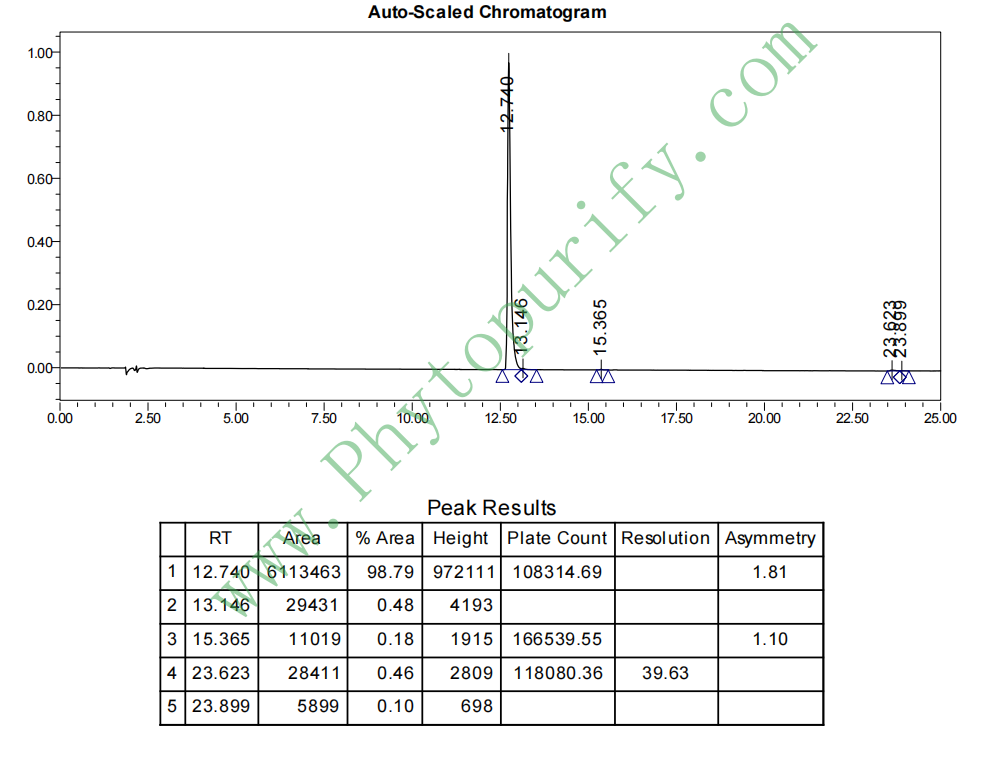
Purity: 95%~99%
Analysis Method: HPLC-DAD or/and HPLC-ELSD
Identification Method: Mass, NMR
Packing: Brown vial or HDPE plastic bottle
Can be supplied from milligrams to grams.
For Reference Standard and R&D, Not for Human Use Directly.
Inquire for bulk scale.
HPLC of Chrysoeriol-7-O-beta-D-glucopyranoside
Storage conditions:Short-term storage at 2~8℃, long-term storage at -20 ~ -80℃
199.1900
-2.0000
-2.5000
No
No
No
No
Unknown
No
Unknown
Chrysoeriol-7-O-beta-D-glucopyranoside (hereinafter referred to as Chrysoeriol-7-O-beta-D-glucopyranoside) is a natural flavonoid compound that has received widespread attention in the field of natural product pharmacology in recent years due to its unique structure and diverse biological activities. Flavonoids, as secondary metabolites in plants, have multiple biological functions such as antioxidant, anti-inflammatory, and anti-tumor. As an important member, coelicin-7-glucoside has shown potential therapeutic value for various diseases, especially colon cancer.
As one of the malignant tumors with high incidence rate and mortality worldwide, colon cancer has many side effects and drug resistance problems in traditional treatment methods such as surgery, radiotherapy and chemotherapy. It is urgent to develop new highly effective and low toxic therapeutic drugs. Coriolin-7-glucoside exhibits significant anti colon cancer potential by regulating various key molecular targets, such as AMPK, BCL2, STAT3, ALOX5, TOP1, MAPK1, TNF, GSK3B, PIK3CA, and EGFR. This article aims to systematically review the chemical structure, sources, pharmacological activity, mechanism of action, drug evaluation, and future clinical application prospects of coelicin-7-glucoside, providing theoretical basis and research direction for its development as a novel anti-tumor drug.
The molecular formula of coelicin-7-glucoside is C22H2O_11, with a molecular weight of 462.40 Da. Its chemical structure is composed of the flavonoid nucleus Chrysoeriol and β - D-glucoside connected by an O-glycosidic bond formed by the 7-hydroxyl group. Koilisin belongs to the flavonol class of flavonoids and has a typical tricyclic structure (C6-C3-C6), where the A and B rings are benzene rings, and the C ring is a heterocyclic ring. The introduction of glucoside significantly increased the water solubility of the molecule, with a TPSA (topological polar surface area) of up to 199.19 Å ² and 11 hydrogen bond acceptors, indicating strong polarity and good water solubility.
The LogP value is -2.00, indicating that the compound has strong hydrophilicity and is difficult to diffuse freely through lipid membranes, which may affect its cell membrane permeability and oral bioavailability. Multiple hydroxyl and ether bonds in the molecular structure provide potential binding sites for its biological activity, while also affecting its metabolic stability. This compound is not easily able to penetrate the blood-brain barrier, indicating that it mainly acts on peripheral tissues and reduces the risk of central nervous system toxicity.
Coriolin-7-glucoside is widely present in various traditional medicinal plants, especially in certain flavonoid rich herbaceous plants such as the Lamiaceae, Leguminosae, and Asteraceae families. Common plant sources include Scutellaria baicalensis, Bupleurum chinense, and flavonoid extracts from certain traditional Chinese medicine formulas.
The extraction method mainly relies on polar solvent extraction, such as ethanol water mixed solvent (30% -70% ethanol) extraction under reflux or ultrasound assisted conditions. The extraction solution was concentrated, liquid-liquid partitioned, purified by silica gel column chromatography and high-performance liquid chromatography (HPLC), and finally obtained high-purity coelicin-7-glucoside. In recent years, supercritical CO2 extraction and membrane separation technologies have also been applied to improve extraction efficiency and purity.
The optimization of extraction process mainly revolves around solvent polarity, temperature, time, and pH conditions to maximize the stability and biological activity of flavonoid structure. During the extraction process, attention should be paid to avoiding high temperature and strong acid-base conditions to prevent hydrolysis of glycosidic bonds.
Coriolin-7-glucoside exhibits significant anti-tumor activity in various in vitro and in vivo colon cancer models. Cell experiments have shown that the compound can inhibit the proliferation and migration of colon cancer cell lines (such as HCT116, SW480), induce cell cycle arrest and apoptosis. In the mouse colon cancer transplantation model, coelicin-7-glucoside significantly reduced tumor volume and weight without significant toxic side effects.
The occurrence and development of colon cancer are closely related to chronic inflammation. Coriolin-7-glucoside reduces intestinal inflammation and improves the tumor microenvironment by inhibiting the pro-inflammatory factors TNF - α, IL-6, and NF - κ B signaling pathways. In addition, its strong antioxidant capacity can clear excess reactive oxygen species (ROS), reduce DNA damage caused by oxidative stress, and lower the risk of cancer.
In addition to anti-tumor effects, coelicin-7-glucoside also exhibits potential activities such as antibacterial, antiviral, and neuroprotective effects. Its multi-target and multi pathway mode of action makes it an ideal candidate for the development of multifunctional drugs.
Coriolin-7-glucoside achieves its anti colon cancer effect through multi-target regulation, mainly involving the following key molecules and signaling pathways:
AMPK (PRKAA1) activation
AMPK, as a key regulatory factor in cellular energy metabolism, can inhibit lipid synthesis and protein synthesis in tumor cells, induce autophagy and cell apoptosis when activated. Coriolin-7-glucoside can activate the AMPK signaling pathway and inhibit the proliferation of colon cancer cells.
BCL2 inhibition
BCL2 family proteins regulate cell apoptosis, and coelicin-7-glucoside promotes mitochondrial mediated cell apoptosis by downregulating BCL2 expression.
STAT3 signaling pathway inhibition
STAT3 is a signal transduction factor that promotes survival in various tumor cells. Coriolin-7-glucoside inhibits the phosphorylation and nuclear translocation of STAT3, blocks its transcriptional activity, and reduces the anti apoptotic and proliferative abilities of tumor cells.
ALOX5 inhibition
ALOX5 participates in fatty acid metabolism and generates pro-inflammatory mediators. Coriolin-7-glucoside inhibits ALOX5 activity, reduces inflammatory response, and suppresses the oncogenic effect of the tumor microenvironment.
TOP1 inhibition
TOP1 is a DNA topoisomerase involved in DNA replication and transcription. Coriolin-7-glucoside inhibits TOP1 activity, hinders cancer cell DNA repair and replication, and induces cell death.
MAPK1 regulation
The MAPK1 (ERK2) signaling pathway regulates cell proliferation and differentiation. Coriolin-7-glucoside inhibits abnormal proliferation of tumor cells by regulating MAPK1 activity.
TNF regulation
As a major pro-inflammatory factor, TNF plays a complex role in the tumor microenvironment. Coriolin-7-glucoside can regulate TNF expression, alleviate chronic inflammation, and inhibit tumor progression.
GSK3B regulation
GSK3B is involved in cell cycle regulation and apoptosis. Coriolin-7-glucoside promotes cancer cell apoptosis by regulating GSK3B activity.
Inhibition of PIK3CA/EGFR signaling pathway
PIK3CA and EGFR are important signaling molecules for tumor cell proliferation and survival. Coriolin-7-glucoside inhibits the PI3K/AKT and EGFR signaling pathways, blocking oncogenic signaling.
In summary, coelicin-7-glucoside exerts a comprehensive anti colon cancer effect through multi-target and multi pathway synergistic effects, demonstrating its advantages as a natural product drug.
The pharmacological parameters of coelicin-7-glucoside indicate its potential for development. The molecular weight of 462.4 Da is slightly higher than the recommended upper limit of 500 Da by Lipinski's rule, but still within an acceptable range. The LogP is -2.00, indicating its strong hydrophilicity, which may limit oral absorption but improve water solubility, which is beneficial for formulation development.
The TPSA is 199.19 Å ², and the higher polar surface area suggests limited membrane permeability, which may require carrier mediated absorption or structural modification to improve bioavailability. The number of hydrogen bond receptors is 11, and having more hydrogen bond receptors helps to form stable binding with the target, but may also affect membrane permeability.
In terms of safety, coelicin-7-glucoside has no hepatotoxicity, cardiotoxicity, or hERG channel inhibition, indicating its high safety. The blood-brain barrier is difficult to penetrate, reducing the risk of central nervous system side effects. The Ames test results are not yet clear and further genotoxicity evaluation is needed.
Pharmacokinetic studies have shown that oral absorption of coelicin-7-glucoside is slow, with a moderate plasma half-life. It is mainly metabolized by the liver, and the metabolites have certain activity. Its glycoside structure is easily hydrolyzed by gut microbiota, releasing active flavonoid mother nuclei, which may affect the existence and function of active forms in the body.
In the future, through structural optimization, nanocarrier encapsulation, or co administration strategies, it is expected to improve its pharmacokinetic performance and enhance its clinical application potential.
As a multi-target natural flavonoid compound, coelicin-7-glucoside has significant anti colon cancer activity and good safety, providing a new approach for adjuvant therapy of colon cancer. Its ability to resist inflammation, oxidation, and regulate the tumor microenvironment helps to comprehensively intervene in multiple stages of tumor occurrence and development.
At present, coelicin-7-glucoside is still in the stage of basic research and early pharmacological evaluation, lacking systematic clinical trial data. Future research should focus on the following directions:
In depth mechanism research
Using genomics, proteomics, and metabolomics techniques, elucidate the panoramic network of the action of coelicin-7-glucoside and reveal its multi-target synergistic mechanism.
Pharmacokinetics and formulation development
Optimize the administration method and dosage form, enhance oral bioavailability and in vivo stability, and develop formulations suitable for clinical application.
Safety and Toxicological Evaluation
Systematically evaluate the safety of long-term medication, especially genotoxicity and immunotoxicity, to provide safety assurance for clinical trials.
Preclinical and clinical trials
Design reasonable animal models and human clinical trials to verify their effectiveness and safety, and promote their conversion into clinical drugs.
Combination therapy strategy
Explore the combination application with existing chemotherapy drugs or targeted drugs to enhance synergy, overcome drug resistance, and improve treatment efficacy.
In summary, as a representative of natural anti-tumor drugs, coelicin-7-glucoside has broad clinical application prospects, but interdisciplinary collaboration and systematic research are still needed to promote its clinical translation.
As a natural flavonoid compound with unique structure and diverse activities, coelicin-7-O-glucoside has shown significant potential in the treatment of colon cancer. It exerts anti-tumor, anti-inflammatory, and antioxidant effects by regulating multiple key molecular targets, demonstrating the advantages of natural product multi-target therapy. The drug efficacy evaluation shows that it has good safety, but its pharmacokinetic properties still need to be optimized.
In the future, with the deepening of molecular mechanisms and advances in drug development technology, coelicin-7-glucoside is expected to become a new candidate drug for the treatment of colon cancer and related diseases. Systematic clinical research and rational drug design will be the key to promoting its clinical application. The continuous development of natural product pharmacology will contribute more innovative forces to the human anti-cancer cause.
