


Product name: Chelidonine
Synonym name: Stylophorine
Catalogue No.: BP0342
Cas No.: 476-32-4
Formula: C20H19NO5
Mol Weight: 353.374
Botanical Source: Chelidonium majus
Physical Description:
Type of Compound: Alkaloids
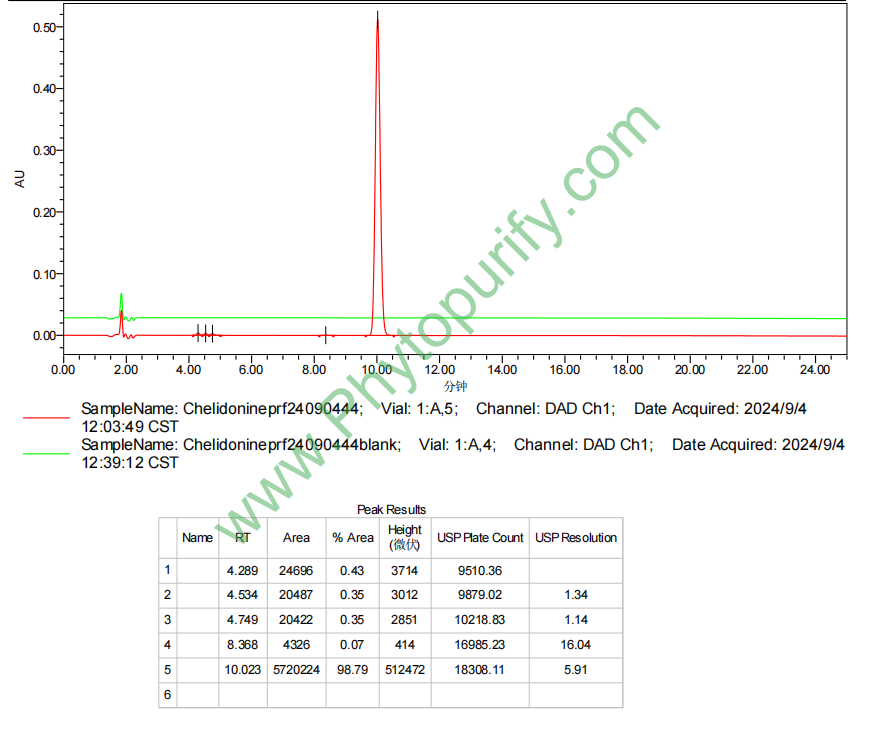
Purity: 95%~99%
Analysis Method: HPLC-DAD or/and HPLC-ELSD
Identification Method: Mass, NMR
Packing: Brown vial or HDPE plastic bottle
The product could be supplied from milligrams to grams
Inquire for bulk scale.
Description:
Chelidonine is a promising model compound for overcoming MDR and for enhancing cytotoxicity of chemotherapeutics, especially against leukaemia cells, its efficacy needs to be confirmed in animal models. Chelidonine may be a potential therapeutic agent against metastasis of invasive human cancer cells, exhibits anti‑migratory and anti‑invasive effects in MDA‑MB‑231 cells, by suppressing COL‑I‑induced integrin signaling, through inhibiting the formation of the IPP complex and subsequent down‑regulation of IPP downstream signaling molecules, such as Akt and ERK1/2.
References:
Chem Biol Interact. 2014 Sep 30;223C:141-149.
Multiple mechanisms of cell death induced by chelidonine in MCF-7 breast cancer cell line.
In a preliminary study screening anti-proliferative natural alkaloids, a very potent benzophenanthridine, Chelidonine showed strong cytotoxicity in cancer cells. While several modes of death have been identified, most of anti-cancer attempts have focused on stimulation of cells to undergo apoptosis.
METHODS AND RESULTS:
Chelidonine seems to trigger multiple mechanisms in MCF-7 breast cancer cells. It induces both apoptosis and autophagy modes of cell death in a dose dependent manner. Alteration of expression levels of bax/bcl2, and dapk1a by increasing concentration of Chelidonine approves switching the death mode from apoptosis induced by very low to autophagy by high concentrations of this compound. On the other hand, submicromolar concentrations of Chelidonine strongly suppressed telomerase at both enzyme activity and hTERT transcriptional level. Long exposure of the cells to 50 nanomolar concentration of Chelidonine considerably accelerated senescence.
CONCLUSIONS:
Altogether, Chelidonine may provide a promising chemistry from nature to treat cancer.
Phytomedicine. 2013 Feb 15;20(3-4):282-94.
Modulation of multidrug resistance in cancer cells by chelidonine and Chelidonium majus alkaloids.
Cancer cells often develop multidrug resistance (MDR) which is a multidimensional problem involving several mechanisms and targets.
METHODS AND RESULTS:
This study demonstrates that Chelidonine and an alkaloid extract from Chelidonium majus, which contains protoberberine and benzo[c]phenanthridine alkaloids, has the ability to overcome MDR of different cancer cell lines through interaction with ABC-transporters, CYP3A4 and GST, by induction of apoptosis, and cytotoxic effects. Chelidonine and the alkaloid extract inhibited P-gp/MDR1 activity in a concentration-dependent manner in Caco-2 and CEM/ADR5000 and reversed their doxorubicin resistance. In addition, Chelidonine and the alkaloid extract inhibited the activity of the drug modifying enzymes CYP3A4 and GST in a dose-dependent manner. The alkaloids induced apoptosis in MDR cells which was accompanied by an activation of caspase-3, -8,-6/9, and phosphatidyl serine (PS) exposure. cDNA arrays were applied to identify differentially expressed genes after treatment with Chelidonine and the alkaloid extract. The expression analysis identified a common set of regulated genes related to apoptosis, cell cycle, and drug metabolism. Treatment of Caco-2 cells with 50 μg/ml alkaloid extract and 50 μM Chelidonine for up to 48 h resulted in a significant decrease in mRNA levels of P-gp/MDR1, MRP1, BCRP, CYP3A4, GST, and hPXR and in a significant increase in caspase-3 and caspase-8 mRNA.
CONCLUSIONS:
Thus, Chelidonine is a promising model compound for overcoming MDR and for enhancing cytotoxicity of chemotherapeutics, especially against leukaemia cells. Its efficacy needs to be confirmed in animal models.
Toxicol Lett. 2013 Sep 12;222(1):10-22.
Cytotoxicity and apoptotic signalling cascade induced by chelidonine-loaded PLGA nanoparticles in HepG2 cells in vitro and bioavailability of nano-chelidonine in mice in vivo.
Poor oral bioavailability of Chelidonine, a bio-active ingredient of Chelidonium majus, showing anti-cancer potentials against cancer cells with multidrug resistance, makes its optimal use rather limited.
METHODS AND RESULTS:
To address this problem, we encapsulated Chelidonine in biodegradable poly(lactide-co-glycolide) (PLGA) polymers and evaluated nano-Chelidonine's (NCs) anti-cancer efficacy vis-à-vis free Chelidonine (FC) against HepG2 cells and also evaluated its bioavailability in mice. Physicochemical characteristics indicated that stable spherical NC were formed in nanometer size range (123±1.15 nm) with good yield (86.34±1.91%), better encapsulation efficiency (82.6±0.574%), negative surface charge (-19.6±2.48 mV) and ability of prolonged and sustained release of Chelidonine. Fourier transform infrared analysis revealed that NC resembled similar peaks as that of FC suggesting effective encapsulation in PLGA. NC exhibited rapid cellular uptake and stronger apoptotic effect (∼46.6% reduced IC₅₀ value) than FC, blocking HepG2 cells at G2/M phase. p53, cyclin-D1, Bax, Bcl-2, cytochrome c, Apaf-1, caspase-9 and caspase-3 expressions also corroborated well to suggest greater anticancer potentials of NC.
CONCLUSIONS:
Our in vivo studies demonstrated NC to be more bio-available than FC and showed a better tissue distribution profile without inducing any toxicity (100 mg/kg bw) in mice. Unlike FC, NC could permeate into brain tissue, indicating thereby NC's better potentials for use in therapeutic oncology.
HPLC of Chelidonine
Storage conditions:Short-term storage at 2~8℃, long-term storage at -20 ~ -80℃
Chelidonine is a typical isoquinoline alkaloid, mainly extracted from the poppy family plant Chelidonium majus L. As one of the most representative active ingredients in Bai Qu Cai, Bai Qu Cai alkaloid is widely used in traditional Chinese medicine due to its effects of clearing heat, detoxifying, reducing swelling, and relieving pain. In recent years, with the development of modern pharmacology and molecular biology techniques, the biological activity and molecular mechanism of action of quercetin have gradually been revealed, especially in the fields of anti-tumor and antiviral effects, showing significant potential. It can induce cell cycle arrest and multiple pathways of cell apoptosis, demonstrating inhibitory effects on various tumor cells such as Candida albicans, melanoma, and lung cancer, making it a hot topic in natural product pharmacology research.
This article will provide a systematic review of the chemical structure and physicochemical properties, plant sources and extraction methods, pharmacological activities, and mechanisms of action of quercetin. The focus will be on exploring its molecular target effects in related diseases such as lung cancer. Combined with drug evaluation and pharmacokinetic analysis, the clinical application prospects will be discussed, aiming to provide theoretical basis and practical guidance for subsequent research and drug development.
Chelidonine has the chemical formula C21H21NO5 and a molecular weight of 353.37. Its structure belongs to isoquinoline alkaloids, and its typical polycyclic structure contains multiple oxidative functional groups, exhibiting high chemical stability and biological activity. The LogP value of quercetin is about 2.4, indicating its moderate lipid solubility, which is beneficial for membrane penetration. Its topological polar surface area (TPSA) is 73.99 Å ² and the number of hydrogen bond acceptors is 6, indicating that the molecule has certain polarity and hydrogen bonding ability, which may affect its binding affinity with target proteins.
The molecular structure of Baiqucai alkaloid contains an isoquinoline skeleton and multiple hydroxyl and methoxy groups, which not only endow it with good biological activity, but also allow it to produce various metabolites during in vivo metabolism. The complexity of its chemical structure provides diverse chemical modification sites for designing derivatives and optimizing drug efficacy.
Chelidonium majus L., a perennial herb in the Papaveraceae family, is the main source of Chelidonium majus alkaloids. It is widely distributed in parts of Europe, Asia, and North America. The whole plant, especially the root and stem parts, of Quercus lactiflora contains abundant isoquinoline alkaloids, among which Quercus lactiflora has a higher content of isoquinoline alkaloids.
The traditional extraction method usually uses alcohol solvents (such as methanol, ethanol) to extract the dried white clover powder, and then enriches the alkaline components through acid-base extraction, liquid-liquid distribution and other steps. Modern extraction techniques such as ultrasound assisted extraction, microwave-assisted extraction, and high-performance liquid chromatography (HPLC) separation and purification have significantly improved the extraction efficiency and purity of quercetin. In recent years, the composite extraction method combining molecular imprinting technology and membrane separation technology has also provided new ideas for the industrial production of quercetin.
During the extraction process, it is necessary to strictly control the pH value and temperature to prevent the degradation and isomerization of quercetin, ensuring the stability and biological activity of its active ingredients.
The pharmacological activities of Baiqucai alkaloid are mainly reflected in anti-tumor, antiviral, and cell cycle regulation aspects. A large number of in vitro cell experiments and some animal model studies have shown that quercetin can significantly inhibit the proliferation of various tumor cells, induce cell apoptosis, and have certain antiviral activity.
Chelidine has cytotoxic effects on melanoma, lung cancer, breast cancer and other tumor cells. It induces G2/M phase arrest of the cell cycle, blocks the process of cell division, and inhibits the proliferation of tumor cells. In terms of cell apoptosis, quercetin can activate caspase dependent pathways and induce cell death through non dependent pathways, demonstrating a multi-target and multi pathway anti-tumor mechanism.
Baiqu alkaloid exhibits inhibitory effects on various viruses, especially in blocking virus replication and infection processes. Although the specific target has not been fully identified, its potential to enhance antiviral ability by regulating host cell signaling pathways and immune responses deserves further investigation.
Baiqu alkaloid can prevent the cell cycle progression of Dugesia japonica stem cells, indicating its potential application value in stem cell biology and regenerative medicine. In addition, the cell cycle inhibition provides important theoretical support for its anti-tumor mechanism.
The biological effects of quercetin depend on its regulation of multiple signaling pathways and molecular targets, especially in the study of its mechanism of action in malignant tumors such as lung cancer.
Baiqu alkaloid induces G2/M phase arrest of the cell cycle, blocks cell mitosis, and reduces cell proliferation. The induced apoptosis of cells depends on both the activation of caspase family proteins (such as CASP9) and non caspase dependent pathways, exhibiting multiple regulatory networks.
In summary, Bai Qu Cai alkaloid regulates the proliferation, apoptosis, and metabolism of tumor cells through multi-target and multi pathway synergistic effects, demonstrating its complex and effective anti-tumor mechanism.
The pharmacological parameters of Baiqucai alkaloid indicate that it has certain potential for drug development, but at the same time, there are safety risks.
The molecular weight of Baiqu Cai alkaloid is 353.37, with a LogP of 2.4, indicating moderate lipid solubility, which is beneficial for cell membrane penetration and oral absorption. The TPSA is 73.99, which conforms to the polarity range of drug molecules and supports its good bioavailability. Its blood-brain barrier permeability is relatively high, indicating that it may affect the central nervous system, which may bring therapeutic advantages but also require vigilance against neurotoxicity.
The LD50 of quercetin is about 100 mg/kg, which belongs to the moderate toxicity range. Both hepatotoxicity and cardiotoxicity have been reported, indicating that strict monitoring of liver and heart function is necessary during drug development. The Ames test is positive, indicating that it may have genotoxicity and further assessment of its mutagenic risk is needed. The inhibitory effect of hERG channel is not yet clear, and further research is needed to assess the risk of arrhythmia.
At present, there are relatively few studies on the systematic pharmacokinetics of quercetin. Preliminary data indicate that it has good oral absorption, but its metabolic pathway is complex, mainly through liver metabolism. The safety and activity of metabolites still need further research. Its high blood-brain barrier permeability suggests potential applications in central system diseases, but also increases the risk of neurotoxicity.
As a natural isoquinoline alkaloid, quercetin has attracted widespread attention in the field of drug development due to its multi-target anti-tumor activity, especially its potential application value in malignant tumors such as lung cancer. The future clinical application prospects are mainly reflected in the following aspects:
Development of anti-tumor drugs
Baiqu alkaloid synergistically regulates tumor cell growth through multiple signaling pathways, providing a theoretical basis for the development of novel anticancer drugs. By combining modern drug design techniques, its selectivity and safety can be improved through structural optimization, while reducing toxic side effects.
Combination therapy strategy
Baiqucai alkaloid can be used in combination with chemotherapy drugs or targeted drugs to enhance anti-tumor effects and overcome drug resistance. Its regulation of signaling pathways such as STAT3 and PI3K provides a molecular basis for combination therapy.
Potential for antiviral therapy
Its antiviral activity provides the possibility for the development of new antiviral drugs, especially in the treatment of viral infection related tumors with dual effects.
Safety and toxicity control
Due to the risks of hepatotoxicity, cardiotoxicity, and genotoxicity, future research needs to focus on safety evaluation, exploring dose optimization, improvement of administration routes, and toxicity mitigation strategies.
Drug formulations and delivery systems
By utilizing modern pharmaceutical technologies such as nanocarriers and targeted delivery systems, the bioavailability and targeting of quercetin can be improved, systemic toxicity can be reduced, and clinical application value can be enhanced.
Overall, as a multifunctional natural product, quercetin has good potential for drug development, but its safety remains a key bottleneck for clinical translation. In the future, it is necessary to strengthen its pharmacological mechanism and toxicology research, and promote its clinical application.
As a widely sourced and structurally unique isoquinoline alkaloid, Baiqu Cai alkaloid has become an important subject of natural product pharmacology research due to its significant anti-tumor and antiviral activities. It exhibits complex and effective biological functions by regulating cell cycle and apoptosis through multiple targets and pathways. Although its pharmacological parameters show certain potential for drug development, safety issues such as hepatotoxicity, cardiotoxicity, and genotoxicity still require high attention.
Future research should focus on in-depth analysis of its molecular mechanism, optimization of chemical structure to improve selectivity and safety, improvement of drug delivery methods in combination with modern pharmaceutical technologies, and systematic pharmacokinetic and toxicological evaluations. Through multidisciplinary collaborative efforts, Bai Qu Cai alkaline is expected to become a new natural medicine for the treatment of lung cancer and other malignant tumors, providing new strategies and choices for clinical tumor treatment.
