


Product name: Raubasine
Synonym name: Ajmalicine; Tetrahydroalstonine; δ-Yohimbine; Vinceine; Vincaine; Py-tetrahydroserpentine; Lamuran
Catalogue No.: SBP00054
Cas No.: 6474-90-4
Formula: C21H24N2O3
Mol Weight: 352.434
Botanical Source:
Physical Description:
Type of Compound: Alkaloids
Purity: 95%~99%
Analysis Method: HPLC-DAD or/and HPLC-ELSD
Identification Method: Mass, NMR
Packing: Brown vial or HDPE plastic bottle
The product could be supplied from milligrams to grams
Inquire for bulk scale.
For Reference Standard and R&D, Not for Human Use Directly.
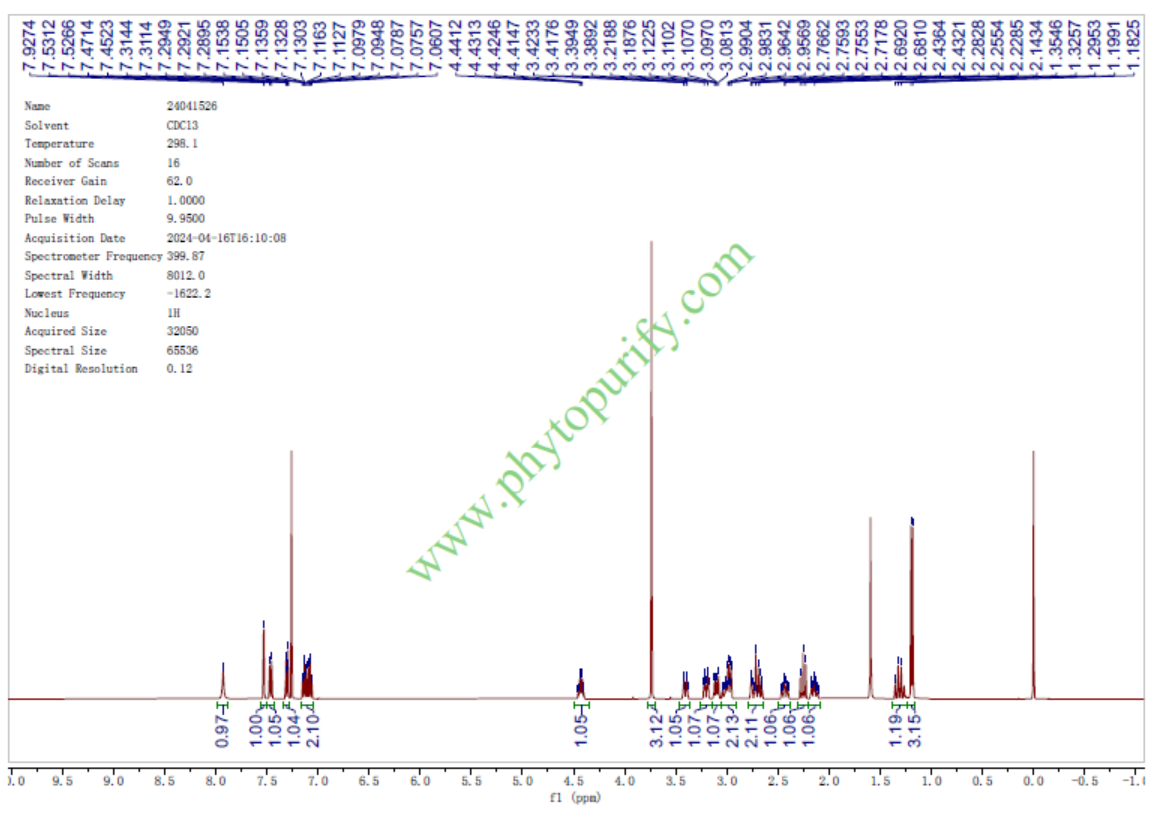
HNMR of Raubasine
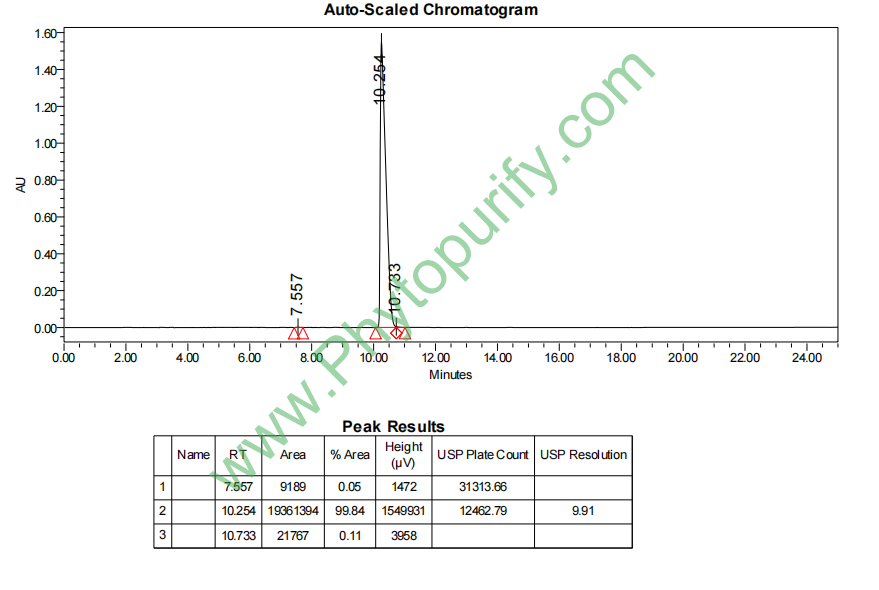
HPLC of Raubasine
Storage conditions:Short-term storage at 2~8℃, long-term storage at -20 ~ -80℃
54.5600
2.8308
2.5881
.0364
2.8876
17.2681
High
76.1428
3.9357
No
No
No
Yes
No
No
0.0
No
No
Yes
Yes
Hypertension is one of the major controllable risk factors for the onset and mortality of cardiovascular and cerebrovascular diseases worldwide. Among numerous antihypertensive drugs, natural products derived from traditional medicinal plants have always been an important treasure trove for drug development due to their unique chemical structure and multi-target mechanism of action. Raubasine, also known as Amanitine or Amarixin, is a monoterpenoid indole alkaloid with significant pharmacological activity. Its discovery and application are exemplary of the successful combination of modern natural medicinal chemistry and pharmacology. Since its isolation and identification from the traditional blood pressure reducing plant Rosa rugosa in the mid-20th century, Robaxin has been developed for the treatment of mild to moderate hypertension and peripheral vascular diseases due to its clear α 1-adrenergic receptor antagonistic activity. With the deepening of research, its pharmacological spectrum continues to expand, especially in improving cerebral circulation, protecting neurons and other aspects, showing potential value, making it receive renewed attention in the field of cerebrovascular diseases. This article aims to provide a systematic review of the chemical properties, plant sources, pharmacological activities, mechanisms of action, pharmacological evaluation, and clinical application prospects of Loquat, in order to provide comprehensive scientific references for the in-depth research and secondary development of this classic natural product.
The chemical name of Robaoxin (CAS number: 483-04-5) is (19 α) -16,17-dehydro-19-methyl-oxahuman-16-carboxylic acid methyl ester, with a molecular formula of C21H24N2O3 and a molecular weight of 352.4340. Its structure belongs to monoterpene indole alkaloids, and its core skeleton is composed of an indole ring fused with a complex polycyclic system (yuhenan type), forming an organic heterocyclic ring system. The structure contains a tertiary amine nitrogen atom, an ester group (methyl ester), and multiple chiral centers, which determine the complexity of its stereochemistry, the specificity of its interaction with receptors, and ultimately its biological activity.
From the analysis of its physical and chemical properties, the calculated lipid water partition coefficient (LogP) of Luobaoxin is about 2.83, indicating its moderate lipophilicity, which is beneficial for its penetration of cell membranes, but may also affect its distribution in aqueous media. Its topological polar surface area (TPSA) is 54.56 Å ², which is relatively moderate. The experimental data shows that its water solubility is low (about 0.0364 mg/mL), which suggests that solubilization strategies may need to be considered in formulation development to improve its bioavailability. It is worth noting that its molecular properties give it a high blood-brain barrier penetration ability, which lays the physical and chemical foundation for its direct action on central nervous system targets, exerting cerebrovascular and neuroprotective effects. In addition, it exists as a conjugated base form of ajmalicin (1+) and mainly interacts with the target in a protonated form under physiological pH conditions.
Lobaoxin mainly exists in various medicinal plants of the Apocynaceae family, among which the genus Lolium(Rauvolfia)Changchun Flower genus(Catharanthus, formerly known as Vinca)Plants are the main source. The most famous source plant is the Indian rosewood(Rauvolfia serpentina)Its roots have long been used in traditional Indian medicine (Ayurveda) to treat hypertension, anxiety, and insomnia. In addition, to urge Turfim(R. vomitoria)Chinese rosewood(R. verticillata)And Changchun flowers(Catharanthus roseus)Plants also contain a considerable amount of lovastatin and its analogues.
The extraction and separation of Luoba Xin usually follow the classic process of natural product chemistry. Firstly, the dried plant raw materials (commonly roots) are crushed and extracted or percolated with polar organic solvents (such as methanol, ethanol, or aqueous ethanol) to obtain the crude extract of total alkaloids. Subsequently, preliminary enrichment was carried out using the acid water alkalization organic solvent extraction method: the crude extract was dissolved in a dilute acid water solution to dissolve the alkaloids into salts, and the acid insoluble substances were filtered out. Then, the pH was adjusted to alkaline using a base (such as ammonia water) to allow the alkaloids to precipitate freely, and extraction was carried out using organic solvents such as chloroform and dichloromethane. The obtained alkaloid mixture needs to be further purified by chromatographic separation techniques. In the early stages, alumina or silica gel column chromatography was commonly used, combined with thin-layer chromatography (TLC) monitoring. Modern separation methods rely more on high-performance liquid chromatography (HPLC), medium pressure preparative chromatography (MPLC), etc., which can more efficiently and high-purity obtain rosmarin monomers. The structural identification mainly relies on spectroscopic methods such as nuclear magnetic resonance (NMR), mass spectrometry (MS), infrared spectroscopy (IR), and X-ray single crystal diffraction.
The pharmacological activity research of Luoba Xin began with its significant antihypertensive effect and gradually expanded to multi-dimensional regulation of the cardiovascular and cerebrovascular systems.
Antihypertensive and vasodilatory effects Lobaoxin is a classic alpha 1-adrenergic receptor antagonist. By blocking the alpha 1 receptor on the smooth muscle of blood vessels, the vasoconstriction caused by norepinephrine is inhibited, leading to a decrease in peripheral vascular resistance and thus producing a hypotensive effect. Its blood pressure lowering effect is stable and has a relatively small impact on heart rate. In addition, research suggests that it may assist in vasodilation through other pathways, such as affecting calcium ion channels or promoting the release of endothelial derived vasodilators.
Improving cerebral circulation and cerebrovascular disease-related activity Thanks to its excellent blood-brain barrier penetrability, rosmarin has a selective vasodilation effect on cerebral blood vessels, which can increase cerebral blood flow, improve brain tissue oxygen supply and energy metabolism. In various experimental models of cerebral vasospasm and cerebral ischemia/reperfusion injury, rosmarin exhibits neuroprotective effects, reducing brain edema, reducing infarct size, and improving neurological deficits. These effects are related to their vasodilation, inhibition of platelet aggregation, antioxidant properties, and potential anti-inflammatory effects.
The impact on the neurotransmitter system In addition to its main antagonistic effect on the adrenergic system, rosmarin also has a certain regulatory effect on other neurotransmitter systems. There are studies reporting that it can inhibit the norepinephrine transporter (NET, encoded by the SLC6A2 gene), thereby increasing the level of norepinephrine in synaptic cleft, which may be related to some of its effects in the central nervous system, such as possible emotional regulation. In addition, it also has weak interactions with the serotonin system.
Other potential activities Early research also found that Loquat has a certain sedative effect. In recent years, few studies have explored its potential in improving cognitive function, anti anxiety, and other aspects, but more evidence is needed to support it.
The pharmacological action of Loquat is the result of its interaction with multiple molecular targets in the body, and its core mechanism revolves around the regulation of the adrenergic system and vascular function.
Core target: α 1-adrenergic receptor (ADRA1A)As a selective α 1-adrenergic receptor antagonist, the main target of Rosuvastatin is the α 1A subtype (ADRA1A). This receptor belongs to the G protein coupled receptor (GPCR) superfamily and is mainly distributed on the membrane of vascular smooth muscle cells. Lobaoxin competitively antagonizes the binding of norepinephrine and adrenaline to this receptor, inhibits Gq protein activation, thereby reducing phospholipase C (PLC) activation and inositol triphosphate (IP3) production, ultimately leading to reduced intracellular calcium mobilization, smooth muscle relaxation, and vascular dilation.
Secondary targets and related pathways:
In summary, the mechanism of action of Rosuvastatin is mainly based on selective antagonism of vascular alpha 1 receptors, supplemented by inhibition of neurotransmitter reuptake and potential improvement of vascular endothelial function, forming a network of its cardiovascular and cerebrovascular protective effects.
Based on the provided pharmacological parameters and existing research, conduct a preliminary pharmacological evaluation of Loquat:
Despite being partially replaced by newer antihypertensive drugs with higher selectivity or fewer side effects (such as highly selective alpha 1 blockers, ACEIs, ARBs, etc.) as a single component antihypertensive drug, its unique pharmacological properties still make it valuable in specific fields and have given rise to new research directions.
As a classic natural product that has emerged from traditional medicinal plants, the discovery and application of Luoba Xin have witnessed the cornerstone role of natural products in drug development. It has a clear α 1-adrenergic receptor antagonistic effect as its core, and possesses multiple pharmacological activities such as improving cerebral circulation and potential neuroprotection, forming the pharmacological basis for its treatment of hypertension and cerebrovascular diseases. Despite facing challenges such as water solubility and cardiac safety, it still exhibits many advantageous properties in terms of drug efficacy. Currently, with the deepening understanding of the pathogenesis of cerebrovascular and neurodegenerative diseases, as well as the advancement of drug research and development technology, Luoba Xin is ushering in a second development opportunity of "new use of old drugs" and "structural optimization". In the future, through in-depth mechanism research, precise clinical positioning, innovative formulation technology, and reasonable structural modification, the ancient natural molecule of Luoba Xin is expected to shine in the field of cardiovascular and neurological and psychiatric disease treatment, and continue to contribute to human health. Its research paradigm also provides valuable reference for the modern development of other natural active ingredients.
