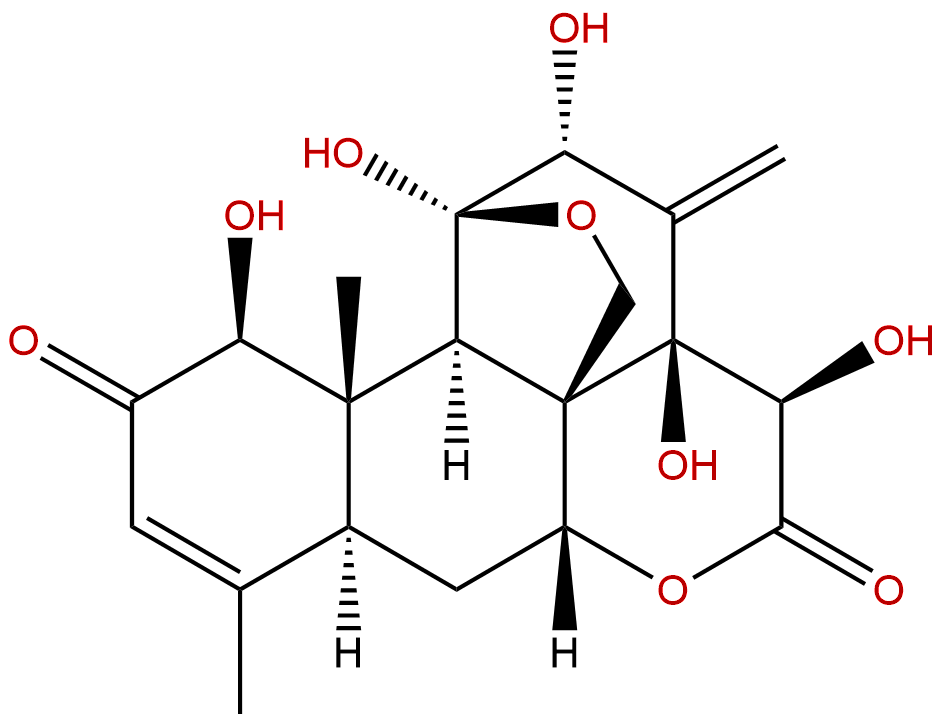


Product name: Eurycomanone
Synonym name:
Catalogue No.: BP1784
Cas No.: 84633-29-4
Formula: C20H24O9
Mol Weight: 408.403
Botanical Source: Eurycoma longifolia
Physical Description: Cryst.
Type of Compound: Diterpenoids
Purity: 95%~99%
Analysis Method: HPLC-DAD or/and HPLC-ELSD
Identification Method: Mass, NMR
Packing: Brown vial or HDPE plastic bottle
Storage: Store in a well closed container, protected from air and light. Put into refrigerate or freeze for long term storage.
Whenever possible, you should prepare and use solutions on the same day. However, if you need to make up stock solutions in advance, we recommend that you store the solution as aliquots in tightly sealed vials at -20℃. Generally, these will be useable for up to two weeks.
The product could be supplied from milligrams to grams, up to kilograms
Inquire for bulk scale.
Descriptions:
Eurycomanone has cytotoxic on HepG2 cells and Human Cervical Carcinoma Cells by inducing apoptosis through the up-regulation of p53 and Bax, and down-regulation of Bcl-2.[1,2]
Eurycomanone exerts antiproliferative activity via apoptosis in Hela cells MCF-7cells .[3,4] and
Eurycomanone at viable therapeutic concentrations of 5–20μg/ml exhibits significant anti-proliferative and anti-clonogenic cell growth effects on A549 lung cancer cells, the treatment also resulted in suppression of the lung cancer cell tumor markers and several known cancer cell growth-associated genes.[5]
Eurycomanone enhances testosterone steroidogenesis at the Leydig cells by inhibiting aromatase conversion of testosterone to oestrogen, and at a high concentration may also involve phosphodiesterase inhibition, it may be worthy for further development as a phytomedicine to treat testosterone-deficient idiopathic male infertility and sterility.[6]
Eurycomanone and eurycomanol as regulators of signaling pathways involved in proliferation, cell death and inflammation.[7]
Eurycomanone possesses growth inhibition of P. berghei by combination of eurycomanone-artesunate with doses 30 mg/kgBW-artesunate 4mg/kgBW, suggests that this combination can be used as potential antimalarial drug.[8]
References:
[1] Zakaria Y, Rahmat A, Pihie A H L, et al. Cancer Cell Int, 2009, 9(1):1-21.
[2] Mahfudh N, Pihie A H L. J Cancer Mol, 2008, 4(4):109-15.
[3] Nurkhasanah, Azimahtol Hawariah Lope Pihie,Jalifah Latip. Majalah Farmasi Indonesia, 2009, 20(4): 190-7.
[4] Pihie A H L. Anticancer Res, 2004, 24(5D):3426-7.
[5] Wong P F, Cheong W F, Shu M H, et al.Phytomedicine, 2012, 19(2):138-44.
[6] Low B S, Choi S B, Wahab H A, et al. J Ethnopharmacol, 2013, 149(1):201-7.
[7] Hajjouli S, Chateauvieux S, Teiten M H, et al. Molecules, 2014, 19(9):14649-66.
[8] Yusuf H, Satria D. J Chem Pharm Res, 2016,(82):18-22.
[9] Khari N, Aisha A, Ismail Z. Trop J Pharm Res, 2014, 13(5):801-7.
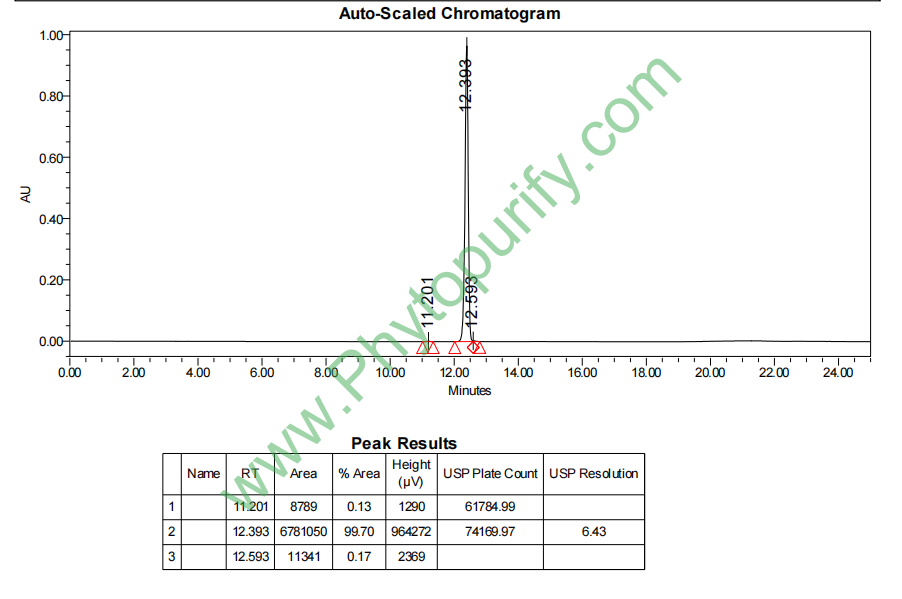
HPLC of Eurycomanone
Storage conditions:Short-term storage at 2~8℃, long-term storage at -20 ~ -80℃
153.7500
-.5007
-.5007
2.7646
.7167
6.2110
Low
40.5747
6.8399
No
No
No
No
Yes
No
0.6
Yes
No
Yes
Yes
Eurycomanone, CAS number 84633-29-4, is a lignin based tetracyclic triterpenoid compound with significant biological activity. Since its discovery, it has attracted sustained attention in the field of natural product pharmacology due to its unique chemical structure and extensive pharmacological effects, especially in the traditional application of male reproductive health. Early research revealed that it can regulate estrogen production by inhibiting the activity of phosphodiesterase and aromatase, thereby positively promoting spermatogenesis, laying a preliminary pharmacological foundation for its application in the treatment of male infertility. However, in recent years, research has continuously expanded the cognitive boundaries of its biological activity, particularly demonstrating remarkable potential in the field of antifungal infections. Fungal infections, especially invasive infections caused by Candida and Aspergillus, have become a global public health challenge, and the problem of resistance to existing antifungal drugs is becoming increasingly severe, requiring the development of new mechanisms of action for drugs. As a naturally occurring lead compound, the multi-target and multi pathway properties of Kuan Ying ketone provide new ideas for the development of antifungal drugs. This article aims to provide a systematic review of the chemical properties, plant sources, extraction methods, and focus on the antifungal pharmacological activity, mechanism of action, drug evaluation, and clinical application prospects of Kuan Ying ketone, in order to provide comprehensive academic references for the in-depth development and transformation research of this compound.
The molecular formula of Kuan Ying ketone is C20H24O9, with a molecular weight of 408.4030. Its core structure belongs to highly oxidized tetracyclic triterpenoids (lignin type), characterized by an unsaturated α, β - ketolactone ring (D ring), which is a key pharmacophore for many of its biological activities. This structure endows it with certain chemical reactivity and the potential to interact with biomolecules.
In terms of physical and chemical properties, the calculated value of the lipid water partition coefficient (LogP) of Kuan Ying ketone is about -0.5007, indicating its relatively hydrophilic characteristics. Its topological polar surface area (TPSA) is as high as 153.7500 Å ², mainly attributed to the presence of multiple polar functional groups such as hydroxyl and carbonyl groups in the molecule. Higher TPSA values are usually associated with poorer cell membrane permeability. The experimental value of water solubility is about 2.7646 mg/L, which belongs to the category of slight solubility, which poses a challenge to the development of its formulation. Preliminary pharmacological predictions indicate that its blood-brain barrier permeability is low, suggesting that it may not easily enter the central nervous system. In early screening for safety, Kuan Ying ketone showed no significant inhibitory effect on hERG potassium channels (hERG inhibition: No), reducing the potential risk of inducing QT interval prolongation in the heart. The Ames test result is 0.6, indicating a low risk of mutagenicity, but further in vitro and in vivo genetic toxicity studies are needed to confirm. These physicochemical and preliminary ADMET (absorption, distribution, metabolism, excretion, and toxicity) properties together form the chemical basis for its subsequent drug development.
Kuan Ying ketone is mainly derived from the traditional medicinal plant Dongge Ali in Southeast Asia(Eurycoma longifolia Jack), Especially its roots. Dongge Ali is known as the "Malay ginseng" in Malay folk medicine, which has been used for a long time to improve energy, resist fatigue, and treat male sexual dysfunction. Kuan Ying ketone is considered one of the most important active ingredients in its root extract.
The extraction and separation methods have undergone development from traditional to modern. Initially, solvent extraction was commonly used, with commonly used solvents including methanol, ethanol, or water alcohol mixed systems. The crude extract was subsequently separated and purified using a series of chromatographic techniques, such as silica gel column chromatography, reverse phase high performance liquid chromatography (RP-HPLC), etc., to obtain high-purity monomers of kaempferol. In recent years, in order to improve extraction efficiency and environmental friendliness, some new technologies such as ultrasound assisted extraction, microwave-assisted extraction, and supercritical fluid extraction have also been applied in the research of extraction process of acetone. Optimizing extraction parameters such as solvent ratio, temperature, time, and pressure is crucial for maximizing the yield of the target compound while preserving its biological activity. The standardized extraction process is a prerequisite for ensuring the controllable quality and stable therapeutic effect of Kuan Ying ketone as a pharmaceutical raw material or dietary supplement.
The pharmacological activity research of Kuan Ying ketone has surpassed its traditional aphrodisiac use and presented a diversified spectrum of biological effects.
Promote sperm production and male hormone regulation This is the earliest confirmed core activity of Kuan Ying ketone. Research has shown that it can stimulate testosterone biosynthesis by inhibiting the activity of phosphodiesterase (PDE) in the testes and other parts of the body, increasing levels of cyclic adenosine monophosphate (cAMP). At the same time, by inhibiting the activity of aromatase (CYP19), the conversion of testosterone to estradiol is reduced, maintaining the androgen/estrogen balance in the body that is conducive to spermatogenesis. Animal experiments have confirmed that it can effectively increase sperm count, vitality, and normal morphology rate.
Antifungal activity This is an emerging hotspot in the pharmacological research of Kuan Ying ketone. In vitro experiments have shown that Kuan Ying ketone is effective against various clinically relevant pathogenic fungi, such as Candida albicans(Candida albicans)Smooth Candida albicans(C. glabrata)And Aspergillus fumigatus(Aspergillus fumigatus)All of them exhibited concentration dependent inhibitory activity, and their minimum inhibitory concentration (MIC) values have research value. It is worth noting that it has also shown inhibitory effects on certain azole resistant fungal strains, suggesting that it may have a mechanism of action different from existing drugs or be able to overcome some resistance pathways.
Anti inflammatory and immune regulatory activity Kuan Ying ketone can significantly inhibit the excessive production of nitric oxide (NO) and prostaglandin E2 (PGE2) in macrophages induced by stimuli such as lipopolysaccharide (LPS), and downregulate the expression of pro-inflammatory cytokines (such as TNF - α, IL-6, IL-1 β). This anti-inflammatory effect is consistent with its application in traditional medicine for treating fever and inflammatory diseases.
Antitumor and cytotoxic activity Several studies have reported that delavarone has selective cytotoxicity to a variety of human cancer cell lines (such as breast cancer, prostate cancer, lung cancer, cervical cancer cells), and can induce cell cycle arrest and apoptosis. Its anti-cancer potential is being extensively explored.
Other activities It also includes reports on anti malaria, anti anxiety, and improving metabolic syndrome (such as lowering blood sugar and blood lipids), demonstrating its multifaceted medicinal potential.
Kuan Ying ketone exerts its extensive pharmacological effects, especially in the mechanism of antifungal activity, involving a complex regulatory network of multiple targets and pathways. Based on the provided target information, the antifungal mechanism can be analyzed as follows:
Directly acting on key targets of fungal cell structure and function:
Interference with fungal resistance efflux pump:
Regulating host immune response and inflammatory pathways:
In summary, the antifungal effect of Kuan Ying ketone is a "multi pronged" combination strategy: it directly attacks the cell membrane (ERG11) and cell wall (CHS3, FKS1) necessary for fungal survival, and overcomes drug resistance by inhibiting the efflux pump (CDR1); At the same time, it actively regulates host immunity, striking a balance between enhancing immune recognition and inhibiting harmful inflammation through the TLR4/MAPK/NF - κ B/CASP1 pathway network. This regulatory effect on both pathogens and hosts gives it a unique advantage in treating complex fungal infections.
Despite its significant in vitro activity, the development of its pharmacological properties still faces challenges, and systematic pharmacokinetic studies are relatively limited.
The clinical application prospects of Kuan Ying ketone are broad, but the road is long and needs to be promoted in stages and from multiple dimensions.
Direct application and functional food/dietary supplements Based on traditional applications and existing safety data, Dongge Ali extract containing standardized content of berberine has certain market applications in improving male fertility, alleviating mild erectile dysfunction, and serving as a sports nutritional supplement. This pathway is relatively mature, but requires strengthened quality control and clinical efficacy verification.
As a lead compound for novel antifungal drugs This is the most innovative direction. In response to the increasingly severe drug-resistant fungal infections, the multi-target mechanism of action of berberine (especially targeting cell walls, cell membranes, and efflux pumps simultaneously) has shown significant advantages. Future research should focus on:
Other therapeutic fields Its potential in anti-inflammatory, anti-cancer, and anti metabolic diseases is also worth exploring and can serve as a starting point for new drug development in related fields.
Kuan Ying ketone is a star natural compound derived from traditional medicinal plants. Its research history has expanded from traditional aphrodisiac uses to multiple modern pharmacological frontiers such as antifungal, anti-inflammatory, and anticancer effects. Especially its unique mechanism of multi-target and host pathogen dual regulation in the fight against fungal infections provides a valuable lead compound template for addressing the global challenge of fungal resistance. Although it faces challenges in terms of solubility, permeability, and systemic pharmacokinetics in drug development, advances in modern medicinal chemistry, pharmacy, and nanotechnology provide powerful tools to overcome these bottlenecks. In the future, through interdisciplinary in-depth research, including structural optimization, mechanism elucidation, formulation innovation, and standardized clinical evaluation, Kuan Ying ketone is expected to successfully transform from a traditional medicinal ingredient into a modern innovative drug for treating male reproductive disorders, drug-resistant fungal infections, and other diseases, fully demonstrating the sustained vitality and enormous value of natural products in drug discovery.
