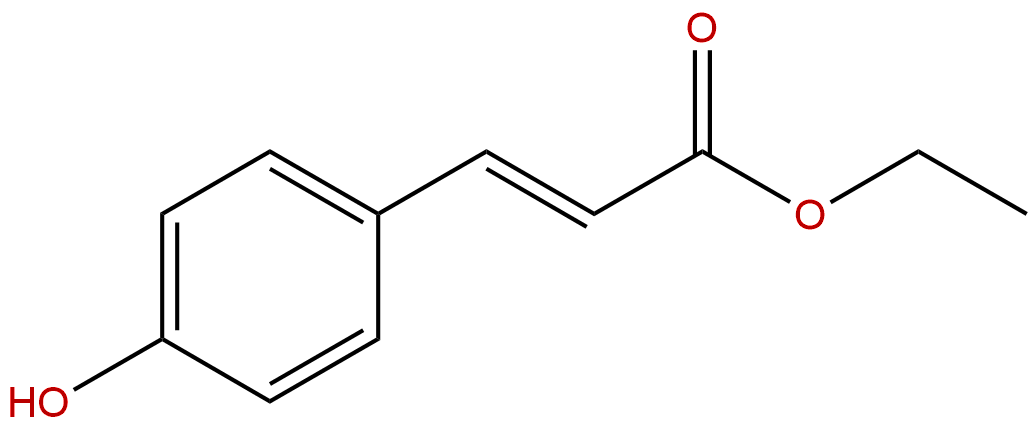


Product name: p-Coumaric acid ethyl ester
Synonym name:
Catalogue No.: SBP01659
Cas No.: 7362-39-2
Formula: C11H12O3
Mol Weight: 192.214
Botanical Source:
Physical Description: Powder
Type of Compound: Phenylpropanoids
Purity: 95%~99%
Analysis Method: HPLC-DAD or/and HPLC-ELSD
Identification Method: Mass, NMR
Packing: Brown vial or HDPE plastic bottle
The product could be supplied from milligrams to grams. Inquire for bulk scale.
We provide solution to improve the water-solubility of compounds, thereby facilitating the variety of activity tests and clinic uses.
For Reference Standard and R&D, Not for Human Use Directly.
Storage conditions:Short-term storage at 2~8℃, long-term storage at -20 ~ -80℃
Ethyl (E) - p-hydroxycinnamate (CAS number: 7362-39-2) is a naturally occurring phenolic compound belonging to coumaric acid and its ester derivatives. As a non competitive reversible inhibitor of tyrosinase (TYR), coumaric acid ethyl ester has shown important pharmacological potential in the fields of antioxidant, anti melanogenesis, and related disease prevention and treatment. In recent years, with the deepening development of natural product pharmacology, ethyl coumarite has gradually become a research hotspot in the fields of drug development, cosmetics, and food preservation due to its unique enzyme inhibition mechanism and good medicinal properties.
This article provides a systematic review of the chemical structure and physicochemical properties, plant sources and extraction methods, pharmacological activity and mechanism of action, pharmacological evaluation and pharmacokinetic characteristics of coumaric acid ethyl ester, combined with its clinical application prospects and future development directions, aiming to provide comprehensive and in-depth reference materials for researchers in related fields.
The chemical name for ethyl coumarite is Ethyl (E) - p-hydroxycinnamate, with a molecular formula of C11H12O3 and a molecular weight of 192.2140. Its structural features include a para hydroxy substituted benzene ring and a cis-4-hydroxycinnamic acid ethyl ester skeleton, making it a typical hydroxycinnamic acid ester compound. In the structural formula, the hydroxyl group (- OH) on the benzene ring endows it with strong antioxidant activity, while the ethyl ester group enhances the lipid solubility of the molecule and increases its cell membrane permeability.
In terms of physical and chemical properties, the LogP value of coumaric acid ethyl ester is 2.5930, indicating its moderate lipophilicity, which is conducive to transmembrane absorption and in vivo distribution. The topological polar surface area (TPSA) is 46.53 Å ², further supporting its good bioavailability. The water solubility is 0.5818, indicating that it has a certain solubility in water, but is more suitable for lipid environments. The high permeability of the blood-brain barrier suggests its potential role in the central nervous system. The negative result of hERG channel inhibition experiment indicates a low risk of cardiac toxicity. The Ames mutagenicity test result is 0, supporting its good safety.
Ethyl coumarite is widely present in various plants, especially in pollen, flowers, and fruits. Common plants rich in ethyl coumarite include Nepenthes spp., certain orchids, and various pollen samples. Its natural form is mostly in the form of free ester or bound state, and extraction and purification techniques are crucial for maintaining its yield and activity.
Traditional extraction methods mainly use organic solvents such as ethanol, methanol, or ethyl acetate for extraction, combined with ultrasound assisted extraction (UAE) or microwave-assisted extraction (MAE) techniques, which can improve extraction efficiency and purity. The extract was purified by liquid-liquid separation, column chromatography, and high-performance liquid chromatography (HPLC) to obtain high-purity ethyl p-coumarite. In recent years, green extraction techniques such as supercritical CO2 extraction have also been applied to the extraction of coumaric acid ethyl ester, balancing environmental friendliness and efficient recovery.
As a non competitive reversible inhibitor of tyrosinase, coumaric acid ethyl ester has an IC50 of 4.89 μ g/mL and a Ki of 1.83 μ g/mL, demonstrating strong enzyme activity inhibition ability. Tyrosinase is a key enzyme in melanin biosynthesis, catalyzing the conversion of L-tyrosine to dopa and dopaquinone, and regulating skin pigmentation. By inhibiting tyrosinase activity, coumaric acid ethyl ester can effectively reduce melanin production and has the potential to whiten and prevent the formation of pigmentation.
Ethyl coumarite has significant antioxidant activity, can scavenge free radicals, and alleviate cell damage caused by oxidative stress. Its antioxidant mechanism involves activating the NFE2L2/NRF2 signaling pathway, promoting the expression of downstream antioxidant enzymes such as superoxide dismutase (SOD1, SOD2), catalase (CAT), glutathione peroxidase (GPX1), heme oxygenase 1 (HMOX1), etc., and enhancing the cell's antioxidant defense ability. In addition, ethyl coumarite also regulates the activity of matrix metalloproteinases (MMP1, MMP3), slows down tissue matrix degradation, and has anti-inflammatory and anti-aging potential.
In addition to tyrosinase inhibition and antioxidant effects, it also exhibits multiple biological activities such as anti-inflammatory, antibacterial, and neuroprotective effects on coumaric acid ethyl ester. Its high permeability to the blood-brain barrier makes it potentially valuable for the prevention and treatment of neurodegenerative diseases. In addition, there is an increasing amount of research on the application of coumaric acid ethyl ester in improving the medicinal value of plant pollen, cosmetic whitening formulas, and fruit preservation.
Ethyl coumarite induces conformational changes in the catalytic region of tyrosinase, altering the binding affinity between L-tyrosine and the enzyme to achieve non competitive inhibition. Its inhibition mechanism does not rely on direct binding with copper ions inside the enzyme, which is different from traditional copper chelating tyrosinase inhibitors and reduces potential metal ion related side effects.
In terms of antioxidant mechanisms, ethyl coumarite activates the NFE2L2/NRF2 signaling pathway, promotes the transcriptional expression of antioxidant enzyme genes, and enhances the ability of cells to clear reactive oxygen species (ROS). By regulating the expression of MMP1 and MMP3, collagen degradation is inhibited, tissue aging and inflammatory response are delayed. In addition, its regulation of antioxidant enzymes such as SOD1, SOD2, CAT, and GPX1 helps maintain intracellular redox balance.
Molecular docking and fluorescence quenching experiments showed that the binding of coumarinate ethyl ester to tyrosinase caused a conformational change in the enzyme, effectively quenching its intrinsic fluorescence, supporting its mode of action as a non competitive inhibitor.
The pharmacological evaluation of ethyl coumarite shows that it has good pharmacokinetic characteristics. The molecular weight of 192.2140 conforms to Lipinski's rule, with a moderate LogP value of 2.5930, which is beneficial for oral absorption and cell membrane penetration. The TPSA is 46.53 Å ², which supports its good bioavailability and blood-brain barrier permeability, indicating its potential in the treatment of central nervous system diseases.
Moderate water solubility (0.5818), which can ensure a certain plasma solubility and facilitate the penetration of fat soluble tissues in vivo distribution. HERG channel inhibition is negative, reducing the risk of cardiac toxicity. The Ames test is negative, indicating low genetic toxicity risk and high safety.
Pharmacokinetic studies have shown that coumaric acid ethyl ester is rapidly absorbed after oral administration, with a short peak plasma concentration time and wide distribution. Its metabolic pathway mainly involves ester bond hydrolysis and corresponding phase I and phase II metabolic reactions through the liver enzyme system. Its metabolites have certain biological activity and may synergistically exert pharmacological effects.
Ethyl coumarite has shown broad application prospects in multiple fields due to its significant tyrosinase inhibition and antioxidant activity.
As a non competitive tyrosinase inhibitor, coumaric acid ethyl ester has potential in the treatment of skin diseases such as pigmentation abnormalities and melasma. Its good safety and pharmacological properties provide ideal candidate molecules for the development of new whitening drugs. In addition, its antioxidant and neuroprotective effects make it worthy of further research in the adjuvant treatment of neurodegenerative diseases such as Parkinson's disease and Alzheimer's disease.
Ethyl coumarite has been applied in various whitening and skincare products, effectively inhibiting melanin production, reducing skin pigmentation, and improving uneven skin tone. Its natural source and safety advantages meet the demand of modern consumers for green and natural cosmetics.
By utilizing the antioxidant properties of ethyl coumarite, a natural preservative based on pollen is developed to effectively extend the shelf life of fruits and agricultural products, reduce oxidative spoilage, and improve food safety and quality.
In the future, efforts should be made to strengthen the pharmacokinetic, toxicological, and preclinical evaluation of ethyl coumarite, and improve its safety and efficacy data. Based on its mechanism of action, design structural modifications and derivative synthesis to enhance activity and selectivity, and expand its applications in anti-inflammatory, anti-tumor and other fields. At the same time, by combining nanocarrier technology, its bioavailability and targeting can be improved, promoting clinical translation.
Ethyl coumarite, as a naturally derived non competitive reversible inhibitor of tyrosinase, has shown extensive potential for application due to its unique mechanism of action, excellent pharmacological activity, and drug properties. Its research in the fields of antioxidant, whitening, anti-inflammatory, and food preservation continues to deepen, providing new ideas for the development of natural product pharmacology and related industries. In the future, through interdisciplinary collaboration, optimizing its structure and formulation, promoting the transformation of coumaric acid ethyl ester into clinical applications, will contribute greater value to human health.
