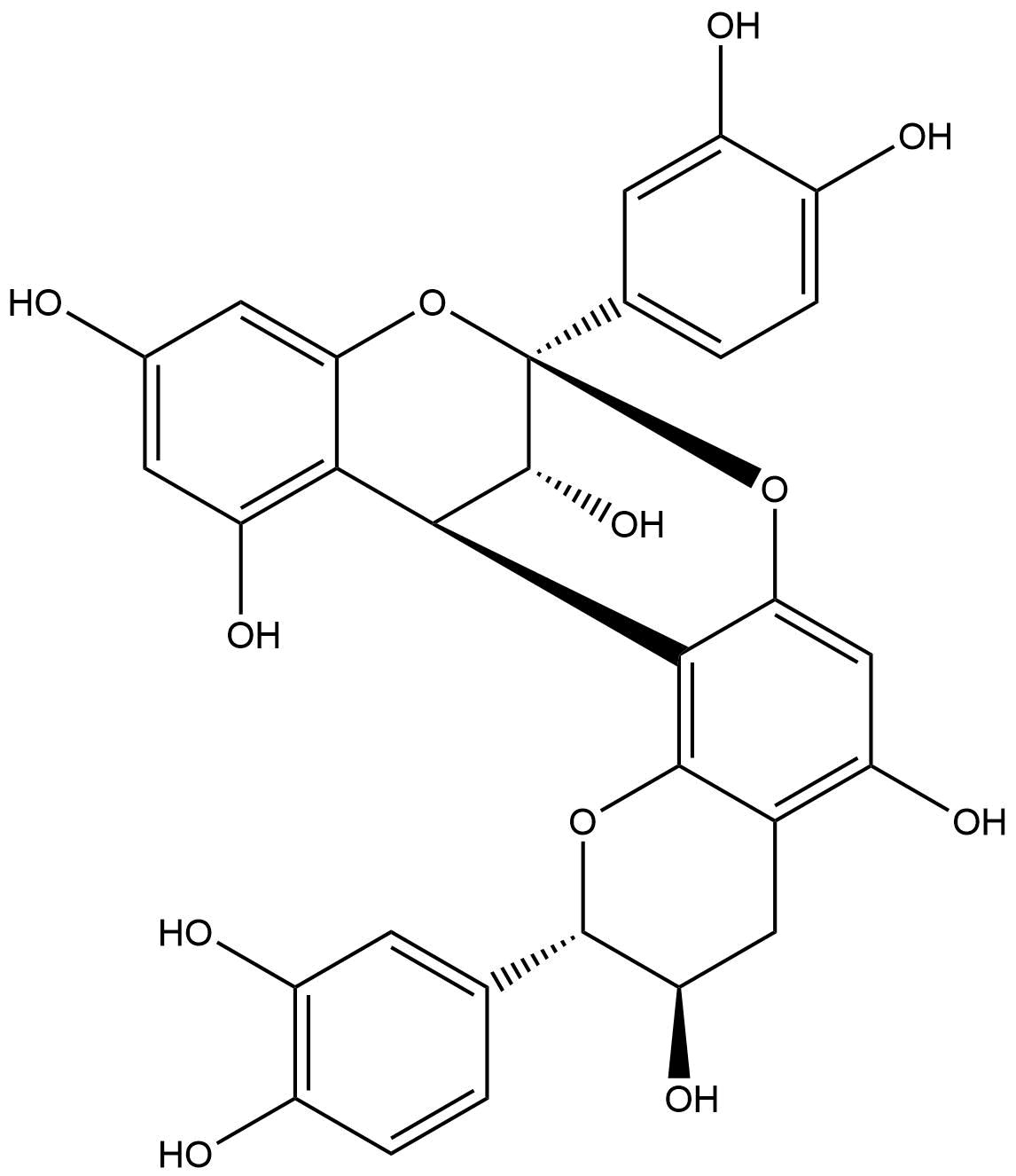


Product name: Proanthocyanidin A4
Synonym name: (2S,3R,8S,14R,15R)-2,8-Bis(3,4-dihydroxyphenyl)-3,4-dihydro-8,14-methano-2H,14H-1-benzopyrano[7,8-d][1,3]benzodioxocin-3,5,11,13,15-pentol
Catalogue No.: BP2044
Cas No.: 111466-29-6
Formula: C30H24O12
Mol Weight: 576.51
Botanical Source:
Physical Description:
Type of Compound: Procyanidins
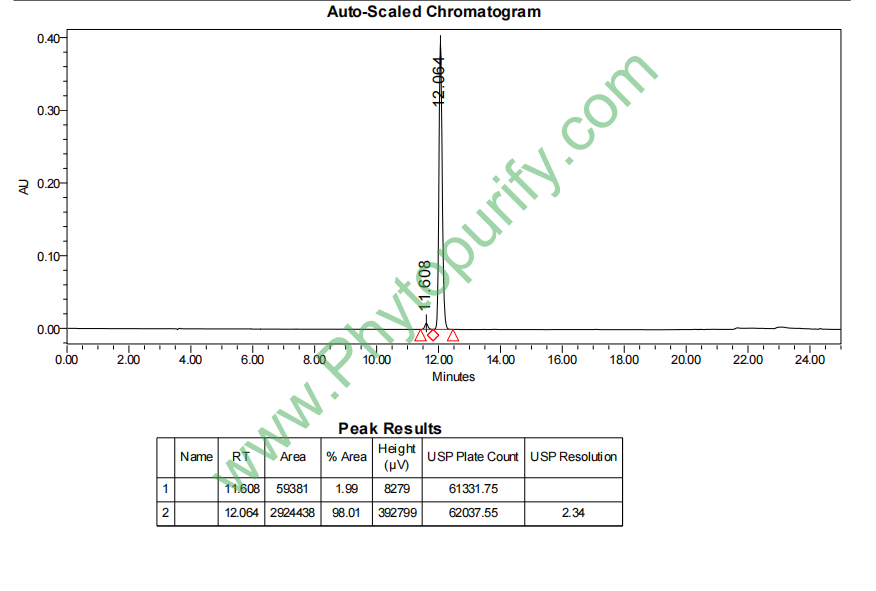
Purity: 95%~99%
Analysis Method: HPLC-DAD or/and HPLC-ELSD
Identification Method: Mass, NMR
Packing: Brown vial or HDPE plastic bottle
Storage: Store in a well closed container, protected from air and light. Put into refrigerate or freeze for long term storage.
Whenever possible, you should prepare and use solutions on the same day. However, if you need to make up stock solutions in advance, we recommend that you store the solution as aliquots in tightly sealed vials at -20℃. Generally, these will be useable for up to two weeks.
The product could be supplied from milligrams to grams
Inquire for bulk scale.
For Reference Standard and R&D, Not for Human Use Directly.
HPLC of Proanthocyanidin A4
Storage conditions:Short-term storage at 2~8℃, long-term storage at -20 ~ -80℃
209.7600
2.2455
2.1978
.0458
.7474
.9741
Low
87.5056
5.3611
No
No
No
No
Yes
No
0.0
Yes
No
Yes
No
Proanthocyanins, as a class of polyphenolic compounds widely present in plants, have attracted much attention in the field of natural product pharmacology in recent years due to their significant biological activity and potential medicinal value. Proanthocyanidin A4 (CAS number: 111466-29-6) is a specific dimer in the anthocyanin family, mainly composed of monomers such as epigallocatechin gallate (EGC) and epigallocatechin gallate (EGCG) connected by C-C and C-O-C bonds. Its unique chemical structure endows anthocyanin A4 with significant biological activities such as antioxidant, anti-inflammatory, and anti-aging, especially demonstrating important therapeutic potential in skin aging related research.
With the increasing trend of global population aging, the problem of skin aging is becoming increasingly prominent and has become a focus of research in cosmetic medicine and skin pathology. Skin aging not only affects appearance, but is also closely related to decreased skin barrier function, increased inflammatory response, and loss of collagen. Anthocyanin A4 has the potential to improve skin structure and function by regulating various key targets such as tyrosinase (TYR), matrix metalloproteinases (MMP1, MMP3), transforming growth factor beta 1 (TGFB1), type I collagen (COL1A1), elastin (ELN), and tissue metalloproteinase inhibitor 1 (TIMP1).
This article will provide a systematic review of the chemical structure and physicochemical properties, plant sources and extraction methods, pharmacological activity and mechanism of action, drug evaluation and pharmacokinetic characteristics of anthocyanin A4. Combined with current research progress, it will explore its clinical application prospects in skin aging and related diseases, providing theoretical basis and practical guidance for subsequent research and development.
Anthocyanin A4 belongs to the A-type dimer of anthocyanins, with a molecular formula of C30H24O12 and a molecular weight of 576.51. Its structural feature lies in the dual connection of two flavan-3-ol units through ether bonds of C2 → O → C7 and carbon carbon bonds of C4 → C8, forming a unique A-type connection. This double bond connection endows it with high chemical stability and biological activity.
From the perspective of physical and chemical properties, the LogP value of anthocyanin A4 is 2.2455, indicating that it has moderate lipid solubility, which is beneficial for cell membrane penetration and bioavailability. The polar surface area (TPSA) is 209.76 Å ², and a higher TPSA value suggests strong molecular polarity, which may affect its oral absorption and cell membrane permeability. Low water solubility (0.0458 mg/mL) indicates limited solubility in the aqueous phase, and appropriate formulation techniques are needed to improve solubility and enhance bioavailability. The low permeability of the blood-brain barrier suggests its limited effect on the central nervous system, which helps to reduce central side effects. The hERG channel inhibition test was negative, indicating a low risk of cardiac toxicity. The Ames mutagenicity test result is 0.0, indicating a low risk of genotoxicity and good safety.
In summary, the chemical structure of anthocyanin A4 provides it with a good basis for biological activity, but its high polarity and low water solubility may limit its in vivo absorption, which needs to be overcome through drug design and formulation optimization.
Anthocyanin A4 is widely present in various plants, especially in tea leaves (Camellia sinensis), grape seeds (Vitis vinifera), citrus peels, and certain traditional Chinese medicinal herbs such as mulberries (Morus alba) and ginkgo leaves (Ginkgo biloba), where it is abundant. The wide distribution of it provides a rich resource foundation for the development of natural medicines and functional health products.
The commonly used methods for extracting anthocyanin A4 include solvent extraction, ultrasound assisted extraction, microwave-assisted extraction, and high-performance liquid chromatography (HPLC) separation and purification. Traditional solvent extraction often uses an ethanol water mixed solvent system, which utilizes its good solubility for polyphenolic compounds to achieve efficient extraction. Ultrasonic assisted extraction enhances solvent penetration through acoustic vibration, improves extraction efficiency, and is easy to operate with short time. Microwave assisted extraction utilizes microwave energy to heat the sample, promote cell wall rupture, and significantly improve extraction efficiency.
After extraction, the original anthocyanin A4 was identified and purified using HPLC combined with mass spectrometry (MS) and nuclear magnetic resonance (NMR) techniques to ensure the accuracy and purity of its structure. In recent years, supercritical fluid extraction (SFE) and membrane separation technologies have gradually been applied to the extraction and separation of anthocyanins, further improving the environmental and economic benefits of extraction.
In addition, the diversity of plant sources and optimization of extraction processes are crucial for the yield and quality control of anthocyanin A4. In the future, systematic research on the impact of different plant species and growth environments on its content should be strengthened to achieve sustainable resource utilization and standardized production.
Anthocyanin A4, due to its significant antioxidant and anti-inflammatory activities, has shown good pharmacological effects in various disease models, especially in the field of skin aging prevention and treatment, making important progress.
Inflammatory response is the core mechanism of various skin pathological states. Anthocyanin A4 can significantly inhibit the expression of pro-inflammatory factors such as tumor necrosis factor alpha (TNF - α), interleukin-1 β (IL-1 β), and interleukin-6 (IL-6), reducing inflammatory response. It exerts anti-inflammatory effects by inhibiting the activation of the NF - κ B signaling pathway, blocking the production of inflammatory mediators. In addition, anthocyanin A4 can regulate the activity of oxidative stress-related enzymes, alleviate oxidative damage, and indirectly inhibit the inflammatory cascade reaction.
As a polyphenolic compound, anthocyanin A4 has strong free radical scavenging ability. It can effectively eliminate superoxide anion radicals (O2-), hydroxyl radicals (· OH), and hydrogen peroxide (H2O2), protecting cells from oxidative stress damage. Its antioxidant mechanism mainly includes direct free radical scavenging and activation of endogenous antioxidant enzyme systems (such as superoxide dismutase (SOD) and catalase (CAT) expression).
Skin aging is mainly manifested by collagen degradation, elastic fiber breakage, and pigmentation. Procyanidin A4 achieves anti-aging effects through multi-target regulation. Research has shown that anthocyanin A4 can inhibit the activity of matrix metalloproteinases MMP1 and MMP3, reducing the degradation of collagen and elastin. At the same time, it promotes the expression of COL1A1 and ELN genes, enhances the synthesis and repair of skin matrix. In addition, anthocyanin A4 regulates the transforming growth factor beta 1 (TGFB1) signaling pathway, promotes skin cell proliferation and collagen formation, and delays the process of skin aging.
Some studies have also shown that anthocyanin A4 has potential activities such as antibacterial, antiviral, and neuroprotective effects, but the relevant data is not sufficient and further in-depth research is needed.
The biological effects of anthocyanin A4 depend on its regulation of multiple molecular targets, especially playing a key role in the prevention and treatment of skin aging.
TYR is the rate limiting enzyme for melanin synthesis, and excessive activation can lead to pigmentation and skin spot formation. Anthocyanin A4 has certain whitening and sun protection effects by inhibiting the activity of TYR and reducing melanin production.
MMPs are key enzymes involved in the degradation of collagen and elastin, and overexpression leads to the destruction of skin structure and loss of elasticity. Anthocyanin A4 can inhibit the expression and activity of MMP1 and MMP3, protecting the integrity of the skin matrix.
TGFB1 plays an important role in collagen synthesis and skin repair. Anthocyanin A4 activates the TGFB1 signaling pathway, promotes the expression of COL1A1 and ELN, and enhances the structure and function of the skin.
COL1A1 and ELN are the main structural proteins of the skin, maintaining skin elasticity and firmness. Procyanidin A4 promotes its gene expression and protein synthesis, delaying skin aging.
TIMP1, as an endogenous inhibitor of MMPs, regulates the balance of collagen degradation. Anthocyanin A4 upregulates TIMP1 expression, synergistically inhibits MMPs activity, and protects the skin matrix.
In summary, anthocyanin A4 achieves comprehensive regulation of skin aging through multi-target and multi pathway synergistic effects, and has strong therapeutic potential.
The evaluation of drug properties is an important step in the development of natural product drugs, and anthocyanin A4 has shown certain advantages and challenges in this regard.
The moderate lipid solubility (LogP=2.2455) of anthocyanin A4 facilitates membrane penetration, but its high polarity (TPSA=209.76) and low water solubility (0.0458 mg/mL) limit its oral absorption and bioavailability. It is necessary to improve its solubility and stability through nanocarriers, liposomes, or other drug delivery systems.
Anthocyanin A4 did not exhibit hERG channel inhibitory activity and had a low risk of cardiac toxicity. Ames test negative, low risk of genotoxicity, good safety, suitable for further development.
At present, there is limited research on the pharmacokinetics of anthocyanin A4. Based on its structural characteristics, it is speculated that its oral absorption is limited, and its metabolism in the body may be carried out through phase II metabolism in the liver (such as glucuronic acid binding), with excretion mainly through the kidneys and bile. The low permeability of the blood-brain barrier suggests that its function is mainly limited to peripheral tissues. In the future, systematic in vivo pharmacokinetic and metabolic studies need to be conducted to clarify their absorption, distribution, metabolism, and excretion (ADME) characteristics, providing a basis for clinical applications.
The potential of anthocyanin A4 in the prevention and treatment of skin aging is significant, and its future clinical application prospects are broad.
Based on its antioxidant, anti-inflammatory, and collagen synthesis promoting effects, anthocyanin A4 can be used as an active ingredient in functional skincare products and pharmaceutical grade topical preparations to improve skin elasticity, reduce wrinkles, and pigmentation. Through the development of nanotechnology and sustained-release formulations, skin permeability and stability can be improved, enhancing therapeutic efficacy.
The anti-inflammatory effect of anthocyanin A4 makes it a potential adjuvant therapy in inflammatory skin diseases such as eczema and psoriasis. Combining modern drug delivery systems is expected to improve local therapeutic efficacy and reduce systemic side effects.
Given its multi-target regulatory ability, anthocyanin A4 also has certain research value in other antioxidant related diseases such as cardiovascular disease and neurodegenerative diseases. In the future, it is necessary to strengthen its systematic pharmacology and preclinical research, and expand its application fields.
The low water solubility and oral bioavailability of anthocyanin A4 are the main bottlenecks in its development. Innovative formulations (such as nanoemulsions, liposomes, solid dispersions) and structural modifications (such as esterification and glycosylation) are effective strategies to enhance their drug performance. At the same time, it is necessary to establish standardized extraction processes and quality control systems to ensure product stability and consistency.
In addition, the safety evaluation and clinical trial design of the system are key to its clinical translation. Multidisciplinary collaboration and innovative technological applications will drive the transition of anthocyanin A4 from the laboratory to clinical practice.
Anthocyanin A4, as a natural polyphenolic compound with significant anti-inflammatory and anti-aging activities, has shown broad prospects for medicinal development due to its unique A-type dimer structure and multi-target regulatory mechanism. Although there are certain challenges in developing its pharmacological properties, through modern drug formulation technology and systematic pharmacological research, it is expected to overcome the limitations of bioavailability and achieve its clinical application in skin anti-aging and related disease treatment.
Future research should focus on the systematic elucidation of its pharmacokinetic characteristics, in-depth analysis of its mechanism of action, and clinical validation of its safety and efficacy. At the same time, by combining sustainable development of plant resources and green extraction technology, we will promote the industrialization and clinical transformation of anthocyanin A4, benefiting a large number of patients and consumers. The continuous progress of natural product pharmacology will provide a solid scientific foundation for the development of anthocyanin A4, helping it become an important representative of the new generation of natural anti-aging and anti-inflammatory drugs.
