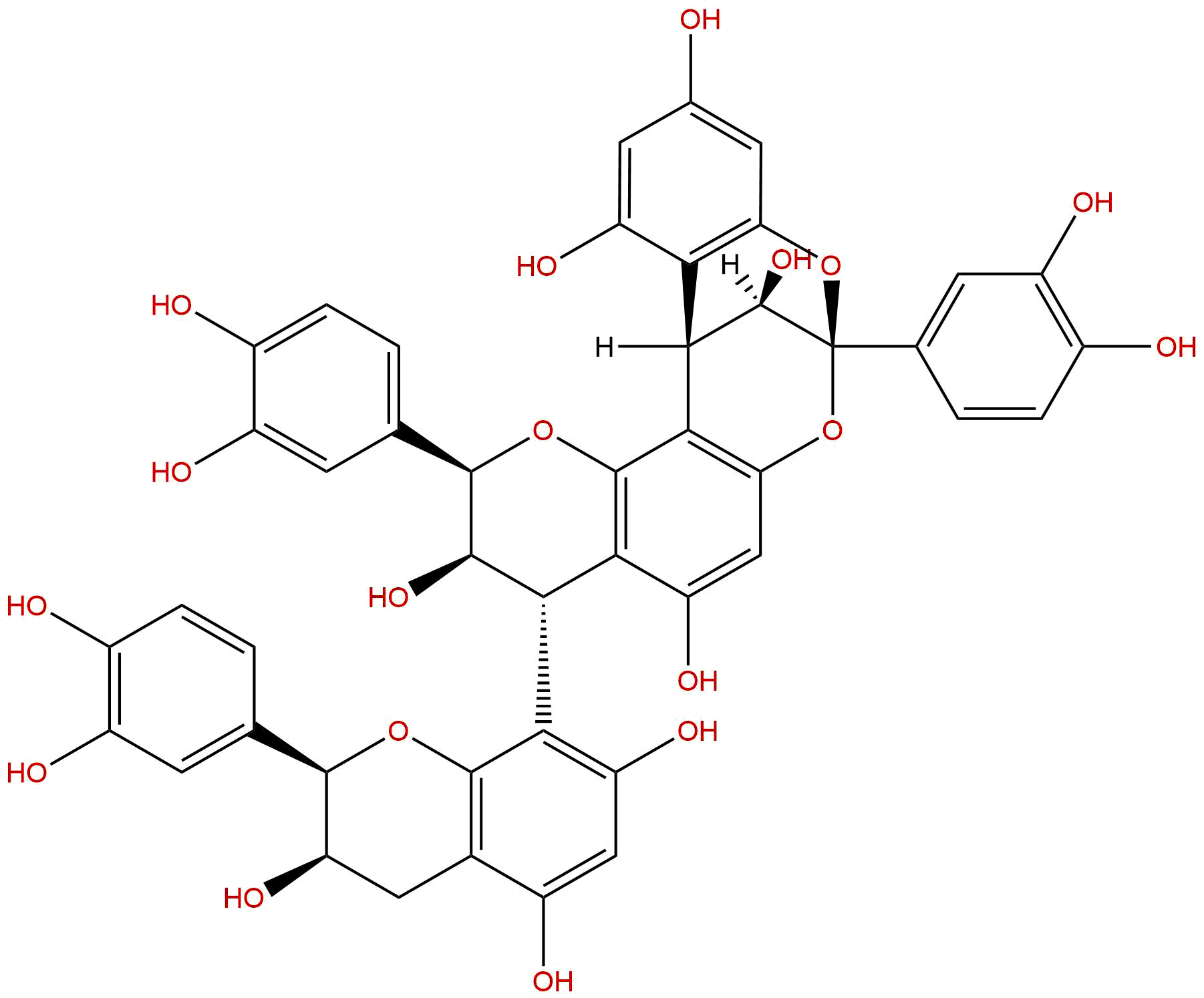


Product name: Cinnamtannin B1
Synonym name:
Catalogue No.: BP2166
Cas No.: 88082-60-4
Formula: C45H36O18
Mol Weight: 864.765
Botanical Source:
Type of Compound:
Purity: 95%~99%
Analysis Method: HPLC-DAD or/and HPLC-ELSD
Identification Method: Mass, NMR
Packing: Brown vial or HDPE plastic bottle
Storage: Store in a well closed container, protected from air and light. Put into refrigerate or freeze for long term storage.
Whenever possible, you should prepare and use solutions on the same day. However, if you need to make up stock solutions in advance, we recommend that you store the solution as aliquots in tightly sealed vials at -20℃. Generally, these will be useable for up to two weeks.
The product could be supplied from milligrams to grams
Inquire for bulk scale.
For Reference Standard and R&D, Not for Human Use Directly.
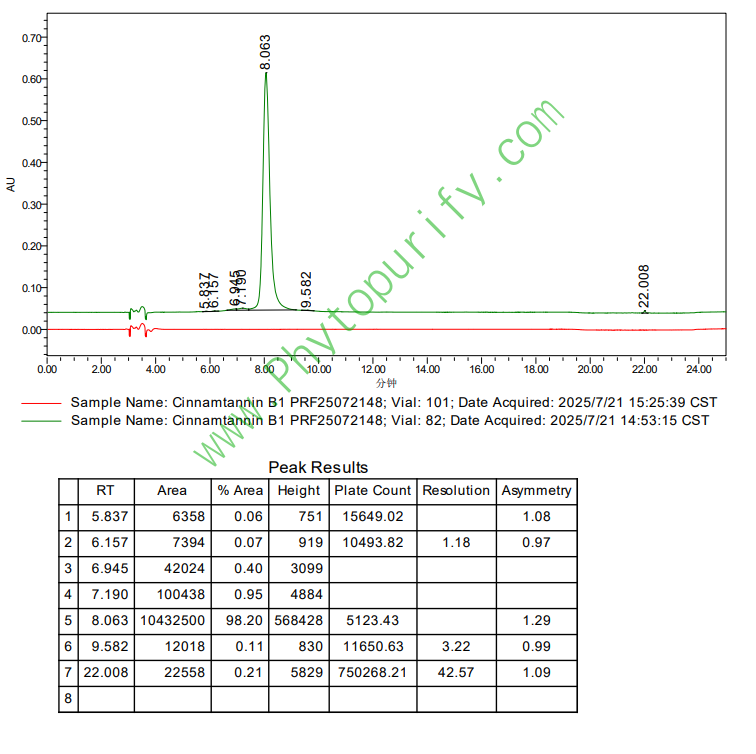
HPLC of Cinnamtannin B1
Storage conditions:Short-term storage at 2~8℃, long-term storage at -20 ~ -80℃
320.1400
2.7407
2.7403
.0118
.7119
.8948
Low
89.3450
6.2997
No
No
No
No
Yes
No
0.0
Yes
No
Yes
No
Natural products have long been an important source of innovative drug discovery, among which polyphenolic compounds have attracted much attention due to their wide range of biological activities. Anthocyanins, as a type of polyphenolic polymer widely present in the plant kingdom, have shown significant potential in cardiovascular protection, antioxidant, anti-inflammatory, and other aspects. Cinnamtannin B1, as a unique A-type anthocyanin trimer, has become a highlight of natural product pharmacology research due to its novel chemical structure and potential biological activity since its discovery in cinnamon plants. Its CAS number is 88082-60-4, mainly derived from the traditional medicinal plant cinnamon(Cinnamomum cassia)Ceylon cinnamon(Cinnamomum zeylanicum). Early studies have revealed its cyclooxygenase-2 (COX-2) inhibitory activity, suggesting its potential for anti-inflammatory applications. In recent years, with the deepening of research, especially its activity in inhibiting oral pathogenic bacteria has been revealed, and its pharmacological value has been further expanded. This article aims to systematically review the chemical structure, plant origin, pharmacological activity, mechanism of action, pharmacological evaluation, and clinical application prospects of cinnamic tannin B1, in order to provide comprehensive academic references for the in-depth research and development of this compound.
Cinnamtannin B1 belongs to the class of anthocyanin compounds in chemistry, specifically an A-type anthocyanin trimer. Its molecular formula is C45H36O18, with a molecular weight of 864.7650 Da. Unlike common B-type anthocyanins (connected by a single C4-C8 or C4-C6 bond), A-type anthocyanins are characterized by the presence of an additional C-O-C ether bond (usually C2-O-C7 or C2-O-C5 bond) between monomers, in addition to the C-C bond, forming a double bond connection, making their structure more complex and stable. Cinnamtannin B1 is polymerized from three flavan-3-ol units (usually epicatechin and its derivatives) through A-type linkage, and this unique topological structure is the material basis for its high biological activity.
From the analysis of physical and chemical properties, the logarithm of the lipid water partition coefficient (LogP) of cinnamon tannin B1 is 2.7407, indicating that it has a certain lipophilicity, but not highly hydrophobic. Its topological polar surface area (TPSA) is as high as 320.1400 Å ², which is closely related to the presence of a large number of polar groups such as hydroxyl groups (- OH) in its molecules. High TPSA values typically affect the membrane permeability of compounds. Its water solubility parameter is 0.0118, which belongs to slightly soluble or poorly soluble in water, which to some extent limits its bioavailability. These parameters collectively determine its pharmacological characteristics: it is difficult to penetrate the blood-brain barrier (predicted as low permeability), has no significant inhibitory risk on the hERG potassium channel in the heart (indicating a low risk of cardiac toxicity), and the Ames test result is 0.0, preliminarily indicating that it is non mutagenic and has good safety.
Cinnamtannin B1 is mainly found in plants of the Cinnamomum genus in the Lauraceae family and is one of the characteristic polyphenolic components of cinnamon. Commonly used Chinese cinnamon in business(Cinnamomum cassia Presl) bark and Ceylon cinnamon, which are more highly regarded for their quality(Cinnamomum verum, also known as C. zeylanicum)The bark is the main raw material for extracting this compound. The content of cinnamon tannin B1 varies among different varieties, regions, and harvesting parts of cinnamon, with the bark typically having a higher content than the branches and leaves.
The extraction and separation method follows the general process of plant polyphenols. Firstly, polar solvents are used to extract the dried cinnamon powder. Common solvents include methanol, ethanol, acetone water mixed systems, etc. In order to obtain extracts richer in anthocyanins, a certain proportion (such as 70%) of aqueous acetone is often used for ultrasound assisted extraction or hot reflux extraction, which can effectively dissolve polyphenolic substances. After filtration and concentration, the crude extract needs to be further purified to obtain monomeric compounds.
Purification steps typically involve multiple chromatographic techniques. Large pore adsorption resins (such as D101, AB-8) are often used for initial enrichment, followed by gradient elution with water and different concentrations of ethanol. Proanthocyanins are mostly concentrated in the 30% -70% ethanol elution site. Subsequently, silica gel column chromatography and dextran gel column chromatography (such as Sephadex LH-20) were used for subdivision. Sephadex LH-20 column chromatography, using methanol, ethanol, or acetone water as mobile phases, is a key step in separating anthocyanin monomers, which can be effectively separated based on molecular size and adsorption characteristics. Finally, high-purity cinnamic tannin B1 monomer can be obtained by preparative high performance liquid chromatography (HPLC) using a reverse phase C18 column and gradient elution with methanol water or acetonitrile water (usually containing a small amount of formic acid or trifluoroacetic acid to improve peak shape) as the mobile phase. Modern technologies such as high-speed countercurrent chromatography (HSCCC) have also been attempted for the preparation and separation of such compounds due to their advantages of irreversible adsorption.
A large number of in vitro and in vivo pharmacological studies have shown that cinnamon tannin B1 has multiple biological activities, and its application potential far exceeds the initial anti-inflammatory category.
Anti inflammatory and analgesic activity As a selective COX-2 inhibitor, cinnamic tannin B1 can effectively inhibit the production of inflammatory mediators such as prostaglandin E2 (PGE2). In the rat paw swelling model induced by carrageenan and the mouse torsion model induced by acetic acid, it exhibits significant anti-inflammatory and analgesic effects, and its strength of action is closely related to its structure. The A-type trimer structure is considered the key to its efficient anti-inflammatory activity.
Antibacterial activity, especially against oral pathogenic bacteria This is the active direction of cinnamon tannin B1 that has received much attention in recent years. Research has confirmed that it is effective against various oral pathogens, including Streptococcus mutans(Streptococcus mutans)Porphyromonas gingivalis(Porphyromonas gingivalis)Fusobacterium nucleatum(Fusobacterium nucleatum)It has significant inhibitory or even killing effects. Its function is not limited to inhibiting bacterial growth, but can also interfere with the formation of bacterial biofilms, which are the core factors in the occurrence and development of dental caries and periodontal disease. Cinnamon extract and its cinnamon tannin B1 are therefore considered potential natural anti caries and periodontal health agents.
Antioxidant and Cardiovascular Protective Activities As a polyphenolic substance, cinnamon tannin B1 has strong ability to scavenge free radicals (such as DPPH, ABTS free radicals) and reduce them. Its antioxidant activity is stronger than many monomeric catechins and B-type anthocyanins. In the cardiovascular field, it can protect vascular endothelial cells from oxidative stress damage, inhibit the oxidation of low-density lipoprotein (LDL), and show a certain anti platelet aggregation activity, which together indicate its potential in preventing atherosclerosis.
Antitumor activity Preliminary studies have shown that cinnamon tannin B1 has inhibitory effects on the proliferation of certain cancer cell lines (such as colon cancer and prostate cancer cells) and can induce cell apoptosis. The mechanism may be related to regulating the cell cycle, activating apoptosis related signaling pathways, and its strong antioxidant/pro oxidative dual properties (under specific conditions, polyphenols can produce reactive oxygen species to induce cancer cell death).
Neuroprotective activity Despite its low blood-brain barrier permeability, there are still studies reporting that it can alleviate beta amyloid induced neuronal toxicity and inhibit excessive activation of microglia in vitro models, suggesting that it may indirectly affect the progression of neurodegenerative diseases through peripheral anti-inflammatory effects, or that it may remain active at low concentrations.
The multiple pharmacological activities of cinnamon tannin B1 stem from its interactions with various biomolecule targets.
Anti inflammatory targets Its most specific molecular target is cyclooxygenase-2 (COX-2). It can reversibly bind to the active site of COX-2, competitively inhibiting the conversion of arachidonic acid to prostaglandin H2, thereby downstream inhibiting the production of pro-inflammatory mediators such as PGE2. Unlike traditional nonsteroidal anti-inflammatory drugs (NSAIDs), it has a weaker inhibitory effect on COX-1 and theoretically has a lower risk of gastrointestinal side effects.
Antibacterial target network Regarding oral pathogenic bacteria, the action of cinnamon tannin B1 is multi-target, which may be one of the reasons why it is not easy to cause bacterial resistance. According to the provided target information, its mechanism of action may involve:
Antioxidant and signal pathway regulation Its powerful antioxidant activity is not only derived from directly clearing free radicals, but also related to its activation of the cell's own antioxidant defense system, such as upregulating the expression of phase II detoxifying enzymes such as heme oxygenase-1 (HO-1) and quinone oxidoreductase-1 (NQO1) by regulating the Nrf2/ARE signaling pathway. In addition, it can also regulate key inflammatory and survival signaling pathways such as NF - κ B, MAPK, PI3K/Akt, and the cross regulation of these pathways is the underlying mechanism for its anti-inflammatory, anti-tumor, and neuroprotective effects.
Although cinnamon tannin B1 exhibits excellent biological activity in vitro, its medicinal properties face challenges, mainly due to its physical and chemical properties and commonalities with polyphenolic compounds.
Absorption, distribution, metabolism, excretion (ADME):
Optimization strategy for drug properties To overcome the bottleneck of low bioavailability, researchers have explored various strategies:
The clinical application development of Cinnamtannin B1 will focus on its advantageous active fields and break through limitations with the help of modern pharmaceutical methods.
Oral care products This is the direction with the most direct conversion potential. Based on its broad-spectrum ability to inhibit oral pathogenic bacteria and biofilm, and its high safety from natural food flavor (cinnamon), it can be developed into a new type of caries prevention mouthwash, toothpaste, oral spray, periodontal sustained-release gel or microcapsule. It can not only kill bacteria, but also inhibit the formation of biofilm matrix that causes dental caries and periodontal disease, playing a dual role of "cleaning" and "anti sticking", with broad market prospects.
Local anti-inflammatory agents: Develop topical cream, gel or patch for local inflammation such as skin inflammation, oral mucositis (caused by chemotherapy), gingivitis, etc. Local administration can avoid the problem of low systemic bioavailability by directly acting on the lesion at high concentrations, exerting its COX-2 inhibition and antioxidant effects.
As a dietary supplement or functional food additive Although the absorption rate is low, long-term intake of standardized cinnamon extract rich in cinnamon tannin B1 may have beneficial effects on maintaining low systemic inflammation, preventing metabolic syndrome and cardiovascular disease through its metabolites or regulating intestinal flora and local immunity. Strict clinical studies are needed to confirm its effective dosage and long-term benefits.
Future research directions:
Cinnamtannin B1, as a unique A-type anthocyanin trimer, is one of the important active ingredients in cinnamon. It not only excels in traditional anti-inflammatory and antioxidant fields, but also demonstrates remarkable potential in inhibiting oral pathogenic bacteria and biofilms, laying a solid scientific foundation for its development as a new type of oral health and therapeutic agent. Although its inherent physicochemical properties, such as low water solubility and low oral bioavailability, pose challenges for systemic medication, this precisely highlights its unique value in local applications, especially in oral local treatment. Empowered by modern medicinal chemistry and pharmaceutical technology, such as structural optimization and the development of novel delivery systems, it is expected to overcome the bottleneck of drug formation and unlock a wider range of application scenarios. In the future, interdisciplinary collaborative research covering natural product chemistry, pharmacology, microbiology, pharmacy, and clinical medicine will be the key to driving cinnamon tannin B1 from the laboratory to the market and ultimately serving human health.
